SMH
May 30, 2006
A 13-month-old baby suffered horrific burns when she was put in a clothes dryer, police say.
The baby was left with her mother's boyfriend at a home in the Perth suburb of Warwick while the woman went to a gym for about an hour last Thursday, police said.
Police were told the baby had spilt liquid on herself and the man put her in the clothes dryer and turned it on.
"The person we allege has done the act has stated that he has put the child into a clothes tumble dryer, closed the door and turned it on for a couple of minutes,'' Senior Detective Deb Newman said.
"The child had burns to both feet, to one of her hands, burns and bruising to her back and bruising to her forehead,'' she said.
"The injuries are horrific. In my years of being a police officer I have not seen or heard of this type of injury before.''
The mother returned home to find her daughter suffering serious burns but her boyfriend did not mention the dryer, she said.
Police investigated after the hospital where the baby was treated informed them the child's injuries were suspicious and highly unusual.
Snr Det Newman said the mother was distraught but the toddler should make a full recovery and be released from the burns unit at Princess Margaret Hospital for Children later this week.
Samuel Marc Barnes Siddall, 21, of suburban Beldon, appeared in Perth Magistrates' Court today charged with causing bodily harm or danger.
He was granted bail on condition that he did not approach, or contact, the mother and child.
He is due to appear in the Joondalup Magistrates' Court at a date to be set next month.
AAP
Tuesday, May 30, 2006

Thursday, May 25, 2006
From the National Drug and Alcohol Research Centre
Many of you may have read the story this morning regarding ecstasy deaths, reported in the Daily Telegraph and the Herald Sun.
The opening paragraph claims the following: The party drug ecstasy is killing more than one person every fortnight nationwide, with almost a third of deaths occurring in car crashes.
As is often the case the story is not entirely accurate, so I would like to give you a little more information.
Unfortunately the Australian Bureau of Statistics (ABS) mortality register does not distinguish between ecstasy and other amphetamine type substances (ATS) related deaths. However, the National Coronial Information System (NCIS) does make this distinction, however these data are quite limited in the information they provide.
The NCIS defines a primary contribution as “producing the actual physical harm, most closely linked to the cause of deathâ€, secondary contribution as “involved at the start of the injury eventâ€, tertiary contribution as “other mechanisms involved in the injury eventâ€.
If it is thought that drug use contributed to the risk of road traffic crashes, for example, it would be a secondary contribution; if the cause of death was drug toxicity or drug overdose and a drug was one of those detected, it would be implicated as one of the primary contributions to death (note that since ecstasy was usually one of a range of drugs detected, other drugs would also be classed as a primary contribution).
So what does the data tell us? Over the four year period 2001-2004, NCIS identified 112 ecstasy-related deaths. Although ecstasy was deemed to be a primary contributor in 51 (46%) of these, MDMA was the sole drug present in only six (5%) of these deaths. It is important to note that the majority of deaths were due to either a road traffic crash (RTC, 28%) or drug toxicity (40%).
Importantly, MDMA was rarely the only drug identified in drug toxicity deaths (3 of 45 deaths), and never the only drug in the overdose deaths. Some of the causes of the ecstasy-related deaths are particularly interesting and quite bizarre – three deaths were due to drowning, six were hangings and 8 were falls from a height!
Two implications of this data are firstly that death as a direct result of ecstasy consumption seems to be very rare in Australia compared to the extent of use, and ecstasy is usually only one of a range of drugs detected at death (a point that the newspapers chose to ignore!). Secondly, a substantial proportion of ecstasy-related deaths involve a motor vehicle accident. If you wish to read more about this, you will find the full PDI Bulletin (Kinner, Fowler, Fischer, et al (2005)) at the following location:
http://ndarc.med.unsw.edu.au/NDARCWeb.nsf/resources/BulletinsPDI_2005/$file/PDI+APRIL+2005.pdf
Paul Dillon
Manager
National Drug and Alcohol Research Centre
UNSW SYDNEY NSW 2052
The opening paragraph claims the following: The party drug ecstasy is killing more than one person every fortnight nationwide, with almost a third of deaths occurring in car crashes.
As is often the case the story is not entirely accurate, so I would like to give you a little more information.
Unfortunately the Australian Bureau of Statistics (ABS) mortality register does not distinguish between ecstasy and other amphetamine type substances (ATS) related deaths. However, the National Coronial Information System (NCIS) does make this distinction, however these data are quite limited in the information they provide.
The NCIS defines a primary contribution as “producing the actual physical harm, most closely linked to the cause of deathâ€, secondary contribution as “involved at the start of the injury eventâ€, tertiary contribution as “other mechanisms involved in the injury eventâ€.
If it is thought that drug use contributed to the risk of road traffic crashes, for example, it would be a secondary contribution; if the cause of death was drug toxicity or drug overdose and a drug was one of those detected, it would be implicated as one of the primary contributions to death (note that since ecstasy was usually one of a range of drugs detected, other drugs would also be classed as a primary contribution).
So what does the data tell us? Over the four year period 2001-2004, NCIS identified 112 ecstasy-related deaths. Although ecstasy was deemed to be a primary contributor in 51 (46%) of these, MDMA was the sole drug present in only six (5%) of these deaths. It is important to note that the majority of deaths were due to either a road traffic crash (RTC, 28%) or drug toxicity (40%).
Importantly, MDMA was rarely the only drug identified in drug toxicity deaths (3 of 45 deaths), and never the only drug in the overdose deaths. Some of the causes of the ecstasy-related deaths are particularly interesting and quite bizarre – three deaths were due to drowning, six were hangings and 8 were falls from a height!
Two implications of this data are firstly that death as a direct result of ecstasy consumption seems to be very rare in Australia compared to the extent of use, and ecstasy is usually only one of a range of drugs detected at death (a point that the newspapers chose to ignore!). Secondly, a substantial proportion of ecstasy-related deaths involve a motor vehicle accident. If you wish to read more about this, you will find the full PDI Bulletin (Kinner, Fowler, Fischer, et al (2005)) at the following location:
http://ndarc.med.unsw.edu.au/NDARCWeb.nsf/resources/BulletinsPDI_2005/$file/PDI+APRIL+2005.pdf
Paul Dillon
Manager
National Drug and Alcohol Research Centre
UNSW SYDNEY NSW 2052
Tuesday, May 16, 2006

Monday, May 15, 2006
Dr Mendelsohn
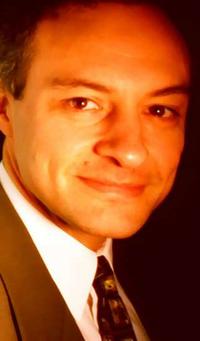
A North Shore doctor who appeared on the television show RPA has been accused of raping one of his female patients at his Chatswood rooms.
Martyn Stuart Mendelsohn, an ear, nose and throat surgeon and former visiting medical officer at Royal Prince Alfred Hospital, is charged with one count of aggravated sexual assault.
Mendelsohn, 46, allegedly had non-consensual sexual intercourse with the woman during a consultation at his surgery on Malvern Avenue between 6pm and 7.40pm on May 30.
The Scots College and University of Sydney graduate is now under strict bail conditions which require an approved "chaperone" be present during any consultations with patients.
Mendelsohn carries out plastic surgery work through his business, Stuart Clinic.
His website details several appearances on the medical reality television show RPA.
Mendelsohn, who resigned from RPA in 2003, also appeared in newspapers and magazines in relation to work earlier this year on the face of a Big Brother contestant, Aphrodite Vuitton.
Thursday, May 11, 2006
Koch and Mel need a good kick up the bum
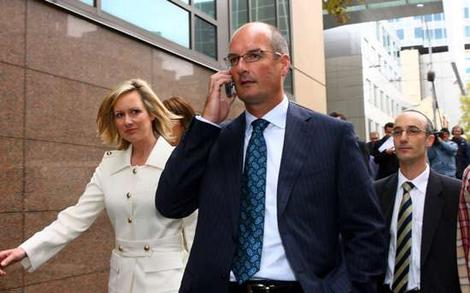
By Jane Holroyd
May 12, 2006
smh
Claims that Channel Seven television presenters were not responsible for broadcasts identifying a child who divorced his mother have been disputed in court.
Sunrise hosts David Koch and Melissa Doyle, newsreaders Jennifer Keyte and Natalie Barr and Today Tonight host Naomi Robson are among a group of employees from Channel Seven and The Sunday Herald Sun to plead not guilty to charges stemming from the identification of a child involved in a Children's Court proceeding in 2004.
The charges stem from the identification of a boy who divorced his mother in May 2004, when a children's court judge allowed the Department of Human Services to become his legal guardian.
Sunday Herald Sun journalist Chris Tinkler wrote an article about the boy and his mother, published on June 20, 2004, under the headline: "Divorced by my son: teen may never see mum again."
The article detailed the case in which the boy divorced his mother, citing irreconcilable differences.
The individual defendants face a maximum penalty of up to two years' jail, or a $10,481 fine, while the companies involved The Herald and Weekly Times, Channel Seven Melbourne and Nationwide News face fines of up to $52,405 each.
Magistrate Lisa Hannan, who is due to hand down her decision at 3.30pm on Monday, said the charges were very serious and carried a jail sentence.
Mr Koch, Ms Doyle and Ms Barr sat in court this morning, listening to Prosecutor Jim Kennan, QC, make his final submission. Ms Robson and Ms Keyte, who were in court yesterday, did not attend the hearing today.
Mr Kennan said the stories clearly identified a matter that was proceeding in the Children's Court and the parties involved in that matter.
He disputed the defendants' argument that identifying the child was in the public interest, saying the story could have been published or broadcast without identifying the parties concerned.
Publishing the identities of the child and his mother "was all gratuitous," Mr Kennan said.
Channel 7 news director Stephen Carey and Sunrise executive producer Adam Boland told the court yesterday that they were responsible, and not the defendants, for the items broadcast on the program.
Mr Kennan today disputed that, saying the person presenting or writing the story was legally responsible.
He said Mr Tinkler's story, which also published the names of the child's siblings, clearly related to the Children's Court proceedings, he said.
All defendants told the court they had sought legal advice before broadcasting and publishing their respective stories.
"They knew there was a problem publishing identifying details, and yet they went ahead," Mr Kennan said.
"Mr Tinkler's story expressly refers to the Children's Court in the interstate publication" he said, referring to other News Ltd newspapers who ran the story.
But he said the Melbourne publication, knowing it was a likely infringement, tried to get around it through "careful choice of words", Mr Kennan said.
Yesterday, former Sunday Herald Sun editor Alan Howe told the court that he took responsibility for his newspaper first publishing the story in June 2004.
Mr Howe said he was "not necessarily" aware the matter was before the Children's Court.
"It was a fair and balanced report using the facts that we had," he said.
"It was my belief that the Children's Court was not necessarily involved. Another court may have been involved."
The story was then covered by Seven News as well as the network's current affairs program, Today Tonight. It was also discussed on Sunrise, where Mr Koch said: "This kid is a brat, obviously. This kid needs a kick up the backside."
Wednesday, May 10, 2006
Cannibal jailed

May 10 2006
Armin Meiwes waits for the verdict in his retrial at a regional court in Frankfurt on Tuesday.
Photo: AP
A German self-confessed cannibal was jailed for life after a court in Frankfurt found him guilty of murder for killing and partly eating an allegedly willing victim he had met on the internet.
The court in the western German city of Frankfurt found that Armin Meiwes, known as the "cannibal of Rotenburg", killed his victim to satisfy his sexual urges.
But it rejected the prosecution's demand that Meiwes be disqualified for release after 15 years, as is usual for prisoners serving life sentences in Germany. This means he could, potentially, be freed in 2021.
Meiwes, 44, immediately indicated that he would appeal, signalling another round in a long legal process that has laid bare a hitherto secret market in cannibalism.
The Frankfurt trial was the second time Meiwes has been tried for killing Bernd Juergen Brandes in Rotenburg, Meiwes' home town, in western Germany in March 2001.
He was originally convicted of manslaughter and sentenced to 8½ years in prison in 2004.
But on appeal, a federal judge dismissed the sentence as too lenient and ordered a retrial on the higher charge of murder.
Meiwes, a computer technician, has insisted throughout both trials that his victim had a death wish and had begged to be killed and eaten, saying it was the "ultimate kick" that both of them were seeking.
"He had wanted everything just the way it eventually happened," he said last week.
He met Brandes after advertising on the internet for a "slaughter victim" and invited him to his farm house.
Brandes, who had written a will, bought a one-way rail ticket, while Meiwes set up a beer-tent table in his house to serve as a butcher's block.
When the two men met, they made a videotape of their fatal encounter. It showed them having sex, then Meiwes severing Brandes' penis, which the two men then fried and tried to eat.
Meiwes later stabbed his bleeding, unconscious victim in the throat and cut away other parts of his body.
He admitted he eventually ate about 20 kilograms of Brandes's flesh, accompanied by potatoes and a pepper or wine sauce, served on "good crockery".
His lawyers argued that he was not guilty of murder but rather of the crime of "killing on demand", which carries a maximum prison sentence of five years.
Psychologists told the court Meiwes was a deeply disturbed and lonely man but mentally fit to stand trial.
Meiwes testified that his fantasies about eating flesh dated back some 30 years. He said that after his father abandoned his family, he realised that he wanted to eat a school friend as a way of keeping somebody with him forever.
He has admitted recently that, even in his prison cell, he still fantasises about killing people when he sees attractive young bodies on television or in magazines.
Prosecutors said this was an indication that there was a high risk he would try to kill and eat somebody again.
Meiwes was arrested months after killing Brandes when an Austrian student noticed another internet advertisement and alerted police.
Investigators found that he had been in touch with more than 200 people who shared his fantasies, while Meiwes himself said there were about 800 cannibals in Germany who hoped to fulfil their urges.
He has urged them to seek psychological help.
His story inspired a US-made horror film called Butterfly, A Grimm Love Story, but Meiwes succeeded in blocking its release on the grounds that it was an infringement of his privacy.
AFP
Friday, May 05, 2006
Fake Botox injection with cooking oil leads to murder charge
Bay City News Service
SALINAS - Monterey County prosecutors announced late this afternoon that the charge against Martha Mata Vasquez has been upgraded to murder for allegedly injecting cooking oil into a woman's buttocks, causing her death.
According to authorities, Vasquez, 39, injected the substance into the buttocks of Olivia Castillo last fall, leading to her death on November 24 from an embolism.
Castillo believed the substance would `enhance her buttocks'' and may have believed it was Botox, Monterey County Assistant District Attorney Berkley Brannon said in March after Vasquez's initial arrest.
Vasquez had been charged with manslaughter in connection with Castillo's death but further investigation uncovered additional witnesses and evidence that led prosecutors to file a murder charge, according to a statement from the Monterey County District Attorney's Office.
Vasquez is currently in custody on $1 million bail.
SALINAS - Monterey County prosecutors announced late this afternoon that the charge against Martha Mata Vasquez has been upgraded to murder for allegedly injecting cooking oil into a woman's buttocks, causing her death.
According to authorities, Vasquez, 39, injected the substance into the buttocks of Olivia Castillo last fall, leading to her death on November 24 from an embolism.
Castillo believed the substance would `enhance her buttocks'' and may have believed it was Botox, Monterey County Assistant District Attorney Berkley Brannon said in March after Vasquez's initial arrest.
Vasquez had been charged with manslaughter in connection with Castillo's death but further investigation uncovered additional witnesses and evidence that led prosecutors to file a murder charge, according to a statement from the Monterey County District Attorney's Office.
Vasquez is currently in custody on $1 million bail.
Tuesday, May 02, 2006
Winner and loser
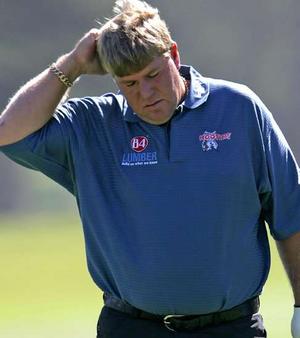
John Daly says he has lost between $66 million and $79 million during 12 years of heavy gambling, and that it has become a problem that could "flat-out ruin me" if he doesn't bring it under control.
Daly discussed his addiction to gambling in the final chapter of his autobiography, John Daly: My Life In and Out of the Rough, to be released next Monday.
He told one story of earning $992,000 when he lost in a playoff to Tiger Woods last year in San Francisco at a World Golf Championship event.
Instead of going home, he drove to Las Vegas and says he lost $2.18 million in five hours playing mostly $6,600 slot machines.
He entered himself into a drug rehabilitation clinic for alcoholism in 1993 and has been divorced three times.
He said he owed $5.3 million to casinos in two years of gambling until he won the 1995 British Open at St. Andrews, his second major. That victory and the ability to get handsome appearance fees, enabled him to pay off the debt.
Daly says he has taken more control of his life in the last six years.
"I'm off those ... medications. I don't drink JD (Jack Daniels) anymore. I don't beat up on hotel rooms and cars as much. Only gambling remains a problem," he wrote.
AP
Thursday, April 27, 2006
Physical Education

April 27, 2006
SMH
A teacher jailed for having sex with a 13-year-old has been arrested again.
Pamela Rogers, 28, of Tennessee, is accused of violating her probation conditions by sending photos and videos of herself naked by mobile phone to the boy.
The former physical education teacher was sent to jail for nine months in a plea deal last August for the three-month affair with the boy.
She was released in February for good behaviour.
But the Tennessean reports that authorites claim that after her release she created a MySpace.com web site and blog.
She denies posting messages to the boy on her site.
Her arrest this week follows allegations that she has breached probation by contacting the boy by phone, e-mails and text messages along with the nude photos and sex videos, according to court documents.
"Some of the naked photos and videos she sent after her most recent court appearance on April 12, a warrant says", reports the Tenneassean.
Her jail term was part of an eight-year sentence for the attractive former homecoming queen, who was directed to surrender her teaching certificate, and barred from granting interviews or profiting from her story.
smh.com.au
Saturday, April 22, 2006
Girl Power

By Jason Hill
April 20, 2006
smh
Lara Croft's creator has been reunited with his million-dollar baby but controversy still surrounds his high-kicking adventurer.
A decade after she raided her first tomb, Lara Croft remains the world's most recognised game character.
Lara was instrumental in gaming's rise to mainstream entertainment as well as in attracting many women to pick up a joypad for the first time.
After six Tomb Raider games selling 25 million copies and two films grossing more than $500 million, it is easy to forget how revolutionary Lara was in 1996. At the time, the game industry was focused on adolescent males and few titles featured female characters, let alone in starring roles.
Lara Croft's rise to pop culture stardom included appearing on stage with U2, on countless magazine covers, television commercials and even a music single. Lara also became PlayStation's de facto mascot just as gaming hit the mainstream - a modern icon to replace the childish heroes of the past such as Mario and Sonic.
Lara's creator, Toby Gard, wanted to create a smart, athletic archaeologist in the Indiana Jones mould.
"Lara is fire and ice, mind and passion, strength and agility, but she is also an unusual anti-hero," he says.
"She pursues knowledge of the past, uncovers mysteries, but for her own personal reasons, and nothing stands between her and those goals. She inhabits a world full of mystery, not least of which is Lara herself."
Gard famously quit Tomb Raider developer Core Design after the first game was released, in protest at how Lara's physical dimensions had been drastically inflated to titillate, turning his back on millions of dollars in royalty payments.
"I left as a result of my disapproval of the sexualised marketing of Tomb Raider," Gard says.
"Over the years she was marketed in more and more sleazy ways, which were completely contrary to the goal of the character, and as a result lost a little of her popularity."
The latest Tomb Raider game released last week reunited Lara's creator and the buxom heroine for the first time in a decade.
After leaving developer Core Design in protest at the sexualisation of his beloved character, Toby Gard established a new studio, Confounding Factor. But the venture closed in 2004 after the failure of its first project, a critically panned pirate adventure called Galleon.
Returning to where he began, Gard was recruited by publisher Eidos to work on Tomb Raider: Legend with developer Crystal Dynamics. Eidos hope Legend will resurrect what many critics consider a flagging franchise after the disastrous reception to 2003's Angel of Darkness.
"I was brought in primarily to create the new look for Lara," says Gard, "but I ended up having input on the story, and overseeing all the other characters' designs, directing the cinematic, working on Lara's movement system and generally consulting on the design."
Despite his famous exit from Core, Gard still feels pride in his creation.
"It's a really cool thing to see Lara being so popular. It's especially mind boggling when I think that a character I made up ended up being turned into two Hollywood movies," he says.
Despite turning his back on millions in royalties, Gard has no regrets. "You are who you are because of your choices. I learned a great deal by leaving Core that I could not have learned if I'd stayed."
The Death of a brother in Arms

By Les Kennedy and Kate McClymont
April 22, 2006 smh
INTERNAL warfare in the Bandidos bike gang - and a dispute over an affair one of its members had with a female parole officer - were catalysts for a killing outside a Sydney restaurant strip, police believe.
Police have named Russell Merrick Oldham, 39, as their chief suspect in Thursday night's shooting of the gang's chapter president, Rodney "Hooks" Monk, in Little Italy in East Sydney. They warned the public not to approach Oldham, saying he was armed and extremely dangerous.
Oldham is the Bandidos' former sergeant-at-arms. He had been a student at Sydney University, in science then in medicine, in the 1980s but eventually dropped out to become a security guard. He has a passion for astronomy and a history of violence.
He lost his post when he went to jail for five years for the manslaughter of two men at Bankstown in 1998, a post Monk, 32, was later to fill. Monk is the brother of senior police officer Detective Inspector Brad Monk.
Police believe the two Bandidos had been arguing about Oldham's relationship with his parole officer - against club rules.
The dinner at Bar Reggio on Thursday was to have been a farewell supper for Oldham. Police believe Monk, who was on bail for driving offences, told him he could no longer wear the gang's black, red and gold colours of a bandit brandishing a machete and pistol. They also believe that when Monk told him he could no longer ride with the gang the two men began shouting at each other.
Oldham, Monk and several other Bandidos entered the crowded restaurant about 9pm, taking a table at the back. It is not known whether Monk had taken his bodyguard, Raymond Curry, who was also jailed over the Bankstown killings.
Superintendent Mark Murdoch said Monk asked Oldham to step outside so they "could continue their discussion".
Monk was unarmed, and police suspect Oldham was carrying a firearm in a small black handbag. No one in the restaurant heard a thing, but neighbours say they heard at least three shots. Then two men ran into Reggios and said a man had been shot at the corner of nearby Chapel and Riley streets.
At 9.15pm police, who were on an undercover sting in neighbouring suburbs, arrived and found Monk sprawled on the ground with two gunshot wounds. He had been shot in the head by a heavy calibre semi-automatic pistol.
Superintendent Murdoch said a man was seen running from the body towards the nearby Lord Roberts Hotel, where he hailed a taxi. At Sydney Town Hall the same man abandoned the taxi and ran off, possibly to Town Hall station.
"Witnesses tell us there was more than one shot," he said. "What we have been told is the deceased and another man had a conversation. The conversation became heated and the two went outside to discuss their differences. We believe we have a good idea who we are looking for … That man has links to the Bandido outlaw motorcycle gang."
Tensions had been simmering within the Bandidos since it had stripped Monk's predecessor, Felix Lyle, of his colours after a dispute over the gang's finances and an alleged assault of a gang member. Matters reached fever pitch when Lyle's 24-year-old son, Dallas Fitzgerald, was kidnapped.
The Herald understands he was released on the payment of a large sum of money and the promise of a further $2 million. Suspicion first fell on a rival gang, the Nomads, but the Bandidos now suspect the job was carried out by some of their own. The resulting dispute threatened Monk's presidency, and it was against this backdrop that Oldham came out in support of Lyle.
Superintendent Murdoch said police had met Bandidos officials yesterday amid concerns of revenge attacks. "It is something that we can't dismiss … We have put plans in place to minimise the impact of that retribution."
Although the gang had given police no promises, "they certainly appreciate what we are trying to do".
"We are confident that we will be able to locate this fellow fairly quickly and put an end to the matter," he said.
Superintendent Murdoch said there had been some discussion that "the person we are looking for was obviously upset with some decisions that had been made by the hierarchy of the Bandidos … It is our understanding they were meeting to resolve those issues, but obviously that didn't occur."
Monk's brother, Inspector Monk, who is Redfern police crime manager, was in shock last night at the news of the shooting. Police said there was no suggestion he was involved in the Bandidos.
White House knew there were no WMD: CIA
April 22, 2006
The CIA had evidence Iraq possessed no weapons of mass destruction six months before the 2003 US-led invasion but was ignored by a White House intent on ousting Saddam Hussein, a former senior CIA official said, according to CBS.
Tyler Drumheller, who headed CIA covert operations in Europe during the run-up to the Iraq war, said intelligence opposing administration claims of a WMD threat came from a top Iraqi official who provided the US spy agency with other credible information.
The source "told us that there were no active weapons of mass destruction programs," Drumheller said in a CBS interview to be aired on Sunday on the US network's 60 Minutes.
"The (White House) group that was dealing with preparation for the Iraq war came back and said they were no longer interested," he was quoted as saying in interview excerpts released by CBS on Friday.
"We said: 'Well, what about the intel?' And they said: 'Well, this isn't about intel anymore. This is about regime change'," added Drumheller, whose CIA operation was assigned the task of debriefing the Iraqi official.
He was the latest former US official to accuse the White House of setting an early course toward war in Iraq and ignoring intelligence that conflicted with its aim.
CBS said the CIA's intelligence source was former Iraqi Foreign Minister Naji Sabri and that former CIA Director George Tenet delivered the information personally to US President George W Bush, Vice President Dick Cheney and other top White House officials in September 2002. They rebuffed the CIA three days later.
"The policy was set. The war in Iraq was coming and they were looking for intelligence to fit into the policy," the former CIA agent told CBS.
US allegations that Saddam had WMD and posed a threat to international security was a main justification for the March 2003 invasion.
A 2002 National Intelligence Estimate, to which the CIA was a major contributor, concluded that prewar Iraq had an active nuclear program and a huge stockpile of unconventional weapons.
No such weapons have been found, however, and US assertions that they existed are now regarded as a hugely damaging intelligence failure.
But Drumheller, co-author of a forthcoming book entitled On the Brink: How the White House Has Compromised American Intelligence, rejects the notion of an intelligence failure.
© 2006 Reuters
The CIA had evidence Iraq possessed no weapons of mass destruction six months before the 2003 US-led invasion but was ignored by a White House intent on ousting Saddam Hussein, a former senior CIA official said, according to CBS.
Tyler Drumheller, who headed CIA covert operations in Europe during the run-up to the Iraq war, said intelligence opposing administration claims of a WMD threat came from a top Iraqi official who provided the US spy agency with other credible information.
The source "told us that there were no active weapons of mass destruction programs," Drumheller said in a CBS interview to be aired on Sunday on the US network's 60 Minutes.
"The (White House) group that was dealing with preparation for the Iraq war came back and said they were no longer interested," he was quoted as saying in interview excerpts released by CBS on Friday.
"We said: 'Well, what about the intel?' And they said: 'Well, this isn't about intel anymore. This is about regime change'," added Drumheller, whose CIA operation was assigned the task of debriefing the Iraqi official.
He was the latest former US official to accuse the White House of setting an early course toward war in Iraq and ignoring intelligence that conflicted with its aim.
CBS said the CIA's intelligence source was former Iraqi Foreign Minister Naji Sabri and that former CIA Director George Tenet delivered the information personally to US President George W Bush, Vice President Dick Cheney and other top White House officials in September 2002. They rebuffed the CIA three days later.
"The policy was set. The war in Iraq was coming and they were looking for intelligence to fit into the policy," the former CIA agent told CBS.
US allegations that Saddam had WMD and posed a threat to international security was a main justification for the March 2003 invasion.
A 2002 National Intelligence Estimate, to which the CIA was a major contributor, concluded that prewar Iraq had an active nuclear program and a huge stockpile of unconventional weapons.
No such weapons have been found, however, and US assertions that they existed are now regarded as a hugely damaging intelligence failure.
But Drumheller, co-author of a forthcoming book entitled On the Brink: How the White House Has Compromised American Intelligence, rejects the notion of an intelligence failure.
© 2006 Reuters
Tuesday, April 04, 2006
Rene Rivkin's chauffeur arrested on murder charges

ONE of Sydney's most controversial murder investigations reached a dramatic climax in London overnight when police arrested Gordon Wood for allegedly murdering his former lover, the model Caroline Byrne, by throwing her over The Gap.
Wood, 43, who was chauffeur to the late millionaire stockbroker Rene Rivkin at the time of the alleged murder in 1995, was arrested about 12.45am Sydney time by British police at his inner-city flat after a tip-off from the Herald. He put up no resistance.
Detective Inspector Paul Jacob, head of Task Force Irondale, which hunted Wood, will fly to London to begin extradition proceedings so Wood can face trial in Sydney. The extradition hearing could take several weeks. Wood, born in England, has dual Australian and British citizenship.
The arrest came three weeks after the Director of Public Prosecutions, Nicholas Cowdery, QC, agreed with police that there was enough evidence to charge Wood, who left Australia in 1998 under a cloud of suspicion.
The former economics graduate and gym instructor has managed a comfortable existence since, spending most of his time in the French Alps ski resort of Megeve and London, to which he returned about 12 months ago to work as a physical fitness consultant to a large company. The job pays about $150,000 a year and affords a lifestyle that involves frequent travel across Europe and the US.
The central allegation by police will be that Wood and a mysterious accomplice threw Byrne off The Gap at Watsons Bay about 11.30pm on June 7. On a moonless night, two fishermen heard a woman scream in distress.
Not long after, Wood ran out of the darkness. They told him about the scream. Wood said, "Oh, no, she's done it," and ran back into the night.
About 1am Wood returned with Byrne's father, Tony, and his son Peter, claiming Byrne's "spirit guided me" to a spot on the cliff face 150 metres from the fishermen. Wood shone a borrowed torch, its glow so weak the fishermen had not used it, on to the rocks 30 metres below, shouting that he could see a leg and a sandshoe. No one else saw anything.
Police have investigated at least three suspects but have been unable to identify the "second man", who remains free.
Wood has three times denied killing Byrne, twice in police interviews and again on a television current affairs show, saying she committed suicide. He did not say why she would do this.
But police got expert evidence from two of Australia's top physicists that it would have been impossible for even an Olympic athlete to have jumped and landed where Byrne did, more than 10 metres out from the cliff face, impaled head first in a cleft in the sea level rock shelf.
After two trials with policewomen and athletes of the same age and build as Byrne, the physicists told Irondale investigators it was "beyond doubt" that Byrne was thrown off the Gap. This evidence clinched the decision to charge Wood with murder.
The alleged motive is as yet unknown. However, witnesses say Byrne had indicated she was thinking of ending her relationship with Wood, who was said to be obsessively jealous.
It might also involve incriminating information Wood had conveyed to Byrne about a fire that destroyed Offset Alpine in 1993, resulting in a $53.2 million insurance payout to Rivkin and other shareholders.
Byrne's death came a day after Rivkin and Wood were interrogated by the Corporate Affairs Commission on their return from a business trip to Switzerland.
Both denied they knew who owned 38.5 per cent of Offset Alpine shares that were held in secret accounts in Swiss banks. Rivkin, at least, was lying because it has since been revealed the shares were owned by him and two business associates. Tony Byrne told police that Wood told him and his daughter in 1994 that the Offset Alpine fire was a "set up" and advised them to buy shares to make a windfall profit when the insurance payout hugely inflated their value.
Wood's mother bought shares and made a profit. Another witness told police Wood asked him for $500,000 to buy Offset Alpine shares, boasting he would turn it into $1 million in a short time.Police believe that Wood was afraid of any disclosures that might arise if Ms Byrne left him. This would have endangered his job with Rivkin, a mentor who had bought Wood and Byrne the Kings Cross flat in which they lived.Rivkin, 61, committed suicide last May, depressed by a broken marriage and the threat of criminal charges arising from the Offset Alpine investigation. He had served nine months' periodic detention in relation to another matter and lost his stockbroker's licence.
In 1998 Wood told an inquest into Byrne's death that he had last seen her "drowsy and still in bed" at lunchtime on the last day of her life.
When he came back at 4pm, she was gone. He said he fell asleep watching television, woke about 11pm and went looking for her. But three witnesses gave a different story.
Two restaurateurs told the inquest they saw Wood, Byrne and a second man in Robert Park at Watsons Bay and near The Gap at 1pm and again at 3pm. They identified the other man as Adam Leigh, Byrne's booking agent. Wood and Leigh denied being at the park with Byrne.Three months after the inquest returned an open finding into Byrne's death, a third witness gave police a graphic description of the last known sighting of Ms Byrne.At 8.30pm, an artist, John Doherty, heard a woman cry out. He went to the front window of his studio and looked down onto Military Road, opposite The Gap.
He saw a woman he identified as Byrne sitting on the kerb, holding her head in her hands, crying, moaning. Nearby he saw a man of similar appearance to Wood who was abusing her verbally and, further away, another man whom he could not clearly see.The three walked to a road that leads to a reserve next to The Gap. Later he heard voices of a woman and two men raised in loud argument from that direction. No other witnesses have testified to seeing Byrne alive after that.
Sunday, April 02, 2006
Prayer does not heal the sick, study finds
Praying for the health of strangers who have undergone heart surgery has no effect, according to the largest scientific study ever commissioned to calculate the healing power of prayer.
In fact, patients who know they are being prayed for suffer a noticeably higher rate of complications, according to the study, which monitored the recovery of 1,800 patients after heart bypass surgery in the US.
The findings of the decade-long study were due to be published in the American Heart Journal next week, but the journal published the report on its website yesterday as anticipation grew.
The power of intercessory prayer has been studied by doctors for years in America, but with no conclusive results. This $2.4 million study, funded in large part by the John Templeton Foundation, which seeks "insights at the boundary between theology and science", was intended to cast some clear light on the matter.
But the study "did not move us forward or backward" in understanding the effects of prayer, admitted Dr Charles Bethea, one of the co-authors and a cardiologist at the Integris Baptist Medical Center in Oklahoma City. "Intercessory prayer under our restricted format had a neutral effect," he said.
Members of three congregations - St. Paul's Monastery in St. Paul; the Community of Teresian Carmelites in Worcester, Massachussetts; and Silent Unity, a Missouri prayer ministry near Kansas City - were asked to pray for the patients, who were divided into three groups: those who would be told they were being prayed for, those who would receive prayers but not know, and those who would not be prayed for at all.
The worshippers starting praying for the patients the night before surgery and for the next two weeks, asking God to grant "a successful surgery with a quick, healthy recovery and no complications".
The study found no appreciable difference between the health of those who did not know they were being prayed for and those who received no prayers. Fifty-two per cent of patients in both groups suffered complications after surgery. But 59 per cent of those who knew they were prayed for went on to develop complications.
The reports authors said they had no explanation for the difference beyond a possibility that the prayers made people anxious about their ability to recover.
"Did the patients think, ’I am so sick that they had to call in the prayer team?"’ said Dr Bethea.
The results of the study provoked discord among doctors and scientists in the US, many of whom questioned the wisdom of subjecting prayer to the conditions of a research project.
Dr Richard Sloan, a professor of behavioral medicine at Columbia and the author of a forthcoming book, Blind Faith: The Unholy Alliance of Religion and Medicine, told The New York Times: "The problem with studying religion scientifically is that you do violence to the phenomenon by reducing it to basic elements that can be quantified, and that makes for bad science and bad religion."
But Paul Kurtz, Professor Emeritus of Philosophy at the State University of New York at Buffalo, and chairman of the Committee for the Scientific Investigation of Claims of the Paranormal, had a simpler response when asked why the study had found no evidence for the power of prayer. "Because there is none," he said. "That would be one answer."
Dr. David Stevens, executive director of the Christian Medical and Dental Associations, told the AP that he believed intercessory prayer could influence people's health, but that scientists were not equipped to measure the phenomenon."Do we control God through prayer? Theologians would say absolutely not. God decides sometimes to intervene, and sometimes not," he said. As for the new study, he said, "I don’t think... it’s going to stop people praying for the sick."
In fact, patients who know they are being prayed for suffer a noticeably higher rate of complications, according to the study, which monitored the recovery of 1,800 patients after heart bypass surgery in the US.
The findings of the decade-long study were due to be published in the American Heart Journal next week, but the journal published the report on its website yesterday as anticipation grew.
The power of intercessory prayer has been studied by doctors for years in America, but with no conclusive results. This $2.4 million study, funded in large part by the John Templeton Foundation, which seeks "insights at the boundary between theology and science", was intended to cast some clear light on the matter.
But the study "did not move us forward or backward" in understanding the effects of prayer, admitted Dr Charles Bethea, one of the co-authors and a cardiologist at the Integris Baptist Medical Center in Oklahoma City. "Intercessory prayer under our restricted format had a neutral effect," he said.
Members of three congregations - St. Paul's Monastery in St. Paul; the Community of Teresian Carmelites in Worcester, Massachussetts; and Silent Unity, a Missouri prayer ministry near Kansas City - were asked to pray for the patients, who were divided into three groups: those who would be told they were being prayed for, those who would receive prayers but not know, and those who would not be prayed for at all.
The worshippers starting praying for the patients the night before surgery and for the next two weeks, asking God to grant "a successful surgery with a quick, healthy recovery and no complications".
The study found no appreciable difference between the health of those who did not know they were being prayed for and those who received no prayers. Fifty-two per cent of patients in both groups suffered complications after surgery. But 59 per cent of those who knew they were prayed for went on to develop complications.
The reports authors said they had no explanation for the difference beyond a possibility that the prayers made people anxious about their ability to recover.
"Did the patients think, ’I am so sick that they had to call in the prayer team?"’ said Dr Bethea.
The results of the study provoked discord among doctors and scientists in the US, many of whom questioned the wisdom of subjecting prayer to the conditions of a research project.
Dr Richard Sloan, a professor of behavioral medicine at Columbia and the author of a forthcoming book, Blind Faith: The Unholy Alliance of Religion and Medicine, told The New York Times: "The problem with studying religion scientifically is that you do violence to the phenomenon by reducing it to basic elements that can be quantified, and that makes for bad science and bad religion."
But Paul Kurtz, Professor Emeritus of Philosophy at the State University of New York at Buffalo, and chairman of the Committee for the Scientific Investigation of Claims of the Paranormal, had a simpler response when asked why the study had found no evidence for the power of prayer. "Because there is none," he said. "That would be one answer."
Dr. David Stevens, executive director of the Christian Medical and Dental Associations, told the AP that he believed intercessory prayer could influence people's health, but that scientists were not equipped to measure the phenomenon."Do we control God through prayer? Theologians would say absolutely not. God decides sometimes to intervene, and sometimes not," he said. As for the new study, he said, "I don’t think... it’s going to stop people praying for the sick."
Wednesday, March 29, 2006
Tamarama
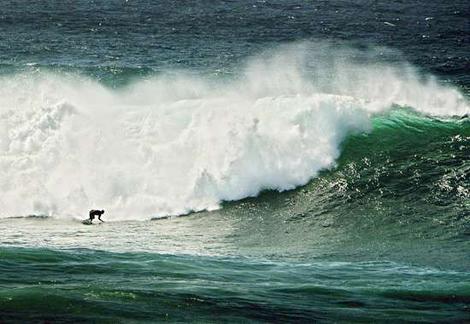
Photo: a brave boarder tackles a wave at Tamarama.
Waves reached heights of up to eight metres, according to weather experts - or a mere four metres, according to the less-macho reckoning of surfers.
Several beaches were closed, including Bronte, Maroubra, Newport and Palm Beach, while Bondi lifeguards stopped swimmers from going beyond shallow water. Water police and rescue helicopters were called to Manly about 6.30pm after two men on surf skis were hit by a giant wave.
One of the men washed onto Shelly Beach, south of Manly.
Water police found the other surfer about an hour later a kilometre off Queenscliff to the north.
Former pro-surfer Matt Grainger, who owns Manly Surf School, spent the day surfing off Long Reef and Queenscliff, but warned that only advanced surfers should brave the treacherous conditions. At Bronte, even the baths were closed as huge waves lashed the southern end of the beach.
High winds from the weather system formerly known as Tropical Cyclone Wati started the huge swell 1000 kilometres offshore in the Tasman Sea.
By Gwyn Topham SMH
Monday, March 27, 2006

Scientists Find Skull of Human Ancestor

ADDIS ABABA, Ethiopia
Mar 25, 2006 (AP)
Scientists in northeastern Ethiopia said Saturday that they have discovered the skull of a small human ancestor that could be a missing link between the extinct Homo erectus and modern man.
The hominid cranium found in two pieces and believed to be between 500,000 and 250,000 years old "comes from a very significant period and is very close to the appearance of the anatomically modern human," said Sileshi Semaw, director of the Gona Paleoanthropological Research Project in Ethiopia.
Archaeologists found the early human cranium five weeks ago at Gawis in Ethiopia's northeastern Afar region, Sileshi said.
Several stone tools and fossilized animals including two types of pigs, zebras, elephants, antelopes, cats, and rodents were also found at the site.
Sileshi, an Ethiopian paleoanthropologist based at Indiana University, said most fossil hominids are found in pieces but the near-complete skull a rare find provided a wealth of information.
"The Gawis cranium provides us with the opportunity to look at the face of one of our ancestors," the archaeology project said in a statement.
Homo erectus, which many believe was an ancestor of modern Homo sapiens, is thought to have died out 100,000 to 200,000 years ago.
The cranium dates to a time about which little is known the transition from African Homo erectus to modern humans. The fossil record from Africa for this period is sparse and most of the specimens poorly dated, project archaeologists said.
The face and cranium of the fossil are recognizably different from those of modern humans, but bear unmistakable anatomical evidence that it belongs to the modern human's ancestry, Sileshi said.
"A good fossil provides anatomical evidence that allows us to refine our understanding of evolution. A great fossil forces us to re-examine our views of human origins. I believe the Gawis cranium is a great fossil," said Scott Simpson, a project paleontologist from Case Western Reserve University School of Medicine at Cleveland, Ohio.
Scientists conducting surveys in the Gawis River drainage basin found the skull in a small gully, the project statement said.
"This is really exciting because it joins a limited number of fossils which appear to be evolutionary between Homo erectus and our own species Homo sapiens," said Eric Delson, a paleoanthropologist at Lehman College of the City University of New York, who was not involved in the discovery but has followed the project.
Homo erectus left Africa about 2 million years ago and spread across Asia from Georgia in the Caucasus to China and Indonesia. It first appeared in Africa between 1 million and 2 million years ago.
Between 1 million and perhaps 200,000 years ago, one or more species existed in Africa that gave rise to the earliest members of our own species Homo sapiens between 150,000 and 200,000 years ago.
Delson said the fossil found in Ethiopia "might represent a population broadly ancestral to modern humans or it might prove to be one of several side branches which died out without living descendants."
On the Net:
Gona Palaeoanthropological Research Project Stone Age Institute:
http://www.stoneageinstitute.org
Saturday, March 25, 2006
Paris burns
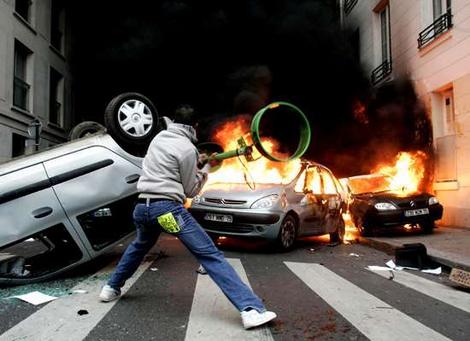
IT WAS just the scene the French Government had been dreading: burning cars seven blocks from the Eiffel Tower, shop windows smashed along one of the capital's smartest streets, and columns of helmeted riot police advancing near a prominent tourist venue.
Antoil Ethuin, 48, stood outside the shattered windows of his Bike'n'Roll rental shop on Thursday, stunned by the destruction of the worst violence in two weeks of student protests in Paris and other French cities.
"My country is broken," said Mr Ethuin, gazing at the smouldering wrecks a few metres away and the carpet of glass shards, broken dishes and computer parts covering the footpath in the heart of one of the city's most affluent suburbs.
"I never imagined I would ever see this in Paris."
The unrest intensified a political crisis threatening to unravel the Government much the way previous French governments have been felled by strikes and street protests when they attempted even modest reforms of the costly welfare state.
The Prime Minister, Dominique de Villepin, hastily arranged an emergency meeting with the most influential unions to defuse the crisis.
On Thursday, as a crowd of 140,000 were about to end their march in the park adjoining the gold-domed Hotel des Invalides, near Napoleon's tomb, gangs of hooded and masked youths darted out of side streets, setting cars ablaze, flipping others upside down, breaking shop windows and hurling rocks at police and firefighters.
Riot police broke up the groups with teargas as acrid black smoke filled narrow streets and billowed above the skyline.
Police said 60 people were injured in the clashes, including 27 police officers. Officials said 141 people were arrested.
Mr Villepin had attempted to capitalise on the political misfortunes of his rival, the Interior Minister, Nicolas Sarkozy, by advocating a law he said was intended to give companies greater incentive to hire young people. The law would allow employers to fire workers aged under 26 without reason during their first two years on the job.
University students, other young people and unions say the law discriminates against the young by denying them the job security that older workers have.
On Thursday newspapers began reporting leaks from anonymous government officials that President Jacques Chirac was threatening to fire Mr Villepin if he did not resolve the escalating crisis quickly.
The Washington Post
Friday, March 24, 2006
Melting ice sheets could spur oceans' rise - study

Miami would be a memory, Bangkok a soggy shadow of its former self and the Maldive Islands would vanish if melting polar ice keeps fuelling a faster-than-expected rise in sea levels, according to scientists.
In an issue of the journal Science focusing on global warming, climate scientist Jonathan Overpeck of the University of Arizona reported that if global trends continue, Earth could ultimately experience sea levels six meters higher than they are now.
By the end of this century, Earth would be at least 2.3C warmer than now, or about as hot as it was nearly 130,000 years ago.
Back then, significant portions of the Greenland and Antarctic ice sheets melted, pushing the global sea levels to about six meters higher than current levels.
A similarly dramatic, and in some cases catastrophic, rise in ocean levels could happen by the year 2500, Overpeck said in a telephone interview, but he noted it could come sooner.
"We know when the sea level was that high in the past, and we know how much warming is necessary to get that amount of sea level rise from both Greenland and Antarctica," Overpeck said.
The Earth will get that hot sometime early in the second half of this century, he said, and once it does, the big ice sheets will start melting "in a more dramatic manner" than they currently are.
A conservative estimate would call for sea level rises of one metre per century, he said.
He cautioned, however, that this estimate assumes the Earth will get only as hot as it did 130,000 years ago when the ice sheets melted.
"If we decide to keep on the track we're on now and just keep on warming, because of greenhouse gas pollution, then we could easily cook those ice sheets more rapidly," Overpeck said.
The earlier ice melt was concentrated in the Northern Hemisphere in the summer months, and was due largely to changes in Earth's orbit, he said.
"The climate warming we're in now is global and it's year-round and it's due to human influences on the climate system," he said. "That will be more damaging to the ice sheets than the that warming we had 130,000 years ago."
The ice sheets are already melting, accelerated by relatively warm water that eats away at them, said NASA glacier expert Bob Bindschadler.
"It's not really a debate any more about whether sea level is rising or not. I think the debate has shifted to, how rapidly is sea level rising," Bindschadler said in a telephone briefing.
Overpeck's Web site -- http://www.geo.arizona.edu/dgesl/ -- offers dynamic maps of the projected results of the rise in sea levels.
Reuters
Wednesday, March 22, 2006
Plant, animal extinctions speeding up

By David Adam
March 22, 2006
HUMANS have provoked the worst series of extinctions since the dinosaurs were wiped out 65 million years ago, says a United Nations report that calls for unprecedented worldwide efforts to address the slide.
The report paints a grim picture of life on earth, with declining numbers of plants and animals, and warns that the current extinction rate is up to 1000 times faster than in the past. About 844 animals and plants are known to have disappeared in the past 500 years.
Released on Monday to mark the start of a UN environment program meeting in Curitiba, Brazil, the report says: "In effect, we are currently responsible for the sixth major extinction event in the history of earth."
A rising human population of 6.5 billion is wrecking the environment for thousands of other species, it adds, and undermining efforts agreed at a 2002 UN summit in Johannesburg to slow the rate of decline by 2010. The global demand for biological resources now exceeds the planet's capacity to renew them by 20 per cent.
The report, Global Biodiversity Outlook 2 from the UN Convention on Biological Diversity, says: "The direct causes of biodiversity loss - habitat change, over-exploitation, the introduction of invasive alien species, nutrient loading and climate change - show no sign of abating."
The Guardian, Reuters
Subscribe to:
Posts (Atom)