Praying for the health of strangers who have undergone heart surgery has no effect, according to the largest scientific study ever commissioned to calculate the healing power of prayer.
In fact, patients who know they are being prayed for suffer a noticeably higher rate of complications, according to the study, which monitored the recovery of 1,800 patients after heart bypass surgery in the US.
The findings of the decade-long study were due to be published in the American Heart Journal next week, but the journal published the report on its website yesterday as anticipation grew.
The power of intercessory prayer has been studied by doctors for years in America, but with no conclusive results. This $2.4 million study, funded in large part by the John Templeton Foundation, which seeks "insights at the boundary between theology and science", was intended to cast some clear light on the matter.
But the study "did not move us forward or backward" in understanding the effects of prayer, admitted Dr Charles Bethea, one of the co-authors and a cardiologist at the Integris Baptist Medical Center in Oklahoma City. "Intercessory prayer under our restricted format had a neutral effect," he said.
Members of three congregations - St. Paul's Monastery in St. Paul; the Community of Teresian Carmelites in Worcester, Massachussetts; and Silent Unity, a Missouri prayer ministry near Kansas City - were asked to pray for the patients, who were divided into three groups: those who would be told they were being prayed for, those who would receive prayers but not know, and those who would not be prayed for at all.
The worshippers starting praying for the patients the night before surgery and for the next two weeks, asking God to grant "a successful surgery with a quick, healthy recovery and no complications".
The study found no appreciable difference between the health of those who did not know they were being prayed for and those who received no prayers. Fifty-two per cent of patients in both groups suffered complications after surgery. But 59 per cent of those who knew they were prayed for went on to develop complications.
The reports authors said they had no explanation for the difference beyond a possibility that the prayers made people anxious about their ability to recover.
"Did the patients think, ’I am so sick that they had to call in the prayer team?"’ said Dr Bethea.
The results of the study provoked discord among doctors and scientists in the US, many of whom questioned the wisdom of subjecting prayer to the conditions of a research project.
Dr Richard Sloan, a professor of behavioral medicine at Columbia and the author of a forthcoming book, Blind Faith: The Unholy Alliance of Religion and Medicine, told The New York Times: "The problem with studying religion scientifically is that you do violence to the phenomenon by reducing it to basic elements that can be quantified, and that makes for bad science and bad religion."
But Paul Kurtz, Professor Emeritus of Philosophy at the State University of New York at Buffalo, and chairman of the Committee for the Scientific Investigation of Claims of the Paranormal, had a simpler response when asked why the study had found no evidence for the power of prayer. "Because there is none," he said. "That would be one answer."
Dr. David Stevens, executive director of the Christian Medical and Dental Associations, told the AP that he believed intercessory prayer could influence people's health, but that scientists were not equipped to measure the phenomenon."Do we control God through prayer? Theologians would say absolutely not. God decides sometimes to intervene, and sometimes not," he said. As for the new study, he said, "I don’t think... it’s going to stop people praying for the sick."
Sunday, April 02, 2006

Wednesday, March 29, 2006
Tamarama
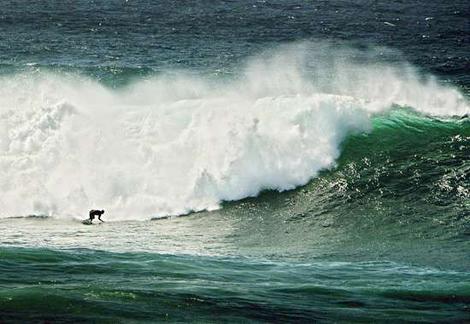
Photo: a brave boarder tackles a wave at Tamarama.
Waves reached heights of up to eight metres, according to weather experts - or a mere four metres, according to the less-macho reckoning of surfers.
Several beaches were closed, including Bronte, Maroubra, Newport and Palm Beach, while Bondi lifeguards stopped swimmers from going beyond shallow water. Water police and rescue helicopters were called to Manly about 6.30pm after two men on surf skis were hit by a giant wave.
One of the men washed onto Shelly Beach, south of Manly.
Water police found the other surfer about an hour later a kilometre off Queenscliff to the north.
Former pro-surfer Matt Grainger, who owns Manly Surf School, spent the day surfing off Long Reef and Queenscliff, but warned that only advanced surfers should brave the treacherous conditions. At Bronte, even the baths were closed as huge waves lashed the southern end of the beach.
High winds from the weather system formerly known as Tropical Cyclone Wati started the huge swell 1000 kilometres offshore in the Tasman Sea.
By Gwyn Topham SMH
Monday, March 27, 2006
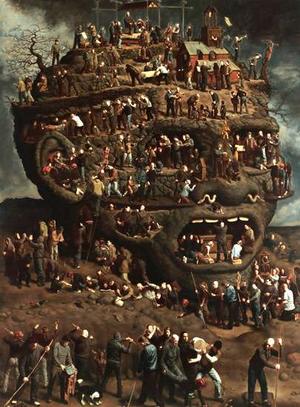
Scientists Find Skull of Human Ancestor

ADDIS ABABA, Ethiopia
Mar 25, 2006 (AP)
Scientists in northeastern Ethiopia said Saturday that they have discovered the skull of a small human ancestor that could be a missing link between the extinct Homo erectus and modern man.
The hominid cranium found in two pieces and believed to be between 500,000 and 250,000 years old "comes from a very significant period and is very close to the appearance of the anatomically modern human," said Sileshi Semaw, director of the Gona Paleoanthropological Research Project in Ethiopia.
Archaeologists found the early human cranium five weeks ago at Gawis in Ethiopia's northeastern Afar region, Sileshi said.
Several stone tools and fossilized animals including two types of pigs, zebras, elephants, antelopes, cats, and rodents were also found at the site.
Sileshi, an Ethiopian paleoanthropologist based at Indiana University, said most fossil hominids are found in pieces but the near-complete skull a rare find provided a wealth of information.
"The Gawis cranium provides us with the opportunity to look at the face of one of our ancestors," the archaeology project said in a statement.
Homo erectus, which many believe was an ancestor of modern Homo sapiens, is thought to have died out 100,000 to 200,000 years ago.
The cranium dates to a time about which little is known the transition from African Homo erectus to modern humans. The fossil record from Africa for this period is sparse and most of the specimens poorly dated, project archaeologists said.
The face and cranium of the fossil are recognizably different from those of modern humans, but bear unmistakable anatomical evidence that it belongs to the modern human's ancestry, Sileshi said.
"A good fossil provides anatomical evidence that allows us to refine our understanding of evolution. A great fossil forces us to re-examine our views of human origins. I believe the Gawis cranium is a great fossil," said Scott Simpson, a project paleontologist from Case Western Reserve University School of Medicine at Cleveland, Ohio.
Scientists conducting surveys in the Gawis River drainage basin found the skull in a small gully, the project statement said.
"This is really exciting because it joins a limited number of fossils which appear to be evolutionary between Homo erectus and our own species Homo sapiens," said Eric Delson, a paleoanthropologist at Lehman College of the City University of New York, who was not involved in the discovery but has followed the project.
Homo erectus left Africa about 2 million years ago and spread across Asia from Georgia in the Caucasus to China and Indonesia. It first appeared in Africa between 1 million and 2 million years ago.
Between 1 million and perhaps 200,000 years ago, one or more species existed in Africa that gave rise to the earliest members of our own species Homo sapiens between 150,000 and 200,000 years ago.
Delson said the fossil found in Ethiopia "might represent a population broadly ancestral to modern humans or it might prove to be one of several side branches which died out without living descendants."
On the Net:
Gona Palaeoanthropological Research Project Stone Age Institute:
http://www.stoneageinstitute.org
Saturday, March 25, 2006
Paris burns
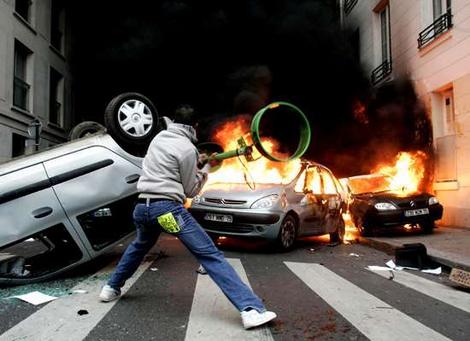
IT WAS just the scene the French Government had been dreading: burning cars seven blocks from the Eiffel Tower, shop windows smashed along one of the capital's smartest streets, and columns of helmeted riot police advancing near a prominent tourist venue.
Antoil Ethuin, 48, stood outside the shattered windows of his Bike'n'Roll rental shop on Thursday, stunned by the destruction of the worst violence in two weeks of student protests in Paris and other French cities.
"My country is broken," said Mr Ethuin, gazing at the smouldering wrecks a few metres away and the carpet of glass shards, broken dishes and computer parts covering the footpath in the heart of one of the city's most affluent suburbs.
"I never imagined I would ever see this in Paris."
The unrest intensified a political crisis threatening to unravel the Government much the way previous French governments have been felled by strikes and street protests when they attempted even modest reforms of the costly welfare state.
The Prime Minister, Dominique de Villepin, hastily arranged an emergency meeting with the most influential unions to defuse the crisis.
On Thursday, as a crowd of 140,000 were about to end their march in the park adjoining the gold-domed Hotel des Invalides, near Napoleon's tomb, gangs of hooded and masked youths darted out of side streets, setting cars ablaze, flipping others upside down, breaking shop windows and hurling rocks at police and firefighters.
Riot police broke up the groups with teargas as acrid black smoke filled narrow streets and billowed above the skyline.
Police said 60 people were injured in the clashes, including 27 police officers. Officials said 141 people were arrested.
Mr Villepin had attempted to capitalise on the political misfortunes of his rival, the Interior Minister, Nicolas Sarkozy, by advocating a law he said was intended to give companies greater incentive to hire young people. The law would allow employers to fire workers aged under 26 without reason during their first two years on the job.
University students, other young people and unions say the law discriminates against the young by denying them the job security that older workers have.
On Thursday newspapers began reporting leaks from anonymous government officials that President Jacques Chirac was threatening to fire Mr Villepin if he did not resolve the escalating crisis quickly.
The Washington Post
Friday, March 24, 2006
Melting ice sheets could spur oceans' rise - study

Miami would be a memory, Bangkok a soggy shadow of its former self and the Maldive Islands would vanish if melting polar ice keeps fuelling a faster-than-expected rise in sea levels, according to scientists.
In an issue of the journal Science focusing on global warming, climate scientist Jonathan Overpeck of the University of Arizona reported that if global trends continue, Earth could ultimately experience sea levels six meters higher than they are now.
By the end of this century, Earth would be at least 2.3C warmer than now, or about as hot as it was nearly 130,000 years ago.
Back then, significant portions of the Greenland and Antarctic ice sheets melted, pushing the global sea levels to about six meters higher than current levels.
A similarly dramatic, and in some cases catastrophic, rise in ocean levels could happen by the year 2500, Overpeck said in a telephone interview, but he noted it could come sooner.
"We know when the sea level was that high in the past, and we know how much warming is necessary to get that amount of sea level rise from both Greenland and Antarctica," Overpeck said.
The Earth will get that hot sometime early in the second half of this century, he said, and once it does, the big ice sheets will start melting "in a more dramatic manner" than they currently are.
A conservative estimate would call for sea level rises of one metre per century, he said.
He cautioned, however, that this estimate assumes the Earth will get only as hot as it did 130,000 years ago when the ice sheets melted.
"If we decide to keep on the track we're on now and just keep on warming, because of greenhouse gas pollution, then we could easily cook those ice sheets more rapidly," Overpeck said.
The earlier ice melt was concentrated in the Northern Hemisphere in the summer months, and was due largely to changes in Earth's orbit, he said.
"The climate warming we're in now is global and it's year-round and it's due to human influences on the climate system," he said. "That will be more damaging to the ice sheets than the that warming we had 130,000 years ago."
The ice sheets are already melting, accelerated by relatively warm water that eats away at them, said NASA glacier expert Bob Bindschadler.
"It's not really a debate any more about whether sea level is rising or not. I think the debate has shifted to, how rapidly is sea level rising," Bindschadler said in a telephone briefing.
Overpeck's Web site -- http://www.geo.arizona.edu/dgesl/ -- offers dynamic maps of the projected results of the rise in sea levels.
Reuters
Wednesday, March 22, 2006
Plant, animal extinctions speeding up

By David Adam
March 22, 2006
HUMANS have provoked the worst series of extinctions since the dinosaurs were wiped out 65 million years ago, says a United Nations report that calls for unprecedented worldwide efforts to address the slide.
The report paints a grim picture of life on earth, with declining numbers of plants and animals, and warns that the current extinction rate is up to 1000 times faster than in the past. About 844 animals and plants are known to have disappeared in the past 500 years.
Released on Monday to mark the start of a UN environment program meeting in Curitiba, Brazil, the report says: "In effect, we are currently responsible for the sixth major extinction event in the history of earth."
A rising human population of 6.5 billion is wrecking the environment for thousands of other species, it adds, and undermining efforts agreed at a 2002 UN summit in Johannesburg to slow the rate of decline by 2010. The global demand for biological resources now exceeds the planet's capacity to renew them by 20 per cent.
The report, Global Biodiversity Outlook 2 from the UN Convention on Biological Diversity, says: "The direct causes of biodiversity loss - habitat change, over-exploitation, the introduction of invasive alien species, nutrient loading and climate change - show no sign of abating."
The Guardian, Reuters
Monday, March 20, 2006
Stop the War

Thousands of demonstrators across the world have denounced the US-led war in Iraq in another day of protests marking the invasion's third anniversary.
Father wants to divorce his 7month old daughter
SEVEN-MONTH-OLD Elizabeth Wells has never been held in her father's arms, and if he has his way she never will be.
In what could be a landmark case in the US, Matt Dubay, a computer programmer, is asking the courts to absolve him of all the responsibilities of fatherhood.
Mr Dubay's lawsuit has the backing of the National Centre for Men, activists who say that equal opportunities have swung too far in favour of women.
For Mr Dubay, 25, news that he was about to become a father was an unwelcome shock. It followed a night spent with a student, Lauren Wells, who he claims told him that she was infertile and using contraception. The apparent contradiction of those remarks did not fully hit Mr Dubay until several weeks later, when Ms Wells, 20, told him she was pregnant.
While the relationship soon foundered, his former girlfriend said she was keeping the child and, when the baby was born last August, she began legal proceedings to ensure that her former boyfriend paid his way in bringing up their daughter.
Faced with a court order for $US500 ($690) a month in child support, Mr Dubay said not paying was his constitutional right.
"I don't believe men have any say … [they are] simply ignored," he said from his home in Saginaw, Michigan. After learning that Ms Wells was pregnant, Mr Dubay said he talked to her about an abortion or having the baby adopted, but she ruled out both. "I painted a very clear picture at that point that I was not ready to be a father," he said. "I was not ready to be a part of the child's life."
His lawsuit, filed in a federal court, says that men who face fatherhood without their consent should be able to opt out of their responsibilities. While it does not seek to force women to have an abortion or give up their babies for adoption, it claims that women have the right to pursue either option if they do not want to bring up a child on their own.
The founder of the National Centre for Men, Mel Feit, said: "Men are routinely forced to give up control, forced to be financially responsible for choices only women are permitted to make, forced to relinquish reproductive choice as the price of intimacy.
"A man must choose to be a father in the same way that a woman chooses to be a mother," Mr Feit said.
Ms Wells said in a statement through her lawyer on Saturday that "my focus is on providing a nurturing home for our baby".
Saying that she was disappointed in Mr Dubay's decision, she added: "I believe that life begins at conception and blossoms. I take responsibility for my acts and will do my best as an adult and mother to protect and provide for our daughter."
Mr Dubay has met his daughter just once, when both attended a clinic for blood tests that proved he was her father. He admitted it was "difficult to look away" when the baby was in the room, but he believes it would disrupt her life if he assumed any other duties of parenthood. "I still, to this point, believe that it isn't right to be part of the child's life. An unwilling parent is not good for a child."
Telegraph, London
In what could be a landmark case in the US, Matt Dubay, a computer programmer, is asking the courts to absolve him of all the responsibilities of fatherhood.
Mr Dubay's lawsuit has the backing of the National Centre for Men, activists who say that equal opportunities have swung too far in favour of women.
For Mr Dubay, 25, news that he was about to become a father was an unwelcome shock. It followed a night spent with a student, Lauren Wells, who he claims told him that she was infertile and using contraception. The apparent contradiction of those remarks did not fully hit Mr Dubay until several weeks later, when Ms Wells, 20, told him she was pregnant.
While the relationship soon foundered, his former girlfriend said she was keeping the child and, when the baby was born last August, she began legal proceedings to ensure that her former boyfriend paid his way in bringing up their daughter.
Faced with a court order for $US500 ($690) a month in child support, Mr Dubay said not paying was his constitutional right.
"I don't believe men have any say … [they are] simply ignored," he said from his home in Saginaw, Michigan. After learning that Ms Wells was pregnant, Mr Dubay said he talked to her about an abortion or having the baby adopted, but she ruled out both. "I painted a very clear picture at that point that I was not ready to be a father," he said. "I was not ready to be a part of the child's life."
His lawsuit, filed in a federal court, says that men who face fatherhood without their consent should be able to opt out of their responsibilities. While it does not seek to force women to have an abortion or give up their babies for adoption, it claims that women have the right to pursue either option if they do not want to bring up a child on their own.
The founder of the National Centre for Men, Mel Feit, said: "Men are routinely forced to give up control, forced to be financially responsible for choices only women are permitted to make, forced to relinquish reproductive choice as the price of intimacy.
"A man must choose to be a father in the same way that a woman chooses to be a mother," Mr Feit said.
Ms Wells said in a statement through her lawyer on Saturday that "my focus is on providing a nurturing home for our baby".
Saying that she was disappointed in Mr Dubay's decision, she added: "I believe that life begins at conception and blossoms. I take responsibility for my acts and will do my best as an adult and mother to protect and provide for our daughter."
Mr Dubay has met his daughter just once, when both attended a clinic for blood tests that proved he was her father. He admitted it was "difficult to look away" when the baby was in the room, but he believes it would disrupt her life if he assumed any other duties of parenthood. "I still, to this point, believe that it isn't right to be part of the child's life. An unwilling parent is not good for a child."
Telegraph, London
Thursday, March 16, 2006
Earth Faces Mass Extinction
By Nassim Khadem, Canberra
March 16, 2006
A LEADING British environmental scientist has urged the Australian Government to switch its focus from nuclear power and clean-coal technologies to renewable energies.
Norman Myers said he had raised the issue with federal Environment Minister Ian Campbell just two days ago.
Professor Myers was speaking yesterday at the National Press Club about the mass extinction of animal and plant species being a greater threat to the world than global warming.
Professor Myers, a visiting fellow of Oxford University, said despite Australia having vast amounts of coal and uranium available to export to countries such as China, it still needed to consider how it would produce energy beyond the fossil-fuel era. "I would suggest to Australia, as I did to the minister, that in anticipation of the end of the fossil fuel era … Australia might want to develop an alternative energy strategy. That is, a clean and renewable source of technology."
Asked whether he agreed with the Australian Government that nuclear power was a possible way to reduce global warming, he said it was not safe and it would take at least 10 years before a nuclear power plant would be operational.
His comments came as Australia confirmed it was close to signing an agreement with China on the sale of uranium. Officials from both nations met in Beijing a fortnight ago for the latest round of negotiations.
Professor Myers, who has been a senior adviser on biodiversity to the United Nations, the World Bank and the White House, said Earth was experiencing the largest mass extinction of species in 65 million years. He said there were about 10 million species and half could be lost if governments did not act quickly.
Professor Myers is renowned for identifying "hot spots" — homes to our most valuable animal and plant species — in grave need of protection. There are 34 hot spots and only five countries have more than one. Australia has two: one in southern Western Australia and the other taking in forests on the east coast.
A UN meeting in Brazil next week will discuss reducing the loss of species by 2010.
AAP
March 16, 2006
A LEADING British environmental scientist has urged the Australian Government to switch its focus from nuclear power and clean-coal technologies to renewable energies.
Norman Myers said he had raised the issue with federal Environment Minister Ian Campbell just two days ago.
Professor Myers was speaking yesterday at the National Press Club about the mass extinction of animal and plant species being a greater threat to the world than global warming.
Professor Myers, a visiting fellow of Oxford University, said despite Australia having vast amounts of coal and uranium available to export to countries such as China, it still needed to consider how it would produce energy beyond the fossil-fuel era. "I would suggest to Australia, as I did to the minister, that in anticipation of the end of the fossil fuel era … Australia might want to develop an alternative energy strategy. That is, a clean and renewable source of technology."
Asked whether he agreed with the Australian Government that nuclear power was a possible way to reduce global warming, he said it was not safe and it would take at least 10 years before a nuclear power plant would be operational.
His comments came as Australia confirmed it was close to signing an agreement with China on the sale of uranium. Officials from both nations met in Beijing a fortnight ago for the latest round of negotiations.
Professor Myers, who has been a senior adviser on biodiversity to the United Nations, the World Bank and the White House, said Earth was experiencing the largest mass extinction of species in 65 million years. He said there were about 10 million species and half could be lost if governments did not act quickly.
Professor Myers is renowned for identifying "hot spots" — homes to our most valuable animal and plant species — in grave need of protection. There are 34 hot spots and only five countries have more than one. Australia has two: one in southern Western Australia and the other taking in forests on the east coast.
A UN meeting in Brazil next week will discuss reducing the loss of species by 2010.
AAP
Tuesday, March 14, 2006
Club 793 - Billionaires Only
A billion dollars, says Luisa Kroll, who edits Forbes magazine’s list of the world super-rich, is “just not what it used to be”. Too right! There’s now something horribly common about being a billionaire. Forbes names an incredible 793 of them round the world — 102 more than last year. In London alone there are 23, including the steel magnate Lakshmi Mittal, now the world’s fifth richest person.
At the top of the Billionaires Club, admittedly, there’s still some serious money around. Between them the three richest dudes on the planet — Bill Gates, Warren Buffett (the man always quaintly described as Gates’s “bridge partner") and the Mexican telecom mogul and serial Rodin hoarder Carlos Helú — possess more wealth than the world’s 600 million poorest people put together.
The Times
At the top of the Billionaires Club, admittedly, there’s still some serious money around. Between them the three richest dudes on the planet — Bill Gates, Warren Buffett (the man always quaintly described as Gates’s “bridge partner") and the Mexican telecom mogul and serial Rodin hoarder Carlos Helú — possess more wealth than the world’s 600 million poorest people put together.
The Times
Thursday, February 23, 2006
'the Gorilla" dead

Papal favourite linked to Vatican scandal dead at 84
By Adam Bernstein
in Washington
February 23, 2006
Photo: Papal bodyguard and banker … Paul Marcinkus in 1982.
Photo: AP
PAUL MARCINKUS, the papal bodyguard dubbed "the Gorilla" and a titular archbishop who led the Vatican bank into a monetary scandal of staggering proportions, has died at his home in Sun City, Arizona.
Archbishop Marcinkus, 84, reportedly had emphysema.
After joining the priesthood in Chicago, where he was born to Lithuanian immigrants, he served in the Vatican's diplomatic corps and soon became a favourite of Pope Paul VI.
A hulking, 195-centimetre-tall rugby player, he served as bodyguard and "advance man" on Paul's historic diplomatic outreach trips abroad.
He was said to have safeguarded the pontiff in 1970 from a knife-wielding assailant at Manila airport. This, along with a penchant for one-liners and an athletic swagger, endeared the archbishop to Paul.
He was president of the bank, formally known as the Institute for Religious Works, from 1971 to 1989, and always had a zinger that explained his work: "You can't run a church on Hail Marys."
He was among the most powerful members of the Vatican elite, and it was assumed he would be elevated to cardinal or serve as president of Vatican City. But his reputation suffered markedly in 1982, when he was indicted as an accessory in the multibillion-dollar financial collapse of Banco Ambrosiano, once the largest private bank in Italy and an institution with close ties to the Vatican.
Shortly after the news broke, Ambrosiano's chairman, Roberto Calvi, sometimes labelled "God's banker" for his Vatican relationships, was found dead under mysterious circumstances - hanging from a bridge in London, in what was officially ruled a suicide. Calvi was said to have had Mafia connections, spurring speculation that he would publicly divulge some nexus between the church and the underworld.
It was sensational news carried worldwide. Archbishop Marcinkus became a central figure in the affair, and he was also one of the most enigmatic.
Largely hidden in the Vatican during the investigation, he declined to answer Italian investigators' questions about the church's role in dummy companies set up abroad to which Banco Ambrosiano funnelled more than $US1 billion.
Later, so-called "letters of comfort" surfaced, reputedly showing his guarantee of protecting bank creditors' investments. While denying wrongdoing, the Vatican paid $US244 million to creditors of the Ambrosiano bank in what it called "recognition of moral involvement" in the bank's collapse.
The Italian Government issued an arrest order for Archbishop Marcinkus and two bank subordinates as "accessories to fraudulent bankruptcy," but the Vatican, an independent state, refused to comply and cited diplomatic immunity. The Italian high court agreed, allowing him to avoid standing trial.
The Washington Post
Tuesday, February 21, 2006
Dunken Sailor
Waratahs winger Wendell Sailor, who now faces a ban after admitting he was drunk and vomited in the street after becoming involved in a scrap at a nightclub near his team's Cape Town hotel on Friday night.
Sailor also has a two-week suspension still hanging over his head after being involved in a similar incident last year before the Test match between SA and Australia at another nightclub.
"I had some wine at dinner. Then, between the hours of 10 and one, I picked up the pace a bit..." said Sailor.
Sailor also has a two-week suspension still hanging over his head after being involved in a similar incident last year before the Test match between SA and Australia at another nightclub.
"I had some wine at dinner. Then, between the hours of 10 and one, I picked up the pace a bit..." said Sailor.
Breath Testing - Prepare to Run

Fallen Eagle Cousins stands down
February 21, 2006
AFL Brownlow medallist Ben Cousins has resigned as West Coast captain in the wake of the infamous booze-bus incident.
Cousins admitted to errors of judgement after his car was found abandoned near a booze bus in Perth and decided to resign because of the pressure placed on the club. Cousins refused to take questions at a media conference yesterday, leaving soon after he read a prepared statement.
WA police are investigating after Cousins admitted he had been the driver of a car abandoned 50m from a booze bus last Sunday week. They said Cousins had ignored orders to stop as he ran away and later refused to answer questions about why he evaded officers.
AAP
Friday, February 17, 2006
"teenage delinquent" elephants

By Roger Highfield
February 17, 2006
Telegraph London
THE reputation that elephants never forget has been given a chilling new twist - a generation of pachyderms may be taking revenge on humans for the breakdown of elephant society.
New Scientist has reported that elephants appear to be attacking settlements as vengeance for years of abuse by humans.
In Uganda, elephant numbers have never been lower or food more plentiful, yet there are reports of the creatures blocking roads and trampling through villages, apparently without cause or motivation.
Scientists suspect that poaching in the 1970s and 1980s marked many of the animals with the equivalent of post-traumatic stress disorder, perhaps caused by being orphaned or witnessing the death of family members.
Many herds lost their matriarch and had to make do with inexperienced "teenage mothers". Combined with a lack of older bulls, this appears to have created a generation of "teenage delinquent" elephants.
Joyce Poole, the research director at the Amboseli Elephant Research Project in Kenya, said: "They are certainly intelligent enough and have good enough memories to take revenge.
"Wildlife managers may feel that it is easier to just shoot so-called 'problem' elephants than face people's wrath. So an elephant is shot without [people] realising the possible consequences on the remaining family members and the … possibility of stimulating a cycle of violence."
A study by Dr Poole showed that a lack of older bulls to lead by example had created gangs of aggressive young males with a penchant for violence towards each other and other species.
In Pilanesburg National Park in South Africa, young bulls have been attacking rhinos since 1992. In Addo Elephant National Park, also in South Africa, 90 per cent of males are killed by another male - 15 times the "normal" figure.
Richard Lair, a researcher specialising in Asian elephants at Thailand's National Elephant Institute, said there were similar problems in India."The more human beings they see, the less tolerant they become," he said
Global Warming
Scientists muzzled for Bush election campaign
By Andrew RevkinFebruary 17, 2006
The New York Times
POLITICAL appointees in NASA's press office exerted strong pressure during the 2004 presidential campaign to cut the flow of press releases on glaciers, climate, pollution and other earth sciences, public affairs officers at the agency say.
The disclosure comes two weeks after the space agency's administrator, Michael Griffin, called for "scientific openness" at the agency. In response to the call, NASA researchers and public affairs officials described how political appointees altered or limited news releases on scientific findings that could have conflicted with Bush Administration policies.
Examples have been reported to senior scientists and administrators who are assembling complaints as part of a review demanded by Mr Griffin.
Press officers said much of the pressure in late 2004 was placed on Gretchen Cook-Anderson. At the time, she was in charge of managing the flow of earth science news at NASA.
In a conference call in October 2004, the colleagues said, Cook-Anderson said that Glenn Mahone, who was then assistant administrator for public affairs, had told her a planned news conference on fresh readings by a NASA satellite, Aura, that measures ozone and air pollution, should not take place until after the election.
Cook-Anderson this week said she could not discuss the matter, but added, "I won't disagree with that description of what took place." Mr Mahone has since left NASA. Dean Acosta, a political appointee who was Mr Mahone's deputy and is now Mr Griffin's press secretary, said he had never pressed Cook-Anderson to cut back on news releases.
But archives of the NASA website show a sharp decline in the number of news releases issued - from about 48 in 2004 to 12 last year.
Mr Griffin announced the review after complaints last month by James Hansen, the agency's top climate scientist, that political appointees were trying to stop him from speaking out on global warming. After those complaints were reported, other staff came forward with similar stories.
In another example of political pressure at the agency, press officers and scientists cited an email sent last July from NASA's headquarters to its jet propulsion laboratory in Pasadena.
The message said a web presentation describing the uncontroversial finding that Earth was a "warming planet" could not use the phrase "global warming". It was "standard practice", the message said, to use the phrase "climate change".
NASA officials said the aim was to use the most general term to describe climate fluctuations.
But other public affairs workers and some scientists called it an effort to avoid mentioning a rise in global temperatures. They said it was a standing unwritten order from political appointees in public affairs.
"There was this general understanding that when something in this field was written about that it was to be described as climate change and not global warming," said Elvia Thompson, who recently retired from the same office.
Allegations of political interference appear to reflect an intensifying debate between a cluster of presidential appointees at NASA and civil servants and scientists at the agency's research centres around the US. "The issue is where does science end and policy begin," said David Goldston, a Republican spokesman.
By Andrew RevkinFebruary 17, 2006
The New York Times
POLITICAL appointees in NASA's press office exerted strong pressure during the 2004 presidential campaign to cut the flow of press releases on glaciers, climate, pollution and other earth sciences, public affairs officers at the agency say.
The disclosure comes two weeks after the space agency's administrator, Michael Griffin, called for "scientific openness" at the agency. In response to the call, NASA researchers and public affairs officials described how political appointees altered or limited news releases on scientific findings that could have conflicted with Bush Administration policies.
Examples have been reported to senior scientists and administrators who are assembling complaints as part of a review demanded by Mr Griffin.
Press officers said much of the pressure in late 2004 was placed on Gretchen Cook-Anderson. At the time, she was in charge of managing the flow of earth science news at NASA.
In a conference call in October 2004, the colleagues said, Cook-Anderson said that Glenn Mahone, who was then assistant administrator for public affairs, had told her a planned news conference on fresh readings by a NASA satellite, Aura, that measures ozone and air pollution, should not take place until after the election.
Cook-Anderson this week said she could not discuss the matter, but added, "I won't disagree with that description of what took place." Mr Mahone has since left NASA. Dean Acosta, a political appointee who was Mr Mahone's deputy and is now Mr Griffin's press secretary, said he had never pressed Cook-Anderson to cut back on news releases.
But archives of the NASA website show a sharp decline in the number of news releases issued - from about 48 in 2004 to 12 last year.
Mr Griffin announced the review after complaints last month by James Hansen, the agency's top climate scientist, that political appointees were trying to stop him from speaking out on global warming. After those complaints were reported, other staff came forward with similar stories.
In another example of political pressure at the agency, press officers and scientists cited an email sent last July from NASA's headquarters to its jet propulsion laboratory in Pasadena.
The message said a web presentation describing the uncontroversial finding that Earth was a "warming planet" could not use the phrase "global warming". It was "standard practice", the message said, to use the phrase "climate change".
NASA officials said the aim was to use the most general term to describe climate fluctuations.
But other public affairs workers and some scientists called it an effort to avoid mentioning a rise in global temperatures. They said it was a standing unwritten order from political appointees in public affairs.
"There was this general understanding that when something in this field was written about that it was to be described as climate change and not global warming," said Elvia Thompson, who recently retired from the same office.
Allegations of political interference appear to reflect an intensifying debate between a cluster of presidential appointees at NASA and civil servants and scientists at the agency's research centres around the US. "The issue is where does science end and policy begin," said David Goldston, a Republican spokesman.
Monday, February 13, 2006
fun anyone?
 NSW gamblers are losing $4.8 billion a year on poker machines.
Department of Gaming and Racing figures showing the average household is losing almost $1300 a year on gaming machines.
Player losses are increasing by about $200 million a year.
The average punter loss on each machine is now $66,000 a year for hotels -- a 25 per cent increase since 2001 -- and $45,000 for clubs.
Symonds 151 (127)
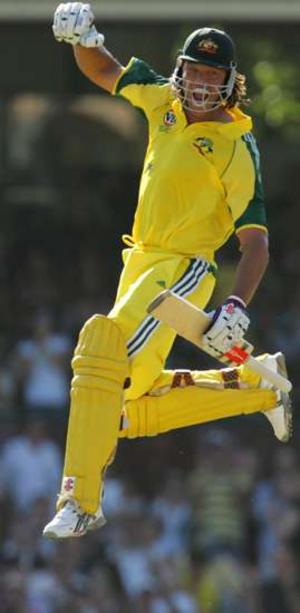
by Alex Brown SMH
For broken records, controversy and all-round intrigue, the Australians' effort against the Sri Lankans yesterday is unsurpassed, rebounding from a seemingly dire predicament at 3-10 to score their highest limited-overs total, 5-368, record a thumping 167-run victory and enforce a third and deciding final at the Gabba tomorrow.
Adam Gilchrist, for one, was enthused by the performance. "I think from the position we were in it's got to be one of the greatest comebacks and most dominating wins ever," he said.
To achieve that, Andrew Symonds and Ricky Ponting combined for the highest partnership by an Australian pair (237) and ensured that Muttiah Muralitharan, who bamboozled the home side in Adelaide on Friday night, returned the worst 10-over figures in the history of limited-overs cricket (0-99). A bloody end to what was almost certainly Muralitharan's last match at the SCG.
"[It was] one of the best batting displays we've ever witnessed," Ponting said. "I said to Andrew on the way in that those sort of things don't happen every day in this game … especially after getting off to the start we did."
The Australian innings was not without its share of controversy, most notably when Mahela Jayawardene claimed to catch Ponting at gully, only for the Australian captain to stand his ground and be subsequently ruled not out.
Replays were inconclusive as to whether the ball bounced before Jayawardene. However, the Sri Lankans were visibly upset at Ponting's decision to stand his ground, and umpire Peter Parker's decision to rule him not out. Jayawardene, however, eventually apologised to Ponting, who was on 57 at the time and went on to post a breathtaking 124 from 127 deliveries; his 19th one-day international century.
Not to be outdone, Symonds also produced an innings of tremendous power, recording his first one-day century on Australian soil and his second-highest limited-overs total. At the conclusion of his innings he had totalled 151, which included 13 boundaries and three sixes over 127 deliveries.
The efforts of Symonds and Ponting overshadowed the late-innings feats of Michael Clarke and Michael Hussey, although both were vital in steering Australia to their record total. Clarke blasted six boundaries to post an unbeaten 54 from 28 deliveries, while Hussey finished with 23 not out from just eight balls - half the deliveries he faced either travelling to, or over, the rope. Such precise, heavy hitting ensured the early failures of openers Adam Gilchrist (0) and Simon Katich (1) and Damien Martyn (8) were all but forgotten.
After Sri Lanka's veteran paceman Chaminda Vaas (4-56) removed those three batsmen within his first two overs - including Gilchrist to the second ball of the game - Australia seemed in danger of losing the match, and the finals series, in quick time.
Enter Ponting and Symonds. United at the crease with Australia reeling at 3-10, the Australian duo adopted a positive approach from the start of their innings. Ponting, the Allan Border medallist, was in particularly menacing form early, while Symonds, after a more watchful start, also found his rhythm.
The Queensland all-rounder, who would have been Australian one-day player of the year if not for his infamous drinking binge in Cardiff last year, celebrated enthusiastically upon reaching his 150, standing mid-pitch with arms raised triumphantly.
"I'll remember that forever - till I'm senile, probably," Symonds quipped. "You couldn't punch the smile off my face tonight."
Faced with such an imposing total, the Sri Lankans were never in the chase. Nathan Bracken (4-30) removed dangermen Sanath Jayasuriya (0) and Kumar Sangakkara (13) early, and Symonds continued his sensational outing by also claiming a pair of wickets.
"It's not going to be hard [to rebound] at all," said Sri Lanka's coach Tom Moody, throwing forward to tomorrow night's decider. "We've done it all series."
SCOREBOARD
At the SCG
AUSTRALIA Runs (Balls)
A GILCHRIST c Dilshan b Vaas 0 (2)
S KATICH lbw b Vaas 1 (5)
R PONTING c Vaas b Perera 124 (127)
D MARTYN c Jayawardene b Vaas 8 (5)
A SYMONDS lbw b Vaas 151 (127)
M CLARKE not out 54 (28)
M HUSSEY not out 23 (8)
Sundries (1lb 4w 2nb) 7
Five wickets for 368
Fall: 0 2 10 247 320.
Bowling: C Vaas 10-0-56-4 (1nb), R Perera 10-1-72-1 (2w), N Kulasekera 5-0-41-0, M Muralitharan 10-0-99-0 (1nb), T Dilshan 2-0-10-0, S Jayasuriya 8-0-52-0 (1w), M Bandara 5-0-37-0 (1w).
Batting time: 227 mins. Overs: 50.
SRI LANKA Runs (Balls)
M ATAPATTU c Gilchrist b Clark 24 (35)
S JAYASURIYA c Lee b Bracken 0 (6)
K SANGAKKARA b Bracken 13 (13)
M JAYAWARDENE b Hogg 50 (48)
R ARNOLD not out 64 (62)
T DILSHAN c Ponting b Symonds 13 (14)
C KAPUGEDERA run out 1 (3)
C VAAS c Clarke b Hogg 0 (6)
M BANDARA c Clark b Symonds 0 (6)
M MURALITHARAN c Lewis b Bracken 27 (24)
R PERERA c Ponting b Bracken 0 (2)
Sundries (4lb 2w 3nb) 9
Total 201
Fall: 4 26 74 116 139 145 146 147 200 201.
Bowling: B Lee 8-0-42-0 (3nb 1w), N Bracken 6-0-30-4 (1w), S Clark 5-0-28-1, M Lewis 5-0-30-0, A Symonds 5-1-32-2, B Hogg 7-0-35-2.
Batting time: 166 mins. Overs: 36.
Result: Australia won by 167 runs.
Best of three series locked 1-1.

Robot goes missing
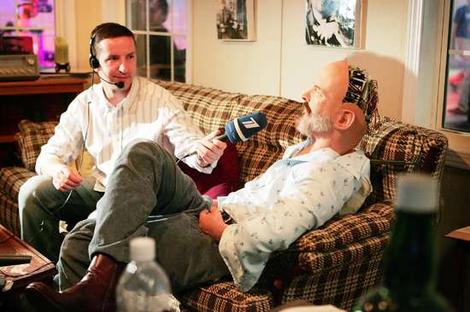
Philip K Dick is missing.
Not the American science fiction writer whose novels spawned hit films such as Blade Runner and Total Recall -- he died more than 20 years ago -- but a state-of-the-art robot named after the author.
The quirky android, was lost in early January while en route to California by commercial airliner.
"We can't find Phil," said Steve Prilliman of Dallas-based Hanson Robotics, which created the futuristic robot with the FedEx Institute of Technology at the University of Memphis, the Automation and Robotics Research Institute at the University of Texas at Arlington and Dick's friend Paul Williams.
"We're very worried because it's been a few weeks now," said Prilliman. "We're pressing hard to find Phil."
Robotics wizard and lead designer David Hanson built the robot as a memorial to Dick, whose 1968 book Do Androids Dream of Electric Sheep? inspired the 1982 classic Blade Runner starring Harrison Ford.
Short stories by Dick, who died in 1982, served as inspiration for other hit films including the 1990 Total Recall, starring Arnold Schwarzenegger, and the 2002 Minority Report, starring Tom Cruise.
In Blade Runner, set in a Los Angeles of 2019, Harrison Ford plays Rick Deckhard, a Blade Runner or policeman whose job is to track down and terminate escaped human clones known as "replicants."
The irony of the situation -- a missing replica of the very author who championed "replicant" freedom -- is not lost on Phil's creators.
But they still want him back.
"We really need to find him soon because the Smithsonian wants to put him in a travelling collection in the autumn," said Prilliman referring to Washington's Smithsonian Institute, an organisation of museums and art galleries.
Along with an eerie likeness to the author, the robot features award-winning artificial intelligence that mimics the writer's mannerisms and lifelike skin material to affect realistic expressions.
Top-of-the-line voice software loaded with data from Dick's vast body of writing allows the robot to carry on natural-sounding conversations, although it does come off as a bit doddering at times.
Biometric-identification software and advanced machine vision allows the robot to recognise people -- even in a crowd -- read their expressions and body language and talk to them sounding a lot like a normal, albeit slightly senile, author who likes to quote his own books when he gets confused.
Prilliman and others close to Phil baulked at giving too many details about his disappearance including the name of the airline that was transporting the robot when he went missing.
Hanson officials said news of Phil's disappearance could hamper the ongoing investigation and search for the robot.
The company officials said they feared ransom demands might be made or Phil could turn up listed for sale on an internet auction house such as eBay.
A spokeswoman, Elaine Hanson, said the company is considering building a new android if the original Phil does not turn up.
AFP
Wednesday, February 01, 2006
Remote Control Robot (SWORDS)
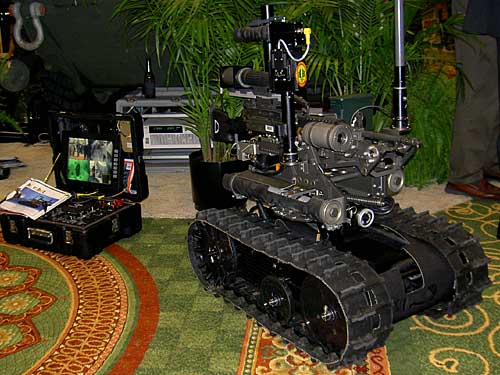



SWORDS (Special Weapons Observation Reconnaissance Detection Systems)
These robots are poised be the first working robots that are actually designed to break Isaac Asimov's First Law of Robotics:
"A robot may not injure a human being, or through inaction, allow a human being to come to harm."
The TALON robot can be reconfigured in the field by operators using simple pin mounted components and plug-and-play subsystems. To date, over 80 different payloads have been developed or adapted and mounted on the TALON robot platform including the following lethal and non-lethal payloads:
Gripper manipulator.
Smoke dropping module.
Grenade dropping module.
Breaching tool.
Gen III night vision camera.
NBC sensors.
UXO/countermine systems/sensors.
Anti-Tank (AT4) launcher.
Light Anti-Tank Weapon (LAW) launcher.
40-mm grenade launcher (M203 barrel).
12-gauge shotgun.
Mounts for remotely controlled weapons including: M240; M249: M16; M82A1 (50-cal).
A smaller version of the TALON robot is available for reconnaissance missions where a low profile platform is required for stealth. Another version is used for underwater missions including inspection of the surf zone and countermine operations. TALON robots have been used in Special Operations missions including EOD and reconnaissance operations in Bosnia, Afghanistan and Iraq.
According to Bob Quinn, general manager of Talon robots for Foster-Miller, Inc., this control system may be replaced with a "Gameboy" type of controller hooked up to virtual reality goggles.
Repliee Q2 (human-like robot)

February 1, 2006 SMH
Students of Hiroshi Ishiguro will struggle to tell their teacher from his robotic doppelganger, writes Deborah Smith.
Travelling long distances to meetings and conferences will soon be a thing of the past for Professor Hiroshi Ishiguro, the creator of the world's most human-like robot - a female named Repliee Q2. Ishiguro, of Osaka University, is close to finishing an even more advanced robot - a male, this time - that will be a physical replica of himself.
"I will not need to come here again," he told a conference in Sydney earlier this week. "I will send my android instead."
The busy Japanese scientist expects his $500,000 lookalike will prove most valuable for avoiding the regular trips to see his research students at the ATR Intelligent Robotics and Communication Laboratories in Kyoto, an hour's drive away from his Osaka office.
Its lifelike presence will keep his researchers on their toes during teleconferences, he hopes. "If they feel my authority with my android there, it will be good," he told the Herald.
Hollywood's robotic creations usually have hard, metallic shells. But people prefer human-like machines with soft skin, Ishiguro says. "They don't like to spend time with a robot-like robot."
He predicts that as lifelike androids become cheaper and more sophisticated, some of their first uses will be as companions for the elderly and as guides for people in railways stations or museums. Replacements for models draped over cars at motor shows is another possible early application, he says. "Then you don't need to hire beautiful women."
He thinks other busy people, apart from himself, will also be attracted to the idea of a stand-in android to do the travelling for them.
Ishiguro was covered from top to toe in a plaster cast and precise measurements of his skull were taken to ensure his new robot, which he expects to be completed within a few months, would resemble him as closely as possible.
The first robot he made in this way was a copy of his five-year-old daughter. It looked like her, but its unsophisticated facial and body movements gave it an unnatural presence, like a "moving corpse".
Young children are particularly sensitive to the appearance of the robots and his daughter was very nervous meeting her spooky double, says Ishiguro, who is attending the International Conference on Intelligent User Interfaces at the Powerhouse Museum and University of Technology, Sydney.
Repliee Q2, which has a soft silicone skin, was unveiled in June at the 2005 World Exposition in Japan and is a copy of a Japanese television presenter. The robot's bigger size meant much more hardware could be inserted, making sophisticated movement possible.
It has to remain seated, but with more than 30 degrees of freedom in its upper body and lots of internal sensors, it reacts to being touched in a much more human-like manner than the child robot. Powered by an air compressor, it gestures, blinks, shifts its eyes naturally and its face and lips move in time with its speech.
Ishiguro says one of the most important aspects of building a lifelike robot is to make it appear to breathe and have it shift position slightly. "When you are sitting you never stop moving," he says.
Repliee Q2 cannot fool anyone for long. But the team's research shows that even when people know it is a robot they unconsciously react to it as if it were human, for example, by averting their gaze when it asks a question, to signal they are thinking of the answer.
Ishiguro says matching lip movement to the speech is also critical to avoid a spooky-looking android. For this reason he thinks some of the first models off the production line will be English speakers.
Japanese requires a lot of lip movement, he says. "And it's very hard for the android."
Saturday, January 28, 2006
Democracy, a faithful dog that bit Bush

Photo: AFP. The gun and the Koran ... Hamas supporters celebrate in the West Bank city of Nablus on Thursday.
Michael Gawenda
Herald Correspondent in Washington
January 28, 2006
WITH his democracy project in the Middle East having produced a landslide victory for Hamas in the Palestinian elections, the US President, George Bush, is hoping Hamas will renounce terrorism and recognise Israel. But analysts agree the chances of this happening soon are remote.
Mr Bush's response to the result was surprisingly mild, even conciliatory. He pointedly avoided calling Hamas a terrorist organisation, leaving the door open for US contact with a Hamas government that recognised Israel and renounced violence. Bush officials, including the Secretary of State, Condoleezza Rice, will soon hold talks with European allies on a joint approach to the Hamas election victory.
The challenge will be to find a way of leaving the door open for Hamas to change its mind on terrorism and recognise Israel while making it clear that without such a change, the peace process and the so-called road map will be dead.
At a hurriedly organised press conference, Mr Bush avoided a direct answer to the question of whether Washington would refuse to deal with a Palestinian government dominated by Hamas, saying "peace is never dead because people want peace".
He said the election had reminded people of "the power of democracy" and, in a reference to the alleged corruption that had characterised the previous government, he said the result was a wake-up call for Fatah and for the Palestinian President, Mahmoud Abbas.
"Obviously people were not happy with the status quo," he said. "The people are demanding honest government. The people want services. And so the elections should open the eyes of the old guard there in the Palestinian territories."
But Mr Bush said as long as Hamas was committed to the destruction of Israel, no Hamas government, not even a democratically elected one, could be part of a peace process.
"We will watch very carefully about the formation of a government, but I will continue to remind people if your platform is the destruction of Israel, it means you're not a partner in peace, and we're interested in peace."
Martin Indyk, the Australian-born and educated former US ambassador to Israel during the Clinton administration, said the result of the Palestinian elections placed a big question mark over Mr Bush's foreign policy of spreading democracy. "Democracy has produced a Hamas victory and it may well have ended the peace process," he said.
Dr Rice left the door open for recognition, saying: "Anyone who wants to govern and do so with the support of the international community has got to be committed to a two-state solution and must be committed to Israel's right to exist."
Her challenge in the weeks leading to the Israeli poll in March will be to maintain the united front between the US and Europe on the need for Hamas to recognise Israel and renounce violence.
Sunday, January 22, 2006

Tuesday, January 17, 2006
The Revenge of Gaia
By James Button,
Herald Correspondent in London
January 17, 2006
Herald Correspondent in London
January 17, 2006
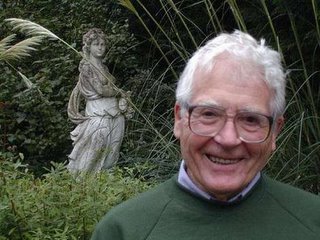
Doomsayer … James Lovelock says billions will die.
Photo: Environmentalists For Nuclear Energy
THE world has already passed the point of no return on global warming, and efforts to slow it may already be doomed, one of Britain's best-known environmentalists says.
In what The Independent described as the bleakest assessment yet of the effects of climate change by a leading scientist, Professor James Lovelock said billions would die by the end of the century, and civilisation as it is known would be unlikely to survive.
"The few breeding pairs of people that survive will be in the Arctic, where the climate remains tolerable," Professor Lovelock wrote in the newspaper.
Professor Lovelock, who in the 1970s coined the Gaia thesis that the Earth was a single organism, called on governments to start making preparations for a "hell of a climate," in which by 2100 Europe and southern Australia would be 8 degrees hotter than they are today.
The scientist makes his predictions in a new book, The Revenge of Gaia, which argues that the feedback mechanisms that used to keep the Earth cooler than it would otherwise be are now working to amplify warming caused by human CO 2 emissions.
"Sadly I cannot see the United States or the economies of China and India cutting back in time and they are the main source of CO 2 emissions."
Professor Lovelock is a controversial but respected scientist who gave a briefing on global warming in 1989 to the then prime minister, Margaret Thatcher. Two years ago he caused a furore in the environment movement by urging greens to embrace nuclear power to reduce global warming gases.
Monday, January 16, 2006
Name your poison
Julie Robotham
January 13, 2006
It's so practical it couldn't possibly happen here.Canadian doctors have completed a controlled experiment to give alcohol-addicted homeless people limited quantities of grog while they are at a shelter. The aim was to see whether it reduced dangerous binges and crime and kept them out of the emergency department or the clutches of the law.And it worked! 17 long-term alcoholics, mostly middle-aged men in Ottawa, were allowed alcohol on demand, up to 140 millilitres of wine or 90ml of sherry hourly between 7am and 10pm.
After five months to two years in the program, they halved on average the frequency with which they had to be taken to hospital, and police reports were also well down for all but two of the participants.Their alcohol intake was also reduced, from an average 46 drinks daily (give or take - most used to drink until they passed out) before going on the program to an average eight drinks, according to the report in the Canadian Medical Association Journal. A couple of them even detoxified after stabilising their intake on the program, a "formidable achievement" as Tina Podymow and Jeff Turnbull point out with justifiable proudness.Naturally, it's attracted some envy. "I believe the taxpayers (including myself) have paid for this wine," wrote hard-up student Yury Monczak to the journal's e-letters section. "If all citizens are equal in Canada, please let me know where I can sign up to participate in this program and get my free daily wine and sherry doses."And it won't go down well with abstinence-based organisations such as the Salvos.But it's a logical extension of harm-reduction programs in other addictions, such as methadone prescribing for heroin addiction. Odd, then, that it's never been tried before. Guess there's a different type of stigma around alcohol.
January 13, 2006
It's so practical it couldn't possibly happen here.Canadian doctors have completed a controlled experiment to give alcohol-addicted homeless people limited quantities of grog while they are at a shelter. The aim was to see whether it reduced dangerous binges and crime and kept them out of the emergency department or the clutches of the law.And it worked! 17 long-term alcoholics, mostly middle-aged men in Ottawa, were allowed alcohol on demand, up to 140 millilitres of wine or 90ml of sherry hourly between 7am and 10pm.
After five months to two years in the program, they halved on average the frequency with which they had to be taken to hospital, and police reports were also well down for all but two of the participants.Their alcohol intake was also reduced, from an average 46 drinks daily (give or take - most used to drink until they passed out) before going on the program to an average eight drinks, according to the report in the Canadian Medical Association Journal. A couple of them even detoxified after stabilising their intake on the program, a "formidable achievement" as Tina Podymow and Jeff Turnbull point out with justifiable proudness.Naturally, it's attracted some envy. "I believe the taxpayers (including myself) have paid for this wine," wrote hard-up student Yury Monczak to the journal's e-letters section. "If all citizens are equal in Canada, please let me know where I can sign up to participate in this program and get my free daily wine and sherry doses."And it won't go down well with abstinence-based organisations such as the Salvos.But it's a logical extension of harm-reduction programs in other addictions, such as methadone prescribing for heroin addiction. Odd, then, that it's never been tried before. Guess there's a different type of stigma around alcohol.
Tuesday, January 10, 2006
Snuppy - cloned dog real
Cloners faked the theory, not the dog: inquiry January 10, 2006 SMH

Snuppy ... the first male dog cloned from adult cells by somatic nuclear cell transfer.
A team led by a once-heralded and now disgraced South Korean scientist faked two landmark papers on embryonic stem cells but did produce the world's first cloned dog, an investigation panel has found.
The panel at Seoul National University told reporters there was no data to support the papers produced by the team led by scientist Hwang Woo-suk.
The two papers were a 2004 report on producing the first cloned human embryos for research and a 2005 paper on producing the first embryonic tailored stem cells.
US Corruption of Language
Behind the US Government's corruption of language lies a far greater perversion,
writes Salman Rushdie.
10/1/2006
SMH
BEYOND any shadow of a doubt, the ugliest phrase to enter the English language last year was "extraordinary rendition". To those of us who love words, this phrase's brutalisation of meaning is an infallible signal of its intent to deceive.
"Extraordinary" is an ordinary enough adjective, but its sense is being stretched here to include more sinister meanings that your dictionary will not provide: secret; ruthless; and extrajudicial.
As for "rendition", the English language permits four meanings: a performance; a translation; a surrender - this meaning is now considered archaic; or an "act of rendering"; which leads us to the verb "to render" among whose 17 possible meanings you will not find "to kidnap and covertly deliver an individual or individuals for interrogation to an undisclosed address in an unspecified country where torture is permitted".
Language, too, has laws, and those laws tell us this new American usage is improper - a crime against the word. Every so often the habitual newspeak of politics throws up a term whose calculated blandness makes us shiver with fear - yes, and loathing.
"Clean words can mask dirty deeds," The New York Times columnist William Safire wrote in 1993, in response to the arrival of another such phrase, "ethnic cleansing".
"Final solution" is a further, even more horrible locution of this Orwellian, double-plus-ungood type. "Mortality response", a euphemism for death by killing that I first heard during the Vietnam War, is another. This is not a pedigree of which any newborn usage should be proud.
People use such phrases to avoid using others whose meaning would be problematically over-apparent. "Ethnic cleansing" and "final solution" were ways of avoiding the word "genocide", and to say "extraordinary rendition" is to reveal one's squeamishness about saying "the export of torture". However, as Cecily remarks in Oscar Wilde's The Importance of Being Earnest, "When I see a spade, I call it a spade", and what we have here is not simply a spade, it's a shovel - and it's shovelling a good deal of ordure.
Now that Senator John McCain has forced upon a reluctant White House his amendment putting the internationally accepted description of torture - "cruel, inhuman or degrading punishment" - into American law, in spite of energetic attempts by the Vice-President, Dick Cheney, to defeat it, the growing belief that the Bush Administration could be trying to get around the McCain amendment by the "rendition" of persons adjudged torture-worthy to less-delicately inclined countries merits closer scrutiny.
We are beginning to hear the names and stories of men seized and transported in this fashion: Maher Arar, a Canadian-Syrian, was captured by the CIA on his way to the US and taken via Jordan to Syria where, says his lawyer, he was "brutally physically tortured".
Khaled el-Masri, a German citizen of Kuwaiti-Lebanese origin, was kidnapped in Macedonia and taken for interrogation to Afghanistan, where he says he was repeatedly beaten. The Syrian-born Mohammed Haydar Zammar says he was grabbed in Morocco and then spent four years in a Syrian dungeon.
Lawsuits are under way. Lawyers for the plaintiffs suggest their clients were only a few of the victims, that in Afghanistan, Egypt, Syria and perhaps elsewhere the larger pattern of the extraordinary-rendition project is yet to be uncovered. Inquiries are under way in Canada, Germany, Italy and Switzerland.
The CIA's internal inquiry admits to "under 10" such cases, which to many ears sounds like another bit of double-talk. Tools are created to be used and it seems improbable, to say the least, that so politically risky and morally dubious a system would be set up and then barely employed.
The US authorities have been taking a characteristically robust line on this issue. On her recent European trip, the Secretary of State, Condoleezza Rice, more or less told European governments to back off the issue - which they duly, and tamely, did, claiming to have been satisfied by her assurances.
At the end of December, the German Government ordered the closing of an Islamic centre near Munich after finding documents encouraging suicide attacks in Iraq. This is a club which, we are told, Khaled al-Masri often visited before being extraordinarily rendered to Afghanistan. "Aha!" we are encouraged to think. "Obvious bad guy. Render his sorry butt anywhere you like."
What is wrong with this kind of thinking is that, as Isabel Hilton of The Guardian wrote last July, "The delusion that officeholders know better than the law is an occupational hazard of the powerful and one to which those of an imperial cast of mind are especially prone … When disappearance became state practice across Latin America in the '70s it aroused revulsion in democratic countries, where it is a fundamental tenet of legitimate government that no state actor may detain - or kill - another human being without having to answer to the law."
In other words, the question isn't whether or not a given individual is "good" or "bad." The question is whether or not we are - whether or not our governments have dragged us into immorality by discarding due process of law, which is generally accorded to be second only to individual rights as the most important pillar of a free society.
The White House, however, plainly believes that it has public opinion behind it in this and other contentious matters such as secret wiretapping. Cheney recently told reporters, "When the American people look at this, they will understand and appreciate what we're doing and why we're doing it."
He may be right for the moment, though the controversy shows no signs of dying. It remains to be seen how long Americans are prepared to go on accepting that the end justifies practically any means Cheney cares to employ.
In the beginning is the word. Where one begins by corrupting language, worse corruptions swiftly follow. Sitting as the Supreme Court to rule on torture last month, Britain's law lords spoke to the world in words that were simple and clear. "The torturer is abhorred not because the information he produces may be unreliable," Lord Rodger of Earlsferry said, "but because of the barbaric means he uses to extract it."
"Torture is an unqualified evil," Lord Brown of Eaton-under-Heywood added. "It can never be justified. Rather, it must always be punished."
The dreadful probability is that the US outsourcing of torture will allow it to escape punishment. It will not allow it to escape moral obloquy.
Salman Rushdie is the author of The Satanic Verses, Fury and many other books.
writes Salman Rushdie.
10/1/2006
SMH
BEYOND any shadow of a doubt, the ugliest phrase to enter the English language last year was "extraordinary rendition". To those of us who love words, this phrase's brutalisation of meaning is an infallible signal of its intent to deceive.
"Extraordinary" is an ordinary enough adjective, but its sense is being stretched here to include more sinister meanings that your dictionary will not provide: secret; ruthless; and extrajudicial.
As for "rendition", the English language permits four meanings: a performance; a translation; a surrender - this meaning is now considered archaic; or an "act of rendering"; which leads us to the verb "to render" among whose 17 possible meanings you will not find "to kidnap and covertly deliver an individual or individuals for interrogation to an undisclosed address in an unspecified country where torture is permitted".
Language, too, has laws, and those laws tell us this new American usage is improper - a crime against the word. Every so often the habitual newspeak of politics throws up a term whose calculated blandness makes us shiver with fear - yes, and loathing.
"Clean words can mask dirty deeds," The New York Times columnist William Safire wrote in 1993, in response to the arrival of another such phrase, "ethnic cleansing".
"Final solution" is a further, even more horrible locution of this Orwellian, double-plus-ungood type. "Mortality response", a euphemism for death by killing that I first heard during the Vietnam War, is another. This is not a pedigree of which any newborn usage should be proud.
People use such phrases to avoid using others whose meaning would be problematically over-apparent. "Ethnic cleansing" and "final solution" were ways of avoiding the word "genocide", and to say "extraordinary rendition" is to reveal one's squeamishness about saying "the export of torture". However, as Cecily remarks in Oscar Wilde's The Importance of Being Earnest, "When I see a spade, I call it a spade", and what we have here is not simply a spade, it's a shovel - and it's shovelling a good deal of ordure.
Now that Senator John McCain has forced upon a reluctant White House his amendment putting the internationally accepted description of torture - "cruel, inhuman or degrading punishment" - into American law, in spite of energetic attempts by the Vice-President, Dick Cheney, to defeat it, the growing belief that the Bush Administration could be trying to get around the McCain amendment by the "rendition" of persons adjudged torture-worthy to less-delicately inclined countries merits closer scrutiny.
We are beginning to hear the names and stories of men seized and transported in this fashion: Maher Arar, a Canadian-Syrian, was captured by the CIA on his way to the US and taken via Jordan to Syria where, says his lawyer, he was "brutally physically tortured".
Khaled el-Masri, a German citizen of Kuwaiti-Lebanese origin, was kidnapped in Macedonia and taken for interrogation to Afghanistan, where he says he was repeatedly beaten. The Syrian-born Mohammed Haydar Zammar says he was grabbed in Morocco and then spent four years in a Syrian dungeon.
Lawsuits are under way. Lawyers for the plaintiffs suggest their clients were only a few of the victims, that in Afghanistan, Egypt, Syria and perhaps elsewhere the larger pattern of the extraordinary-rendition project is yet to be uncovered. Inquiries are under way in Canada, Germany, Italy and Switzerland.
The CIA's internal inquiry admits to "under 10" such cases, which to many ears sounds like another bit of double-talk. Tools are created to be used and it seems improbable, to say the least, that so politically risky and morally dubious a system would be set up and then barely employed.
The US authorities have been taking a characteristically robust line on this issue. On her recent European trip, the Secretary of State, Condoleezza Rice, more or less told European governments to back off the issue - which they duly, and tamely, did, claiming to have been satisfied by her assurances.
At the end of December, the German Government ordered the closing of an Islamic centre near Munich after finding documents encouraging suicide attacks in Iraq. This is a club which, we are told, Khaled al-Masri often visited before being extraordinarily rendered to Afghanistan. "Aha!" we are encouraged to think. "Obvious bad guy. Render his sorry butt anywhere you like."
What is wrong with this kind of thinking is that, as Isabel Hilton of The Guardian wrote last July, "The delusion that officeholders know better than the law is an occupational hazard of the powerful and one to which those of an imperial cast of mind are especially prone … When disappearance became state practice across Latin America in the '70s it aroused revulsion in democratic countries, where it is a fundamental tenet of legitimate government that no state actor may detain - or kill - another human being without having to answer to the law."
In other words, the question isn't whether or not a given individual is "good" or "bad." The question is whether or not we are - whether or not our governments have dragged us into immorality by discarding due process of law, which is generally accorded to be second only to individual rights as the most important pillar of a free society.
The White House, however, plainly believes that it has public opinion behind it in this and other contentious matters such as secret wiretapping. Cheney recently told reporters, "When the American people look at this, they will understand and appreciate what we're doing and why we're doing it."
He may be right for the moment, though the controversy shows no signs of dying. It remains to be seen how long Americans are prepared to go on accepting that the end justifies practically any means Cheney cares to employ.
In the beginning is the word. Where one begins by corrupting language, worse corruptions swiftly follow. Sitting as the Supreme Court to rule on torture last month, Britain's law lords spoke to the world in words that were simple and clear. "The torturer is abhorred not because the information he produces may be unreliable," Lord Rodger of Earlsferry said, "but because of the barbaric means he uses to extract it."
"Torture is an unqualified evil," Lord Brown of Eaton-under-Heywood added. "It can never be justified. Rather, it must always be punished."
The dreadful probability is that the US outsourcing of torture will allow it to escape punishment. It will not allow it to escape moral obloquy.
Salman Rushdie is the author of The Satanic Verses, Fury and many other books.
Saturday, January 07, 2006
Rugby Larger
Code's been in last-chance saloon plenty of times, but scandals keep coming
May 21, 2004 SMH
Despite official condemnation, rugby league still has a serious drinking problem that is damaging the sport's image. Darren Walton reports.
If the situation wasn't so serious, you could say it was enough to drive rugby league bosses to drink. But right now is not the time to be making jokes.
Mark Gasnier's obscene phone call scandal is the latest in a long, long line of alcohol-related public relations disasters for the code. Given that Gasnier's offensive phone call followed a NSW State of Origin team drinking session on the very same night the NRL launched a $1 million forum into players' behaviour towards women, it can be argued that his regrettable act might well be the dumbest of all of league's alcohol-fuelled social faux pas.
And there's been a lot since the foundation of the NRL in 1998, almost all of them the dubious results of team bonding sessions.
It seems the NRL and the ARL have lurched from one boozy calamity to another ever since Julian O'Neill defecated in the shoe of a teammate and made a mess of a Dubbo motel room in March, 1999.
That was the same O'Neill who was once ejected from Jupiters Casino on the Gold Coast for urinating under a gaming table . . . while drunk, of course.
The same week O'Neill couldn't find a toilet in Dubbo, four North Sydney players were embroiled in their own alcohol-inspired mischief on another pre-season tour in Wagga Wagga.
A month later, Australian hooker Craig Gower exposed himself to a female Irish tourist at the Coogee Bay Hotel following - you guessed it - a bonding session, for the Test team.
The same week, Brad Fittler was discovered heavily intoxicated outside a Sydney police station after a big night out.
One police source at the time described him as "the drunkest human being ever". Whether he was or not, one thing is indisputable is this: he was drunk and he was to be named Australian captain 24 hours later.
At the time, Nick Politis - the chairman of Fittler's Sydney Roosters - called for an alcohol ban across the code. The ban never eventuated and the problems continued.
If it wasn't John Hopoate turning up intoxicated to Manly training (1999), it was St George Illawarra forward Lance Thompson at the Dragons (2004) - or someone else.
There have been countless other drinking indiscretions in between. League officials could be forgiven for thinking they had documented enough of the dangers of its players drinking excessively on a team bonding session, although some observers might say such a stance was naive. The league might have learned after Chris Walker's exploits while breaking curfew at a Queensland State of Origin camp last month.
Capsicum spray was needed to rein in an intoxicated Walker in the early hours in Brisbane. He was later charged with assaulting police, obstructing police and being a public nuisance. Walker put his hand up, apologised and vowed to stay off the drink for the rest of the season.
In the wake of the latest incident, the Queensland players - sans Walker, who was sacked by the Maroons - will spend the next two evenings at their Gold Coast hinterland base some 20 km away from any major nightspots.
The Queenslanders will play cricket and golf and train, and probably drink and be merry - but they will only bother themselves. Maybe other clubs and players should also take the hint.
May 21, 2004 SMH
Despite official condemnation, rugby league still has a serious drinking problem that is damaging the sport's image. Darren Walton reports.
If the situation wasn't so serious, you could say it was enough to drive rugby league bosses to drink. But right now is not the time to be making jokes.
Mark Gasnier's obscene phone call scandal is the latest in a long, long line of alcohol-related public relations disasters for the code. Given that Gasnier's offensive phone call followed a NSW State of Origin team drinking session on the very same night the NRL launched a $1 million forum into players' behaviour towards women, it can be argued that his regrettable act might well be the dumbest of all of league's alcohol-fuelled social faux pas.
And there's been a lot since the foundation of the NRL in 1998, almost all of them the dubious results of team bonding sessions.
It seems the NRL and the ARL have lurched from one boozy calamity to another ever since Julian O'Neill defecated in the shoe of a teammate and made a mess of a Dubbo motel room in March, 1999.
That was the same O'Neill who was once ejected from Jupiters Casino on the Gold Coast for urinating under a gaming table . . . while drunk, of course.
The same week O'Neill couldn't find a toilet in Dubbo, four North Sydney players were embroiled in their own alcohol-inspired mischief on another pre-season tour in Wagga Wagga.
A month later, Australian hooker Craig Gower exposed himself to a female Irish tourist at the Coogee Bay Hotel following - you guessed it - a bonding session, for the Test team.
The same week, Brad Fittler was discovered heavily intoxicated outside a Sydney police station after a big night out.
One police source at the time described him as "the drunkest human being ever". Whether he was or not, one thing is indisputable is this: he was drunk and he was to be named Australian captain 24 hours later.
At the time, Nick Politis - the chairman of Fittler's Sydney Roosters - called for an alcohol ban across the code. The ban never eventuated and the problems continued.
If it wasn't John Hopoate turning up intoxicated to Manly training (1999), it was St George Illawarra forward Lance Thompson at the Dragons (2004) - or someone else.
There have been countless other drinking indiscretions in between. League officials could be forgiven for thinking they had documented enough of the dangers of its players drinking excessively on a team bonding session, although some observers might say such a stance was naive. The league might have learned after Chris Walker's exploits while breaking curfew at a Queensland State of Origin camp last month.
Capsicum spray was needed to rein in an intoxicated Walker in the early hours in Brisbane. He was later charged with assaulting police, obstructing police and being a public nuisance. Walker put his hand up, apologised and vowed to stay off the drink for the rest of the season.
In the wake of the latest incident, the Queensland players - sans Walker, who was sacked by the Maroons - will spend the next two evenings at their Gold Coast hinterland base some 20 km away from any major nightspots.
The Queenslanders will play cricket and golf and train, and probably drink and be merry - but they will only bother themselves. Maybe other clubs and players should also take the hint.
Wednesday, December 28, 2005
A matchless style
By Paul Barry
December 28, 2005 SMH
Illustration: Rocco Fazzari
AUSTRALIA will never be quite the same again. He shaped this country's television, transformed cricket around the world and rampaged through corporate and political Australia in a style that none will ever match.
Politicians and ministers quailed at his call. Rival businessmen wilted under his attack.
On the racetrack, bookies trembled at his approach, while casinos either closed their doors or rubbed their hands with glee.
Kerry Packer was Australia's richest man, perhaps the world's biggest gambler and a huge and dominating presence for 30 years. Whatever he did, he did it large and loud, without apology.
Employees at Channel Nine and rivals in TV spoke of him as the rudest and most frightening man they ever met - they didn't know his father, Sir Frank - yet he also commanded huge loyalty and affection. Though brutal, he could also be charming, polite and extraordinarily generous. Like his father before him, he was an enigma: a man of moods and contradictions, often isolated, lonely and unhappy.
Kerry Packer was one of the most powerful people in Australia, and here's why: he was a billionaire, which was a good start; he owned the nation's top TV network and a stable of magazines, which was even better; and he was extremely smart and negotiated well, which guaranteed he made the most of his advantages. But most of all, he was a terrifying man to say no to.
Face to face, he was quite formidable. Put simply, he inspired fear.
Unlike Rupert Murdoch, Packer very rarely used his magazines, newspapers or TV stations to attack governments. As a general rule, he did not tell his journalists whom to attack, whom to support or what to write.
Yet successive governments, including the current one, were so worried about what he or his media outlets might do that they rushed to give Packer what he wanted, almost before he asked.
The decision in 1986 by the Hawke government to permit TV companies to own networks across Australia more than doubled the value of Packer's Sydney and Melbourne Channel Nine stations, and allowed him to sell to Alan Bond for $1 billion.
The restrictions imposed on pay TV by the Keating government in 1992 were similarly slanted in favour of the big man. And the Howard Government was no better. Its 1999 decision to guarantee the commercial TV networks a monopoly until 2007 benefited the Packers enormously.
For two decades and more, politicians came running when Packer called. And if he wielded more power than is healthy, it was because governments let him do so. Even prime ministers went out of their way to be nice to him.
When Packer sold Channel Nine to Bond in 1987, the program makers organised a testimonial video for their departing boss. All the stars joined in to sing his praises. But the real star was Bob Hawke, who introduced the proceedings from his garden at Kirribilli House.
Straight to camera, one powerful man to another, he gave the big man a ringing personal endorsement: "G'day, Kerry, I don't think anyone has made a greater contribution to television news and current affairs than you."
He followed up with a heartfelt homily on Packer's treatment at the Costigan royal commission, in which Packer had been famously accused of involvement in organised crime, drug smuggling and even murder, under the code name "the Goanna".
"I don't think any figure in Australia has had to bear such a burden as Kerry Packer," said Hawke, "with the unjustified innuendos, slanders, the malicious gossip.
"And it was all untrue. Loyalty is a two-way thing, Kerry. You've certainly given it to your people. I hope you feel that all of them and all of your friends have stuck by you. You deserve it."
Far more recently, John Howard has publicly defended Packer's meagre tax-paying record, when he could just as easily have attacked it, showering praise on Packer's generosity to charity and his record as a good corporate citizen.
Bob Carr has also joined the queue of homage-payers, telling The Daily Telegraph while premier of NSW that it was vital for the economy that Packer recovered from a health scare.
In business Packer wielded huge power, bullying and threatening those who got in his way. Steve Cosser and John Gerahty, who ran Channel Ten in the early 1990s and tried to challenge Channel Nine's dominance of the TV market, were two who felt the full force of Packer's wrath.
Cosser remembers being told: "If you think there's no difference between being No.1 and No.2 in a f---ing two-station market, then you be f---ing No.2."
Gerahty was summoned to Packer's office to be treated to a tirade that had him still shaking months later. The big man's message was that Channel Ten should not compete against Packer's station and should not bid against Channel Nine for programs. But the style was even more shocking. According to Gerahty, Packer's manner was threatening and his language was coarse and abusive.
Packer's attitude to journalists was much the same, especially if they were writing about him or his business. He held most of them in contempt, along with politicians, and rarely talked to them. When he did do so, it was usually to complain that no one ever checked stories with him or asked for his opinion.
When I wrote The Rise and Rise of Kerry Packer in 1993, he threatened to "prosecute [me] with the utmost vigour" and warned me that he would also sue "any other person who has any involvement whatsoever in the production of the book and the provision of information to you".
He tried to ensure that employees and friends did not talk to me. But while some journalists who wrote about Packer ended up being sued personally, so that their houses were on the line, I escaped. I even ended up working for him.
Even though he insisted on his privacy, his media empire regularly dished the dirt on other people's private lives. But, to his credit, he was a key factor in making Channel Nine a leader in commercial news. 60 Minutes was Packer's baby, as was the more serious and upmarket Sunday.
Packer's talent in television and, to a lesser extent, in magazines, was to know what worked and to go for it. He hired the right people and inspired them to give him the best.
On a broader canvas, he did what rich men do. He showed great skill in turning a $100 million inheritance into an empire that is worth some $7 billion today. And he did so without succumbing to the excesses of the 1980s, or committing corporate crimes.
He also gave back. While he did not pump billions into a charitable foundation - as so many rich Americans have done - he did give millions of dollars to the Children's Hospital at Westmead and the Royal Prince Alfred Hospital in Sydney. And he helped many friends, and friends of friends, when they were in trouble.
But paying tax was another matter altogether. His policy, like that of his father before him, was to pay as little as possible and to employ an army of lawyers and accountants to find loopholes in the law.
In the 1970s, tax investigators were constantly on his tail and on more than one occasion he was forced to settle out of court to avoid the risk of prosecution. In the 1980s and 1990s the Tax Office's audit teams were also on his case.
The problems with Costigan - who was interested in large deliveries of cash to Packer - stemmed largely from tax schemes he engaged in to avoid paying his dues. As he famously told the nation in 1991 during the televised Senate inquiry into the media, only a fool paid more tax than he had to and he didn't think politicians were spending his money so well that he wanted to contribute more.
Packer's business empire is owned through a holding company in the Bahamas and ultimate control rests with a string of family trusts. The clear purpose of such arrangements is to keep tax payments to an absolute minimum. So much for the concerned corporate citizen.
Meanwhile, he spent big on having fun, or trying to. Hundreds of millions of dollars went on playing polo (building lavish facilities on three continents) and he gambled hundreds of millions more in casinos, racetracks and foreign-exchange markets.
At the Sydney spring carnival in 1987 he was reportedly $28 million down to the bookmaker Bruce McHugh on the last day of racing, then backed three successive winners to end up $2 million ahead. Two days later, a shaken McHugh walked into the Australian Jockey Club offices and handed in his bookmaker's licence.
Packer's worry when he took over the family business from his father was that he might lose his inheritance and take the Packers from shirtsleeves to shirtsleeves in three generations. But his worries were groundless. And there is no need to fret about his son, James, despite the One.Tel fiasco in which the Packers' public company, PBL, lost $400 million.
James may not have his father's uncanny instinct but he has a good team of people around him and has already taken the important (and successful) strategic decision to concentrate on casino and internet gaming. With Kerry gone, Channel Nine may be sold, but it was probably on the block anyway.
Sadly, no one was able to ask Kerry the question that was posed to Sir Frank Packer in his twilight years in a wonderfully grovelling interview on ABC TV in 1970. "Your father was a pioneer and you have become a legend," the great man was asked. "What is left for your sons to do?"
"Plenty" should have been the answer. And it might have been if Kerry had been asked it before his death.
There will be plenty more to come from James. I can't see him going off to grow vegetables. He may not be so much fun to watch. He may not spawn so many stories. His style is not so loud and brutal, thank heavens. But James is smart and tough and he has learnt at the feet of the master.
Betting man's advice: never risk the lot

By Kate McClymont
December 28, 2005 SMH
"MY FATHER was a gambler. Every man who ever created anything was a gambler," Kerry Packer once said. "I am also, but there's a difference … I've never risked the lot. I've never risked anything that's going to put Consolidated Press at risk."
While he became Australia's richest man with his successful gambling forays on the business field, Packer's activities at the track and in casinos around the world are legendary. And while he might have been careful not to risk it all, Packer was never averse to challenging others, whether casino operators or bookmakers, to risk their all to take him on.
There is the famous tale which has Packer ensconced in the high-roller suite at a Las Vegas casino with a big-talking American businessman. The loud American let it be known that he was worth some $US60 million ($82 million). Packer reputedly said nothing. Then, without raising his eyes from the table, said: "Toss you for it."
In The Rise and Rise of Kerry Packer, the author Paul Barry wrote: "As one of his executives put it, he gambles when he's bored, and he gambles often because he's often bored."
The months after Packer's billion-dollar sale of Channel Nine to Alan Bond must have severely tested the media magnate's boredom threshold. Two months later, in March 1987, Packer lost $19 million playing blackjack at the Ritz in London.
At Easter he was back in town for the Golden Slipper at Rosehill where it was alleged that Australia's richest man wagered $20 million in one day and finished the day $7 million worse off.
Sydney bookmaker Bruce McHugh hung up his bookie's satchel at the end of that autumn's racing after what observers described an an unprecedented betting duel with the media tycoon which was estimated to have topped $50 million in three days.
Packer's forays into the business of gaming were increasing at the time of his death. Publishing and Broadcasting Limited appeared to be looking to casinos and online gaming to provide future profits as free-to-air television revenue continued to slow. Already the owner of Melbourne's Crown Casino and Perth's Burswood Casino, PBL turned its attention to the potential riches to be reaped in Asia.
And another of Packer's gaming ventures appears finally set to fly. The Tasmanian Government recently announced it would grant Betfair Australia, a $60 million joint venture between PBL and the British company Betfair, the first Australian betting exchange licence.
With Packer's passing, it appears likely that James Packer will follow the money trail which leads towards Asian gamblers.
As he said recently: "I'd hate to be [Ten executive chairman] Nick Falloon. I'd be going to bed in a cold sweat each night … to have 100 per cent of your business in free-to-air TV, in one platform, in a platform which has enormous challenges. We don't have that problem.
"Nine is about 20 per cent of our business. In a perfect world Nine will grow, but its share of PBL earnings will decline and that is a happy outcome."
Man with his finger on the TV remote
By Stephen Gibbs
December 28, 2005 SMH
HE SITS, he glares, barely moving. All the televisions are turned on. To change the picture he can reach for the remote control, a telephone or a gun.
The best-known Packer anecdotes create this image of the billionaire-lizard: watching, waiting, wanting to strike when he does not like what he sees.
Told over decades, usually by former employees, they make a canon of colourful stories - a narrative stretching from his ancestry into the afterlife. They could be told because of the Packer motto: "Never complain, never explain" and Gordon French tells one of the best.
On the day of the Hilton hotel bombing in 1978 the Sydney program boss offered his view that security in Mr Packer's Park Street headquarters was not up to scratch. He asked what Mr Packer would do if someone came into his office intent upon doing him harm.
"Kerry opened his desk drawer, produced a big handgun and said 'I'd use this', or words to that effect," Mr French recalled last year. "He then leaned across the desk and pointed the gun at my head and added: 'Which is what I'll do to you if the ratings don't improve' and pulled the trigger."
All the best Packer anecdotes contribute to the picture of a man oblivious to outside interference, in supreme command. They show the ruthless exercise of wealth and power, but also spontaneous acts of wild generosity and a resignedly bleak outlook on life.
His policy of not personally replying to what was said about him in public means the apocryphal sits alongside fact. Most rumours of his gambling, and outrageous tipping, he let stand.
The Packer biographer Paul Barry has cited AJC betting turnover figures, and Mr Packer's attendance at the track, to estimate the billionaire staked $55 million during the autumn carnival at Royal Randwick in 1987.
The British gossip columnist Nigel Dempster reported in 1991 that Mr Packer had tipped croupiers at the Las Vegas Hilton $US50,000 each after a $7 million blackjack win. Four hostesses each scored $75,000 tips after a lucky Packer run at Jupiters on the Gold Coast in 1998.
A few anecdotes that go some way to explaining Mr Packer's behaviour, or creating his image, were told by Mr Packer himself.
The most famous is probably a story from his childhood retold in Barry's book The Rise and Rise of Kerry Packer. It tells of the Geelong Grammar student arriving home to Bellevue Hill for a summer holiday, having forgotten to pack his tennis racquet. Sir Frank sent him back on the train.
It suggests a terrible childhood and alludes to ingrained discipline but when Mr Packer told the story on television he made it sound humorous. Mr French reportedly laughed retelling the gun-to-the-head yarn, but when in Mr Packer's office that day his hands shook with fear.
In other anecdotes, Mr Packer wielded a phone like a gun. In 1992 he pulled Doug Mulray off air after watching dogs mating presented as entertainment on Australia's Naughtiest Home Videos.
December 28, 2005 SMH
HE SITS, he glares, barely moving. All the televisions are turned on. To change the picture he can reach for the remote control, a telephone or a gun.
The best-known Packer anecdotes create this image of the billionaire-lizard: watching, waiting, wanting to strike when he does not like what he sees.
Told over decades, usually by former employees, they make a canon of colourful stories - a narrative stretching from his ancestry into the afterlife. They could be told because of the Packer motto: "Never complain, never explain" and Gordon French tells one of the best.
On the day of the Hilton hotel bombing in 1978 the Sydney program boss offered his view that security in Mr Packer's Park Street headquarters was not up to scratch. He asked what Mr Packer would do if someone came into his office intent upon doing him harm.
"Kerry opened his desk drawer, produced a big handgun and said 'I'd use this', or words to that effect," Mr French recalled last year. "He then leaned across the desk and pointed the gun at my head and added: 'Which is what I'll do to you if the ratings don't improve' and pulled the trigger."
All the best Packer anecdotes contribute to the picture of a man oblivious to outside interference, in supreme command. They show the ruthless exercise of wealth and power, but also spontaneous acts of wild generosity and a resignedly bleak outlook on life.
His policy of not personally replying to what was said about him in public means the apocryphal sits alongside fact. Most rumours of his gambling, and outrageous tipping, he let stand.
The Packer biographer Paul Barry has cited AJC betting turnover figures, and Mr Packer's attendance at the track, to estimate the billionaire staked $55 million during the autumn carnival at Royal Randwick in 1987.
The British gossip columnist Nigel Dempster reported in 1991 that Mr Packer had tipped croupiers at the Las Vegas Hilton $US50,000 each after a $7 million blackjack win. Four hostesses each scored $75,000 tips after a lucky Packer run at Jupiters on the Gold Coast in 1998.
A few anecdotes that go some way to explaining Mr Packer's behaviour, or creating his image, were told by Mr Packer himself.
The most famous is probably a story from his childhood retold in Barry's book The Rise and Rise of Kerry Packer. It tells of the Geelong Grammar student arriving home to Bellevue Hill for a summer holiday, having forgotten to pack his tennis racquet. Sir Frank sent him back on the train.
It suggests a terrible childhood and alludes to ingrained discipline but when Mr Packer told the story on television he made it sound humorous. Mr French reportedly laughed retelling the gun-to-the-head yarn, but when in Mr Packer's office that day his hands shook with fear.
In other anecdotes, Mr Packer wielded a phone like a gun. In 1992 he pulled Doug Mulray off air after watching dogs mating presented as entertainment on Australia's Naughtiest Home Videos.
Saturday, December 24, 2005
Clint shares 96 percent of human DNA
Chimps, Humans 96 Percent the Same, Gene Study Finds
Stefan Lovgrenfor August 31, 2005
National Geographic news
Scientists have sequenced the genome of the chimpanzee and found that humans are 96 percent similar to the great ape species.
"Darwin wasn't just provocative in saying that we descend from the apes—he didn't go far enough," said Frans de Waal, a primate scientist at Emory University in Atlanta, Georgia. "We are apes in every way, from our long arms and tailless bodies to our habits and temperament."
Because chimpanzees are our closest living relatives, the chimp genome is the most useful key to understanding human biology and evolution, next to the human genome itself. The breakthrough will aid scientists in their mission to learn what sets us apart from other animals.
By comparing human and chimpanzee genomes, the researchers have identified several sequences of genetic code that differ between human and chimp. These sequences may hold the most promise for determining what creates human-specific traits such as speech.
"If people are asking what makes us human, they're not going to find a smoking gun [in this study]," said Evan Eichler, a genome scientist at the University of Washington in Seattle who was part of the research team. "But they're going to find suggestions for where to look."
The project was conducted by an international group of scientists called the Chimp Sequencing and Analysis Consortium. Sixty-seven researchers co-authored the study, which is detailed tomorrow in the journal Nature.
Genetic Blueprints
To map the chimp genome, researchers used DNA from the blood of a male common chimpanzee (Pan troglodytes) named Clint, who lived at the Yerkes National Primate Research Center in Atlanta. Clint died last year from heart failure at the relatively young age of 24.
A comparison of Clint's genetic blueprints with that of the human genome shows that our closest living relatives share 96 percent of our DNA. The number of genetic differences between humans and chimps is ten times smaller than that between mice and rats.
Scientists also discovered that some classes of genes are changing unusually quickly in both humans and chimpanzees, as compared with other mammals. These classes include genes involved in the perception of sound, transmission of nerve signals, and the production of sperm.
Despite the similarities in human and chimp genomes, the scientists identified some 40 million differences among the three billion DNA molecules, or nucleotides, in each genome.
The vast majority of those differences are not biologically significant, but researchers were able to identify a couple thousand differences that are potentially important to the evolution of the human lineage.
"The goal is to answer the basic question: What makes us humans?" said Eichler.
Eichler and his colleagues found that the human and chimp sequences differ by only 1.2 percent in terms of single-nucleotide changes to the genetic code.
But 2.7 percent of the genetic difference between humans and chimps are duplications, in which segments of genetic code are copied many times in the genome.
"If genetic code is a book, what we found is that entire pages of the book duplicated in one species but not the other," said Eichler. "This gives us some insight into the genetic diversity that's going on between chimp and human and identifies regions that contain genes that have undergone very rapid genomic changes."
Mutations
Humans and chimps originate from a common ancestor, and scientists believe they diverged some six million years ago.
Given this relatively short time since the split, it's likely that a few important mutations are responsible for the differences between the two species, according to Wen-Hsiung Li, a molecular evolutionist at the University of Chicago in Illinois.
"If you look at two species of frogs over 10 million years, you probably won't see a lot of the morphological or behavioral differences that you see between humans and chimps," said Li, who wrote an accompanying commentary on the chimp genome sequencing for Nature.
There are several hypotheses that account for the evolution of human traits. Li believes these traits come from changes in the parts of the genome that regulate other gene activity.
Scientists agree that many questions remain unanswered but the chimp genome provides important clues to understanding what makes us human.
"We're in a very nice intermediate stage of understanding human-chimp differences," said Eichler. "We can't say, This is the difference that makes us human, but we can say, These are the regions of the genome that show a lot of potential and are excellent candidates to do further work on."
Korea Stem Cell Fraud
To the shock of the South Korean nation, Hwang Woo Suk, the world renowned cloning pioneer, admitted to a colleague that his that the majority of his famous paper's data regarding human embryo cloning published in Science earlier this year was in fact "fake."
The journal Science, which has until now consistently supported Hwang in spite of the growing suspicions of the international media regarding the authenticity of the research paper published in May, have not yet publicly responded to today's events.
According to sources Prof. Hwang's confession verified the fact that actually nine of the 11 stem cells referred to in the paper did not actually exist, and were actually invented by Hwang himself with the knowledge of only three others in his laboratory.
According to reports by the media here, Hwang had ordered one of the junior scientists in his lab team to have three original stem cells and DNA fingerprint samples duplicated and then doctored so as to make it look like there were in fact 11 cells that were a success in their research.
All of Hwang's famous breakthroughs in cloning, such as the cloning of a calf in 1999, would come under serious questioning by the international science community.
The reason given by sources published in the media here, for Hwang's faking of data in the Science article, was that he felt pressurized by the science community to get results, since his team had used several hundred donated ova for the research.
In similar research done in 2004, Hwang had succeeded in creating only one successful cell line, despite having used over 200 ova, which lead to criticism overseas for his squandering such a valuable resources.
Other analysts point to the cost of the research to explain Hwang's actions. The South Korean government has invested more than $26 million in his stem cell project and any failure on the part of Hwang's team would have probably jeopardized future investment by the government.
The timing of Hwang's admission of fault to Roh after a month of silence, during which the suspicions of the international science community grew steadily, seemingly corresponds with the beginning of SNU's investigation of the pioneer cloning scientist's data and their request for Hwang to provide evidence of his research.
Another explanation for Hwang's confession today is the request made three days ago by one of his co-authors, Gerald Schatten of Pittsburgh University, to have his name removed from the article. Schatten explained in a letter to the scientific journal that he had received information from an unnamed source that much of the data used in the article had in fact been doctored.
ohmynews
Hwang Woo-suk drinks
Mixing 'Hwang Woo-suk' drinks
Korea Herald 24 dec 2005
A new drinking trend to substitute "poktanju" (bomb-shot) culture has surfaced during year-end celebrations among working people.
Dubbed the "Hwang Woo-suk poktanju," it involves creating 11 drinks and numbering them 2 to 12. Of these, all except No. 2 and 3 are made just with beer with an empty shot glass inside.
The "poktanju" or "bomb drink," is a mixed drink notoriously popular among Koreans, concocted with beer and a shot of whiskey or soju, intended to be drunk in one shot, to get the party started.
The new drinking trend, invented by Hwang-weary working people, is a parody of Professor Hwang's 11 stem cell lines of which all except for Nos. 2 and 3 are alleged to be faked. The empty shot glass represents the alleged "fakeness."
"While it is fun to engage in such parody, a part of us is in shock and disappointment over the allegations that Hwang's work may be fake," said a 40-year-old man.
The culture of drinking "poktanju" arose out of a desire for people to get drunk quickly and open up to each other away from the reserved atmosphere prevalent in Korean workplaces
Korea Herald 24 dec 2005
A new drinking trend to substitute "poktanju" (bomb-shot) culture has surfaced during year-end celebrations among working people.
Dubbed the "Hwang Woo-suk poktanju," it involves creating 11 drinks and numbering them 2 to 12. Of these, all except No. 2 and 3 are made just with beer with an empty shot glass inside.
The "poktanju" or "bomb drink," is a mixed drink notoriously popular among Koreans, concocted with beer and a shot of whiskey or soju, intended to be drunk in one shot, to get the party started.
The new drinking trend, invented by Hwang-weary working people, is a parody of Professor Hwang's 11 stem cell lines of which all except for Nos. 2 and 3 are alleged to be faked. The empty shot glass represents the alleged "fakeness."
"While it is fun to engage in such parody, a part of us is in shock and disappointment over the allegations that Hwang's work may be fake," said a 40-year-old man.
The culture of drinking "poktanju" arose out of a desire for people to get drunk quickly and open up to each other away from the reserved atmosphere prevalent in Korean workplaces
Friday, December 23, 2005

barbie torture
Why little girls like to torture Barbie
By Nick Foley in London
December 20, 2005 SMH
IF you've caught your daughter mutilating her Barbie doll, microwaving her, or decapitating her, don't be disturbed - your girl is perfectly normal.
Research published yesterday reveals that as girls grow up, they come to hate Barbie so much that many admit torturing and maiming the doll. The toy has become a "hate figure" among seven to 11-year-old girls, who regard Barbie as a "babyish" symbol of their earlier childhood.
Researchers from the University of Bath questioned 100 youngsters about their attitudes to a range of branded products and found the iconic doll provoked the strongest reaction.
"When we asked the groups of junior school children about Barbie, the doll provoked rejection, hatred and violence," said Agnes Nairn, who led the study. "The meaning of Barbie went beyond an expressed antipathy; actual physical violence and torture towards the doll was repeatedly reported, quite gleefully, across age, school and gender."
Dr Nairn said: "It's as though disavowing Barbie is a rite of passage and a rejection of their past.
"The types of mutilation .. range from removing the hair to decapitation, burning, breaking and even microwaving."
The study also found that while boys expressed feelings of nostalgia towards Action Man, girls' attitude to Barbie was hostile.
"The girls almost always talked about having a box full of Barbies," Dr Nairn said. "So, to them, Barbie has come to symbolise excess. Barbies are not special, they are disposable, and are thrown away and rejected."
By Nick Foley in London
December 20, 2005 SMH
IF you've caught your daughter mutilating her Barbie doll, microwaving her, or decapitating her, don't be disturbed - your girl is perfectly normal.
Research published yesterday reveals that as girls grow up, they come to hate Barbie so much that many admit torturing and maiming the doll. The toy has become a "hate figure" among seven to 11-year-old girls, who regard Barbie as a "babyish" symbol of their earlier childhood.
Researchers from the University of Bath questioned 100 youngsters about their attitudes to a range of branded products and found the iconic doll provoked the strongest reaction.
"When we asked the groups of junior school children about Barbie, the doll provoked rejection, hatred and violence," said Agnes Nairn, who led the study. "The meaning of Barbie went beyond an expressed antipathy; actual physical violence and torture towards the doll was repeatedly reported, quite gleefully, across age, school and gender."
Dr Nairn said: "It's as though disavowing Barbie is a rite of passage and a rejection of their past.
"The types of mutilation .. range from removing the hair to decapitation, burning, breaking and even microwaving."
The study also found that while boys expressed feelings of nostalgia towards Action Man, girls' attitude to Barbie was hostile.
"The girls almost always talked about having a box full of Barbies," Dr Nairn said. "So, to them, Barbie has come to symbolise excess. Barbies are not special, they are disposable, and are thrown away and rejected."
Barbie in the news
 Fulla has the Mid-East doll market covered
By Ed O'Loughlin Herald Correspondent in Jerusalem
December 23, 2005 SMH
Contrasting role models … Barbie and Fulla in Jerusalem this week. Photo: ED O'Loughlin
SHE is the must-have toy this festive season, flying off the shelves. But the season in question is Eid al-Adha next month, not Christmas. Santa Claus means nothing to her.
Fulla, the Muslim doll, is now thought to be the best-selling girl's toy in the Arab world, two years after she first came on the market, displacing her Western rival, Barbie, in shops across her native Levant.
With thick black hair and large dark eyes, Fulla is the physical antithesis of Mattel's blonde, empty-eyed icon of Western consumerism.
Compared with Barbie's improbably pneumatic curves and lanky legs, Fulla's assets are modest, and never officially on display. Although she is marketed with a range of funky clothes, furniture, jewellery and grooming equipment, to avoid offending Muslim modesty, she has no swimwear.
And when she steps outdoors, she hides beneath a white hijab scarf and modest ankle-length coat, or even an all-enveloping black abaya cloak. Like the little girls who play with her, Fulla must learn to lead a double life.
The rise of Fulla, who is skilfully marketed by her Syrian creators, New Boy Toys, has aroused mixed feelings across the Middle East.
Many Arab parents are happy to see a local girl take on and defeat the might of Western myth-making. But some worry that Barbie, with her independent lifestyle and wide range of jobs, is giving way to a new role model who hides her hair and figure and - judging from the slick adverts on Arabic satellite TV - has little to do but shop, hang out with her friends, Yasmeen (suspiciously blonde) and Nadia (a coppery redhead), or pray on her optional prayer mat.
As for romantic prospects, Fulla has no male friends at all, "though she might have angry brothers", as one joke has it.
Fulla's role in shaping expectations is undoubtedly a selling point for some conservative Muslim parents.
"Fulla is one of us but Barbie is still a stranger," says Mohammed al-Sabbagh, a manager at Space Toon, Damascus's leading toy store.
"Fulla is my sister, my wife, my mother. She comes from the same culture. The other thing for me, as a parent, is about what I want for my child. Barbie has a boyfriend and a bikini and so on, which is not our style in the Middle East."
Space Toon has recently been running a special promotion: buy one "outdoor" Fulla and get two cartons of Fulla spreadable processed cheese.
New Boy's Western-style aspirational TV advertising has created a profitable buzz among little girls across the region, who - like their Western counterparts - compete to be first in the playground with the latest spin-off product.
For the vast majority, questions of religion and modesty play no conscious role in their choice of toy. Yasmin Bakr, 7, who comes from a liberal, non-hijab-wearing family in the Palestinian town of Ramallah, has Barbie and Fulla dolls. But if she had to choose between them, she would hold on to Fulla.
"Because she's nice. She looks nice, everything. I like her face so much."
Both dolls are of very similar size and construction, and some are even manufactured by the same subcontractor in China.
So successful is the Fulla range, selling more than 1.3 million dolls at about $20 each, that it has already spawned a Chinese knock-off, Fulah, sold in near identical packaging.
Fulla's connection with Syria - still at war with Israel - prevents formal distribution in Israeli-controlled areas like East Jerusalem, although they can sometimes be found in toyshops there.
Across the city, the three toy stores in West Jerusalem's Malcha Mall do not sell Fulla dolls at all.
Subscribe to:
Posts (Atom)