September 25, 2006
The number of television sets has dwarfed the number of people in US households in the past two years, according to Nielsen Media Research.
"There are today 2.73 television sets versus 2.55 people in typical US households," said Gary Holmes, spokesman for Nielsen. "Somewhere between 2001 and 2004, the number of TVs outgrew the number of people."
He attributed that trend to the fact that television sets have become more affordable and to increasing diversity in programming.
"With the proliferation of television channels and programs, there is more desire for everyone in the house to have their own TV set," Holmes said.
He said half of US homes have three or more sets today, and a mere 19 per cent have one set. That is compared to 1975 when 57 per cent of households had one TV set and 11 per cent had three or more.
The increase in the number of television sets coincides with an increase in television viewing, which now stands at eight hours and 14 minutes a day per average household, a record high and a three-minute increase from the 2004-05 season.
The average amount of television watched by an individual viewer increased three minutes per day to four hours and 35 minutes, also a record, Nielsen said.
Holmes said another surprising finding was an increase in the amount of time teenagers, particularly girls, spent watching television.
AFP
Monday, September 25, 2006

Saturday, September 23, 2006
Swans into Grand Final

The Swans 19.13 (127) def Dockers 14.8. (92) to move into the Grand Final.
Barry Hall kicked 6 goals
O'Keefe kicked 4 goals
O'Loughlin also kicked 4 goals
Go Swans !!!!!!!!!!!!!!!!!!!!!!!!!!!!!
64 Foot Wave
Monster breaks off Tassie
September 22, 2006
SMH
Gale force winds have produced a massive 19.5-metre wave off the coast of Tasmania, according to surf forecasters.
The rogue wave was recorded about 9am (AEST) yesterday and is believed to be one of the largest ever measured in Australia, forecasters say.
Swellnet website forecaster Ben Matson said a waverider buoy located 10 kilometres from Cape Sorell, on Tasmania's west coast, recorded a wave peaking at a height of 19.5 metres (64 foot) as westerly winds crossed the coastline.
"It was probably a combination of several waves that all combined at the one time to produce this single enormous wave," he said.
"Large swells are common in the Southern Ocean at this time of year but wave heights of this magnitude are extremely rare."
Mr Matson said waves of that size had the potential to cause significant damage to ships and had been known to "send oil tankers to the bottom of the ocean" in other parts of the world.
Forecasters were currently examining old data but Mr Matson said the wave could be the largest ever measured in the country.
September 22, 2006
SMH
Gale force winds have produced a massive 19.5-metre wave off the coast of Tasmania, according to surf forecasters.
The rogue wave was recorded about 9am (AEST) yesterday and is believed to be one of the largest ever measured in Australia, forecasters say.
Swellnet website forecaster Ben Matson said a waverider buoy located 10 kilometres from Cape Sorell, on Tasmania's west coast, recorded a wave peaking at a height of 19.5 metres (64 foot) as westerly winds crossed the coastline.
"It was probably a combination of several waves that all combined at the one time to produce this single enormous wave," he said.
"Large swells are common in the Southern Ocean at this time of year but wave heights of this magnitude are extremely rare."
Mr Matson said waves of that size had the potential to cause significant damage to ships and had been known to "send oil tankers to the bottom of the ocean" in other parts of the world.
Forecasters were currently examining old data but Mr Matson said the wave could be the largest ever measured in the country.
Friday, September 22, 2006
Vampire Jet Car

The Vampire Jet Car weighs 2,200 lbs. The car is 30 feet long and drinks 7-10 gallons per mile of fuel.
It accelerates at 0-272 in six seconds and is powered by a Rolls Royce Orpheus jet engine.
The car is theoretically capable of 370mph.
Tuesday, September 19, 2006
First penis transplant comes unstuck
Ian Sample in London
September 19, 2006
A CHINESE man who had the world's first penis transplant had the organ removed two weeks later because he and his wife had a "severe psychological problem" with his new penis.
The man's penis was damaged beyond repair in an accident this year, leaving him with a one centimetre-long stump with which he was unable to urinate or have sexual intercourse.
"His quality of life was affected severely," said Dr Weilie Hu, a surgeon at Guangzhou General Hospital.
Doctors spent 15 hours attaching a 10-centimetre penis to the 44-year-old man after the parents of a brain-dead man half his age agreed to donate their son's organ.
The procedure, described in a case study due to appear in the journal European Urology next month, represents a big leap forward in transplant surgery.
After 10 days, tests revealed the organ had a rich blood supply and the man was able to urinate normally. Although the operation was a surgical success, surgeons said they had to remove the penis two weeks later.
"Because of a severe psychological problem of the recipient and his wife, the transplanted penis regretfully had to be cut off," Dr Hu said.
An examination of the organ showed no signs of it being rejected by the body, he said.
Jean-Michel Dubernard, the French surgeon who this year performed the world's first face transplant on a woman who had been attacked by a dog, said psychological factors were a serious issue for many patients receiving certain "allografts", or organs from donors.
"Psychological consequences of hand and face allografts show that it is not so easy to use and see permanently a dead person's hands, nor is it easy to look in a mirror to see a dead person's face," Dr Dubernard wrote in European Urology.
"Clearly, in the Chinese case the failure at a very early stage was first psychological. It involved the recipient's wife and raised many questions."
In 2001, surgeons were forced to amputate the world's first transplanted hand from Clint Hallam, a 50-year-old New Zealander, who said he wanted the "hideous and withered" hand removed because he had become "mentally detached" from it.
Andrew George, a transplant expert at Imperial College London, said: "Doing a penis transplant should be no more complex than anything else. But it takes time for nerve sensations to kick in and it's not clear whether the patient would ever be able to have sex with it."
The Guardian
September 19, 2006
A CHINESE man who had the world's first penis transplant had the organ removed two weeks later because he and his wife had a "severe psychological problem" with his new penis.
The man's penis was damaged beyond repair in an accident this year, leaving him with a one centimetre-long stump with which he was unable to urinate or have sexual intercourse.
"His quality of life was affected severely," said Dr Weilie Hu, a surgeon at Guangzhou General Hospital.
Doctors spent 15 hours attaching a 10-centimetre penis to the 44-year-old man after the parents of a brain-dead man half his age agreed to donate their son's organ.
The procedure, described in a case study due to appear in the journal European Urology next month, represents a big leap forward in transplant surgery.
After 10 days, tests revealed the organ had a rich blood supply and the man was able to urinate normally. Although the operation was a surgical success, surgeons said they had to remove the penis two weeks later.
"Because of a severe psychological problem of the recipient and his wife, the transplanted penis regretfully had to be cut off," Dr Hu said.
An examination of the organ showed no signs of it being rejected by the body, he said.
Jean-Michel Dubernard, the French surgeon who this year performed the world's first face transplant on a woman who had been attacked by a dog, said psychological factors were a serious issue for many patients receiving certain "allografts", or organs from donors.
"Psychological consequences of hand and face allografts show that it is not so easy to use and see permanently a dead person's hands, nor is it easy to look in a mirror to see a dead person's face," Dr Dubernard wrote in European Urology.
"Clearly, in the Chinese case the failure at a very early stage was first psychological. It involved the recipient's wife and raised many questions."
In 2001, surgeons were forced to amputate the world's first transplanted hand from Clint Hallam, a 50-year-old New Zealander, who said he wanted the "hideous and withered" hand removed because he had become "mentally detached" from it.
Andrew George, a transplant expert at Imperial College London, said: "Doing a penis transplant should be no more complex than anything else. But it takes time for nerve sensations to kick in and it's not clear whether the patient would ever be able to have sex with it."
The Guardian
Monday, September 18, 2006
Energy Polariser
ANDREW DENTON: I will move on to what was the low point in your career, which was the Energy Polarizer, which you brought out in the...
PETER BROCK: Yeah, that was an interesting thing, actually, because...
ANDREW DENTON: Can I just explain to those that don't know what it was, it was just a, it was a box...with magnets and crystals, which you said would turn even a dog of a car into a sweet-running one. And basically, the press turned on you as some kind of New-Age crank.
PETER BROCK: They did, but I must tell you that the only portion of crystal in that was a sliver of crystal, not unlike what you have in a wristwatch. So I wasn't exactly, you know, sleeping under pyramids and stuff like that.
ANDREW DENTON: Why did they turn on you?
PETER BROCK: I didn't have the ability to give them a suitable explanation as to why it worked.
ANDREW DENTON: And why not?
PETER BROCK: Too difficult, really. I mean, it was gonna cost me 750,000 dollars to get a scientific validation of it. And I didn't have it. I said, "Look, can you just trust the fact that it does work?" And most of the journalists said, "Yeah, this works good."
PETER BROCK: Yeah, that was an interesting thing, actually, because...
ANDREW DENTON: Can I just explain to those that don't know what it was, it was just a, it was a box...with magnets and crystals, which you said would turn even a dog of a car into a sweet-running one. And basically, the press turned on you as some kind of New-Age crank.
PETER BROCK: They did, but I must tell you that the only portion of crystal in that was a sliver of crystal, not unlike what you have in a wristwatch. So I wasn't exactly, you know, sleeping under pyramids and stuff like that.
ANDREW DENTON: Why did they turn on you?
PETER BROCK: I didn't have the ability to give them a suitable explanation as to why it worked.
ANDREW DENTON: And why not?
PETER BROCK: Too difficult, really. I mean, it was gonna cost me 750,000 dollars to get a scientific validation of it. And I didn't have it. I said, "Look, can you just trust the fact that it does work?" And most of the journalists said, "Yeah, this works good."
Tuesday, September 12, 2006
Fish aren't thick: scientist
David Braithwaite
September 12, 2006 SMH
Fish can be trained en masse and then used to train other fish
Watch this space ... "It's completely ridiculous that an animal could survive without a memory," says Dr Brown.
Having a memory like a goldfish could actually be a good thing, says a Sydney scientist who has spent 10 years proving fish are not as dumb as we think.
Fish are not the bowl-circling dimwits we imagine and could be as socially able as monkeys and elephants, Dr Culum Brown of Macquarie University says.
The biology lecturer has spent the past decade putting fish through learning and memory tests, which he says shows they are much deeper thinkers than they look.
For a start, Dr Brown says the three-second memory of goldfish is a myth: "It's completely ridiculous that an animal could survive without a memory."
Fish are so clever, Dr Brown says, that those schooled in survival skills can even teach their captivity-raised peers how to get by in the sea.
To help prove his theories, Dr Brown put rainbow fish into a tank with a mock trawler net with a single hole and watched how long it took them to find an escape route.
"Without any prior experience the fish learned where the hole was in about five runs," he says.
A year later, the same fish managed to find the hole on their first try, which Dr Brown says shows they easily recalled the skills they had learned.
In another study, Dr Brown scared intertidal gobies from a rock pool and as they dived for safety found they plopped precisely in surrounding pools.
"This suggests that fish are able to form mental maps similar to those people use when planning a route to a familiar destination," he says.
Dr Brown also studies "social learning" among fish, where fish trained to recognise predators and wild food teach captivity-bred fish how to survive.
"Fish can be trained en masse and then used to train other fish," he says.
"What we've found is the latter groups of fish learn more rapidly when ... placed with trained fish."
The research could prove useful to the aquaculture industry, Dr Brown says.
September 12, 2006 SMH
Fish can be trained en masse and then used to train other fish
Watch this space ... "It's completely ridiculous that an animal could survive without a memory," says Dr Brown.
Having a memory like a goldfish could actually be a good thing, says a Sydney scientist who has spent 10 years proving fish are not as dumb as we think.
Fish are not the bowl-circling dimwits we imagine and could be as socially able as monkeys and elephants, Dr Culum Brown of Macquarie University says.
The biology lecturer has spent the past decade putting fish through learning and memory tests, which he says shows they are much deeper thinkers than they look.
For a start, Dr Brown says the three-second memory of goldfish is a myth: "It's completely ridiculous that an animal could survive without a memory."
Fish are so clever, Dr Brown says, that those schooled in survival skills can even teach their captivity-raised peers how to get by in the sea.
To help prove his theories, Dr Brown put rainbow fish into a tank with a mock trawler net with a single hole and watched how long it took them to find an escape route.
"Without any prior experience the fish learned where the hole was in about five runs," he says.
A year later, the same fish managed to find the hole on their first try, which Dr Brown says shows they easily recalled the skills they had learned.
In another study, Dr Brown scared intertidal gobies from a rock pool and as they dived for safety found they plopped precisely in surrounding pools.
"This suggests that fish are able to form mental maps similar to those people use when planning a route to a familiar destination," he says.
Dr Brown also studies "social learning" among fish, where fish trained to recognise predators and wild food teach captivity-bred fish how to survive.
"Fish can be trained en masse and then used to train other fish," he says.
"What we've found is the latter groups of fish learn more rapidly when ... placed with trained fish."
The research could prove useful to the aquaculture industry, Dr Brown says.
Monday, September 11, 2006
Poor twice as likely to commit suicide
Julie Robotham Medical Editor
September 11, 2006
SMH
YOUNG adults from disadvantaged backgrounds are almost twice as likely to commit suicide as their more affluent peers, new research has found.
Despite overall reductions in suicides, the proportion of people from low socio-economic groups who took their lives between 1999 and 2003 rose more steeply than at any other period in the previous three decades, analysis by Richard Taylor, professor of population health at the University of Queensland, found.
"These aren't individual phenomena, these are group phenomena," Professor Taylor said.
"We've got to get beyond the psychiatric model … depression is not an answer. Depression is a question. We have got to look harder at what are the social and economic underpinnings of risk."
Suicide rates peaked in the late 1990s, when the wider use of anti-depressants and the introduction of a National Suicide Prevention Strategy began to turn around an increase that had persisted since the 1970s.
But Professor Taylor said these measures had been insufficient to save the lives of people lower down the income and education scales, who were increasingly priced out of the housing market and denied secure employment.
It was also possible that poorer people had less access to specialist mental health services and medications for their mood disorder and that mental health campaigns might be bypassing the most vulnerable people because their messages were "made by the middle class for the middle class".
Professor Taylor found suicides among 20- to 34-year-old men in the most disadvantaged one-fifth of the population had risen by 8 per cent in the five years from 1999 to 2003, compared with the preceding period, to 48.6 suicide deaths for every 100,000 people. That was nearly double the 27 per 100,000 of young men from the most affluent one-fifth of backgrounds, whose suicide rate fell by 15 per cent over the same period.
The analysis, published this week in the journal Social Psychiatry and Psychiatric Epidemiology, applied Australian Bureau of Statistics rankings of the relative socioeconomic status of small geographic areas to the addresses of people who had died by suicide.
September 11, 2006
SMH
YOUNG adults from disadvantaged backgrounds are almost twice as likely to commit suicide as their more affluent peers, new research has found.
Despite overall reductions in suicides, the proportion of people from low socio-economic groups who took their lives between 1999 and 2003 rose more steeply than at any other period in the previous three decades, analysis by Richard Taylor, professor of population health at the University of Queensland, found.
"These aren't individual phenomena, these are group phenomena," Professor Taylor said.
"We've got to get beyond the psychiatric model … depression is not an answer. Depression is a question. We have got to look harder at what are the social and economic underpinnings of risk."
Suicide rates peaked in the late 1990s, when the wider use of anti-depressants and the introduction of a National Suicide Prevention Strategy began to turn around an increase that had persisted since the 1970s.
But Professor Taylor said these measures had been insufficient to save the lives of people lower down the income and education scales, who were increasingly priced out of the housing market and denied secure employment.
It was also possible that poorer people had less access to specialist mental health services and medications for their mood disorder and that mental health campaigns might be bypassing the most vulnerable people because their messages were "made by the middle class for the middle class".
Professor Taylor found suicides among 20- to 34-year-old men in the most disadvantaged one-fifth of the population had risen by 8 per cent in the five years from 1999 to 2003, compared with the preceding period, to 48.6 suicide deaths for every 100,000 people. That was nearly double the 27 per 100,000 of young men from the most affluent one-fifth of backgrounds, whose suicide rate fell by 15 per cent over the same period.
The analysis, published this week in the journal Social Psychiatry and Psychiatric Epidemiology, applied Australian Bureau of Statistics rankings of the relative socioeconomic status of small geographic areas to the addresses of people who had died by suicide.
Generation Y's crime of their lives
Matthew Moore
September 11, 2006
SMH
ONE IN seven men born in NSW in 1984 had a criminal record by the time they turned 21, the first study of the proportion of generation Y members charged with a crime has found.
The study of all 81,784 people born in the state that year shows that 9.9 per cent of them were brought before a court before they turned 21, and virtually all of that 9.9 per cent were convicted of at least one offence.
About a third of these convictions were for drink-driving and other motor vehicle offences, 13 per cent were for theft and 10 per cent were for "acts intended to cause injury".
The study by NSW Bureau of Crime Statistics reveals that one in 200 people born in 1984 was sentenced to jail before their 21st birthday.
The director of the bureau, Don Weatherburn, said he was surprised such a big proportion of people had criminal records.
"It gives the lie to the proposition that criminals represent some tiny fraction of the community," he said.
As this study was the first of its type, Dr Weatherburn said he could not say whether the proportion of people with criminal records was likely to be different for people born in other years.
One brush with the law was enough for most, as 61 per cent of those who had records had only one appearance before the courts.
Seventy-two per cent of people who appeared before the courts did so after they turned 18.
A small number of people were responsible for a large number of court appearances: 9 per cent of the 9.9 per cent brought before a court appeared in court five times or more before they turned 21 and 2.3 per cent appeared in court 10 times or more.
As most people only offended once, Dr Weatherburn said, it was pointless "coming down hard" on them. He said resources should be allocated to the small group who committed most of the offences, because there were "enormous potential savings".
September 11, 2006
SMH
ONE IN seven men born in NSW in 1984 had a criminal record by the time they turned 21, the first study of the proportion of generation Y members charged with a crime has found.
The study of all 81,784 people born in the state that year shows that 9.9 per cent of them were brought before a court before they turned 21, and virtually all of that 9.9 per cent were convicted of at least one offence.
About a third of these convictions were for drink-driving and other motor vehicle offences, 13 per cent were for theft and 10 per cent were for "acts intended to cause injury".
The study by NSW Bureau of Crime Statistics reveals that one in 200 people born in 1984 was sentenced to jail before their 21st birthday.
The director of the bureau, Don Weatherburn, said he was surprised such a big proportion of people had criminal records.
"It gives the lie to the proposition that criminals represent some tiny fraction of the community," he said.
As this study was the first of its type, Dr Weatherburn said he could not say whether the proportion of people with criminal records was likely to be different for people born in other years.
One brush with the law was enough for most, as 61 per cent of those who had records had only one appearance before the courts.
Seventy-two per cent of people who appeared before the courts did so after they turned 18.
A small number of people were responsible for a large number of court appearances: 9 per cent of the 9.9 per cent brought before a court appeared in court five times or more before they turned 21 and 2.3 per cent appeared in court 10 times or more.
As most people only offended once, Dr Weatherburn said, it was pointless "coming down hard" on them. He said resources should be allocated to the small group who committed most of the offences, because there were "enormous potential savings".
Sunday, September 10, 2006
Peter Brock RIP


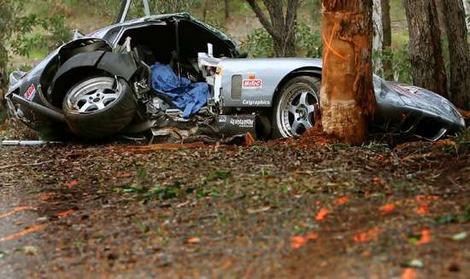
Australian motor racing legend Peter Brock has been killed in an accident while taking part in the Targa West rally in Western Australia, motor sport officials have confirmed.
He was driving a Daytona Coupe and died after hitting a gum tree, his co-driver Mick Hone survived the accident.
Go Swans !!

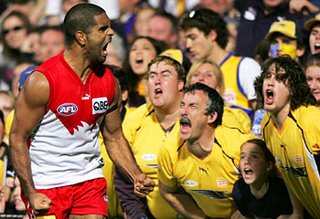 THE Sydney Swans advance to the preliminary final after a thrilling one-point win.
Michael O'Loughlin goaled with three minutes to go to win against the West Coast Eagles last night.
Thursday, September 07, 2006
WHO concerned by drug resistant strain of TB
The World Today - Thursday, 7 September , 2006
Reporter: Zoe Daniel
ELEANOR HALL: The World Health Organisation has released alarming findings about new strains of the disease tuberculosis, which it says are almost untreatable.In most Western countries TB is virtually non-existent but it's still highly prevalent in the third world. These virulent new strains have already infected people in the United States and Eastern Europe.And experts are meeting in South Africa to deal with a serious outbreak in the province of Kwa Zulu Natal, as Africa Correspondent Zoe Daniel reports.
ZOE DANIEL: It's feared that the Extreme Drug Resistant strain of TB was created by inappropriate use of TB medications. It's believed that TB resistance can be created by the use of drugs at the wrong dosage or for the wrong period of time.
Dr Paul Nunn from the World Health Organisation says the increasing prevalence of the drug resistant strain is a huge concern to health authorities.
PAUL NUNN: Well, the World Health Organisation is concerned because it's virtually or definitely untreatable. By definition this extreme drug resistance or XDR, as it's increasingly be called, is resistant to at least three of the six groups of second line drugs that are available. And by definition they're already resistant to the first line drugs. And so this means that any patient with XDR TB cannot get optimal treatment because we recommend that a patient with tuberculosis be treated with at least four drugs.
ZOE DANIEL: In South Africa an outbreak of drug resistant TB in Kwa Zulu Natal illustrates the extent of the problem. South Africa has the highest rate of HIV in the world, and tuberculosis is notorious for attacking the weakened immune systems of those who are HIV positive.However there was no treatment available when the drug resistant strain took hold, and the result for most was death.
PAUL NUNN: We carried out a survey that was published earlier this year showing the problem exists in about two per cent of cases globally. But what's most worrying is an outbreak recently reported from Kwa Zulu Natal showing that the XDR is there. That of the 53 patients that they looked at, 52 died within 210 days. So this is an extraordinarily high mortality rate. And clearly this is linked to the fact that all those tested were HIV infected as well. And this is the problem that we're really worried about. It's the spectre of extreme drug resistance fuelled by HIV in countries that don't really have the resources to address it right now.
ZOE DANIEL: At the moment TB causes about 1.7 million deaths per year around the world. But that's with the cocktail of drugs commonly used to treat it. Now resistance is showing up to the usual front line drugs and many of the so-called second line drugs that are used when the frontline drugs don't work.Dr Paul Nunn says part of the problem is that new drugs aren't coming onto the market because TB isn't present in most Western countries.
PAUL NUNN: During the 1980s and 1990s research into new anti-TB agents virtually disappeared in pharmaceutical companies because the TB problem was felt to be solved in the north and people did not realise the scale of the TB problem in developing countries at that time. And only in the last six or seven years has research really ramped up for new anti TB agents.The global alliance for anti TB drug development leading the fray, if you like, in New York funded largely by the Bill and Melinda Gates foundation. But clearly more investment in that area is required.
ZOE DANIEL: It's not yet clear how easily the drug resistant strain of TB is transmitted.
In Johannesburg, this is Zoe Daniel reporting for The World Today.
Reporter: Zoe Daniel
ELEANOR HALL: The World Health Organisation has released alarming findings about new strains of the disease tuberculosis, which it says are almost untreatable.In most Western countries TB is virtually non-existent but it's still highly prevalent in the third world. These virulent new strains have already infected people in the United States and Eastern Europe.And experts are meeting in South Africa to deal with a serious outbreak in the province of Kwa Zulu Natal, as Africa Correspondent Zoe Daniel reports.
ZOE DANIEL: It's feared that the Extreme Drug Resistant strain of TB was created by inappropriate use of TB medications. It's believed that TB resistance can be created by the use of drugs at the wrong dosage or for the wrong period of time.
Dr Paul Nunn from the World Health Organisation says the increasing prevalence of the drug resistant strain is a huge concern to health authorities.
PAUL NUNN: Well, the World Health Organisation is concerned because it's virtually or definitely untreatable. By definition this extreme drug resistance or XDR, as it's increasingly be called, is resistant to at least three of the six groups of second line drugs that are available. And by definition they're already resistant to the first line drugs. And so this means that any patient with XDR TB cannot get optimal treatment because we recommend that a patient with tuberculosis be treated with at least four drugs.
ZOE DANIEL: In South Africa an outbreak of drug resistant TB in Kwa Zulu Natal illustrates the extent of the problem. South Africa has the highest rate of HIV in the world, and tuberculosis is notorious for attacking the weakened immune systems of those who are HIV positive.However there was no treatment available when the drug resistant strain took hold, and the result for most was death.
PAUL NUNN: We carried out a survey that was published earlier this year showing the problem exists in about two per cent of cases globally. But what's most worrying is an outbreak recently reported from Kwa Zulu Natal showing that the XDR is there. That of the 53 patients that they looked at, 52 died within 210 days. So this is an extraordinarily high mortality rate. And clearly this is linked to the fact that all those tested were HIV infected as well. And this is the problem that we're really worried about. It's the spectre of extreme drug resistance fuelled by HIV in countries that don't really have the resources to address it right now.
ZOE DANIEL: At the moment TB causes about 1.7 million deaths per year around the world. But that's with the cocktail of drugs commonly used to treat it. Now resistance is showing up to the usual front line drugs and many of the so-called second line drugs that are used when the frontline drugs don't work.Dr Paul Nunn says part of the problem is that new drugs aren't coming onto the market because TB isn't present in most Western countries.
PAUL NUNN: During the 1980s and 1990s research into new anti-TB agents virtually disappeared in pharmaceutical companies because the TB problem was felt to be solved in the north and people did not realise the scale of the TB problem in developing countries at that time. And only in the last six or seven years has research really ramped up for new anti TB agents.The global alliance for anti TB drug development leading the fray, if you like, in New York funded largely by the Bill and Melinda Gates foundation. But clearly more investment in that area is required.
ZOE DANIEL: It's not yet clear how easily the drug resistant strain of TB is transmitted.
In Johannesburg, this is Zoe Daniel reporting for The World Today.
Wednesday, September 06, 2006
Yin and Yang

From Wikipedia
Taijitu, the traditional symbol representing the forces of Yin and Yang
The concepts of yin and yang originate in ancient Chinese philosophy and metaphysics, which describes two primal opposing but complementary forces found in all things in the universe.
Yin, is sad, the darker element, is passive, dark, feminine, downward-seeking, and corresponds to the night;
Yang, is happy, the brighter element, is active, light, masculine, upward-seeking and corresponds to the day;
Yin is often symbolized by water, while Yang is symbolized by fire.
The pair probably goes back to ancient agrarian religion; it exists in Confucianism, and it is prominent in Taoism.
Though the words yin and yang only appear once in theTeo Te Ching, the book is laden with examples and clarifications of the concept of mutual arising.
The concept is a fundamental principle of Traditional Chinese Medicine.
Yin and yang are descriptions of complementary opposites rather than absolutes.
Any yin/yang dichotomy can be seen as its opposite when viewed from another perspective.
Monday, September 04, 2006
"Crikey" - Steve Irwin killed by stingray

Crocodile man reported dead
September 4, 2006
Television personality and environmentalist Steve Irwin has died in a marine accident in north Queensland, state government sources say.
The 44-year-old is believed to have been killed by a stingray barb that went through his chest, the sources said.
He was filming an underwater documentary off Port Douglas when the accident occurred.
Mr Irwin's body was being flown to Cairns by helicopter.
Australian emergency officials could not immediately confirm the reports.
Irwin won a global following for his daredevil antics but also triggered outrage in 2004 by holding his then one-month-old baby while feeding a snapping crocodile at his Australian zoo.
It is believed his American-born wife Terri is trekking on Cradle Mountain in Tasmania.
Mr Irwin - known worldwide as the Crocodile Hunter - is famous for his enthusiasm for wildlife and his catchcry "Crikey!''.
The father of two's Crocodile Hunter program was first broadcast in 1992 and has been shown around the world on cable network Discovery.
AAP and SMH
Friday, September 01, 2006
Left or Right Pawed ???
Richard Macey
September 1, 2006
SMH
YOUR dog is inquisitive and loves exploring the neighbourhood. Or he is timid, nervous, and prefers sticking nearer to home.
His behaviour could be linked to his being left- or right-pawed.
And before you punt your wages on the next race at Randwick, it might be handy to know whether the horse, thanks to being left- or right-hoofed, prefers galloping clockwise, as they do in NSW, or anti-clockwise, as in Victoria.
There is growing evidence, says Paul McGreevy, a senior lecturer in the University of Sydney's Faculty of Veterinary Science, that behavioural traits in many animals, including dogs and horses, are linked to their handedness, or "laterality".
That animals have a preferred side has been accepted for almost 20 years. Now Dr McGreevy is conducting a three-year study, funded by the Australian Research Council, to explore "pawedness" in dogs.
His students have tested 270, giving them food cylinders and watching which paw they use to hold them steady. Repeating the experiment 100 times on each dog, they found about 15 per cent are left-pawed, 15 per cent right-pawed, and the rest are neither.
"Dogs that lack any bias are more likely to have noise phobias," Dr McGreevy said. "They get upset by thunderstorms and fireworks. If we can show laterality is a predictor of a dog's motivation or reluctance to explore, we can help guide dog and sniffer dog trainers select the right animals."
Knowing which side of a dog's brain is dominant could change pet training.
"There is a convention to train dogs on the left of the trainer. It's a human convention we have imposed, and it's unlikely to suit all dogs equally."
There appeared to be no differences in pawedness between breeds, but "males are more likely to be left than right, and females more likely to be right than left".
He has also confirmed "hoofedness" in racing horses. After watching 186 grazing in paddocks, observing whether they put their left or right hoofs forward as they ate, he found 40 per cent had a left preference, while 10 per cent had a right bias. The rest had none.
A horse might develop more powerful muscles on, for example, its right side, as a result of its hoofedness. It might thus excel on right curving tracks, but be disadvantaged going anti-clockwise.
That animals share the human trait of being left- or right-handed should not be surprising.
"It's evidence we all came from a common ancestor."
September 1, 2006
SMH
YOUR dog is inquisitive and loves exploring the neighbourhood. Or he is timid, nervous, and prefers sticking nearer to home.
His behaviour could be linked to his being left- or right-pawed.
And before you punt your wages on the next race at Randwick, it might be handy to know whether the horse, thanks to being left- or right-hoofed, prefers galloping clockwise, as they do in NSW, or anti-clockwise, as in Victoria.
There is growing evidence, says Paul McGreevy, a senior lecturer in the University of Sydney's Faculty of Veterinary Science, that behavioural traits in many animals, including dogs and horses, are linked to their handedness, or "laterality".
That animals have a preferred side has been accepted for almost 20 years. Now Dr McGreevy is conducting a three-year study, funded by the Australian Research Council, to explore "pawedness" in dogs.
His students have tested 270, giving them food cylinders and watching which paw they use to hold them steady. Repeating the experiment 100 times on each dog, they found about 15 per cent are left-pawed, 15 per cent right-pawed, and the rest are neither.
"Dogs that lack any bias are more likely to have noise phobias," Dr McGreevy said. "They get upset by thunderstorms and fireworks. If we can show laterality is a predictor of a dog's motivation or reluctance to explore, we can help guide dog and sniffer dog trainers select the right animals."
Knowing which side of a dog's brain is dominant could change pet training.
"There is a convention to train dogs on the left of the trainer. It's a human convention we have imposed, and it's unlikely to suit all dogs equally."
There appeared to be no differences in pawedness between breeds, but "males are more likely to be left than right, and females more likely to be right than left".
He has also confirmed "hoofedness" in racing horses. After watching 186 grazing in paddocks, observing whether they put their left or right hoofs forward as they ate, he found 40 per cent had a left preference, while 10 per cent had a right bias. The rest had none.
A horse might develop more powerful muscles on, for example, its right side, as a result of its hoofedness. It might thus excel on right curving tracks, but be disadvantaged going anti-clockwise.
That animals share the human trait of being left- or right-handed should not be surprising.
"It's evidence we all came from a common ancestor."
Wednesday, August 30, 2006
"Build a Brain" tutorial

Random Man says check out this link . . .
http://www.stanford.edu/group/hopes/basics/braintut/ab0.html
Star Trek's a thesis
By Adam Morton
August 28, 2006
The Age
It's the PhD thesis that boldly goes where no thesis has gone before. Djoymi Baker watched 700 episodes - 624 hours without ads - of Star Trek and its spin-offs, dating from 1966 to 2005, in the name of research.
She analysed the series armed with an exhaustive knowledge of the characters and storylines of ancient mythology - from Homer's Odyssey down.
It may sound like torture for those with an aversion to William Shatner's campy theatrics but, six years and 90,000 words on, it has earned Dr Baker a coveted chancellor's prize for excellence at Melbourne University. And the respect of academics and Trekkies alike.
"I was interested in where myths turn up in less obvious forms, and there wasn't much work on the early years of television and its relation to myth," Dr Baker said.
Importantly, she was also a fan of the series.
"I don't think just because a study is serious and that I'm connecting Star Trek to a broader history of TV and ancient myths that it means there is not also a fun side - I can see the fun side as well."
Among the dark corners where Dr Baker's thesis - titled Broadcast Space: TV Culture, Myth and Star Trek - shines light is the changing link between the starship Enterprise's intergalactic adventures and the real world's space race.
Shatner's monologues were inspired by the visionary speeches of JFK, advocating greater exploration. Thirty years on, the roles were reversed, with astronauts from the National Aeronautics and Space Administration guest-starring on Star Trek spin-offs to promote their underfunded existence.
Since finishing her thesis last year, the 34-year-old has had a daughter and is turning her thesis into an academic text.
She's also writing an introductory piece for a Star Trek exhibition at the Victorian College of the Arts in October.
August 28, 2006
The Age
It's the PhD thesis that boldly goes where no thesis has gone before. Djoymi Baker watched 700 episodes - 624 hours without ads - of Star Trek and its spin-offs, dating from 1966 to 2005, in the name of research.
She analysed the series armed with an exhaustive knowledge of the characters and storylines of ancient mythology - from Homer's Odyssey down.
It may sound like torture for those with an aversion to William Shatner's campy theatrics but, six years and 90,000 words on, it has earned Dr Baker a coveted chancellor's prize for excellence at Melbourne University. And the respect of academics and Trekkies alike.
"I was interested in where myths turn up in less obvious forms, and there wasn't much work on the early years of television and its relation to myth," Dr Baker said.
Importantly, she was also a fan of the series.
"I don't think just because a study is serious and that I'm connecting Star Trek to a broader history of TV and ancient myths that it means there is not also a fun side - I can see the fun side as well."
Among the dark corners where Dr Baker's thesis - titled Broadcast Space: TV Culture, Myth and Star Trek - shines light is the changing link between the starship Enterprise's intergalactic adventures and the real world's space race.
Shatner's monologues were inspired by the visionary speeches of JFK, advocating greater exploration. Thirty years on, the roles were reversed, with astronauts from the National Aeronautics and Space Administration guest-starring on Star Trek spin-offs to promote their underfunded existence.
Since finishing her thesis last year, the 34-year-old has had a daughter and is turning her thesis into an academic text.
She's also writing an introductory piece for a Star Trek exhibition at the Victorian College of the Arts in October.
Monday, August 28, 2006
Scorpions into the Grand Final !!

Lining up the the Scorpions at the SCG this sunday
Leo Barry (back)
Brett Kirk (centre)
Darren Jolly (ruck)
Michael O'Loughlin (forward)
Barry Hall (forward)
With Jason Roe and Trent Hentschel out with leg injuries and Josh Kennedy out with a punctured lung it is not going to be easy for the Scorpions. Hopefully Chris Tarrant is back this week. Fingers crossed !!
Fantastic effort from Matthew Richardson on the weekend (189 points).
Tuesday, August 22, 2006
Dark matter exists
By Robert Roy Britt
Monday, August 21, 2006
Scientists found proof of dark matter in galaxy cluster 1E0657-556
Harvard-Smithsonian Center for Astrophysics
National Aeronautics and Space Administration (NASA)
University of Arizona
New observations of a great big cosmic collision provide the best evidence yet that invisible and mysterious dark matter really does exist.
The collision, between two huge clusters of galaxies, is the "most energetic cosmic event, besides the Big Bang, that we know about," said Maxim Markevitch of the Harvard-Smithsonian Center for Astrophysics in Cambridge, Massachusetts.
The impact split normal matter and dark matter apart, rendering the dark matter's gravitational presence observable.
Scientists announced the discovery today in a teleconference with reporters.
The normal matter in the cosmos -- atoms that make up stars, planets, air and life -- accounts for only a small fraction of what must exist, based on the fact that without an additional source of gravity, galaxies would fly apart and galaxy clusters could not hold together as they do.
Nobody knows where all that gravity comes from, so scientists say there must be some invisible stuff out there, which they call dark matter. Its presence is indirectly supported by many observations.
Given what's known, this is the makeup of the universe:
5 percent normal matter
25 percent dark matter
70 percent dark energy
Dark energy is an even more mysterious phenomenon, a force of some sort that beats out gravity and is causing the universe to expand at an ever-faster pace.
Some theorists have suggested that rather than invoking dark matter, perhaps existing ideas about gravity might be wrong. Maybe gravity is stronger on intergalactic scales than what is predicted by Newton and Einstein.
And all astronomers agree that dark matter is such an exotic idea as to border on the crazy.
"A universe that's dominated by dark stuff seems preposterous, so we wanted to test whether there were any basic flaws in our thinking," said Doug Clowe of the University of Arizona at Tucson, and leader of the study. "These results are direct proof that dark matter exists."
Splitting matter
Clowe and colleagues used NASA's Chandra X-ray Observatory to study the galaxy cluster 1E0657-556, which contains a bullet-shaped cloud of superheated gas. X-rays show the shape was produced by cosmic winds created in a high-speed collision of two clusters of galaxies.
Other telescopes were used to locate and quantify the mass in the clusters. They actually measured the effect of gravitational lensing, in which gravity from the clusters distorts light from thousands of background galaxies, as predicted by Einstein's theory of general relativity.
The dark matter is not seen, but its gravity has a predictable effect on the observations. The resulting blue color in a new image represents the gravity fields observed by noting how the light from each background galaxy is distorted.
Here's what the image reveals:
The hot gas -- normal matter -- was slowed by a drag force described as the cosmic equivalent of air resistance. But the dark matter was not slowed by this effect, presumably because it does not interact with normal matter, as theory had predicted.
So the normal matter and dark matter became separated.
"This proves in a simple and direct way that dark matter exists." Markevitch said in the teleconference.
Other theories must cope
The finding provides further evidence that standard Newtonian gravity, which keeps planets in orbit around the sun, is the glue that makes things stick on the largest scales, too.
It is still possible there is some modification of gravity going on, but these findings make it less necessary to have such theories, said Sean Carroll, a cosmologist at the University of Chicago who was not involved with the study. "No matter what you do [in devising new theories] you're going to have to believe in dark matter."
"We've closed this loophole about gravity, and we've come closer than ever to seeing this invisible matter," Clowe said. "This is the first time we've had a direct detection of dark matter" in which you can't explain the results with any altered-gravity theory, he said.
The findings will be detailed in an upcoming issue of the Astrophysical Journal Letters.
Monday, August 21, 2006
Scientists found proof of dark matter in galaxy cluster 1E0657-556
Harvard-Smithsonian Center for Astrophysics
National Aeronautics and Space Administration (NASA)
University of Arizona
New observations of a great big cosmic collision provide the best evidence yet that invisible and mysterious dark matter really does exist.
The collision, between two huge clusters of galaxies, is the "most energetic cosmic event, besides the Big Bang, that we know about," said Maxim Markevitch of the Harvard-Smithsonian Center for Astrophysics in Cambridge, Massachusetts.
The impact split normal matter and dark matter apart, rendering the dark matter's gravitational presence observable.
Scientists announced the discovery today in a teleconference with reporters.
The normal matter in the cosmos -- atoms that make up stars, planets, air and life -- accounts for only a small fraction of what must exist, based on the fact that without an additional source of gravity, galaxies would fly apart and galaxy clusters could not hold together as they do.
Nobody knows where all that gravity comes from, so scientists say there must be some invisible stuff out there, which they call dark matter. Its presence is indirectly supported by many observations.
Given what's known, this is the makeup of the universe:
5 percent normal matter
25 percent dark matter
70 percent dark energy
Dark energy is an even more mysterious phenomenon, a force of some sort that beats out gravity and is causing the universe to expand at an ever-faster pace.
Some theorists have suggested that rather than invoking dark matter, perhaps existing ideas about gravity might be wrong. Maybe gravity is stronger on intergalactic scales than what is predicted by Newton and Einstein.
And all astronomers agree that dark matter is such an exotic idea as to border on the crazy.
"A universe that's dominated by dark stuff seems preposterous, so we wanted to test whether there were any basic flaws in our thinking," said Doug Clowe of the University of Arizona at Tucson, and leader of the study. "These results are direct proof that dark matter exists."
Splitting matter
Clowe and colleagues used NASA's Chandra X-ray Observatory to study the galaxy cluster 1E0657-556, which contains a bullet-shaped cloud of superheated gas. X-rays show the shape was produced by cosmic winds created in a high-speed collision of two clusters of galaxies.
Other telescopes were used to locate and quantify the mass in the clusters. They actually measured the effect of gravitational lensing, in which gravity from the clusters distorts light from thousands of background galaxies, as predicted by Einstein's theory of general relativity.
The dark matter is not seen, but its gravity has a predictable effect on the observations. The resulting blue color in a new image represents the gravity fields observed by noting how the light from each background galaxy is distorted.
Here's what the image reveals:
The hot gas -- normal matter -- was slowed by a drag force described as the cosmic equivalent of air resistance. But the dark matter was not slowed by this effect, presumably because it does not interact with normal matter, as theory had predicted.
So the normal matter and dark matter became separated.
"This proves in a simple and direct way that dark matter exists." Markevitch said in the teleconference.
Other theories must cope
The finding provides further evidence that standard Newtonian gravity, which keeps planets in orbit around the sun, is the glue that makes things stick on the largest scales, too.
It is still possible there is some modification of gravity going on, but these findings make it less necessary to have such theories, said Sean Carroll, a cosmologist at the University of Chicago who was not involved with the study. "No matter what you do [in devising new theories] you're going to have to believe in dark matter."
"We've closed this loophole about gravity, and we've come closer than ever to seeing this invisible matter," Clowe said. "This is the first time we've had a direct detection of dark matter" in which you can't explain the results with any altered-gravity theory, he said.
The findings will be detailed in an upcoming issue of the Astrophysical Journal Letters.
Monday, August 21, 2006
Good win for the Scorpions

Sydney_Scorpions def Happy Hermits to move into the 2nd Prelim. Final against The Rock Bottoms this coming weekend.
With Tarrant back, the Scorpions are at full strength (hopefully).
Can they take down the UN Peacekeepers in the Grand Final ?
Will need a better game from Hall and Gehrig for starters.
Fingers Crossed.
Sunday, August 20, 2006
Abbott lashes out at scientists
August 20, 2006
Scientists are "peddling" hopes of medical breakthroughs without convincing evidence that expanding stem cell research will deliver, Health Minister Tony Abbott says.
Mr Abbott, who is strongly opposed to therapeutic cloning, today lashed out at "evangelical" scientists, accusing them of giving false hopes to sufferers of crippling diseases just to get "a leg up" in their research.
The comments were some of Mr Abbott's strongest on the issue as MPs and senators head towards a conscience vote on overturning the four year ban on therapeutic cloning - the creation of embryos to produce stem cells.
Labor's health spokeswoman Julia Gillard today called for calm and accused the minister of misleading the public.
Mr Abbott's language, she said, "is calculated in my view to misinform the public and to misrepresent this debate".
"I think Tony Abbott as health minister has actually got an obligation to keep the debate calm and keep it focussed on the facts," Ms Gillard told the Ten Network.
"Instead he believes it's his job to run in with the most inflammatory language he can think of.
"No one in federal parliament is advocating human cloning, that is the complete reproduction of human beings."
But the pro-life minister, a devout Catholic, said politicians were being asked to cross a bridge too far.
"People are asking us to cross a very serious ethical bridge for no good reason because there is no strong evidence that this kind of research is actually going to produce the massive breakthroughs that people are claiming," Mr Abbott told ABC television.
"I think what we are seeing at the moment is a lot of peddling of hope, but no great evidence that these new and radical research techniques are actually going to produce the breakthroughs that some of the more evangelical scientists are claiming for them."
Mr Abbott said MPs and senators needed to explain what had changed since parliament voted in 2002 not to allow therapeutic cloning.
He made it clear that he did not trust scientists to steer the debate, saying they would want "a little bit more human cloning in a few years' time".
"Even potential human life needs to be treated with great respect and we shouldn't be willy-nilly creating potential human life just to satisfy the urges of the scientific community," Mr Abbott said.
Two senators are preparing private members' bills intended to end the ban on therapeutic cloning - Australian Democrat Natasha Stott Despoja and Liberal Kay Patterson, a former health minister.
Senator Patterson plans to base the bill on the findings of the expert Lockhart review, which recommended the Government allow scientists to conduct embryonic stem cell research.
Present laws restrict research to spare IVF embryos.
Mr Abbott said he believed a large number of MPs and senators remained undecided on the issue, but acknowledged the influence of the Lockhart report.
"I certainly think the Lockhart review has had an impact on people but I think that the more people think about this the more concerned they will be about just where this might be leading," he said.
Cabinet rejected the Lockhart review's recommendation in June, but Prime Minister John Howard last week bowed to backbench pressure and promised his MPs a conscience vote should any legislation come to parliament.
AAP
Scientists are "peddling" hopes of medical breakthroughs without convincing evidence that expanding stem cell research will deliver, Health Minister Tony Abbott says.
Mr Abbott, who is strongly opposed to therapeutic cloning, today lashed out at "evangelical" scientists, accusing them of giving false hopes to sufferers of crippling diseases just to get "a leg up" in their research.
The comments were some of Mr Abbott's strongest on the issue as MPs and senators head towards a conscience vote on overturning the four year ban on therapeutic cloning - the creation of embryos to produce stem cells.
Labor's health spokeswoman Julia Gillard today called for calm and accused the minister of misleading the public.
Mr Abbott's language, she said, "is calculated in my view to misinform the public and to misrepresent this debate".
"I think Tony Abbott as health minister has actually got an obligation to keep the debate calm and keep it focussed on the facts," Ms Gillard told the Ten Network.
"Instead he believes it's his job to run in with the most inflammatory language he can think of.
"No one in federal parliament is advocating human cloning, that is the complete reproduction of human beings."
But the pro-life minister, a devout Catholic, said politicians were being asked to cross a bridge too far.
"People are asking us to cross a very serious ethical bridge for no good reason because there is no strong evidence that this kind of research is actually going to produce the massive breakthroughs that people are claiming," Mr Abbott told ABC television.
"I think what we are seeing at the moment is a lot of peddling of hope, but no great evidence that these new and radical research techniques are actually going to produce the breakthroughs that some of the more evangelical scientists are claiming for them."
Mr Abbott said MPs and senators needed to explain what had changed since parliament voted in 2002 not to allow therapeutic cloning.
He made it clear that he did not trust scientists to steer the debate, saying they would want "a little bit more human cloning in a few years' time".
"Even potential human life needs to be treated with great respect and we shouldn't be willy-nilly creating potential human life just to satisfy the urges of the scientific community," Mr Abbott said.
Two senators are preparing private members' bills intended to end the ban on therapeutic cloning - Australian Democrat Natasha Stott Despoja and Liberal Kay Patterson, a former health minister.
Senator Patterson plans to base the bill on the findings of the expert Lockhart review, which recommended the Government allow scientists to conduct embryonic stem cell research.
Present laws restrict research to spare IVF embryos.
Mr Abbott said he believed a large number of MPs and senators remained undecided on the issue, but acknowledged the influence of the Lockhart report.
"I certainly think the Lockhart review has had an impact on people but I think that the more people think about this the more concerned they will be about just where this might be leading," he said.
Cabinet rejected the Lockhart review's recommendation in June, but Prime Minister John Howard last week bowed to backbench pressure and promised his MPs a conscience vote should any legislation come to parliament.
AAP
Carl Sagan - smarter than Asimov
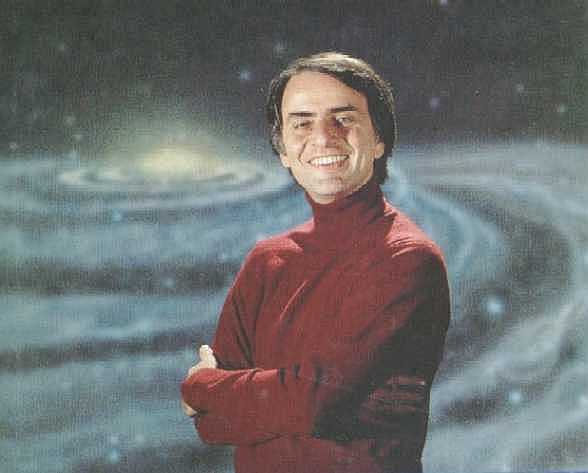
Carl Sagan married three times:
1) the famous biologist, Lynn Margulis (mother of Dorion Sagan and Jeremy Sagan) in 1957
2) artist Linda Salzman (mother of Nick Sagan) in 1968
3) author Ann Druyan (mother of Sasha and Sam) in 1981, to whom he remained married until his death.
Isaac Asimov described Sagan as one of the only two people he ever met who were just plain smarter than Asimov himself.
The other was computer scientist and expert on artifical intelligence, Marvin Minsky.
Thursday, August 17, 2006
World water demand will double by 2050
By Robin Pash
August 16, 2006
AAP
WORLD demand for water will double by 2050, with a third of the globe's population already facing shortages of the precious resource, an international expert has warned.
That will also send the cost of the "blue gold" through the roof, but it is unlikely to match the pricing spiral experienced by crude oil.
Dr Frank Rijsberman, a Dutch scientist who heads the eminent International Water Management Institute, said about 2.5 billion people – most of them in Asia – already faced scarcity of water.
He delivered a daunting assessment of the world's current and future water needs to the Crawford Fund's annual development conference in Canberra today.
But he also said there was plenty of water in the world – how it was managed would be the key to meeting demand.
"The point is, water scarcity is a choice. You're not necessarily water scarce because there is no rain," he told the conference.
"You're water scarce because you're doing something with the water, such as growing food and exporting it."
In another paper delivered to the conference, the International Food Policy Research Institute warned that failure to change current trends in water policy and investment would strip 350 million tonnes from the world's annual food production by 2025.
The figure is more than the entire grain crop in the United States.
Dr Rijsberman said the total amount of water needed for the world would double between now and 2050.
That would likely lead to big price rises – at least double, possibly treble current levels.
But the increases were unlikely to match oil prices, currently approaching $US80 a barrel.
Dr Rijsberman highlighted huge differences in the global pricing of water, saying "designer" products like Perrier bottled water already topped the price of oil.
Bottom-end prices for Australian wine, he noted, were currently cheaper than domestic water, as the wine industry experienced an oversupply.
For domestic use, Australians currently paid between $1 and $2 per cubic metre for water.
But prices were already much higher in many developed nations, such as Germany, which paid about $10 per cubic metre for its domestic water.
With water a big issue in the current Queensland election campaign, Dr Rijsberman said the resource would become an increasingly significant factor in the rise and fall of governments.
State election results in India, for example, were frequently determined by water and energy prices, he said.
Residents of the drought-stricken Queensland city of Toowoomba recently voted against including recycled effluent in the drinking water supply – the first poll of its kind in Australia.
Recycling was inevitable, Dr Rijsberman said, but there was no rush to include it in drinking stocks.
Using waste water for purposes like irrigating crops should be a higher priority, he said.
"Probably the people of Toowoomba are right. You don't have to drink it," Dr Rijsberman said.
"There are a lot of other things you can do before you start drinking it, but that we'll have to recycle it is pretty obvious."
August 16, 2006
AAP
WORLD demand for water will double by 2050, with a third of the globe's population already facing shortages of the precious resource, an international expert has warned.
That will also send the cost of the "blue gold" through the roof, but it is unlikely to match the pricing spiral experienced by crude oil.
Dr Frank Rijsberman, a Dutch scientist who heads the eminent International Water Management Institute, said about 2.5 billion people – most of them in Asia – already faced scarcity of water.
He delivered a daunting assessment of the world's current and future water needs to the Crawford Fund's annual development conference in Canberra today.
But he also said there was plenty of water in the world – how it was managed would be the key to meeting demand.
"The point is, water scarcity is a choice. You're not necessarily water scarce because there is no rain," he told the conference.
"You're water scarce because you're doing something with the water, such as growing food and exporting it."
In another paper delivered to the conference, the International Food Policy Research Institute warned that failure to change current trends in water policy and investment would strip 350 million tonnes from the world's annual food production by 2025.
The figure is more than the entire grain crop in the United States.
Dr Rijsberman said the total amount of water needed for the world would double between now and 2050.
That would likely lead to big price rises – at least double, possibly treble current levels.
But the increases were unlikely to match oil prices, currently approaching $US80 a barrel.
Dr Rijsberman highlighted huge differences in the global pricing of water, saying "designer" products like Perrier bottled water already topped the price of oil.
Bottom-end prices for Australian wine, he noted, were currently cheaper than domestic water, as the wine industry experienced an oversupply.
For domestic use, Australians currently paid between $1 and $2 per cubic metre for water.
But prices were already much higher in many developed nations, such as Germany, which paid about $10 per cubic metre for its domestic water.
With water a big issue in the current Queensland election campaign, Dr Rijsberman said the resource would become an increasingly significant factor in the rise and fall of governments.
State election results in India, for example, were frequently determined by water and energy prices, he said.
Residents of the drought-stricken Queensland city of Toowoomba recently voted against including recycled effluent in the drinking water supply – the first poll of its kind in Australia.
Recycling was inevitable, Dr Rijsberman said, but there was no rush to include it in drinking stocks.
Using waste water for purposes like irrigating crops should be a higher priority, he said.
"Probably the people of Toowoomba are right. You don't have to drink it," Dr Rijsberman said.
"There are a lot of other things you can do before you start drinking it, but that we'll have to recycle it is pretty obvious."
Wednesday, August 16, 2006
Orangutangs look for love online
August 17, 2006
Single male (red hair, long arms, interests include hanging in trees and grooming) seeks female for long-distance relationship and possibility of meeting up in future to help save species.
Zookeepers in the Netherlands are planning to hook up Dutch and Indonesian orangutans over the Internet and believe the link could at some stage be used as an online dating service where apes could get to know one another and keepers could work out whether they would be compatible mates.
First things first: A romantic dinner for two.
"We are going to set up an Internet connection between Indonesia and Apeldoorn so that the apes can see each other and, by means of pressing a button, be able to give one another food, for example," said Anouk Ballot, a spokeswoman for the Apenheul ape park in the central Dutch city of Apeldoorn.
She said the chance of two orangutans actually mating as a result of the online interaction was small due to the problem of transporting them between the Netherlands and Indonesia. "But I wouldn't rule it out completely," she told The Associated Press.
Ballot said the primary aim of the computer link between Apenheul and an orangutan center on the Indonesian part of Borneo was to raise public awareness of the apes and their plight.
Activists say that the spread of palm oil plantations, coupled with logging, especially on Malaysian and Indonesian territories on Borneo island, is threatening animals such as wild orangutans with extinction by chewing up their native jungle habitat.
Ballot said that, in the past, captive orangutans separated by a wall have communicated with one another via a mirror placed in front of the two enclosures. Using Web cams and computer screens is an extension of that, she said.
She stressed that only orangutans who show a natural interest and aptitude will take part. The Apenheul park has 13 orangutans among its collection of apes.
There is still work to be done to set up the Internet connection. "We need to find ape-proof cables and screens," Ballot said, adding that the zoo hopes to have the orangutans online by the end of this year or early 2007.
So next time you run into someone in a chatroom and think "what a baboon," think twice: it just might be.
AP
Boy tied to tree for nine years for biting dogs
August 16, 2006
Authorities in Indian state of West Bengal rescued a 15-year-old boy tied to a tree for nine years because he used to bite dogs and goats besides gnawing on the feet of relatives and neighbours, officials said today.
Rahul Amin Dhali was just six when he first bit a dog in Biramnagar village, 60km north of Kolkata, the state capital, they said.
A few days later he tasted the flesh of a family member.
"We chose to ignore the issue since he was just a child but it turned worse with every passing day," Rahman Dhali, the boy's father, told Reuters.
Rahul later wandered off in the village and bit a goat grazing in a field before nibbling at the paws of the neighbour's pet dog, leaving Rahman, a poor farmer, flummoxed.
When neighbours' complaints increased, the Dhalis chained their son by the wrist to a tree in front of their house, where the boy has since been taught to read.
"We found him tied to a tree with a long chain near a pond and he seemed very sick to us," said Sushanata Dutta, a senior government official who organised Monday's rescue mission after being told of Rahul's condition by village health workers.
"Dhali had the habit of nibbling at his hands and feet when he failed to lure dogs and cats for a bite," Dutta added.
Doctors said the boy was suffering from a serious neurological disorder and was admitted to a psychiatric hospital in Kolkata for treatment.
"Everyone was scared about Dhali because they thought he was a demon possessed with evil powers, but actually he should be fine with several months of treatment," Ranadip Ghosh Roy, one of the doctors treating Rahul, said.
Reuters
Authorities in Indian state of West Bengal rescued a 15-year-old boy tied to a tree for nine years because he used to bite dogs and goats besides gnawing on the feet of relatives and neighbours, officials said today.
Rahul Amin Dhali was just six when he first bit a dog in Biramnagar village, 60km north of Kolkata, the state capital, they said.
A few days later he tasted the flesh of a family member.
"We chose to ignore the issue since he was just a child but it turned worse with every passing day," Rahman Dhali, the boy's father, told Reuters.
Rahul later wandered off in the village and bit a goat grazing in a field before nibbling at the paws of the neighbour's pet dog, leaving Rahman, a poor farmer, flummoxed.
When neighbours' complaints increased, the Dhalis chained their son by the wrist to a tree in front of their house, where the boy has since been taught to read.
"We found him tied to a tree with a long chain near a pond and he seemed very sick to us," said Sushanata Dutta, a senior government official who organised Monday's rescue mission after being told of Rahul's condition by village health workers.
"Dhali had the habit of nibbling at his hands and feet when he failed to lure dogs and cats for a bite," Dutta added.
Doctors said the boy was suffering from a serious neurological disorder and was admitted to a psychiatric hospital in Kolkata for treatment.
"Everyone was scared about Dhali because they thought he was a demon possessed with evil powers, but actually he should be fine with several months of treatment," Ranadip Ghosh Roy, one of the doctors treating Rahul, said.
Reuters
Don't eat toadfish !!
 Angler dies after eating toadfish
August 15, 2006
A man has died in north Queensland after eating what is believed to be a poisonous toadfish.
The 45-year-old Fijian man caught the fish off a jetty near Bowen on Sunday, police said.
He filleted and cooked the fish on a barbecue on Sunday afternoon before collapsing on the beachfront.
An ambulance took him to Bowen Hospital but, attempts to revive him failed.
Two other men with him at the barbecue survived.
It was not known how much of the fish, if any, they had eaten.
A post-mortem examination is due to be conducted today.
AAP
Tuesday, August 15, 2006


Art Neuro's new track

http://www.icompositions.com/music/song.php?sid=43405
"The gal in the pickie is Kate Beckinsale who in my opinion looks like she has been lobotomised; or perhaps she's just had the mother of all orgasms and can't string a coherent sentence together as a result. I guess that too would be a kind of miracle of love. Or she was on drugs during the photo shoot, but I kind of like the way she looks totally stunned"
Art





Remote Control People

11 August 2006
UNSW
Pic: Dr Fitzpatrick steering a man by remote
UNSW researchers have proven it is possible to steer people accurately by remote control as they walk.The research, which has just been published in Current Biology, could eventually be used to diagnose balance disorders and help treat motion sickness or vertigo.
Until now the technique, which uses electrodes placed just behind peoples’ ears and stimulates their nerves, has led people to lose their balance.
What Drs Richard Fitzpatrick and Jane Butler from the Prince of Wales Medical Research Institute (POWMRI) did differently was ask the volunteers to walk with the head in specific pre-calculated positions, facing either downwards or slightly upwards.
While blindfolded, the five female and five male subjects were able to be steered in different directions without affecting their balance. The control was accurate enough to allow them to be steered around the paths and obstacles in Sydney’s Botanical Gardens for extended periods.
The researchers found that with a subject’s head in another position, the same stimulus caused the person to lean in one direction or another but did not steer their walking.
The stimulus affects the semicircular canals, which are small receptors in the inner ear that detect head rotation. These are part of the vestibular system that assists in orientation and balance.
“We were effectively introducing a small signal of vertigo but at subclinical levels. Vertigo is the symptom of spinning that comes from the rotational receptors” said Dr Fitzpatrick.
“We have shown that the brain can effectively break down this signal and that it uses it to control steering and balance.”
The findings support fossil evidence of an evolutionary change in the human semicircular ear canals during the development of upright posture. Collaborating with them in their research and an author on the paper is Dr Brian Day from Institute of Neurology at University College London.
UNSW
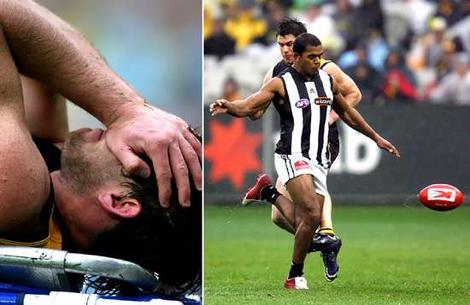
Poor Nic !
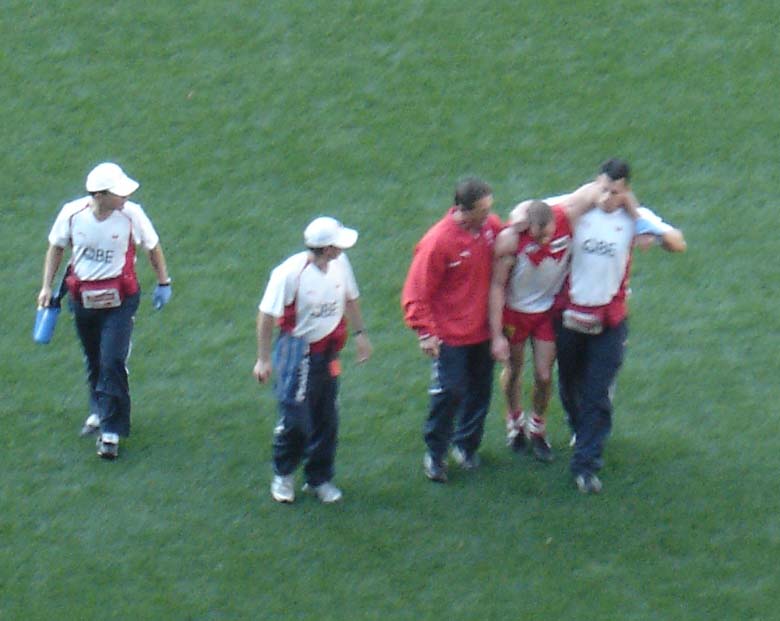
Nic Fosdike in the hands of trainers after hitting his head on the MCG turf after a bumb from Shannon Motlop
Mark Thompson (Geelong Coach)

Look who we saw at the MCG . . .
Just turning round to ask Random Man's advice on what Geelong should do . . .
Maybe a new coach ??? lol

Wednesday, August 09, 2006
Abraham Maslow
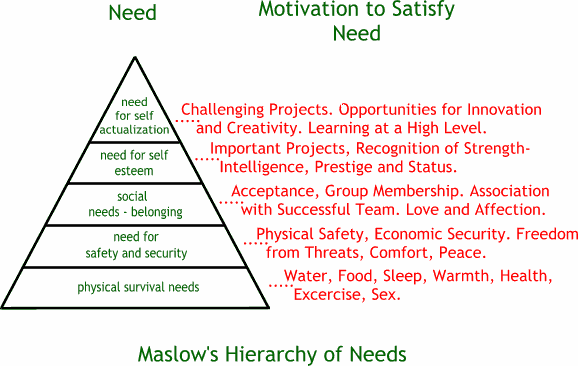
Maslow's Hierarchy of Needs is a theory in psychology that Abraham Maslow proposed in his 1943 paper A Theory of Human Motivation, which he subsequently extended.
His theory contends that as humans meet 'basic needs', they seek to satisfy successively 'higher needs' that occupy a set hierarchy.
Maslow studied exemplary people such as Albert Einstein, Jane Adams, Elanore Roosevelt, and Fredrick Douglas rather than mentally ill or neurotic people, writing that "the study of crippled, stunted, immature, and unhealthy specimens can yield only a cripple psychology and a cripple philosophy." (Motivation and Personality, 1987)
From Wikipedia
Tuesday, July 11, 2006
Ying and Yang ?
Random Man says compare the following ...
Dear updaters
For those of us who didn't know, it appears that marijuana smoking may be bad for you.
The current Archives of Internal Medicine journal includes a free article describing a systematic review of the association of marijuana smoking withthe development of premalignant changes in the lung and lung cancer.
The resulting 19 studies included in the review found an association of marijuana smoking with increased tar exposure, alveolar macrophagetumoricidal dysfunction, increased oxidative stress, and bronchial mucosal histopathologic abnormalities compared with tobacco smokers or nonsmoking controls It can be accessed at:
http://archinte.ama-assn.org/
Dr Malcolm Dobbin
Senior Medical Adviser
Drugs Policy and Services
and the following
Dear Readers,
Thanks to Malcolm Dobbin for bringing Update readers' attention to this week's Archives of Internal Medicine. But the journal's brief, catchy, capitalized headline "The Association Between Marijuana Smoking and Lung Cancer" is contrary to their published article's findings for some reason.
In fact, the authors, after examining 19 rigorous studies, find that there was NO association between cannabis smoking and cancer.
So why would the journal imply in big letters that such an association exists?
The authors state: 'Therefore, we must conclude that no convincing evidence exists for an association between marijuana smoking and lung cancer based on existing data.' Many of us believe that there probably is an association between any smoked organic product and lung damage.
However, when 19 rigorous studies fail to show an association with cancer, we are entitled to conclude that the effect must be relatively small, and substantially less than the long accepted causation with tobacco.
The authors conclusions "is that physicians should advise patients regarding potential adverse health outcomes" of cannabis.
It would appear that politics even pervades peer reviewed journals.
Reefer madness is still with us! I note that the study and one of its authors were partially supported by the National Institute on Drug Abuse (NIDA) in America.
Further evidence of the disconnect between science and drug policy is that even the most serious scientists and clinicians in America still often use the slang term marijuana rather than the correct Latin cannabis or English Indian hemp.
Andrew Byrne ..
Mehra R, Moore BA, Crothers K, Tetrault J, Fiellin DA. The Association Between Marijuana Smoking and Lung Cancer: A Systematic Review. Arch Intern Med. 2006;166:1359-1367
Dear updaters
For those of us who didn't know, it appears that marijuana smoking may be bad for you.
The current Archives of Internal Medicine journal includes a free article describing a systematic review of the association of marijuana smoking withthe development of premalignant changes in the lung and lung cancer.
The resulting 19 studies included in the review found an association of marijuana smoking with increased tar exposure, alveolar macrophagetumoricidal dysfunction, increased oxidative stress, and bronchial mucosal histopathologic abnormalities compared with tobacco smokers or nonsmoking controls It can be accessed at:
http://archinte.ama-assn.org/
Dr Malcolm Dobbin
Senior Medical Adviser
Drugs Policy and Services
and the following
Dear Readers,
Thanks to Malcolm Dobbin for bringing Update readers' attention to this week's Archives of Internal Medicine. But the journal's brief, catchy, capitalized headline "The Association Between Marijuana Smoking and Lung Cancer" is contrary to their published article's findings for some reason.
In fact, the authors, after examining 19 rigorous studies, find that there was NO association between cannabis smoking and cancer.
So why would the journal imply in big letters that such an association exists?
The authors state: 'Therefore, we must conclude that no convincing evidence exists for an association between marijuana smoking and lung cancer based on existing data.' Many of us believe that there probably is an association between any smoked organic product and lung damage.
However, when 19 rigorous studies fail to show an association with cancer, we are entitled to conclude that the effect must be relatively small, and substantially less than the long accepted causation with tobacco.
The authors conclusions "is that physicians should advise patients regarding potential adverse health outcomes" of cannabis.
It would appear that politics even pervades peer reviewed journals.
Reefer madness is still with us! I note that the study and one of its authors were partially supported by the National Institute on Drug Abuse (NIDA) in America.
Further evidence of the disconnect between science and drug policy is that even the most serious scientists and clinicians in America still often use the slang term marijuana rather than the correct Latin cannabis or English Indian hemp.
Andrew Byrne ..
Mehra R, Moore BA, Crothers K, Tetrault J, Fiellin DA. The Association Between Marijuana Smoking and Lung Cancer: A Systematic Review. Arch Intern Med. 2006;166:1359-1367
Koschitzke plays for the Scorpions

Emma Quayle
The Age
July 10, 2006
St Kilda's Justin Koschitzke back in the thick of it, with a custom-made helmet, in a comeback game with the Scorpions. Photo: Wayne Taylor
JUSTIN Koschitzke pushed aside some early-morning apprehension yesterday to find his first fresh match fitness and confidence in the VFL guernsey he expects to wear for the next few weeks.
Nine weeks after his skull was fractured, and his immediate and long-term future questioned, Koschitzke protected his head with a custom-made helmet and played in the ruck for the first half of the Casey Scorpions clash with the Northern Bullants.
Hesitant at first and keen to get his first contest done with, the star-crossed St Kilda player relaxed into the match and finished his half taking a few strong marks across half-back in the No. 73 jumper.
Koschitzke did not shy away from body contact, agitating Bullants player Ali Fahour by hurling him over the boundary line with a tough tackle.
Tuesday, July 04, 2006
Ouch !!
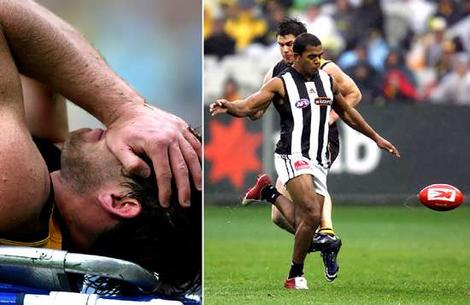
Richmond's Chris Newman has had surgery to repair a badly broken leg, but the Tigers are unsure whether he will be back for the start of next AFL season.
Newman last night had a rod inserted in his tibia and had his fibula realigned, after both bones were broken in a clash of legs with Collingwood's Leon Davis at the MCG yesterday.
'Plenty' of sex assaults on cruises: ex-security officer
July 4, 2006
Passengers on board the Pacific Sky cruise ship were encouraged to engage in binge-drinking while staff also ignored the use of drugs, a former P&O crew member claims.
Former security officer Jeff Dobjeckie will this week meet with lawyers for the coroner at the inquest into the death of Brisbane woman Dianne Brimble.
A naked Mrs Brimble was found dead on the floor of a cabin of the Pacific Sky less than 24 hours after she boarded the cruise liner on September 23, 2002, apparently from an overdose of the date rape drug gamma-hydroxybutyrate, or fantasy.
The body of the 42-year-old mother was found in a cabin belonging to four men, who are among eight men identified by police as being persons of interest.
A newspaper on Tuesday reports that Mr Dobjeckie, who was sacked by P&O in March for arguing with another crew member, will reveal that officers were told to turn a blind eye to drug use.
"We knew of people giving ecstasy to people, that sort of thing," he was quoted as saying.
"There was marijuana smoke coming out of the cabins but we just had to walk on past."
He said bar staff encouraged excessive drinking because they were paid commission for the amount of alcohol they sold.
"You had bar tenders depending on everyone at the Legends Bar and the Starlight Disco getting blind drunk so they could claim commissions," he said.
He also said he had seen "plenty" of sexual assaults during his 10 years onboard cruise ships.
Mr Dobjeckie said he was also outraged that four men of interest into Mrs Brimble's death were allowed back into their cabin, where the Brisbane woman died, while the Brimble family were not allowed to get clothes from their cabin.
He said his story could be backed up by current and former P&O workers, adding that he would tell all to the coroner.
On Friday, he will fly from the Gold Coast to meet with counsel assisting the coroner Ron Hoening.
The inquest into Mrs Brimble's death, being held before Deputy State Coroner Jacqueline Milledge, resumes on July 24.
AAP
Passengers on board the Pacific Sky cruise ship were encouraged to engage in binge-drinking while staff also ignored the use of drugs, a former P&O crew member claims.
Former security officer Jeff Dobjeckie will this week meet with lawyers for the coroner at the inquest into the death of Brisbane woman Dianne Brimble.
A naked Mrs Brimble was found dead on the floor of a cabin of the Pacific Sky less than 24 hours after she boarded the cruise liner on September 23, 2002, apparently from an overdose of the date rape drug gamma-hydroxybutyrate, or fantasy.
The body of the 42-year-old mother was found in a cabin belonging to four men, who are among eight men identified by police as being persons of interest.
A newspaper on Tuesday reports that Mr Dobjeckie, who was sacked by P&O in March for arguing with another crew member, will reveal that officers were told to turn a blind eye to drug use.
"We knew of people giving ecstasy to people, that sort of thing," he was quoted as saying.
"There was marijuana smoke coming out of the cabins but we just had to walk on past."
He said bar staff encouraged excessive drinking because they were paid commission for the amount of alcohol they sold.
"You had bar tenders depending on everyone at the Legends Bar and the Starlight Disco getting blind drunk so they could claim commissions," he said.
He also said he had seen "plenty" of sexual assaults during his 10 years onboard cruise ships.
Mr Dobjeckie said he was also outraged that four men of interest into Mrs Brimble's death were allowed back into their cabin, where the Brisbane woman died, while the Brimble family were not allowed to get clothes from their cabin.
He said his story could be backed up by current and former P&O workers, adding that he would tell all to the coroner.
On Friday, he will fly from the Gold Coast to meet with counsel assisting the coroner Ron Hoening.
The inquest into Mrs Brimble's death, being held before Deputy State Coroner Jacqueline Milledge, resumes on July 24.
AAP
Monday, July 03, 2006
Rabbit Man to get lots of cuddles in jail
Rabbit mutilator jailed
Leonie Lamont
July 3, 2006
Jailed ... Brendan Francis McMahon.Photo: Peter Rae
A Sydney financier has been jailed for 16 months for "the worst case" of aggravated cruelty against animals.
Brendan Francis McMahon, 37, of Tamarama, will have to spend at least 12 months in jail for his torture, mutilation, and alleged sexual offences against 17 rabbits and a guinea pig.
The magistrate, Ian Barnett, said a strong message should be sent to the community that people such as McMahon could not escape responsibility for their actions by the fact they were psychotic at the time.
"In my view this is one of the worst case scenarios of aggravated cruelty to animals," he said.
He accepted McMahon had a lifelong cannabis addiction and, before and during the offences against the animals, had a $125 a day addiction to methamphetamine (also known as ice).
"In my view there is community outrage at this matter and someone should not be allowed to commit such offences of aggravated cruelty against animals and say 'Well I had been using ice at the time. I have been taking cannabis most of my life.'
"My view is ... this is not acceptable."
The dead or dying animals, some skinned, were allegedly found in and around McMahon's York Street office between July and early August last year.
McMahon ran a financial planning and mortgage brokerage, Meares-McMahon Capital, with Jason Meares, the brother of the swimsuit designer Jodhi Meares, former wife of James Packer.
Leonie Lamont
July 3, 2006
Jailed ... Brendan Francis McMahon.Photo: Peter Rae
A Sydney financier has been jailed for 16 months for "the worst case" of aggravated cruelty against animals.
Brendan Francis McMahon, 37, of Tamarama, will have to spend at least 12 months in jail for his torture, mutilation, and alleged sexual offences against 17 rabbits and a guinea pig.
The magistrate, Ian Barnett, said a strong message should be sent to the community that people such as McMahon could not escape responsibility for their actions by the fact they were psychotic at the time.
"In my view this is one of the worst case scenarios of aggravated cruelty to animals," he said.
He accepted McMahon had a lifelong cannabis addiction and, before and during the offences against the animals, had a $125 a day addiction to methamphetamine (also known as ice).
"In my view there is community outrage at this matter and someone should not be allowed to commit such offences of aggravated cruelty against animals and say 'Well I had been using ice at the time. I have been taking cannabis most of my life.'
"My view is ... this is not acceptable."
The dead or dying animals, some skinned, were allegedly found in and around McMahon's York Street office between July and early August last year.
McMahon ran a financial planning and mortgage brokerage, Meares-McMahon Capital, with Jason Meares, the brother of the swimsuit designer Jodhi Meares, former wife of James Packer.
Inner-ear mystery solved
14 March 2006
Belle Dumé is science writer at PhysicsWeb
Why is the cochlea in our ears shaped like a spiral? According to new work by scientists in the US, the spiral shape makes us more sensitive to low frequency sounds. Daphne Manoussaki of Vanderbilt University in Nashville, Tennessee, together with Emilios Dimitriadis and Richard Chadwick at the National Institutes of Health in Bethesda, Maryland, have calculated that the spiral shape can affect the wave mechanics that take place inside the cochlea. It increases the strength of vibrations produced by sound waves, especially at low pitch (Phys. Rev. Lett. 96 088701).
The cochlea is a small seashell-shaped organ in the inner part of the ear where sound vibrations are converted into nerve impulses. These are then sent to the brain as electrical signals. The human cochlea occupies a volume of about 1 cubic centimetre and operates at frequencies between 20 hertz and 20 kilohertz. It can detect sounds over a range of 120 decibels.
Scientists have long wondered whether the cochlea's coiled-up shape plays an important role in how it processes sound. Although intuition said it should, theoretical models did not support the idea. The new work by Manoussaki, who is an applied mathematician, and colleagues has now shown that the spiral shape probably increases hearing sensitivity to low frequency sounds by as much as 20 decibels.
When we hear something, the incoming sounds are transmitted via the tympanic membrane (or eardrum) to the basilar membrane, which runs along the length of the cochlea. The sound waves then cause the basilar membrane to vibrate. Manoussaki and co-workers looked at the equations that describe the mechanical interaction between this membrane and its surrounding fluid. In this way, they were able to describe how the amplitude of the membrane's movement changes across the width in each section of the spiral tube.
The scientists found that the spiral shape makes the membrane deflect more towards the outside of the cochlea wall and less towards the inside. This difference in the membrane's motion, which is effectively a tilt about a line running along its centre, increases with increasing radius of curvature and so enhances hearing sensitivity. "Since low frequency sounds are processed where the spiral curvature is greatest – at the apex of the cochlea - the effect will be more important for low-frequency sound waves," explains Manoussaki.
The spiral structure may have developed because animals use low-frequency sounds, which travel the furthest of all sound waves, for communication and survival. The US team will now try to confirm its results by comparing cochlea in different mammals.
Belle Dumé is science writer at PhysicsWeb
Why is the cochlea in our ears shaped like a spiral? According to new work by scientists in the US, the spiral shape makes us more sensitive to low frequency sounds. Daphne Manoussaki of Vanderbilt University in Nashville, Tennessee, together with Emilios Dimitriadis and Richard Chadwick at the National Institutes of Health in Bethesda, Maryland, have calculated that the spiral shape can affect the wave mechanics that take place inside the cochlea. It increases the strength of vibrations produced by sound waves, especially at low pitch (Phys. Rev. Lett. 96 088701).
The cochlea is a small seashell-shaped organ in the inner part of the ear where sound vibrations are converted into nerve impulses. These are then sent to the brain as electrical signals. The human cochlea occupies a volume of about 1 cubic centimetre and operates at frequencies between 20 hertz and 20 kilohertz. It can detect sounds over a range of 120 decibels.
Scientists have long wondered whether the cochlea's coiled-up shape plays an important role in how it processes sound. Although intuition said it should, theoretical models did not support the idea. The new work by Manoussaki, who is an applied mathematician, and colleagues has now shown that the spiral shape probably increases hearing sensitivity to low frequency sounds by as much as 20 decibels.
When we hear something, the incoming sounds are transmitted via the tympanic membrane (or eardrum) to the basilar membrane, which runs along the length of the cochlea. The sound waves then cause the basilar membrane to vibrate. Manoussaki and co-workers looked at the equations that describe the mechanical interaction between this membrane and its surrounding fluid. In this way, they were able to describe how the amplitude of the membrane's movement changes across the width in each section of the spiral tube.
The scientists found that the spiral shape makes the membrane deflect more towards the outside of the cochlea wall and less towards the inside. This difference in the membrane's motion, which is effectively a tilt about a line running along its centre, increases with increasing radius of curvature and so enhances hearing sensitivity. "Since low frequency sounds are processed where the spiral curvature is greatest – at the apex of the cochlea - the effect will be more important for low-frequency sound waves," explains Manoussaki.
The spiral structure may have developed because animals use low-frequency sounds, which travel the furthest of all sound waves, for communication and survival. The US team will now try to confirm its results by comparing cochlea in different mammals.
Monday, June 26, 2006
Bill Gates seen as role model in philanthropy
By JESSICA GUYNN
San Francisco Chronicle
June 25, 2006
The 19th-century steel magnate Andrew Carnegie, who late in life reshaped his legacy from predatory businessman to renowned philanthropist, famously said: "He who dies rich dies thus disgraced."
Like Carnegie, Microsoft mogul Bill Gates wants to be remembered not just for how ruthlessly he made his fortune, but for how he gave it away.
The world's richest man recently announced that in 2008 he will step back from day-to-day oversight of the company he founded with Paul Allen to focus his attention on the Bill and Melinda Gates Foundation, which has pledged to spend billions of dollars on health, education and overcoming poverty.
Gates' decision has led to speculation that he could influence other self-made philanthropists to step up their efforts in Silicon Valley.
"He's setting the standard for what wealthy entrepreneurs in this generation ought to be doing," said Kathleen Gwynn, chief executive officer of the Steven and Michele Kirsch Foundation in San Jose, Calif. "He has the financial capacity, the intellect and the drive to make a real difference. He could be the Carnegie of our generation."
In Silicon Valley, David Packard and William Hewlett pioneered a philanthropic tradition emulated by everyone from Intel founder Gordon Moore to entrepreneur Steven Kirsch to Oracle CEO Larry Ellison. But the region was dubbed "Stingy Valley" after a 1998 study showed that a quarter of households with incomes in excess of $100,000 gave $500 or less a year to charity.
In recent years, tech-boom beneficiaries have become tech-boom benefactors in greater numbers, helping Silicon Valley shed its tightwad image.
"This is one of the areas where there are new ventures in philanthropy and new directions in philanthropy," said Paul Schervish, director of the Center for Wealth and Philanthropy at Boston College.
Schervish predicts Gates will become a prototype for the wealthy who, when faced with limitless quantity of choices, may begin to consider the quality of their choices.
"It's a fulfillment of a deeper purpose and something he will find bigger happiness in," Schervish said.
San Francisco Chronicle
June 25, 2006
The 19th-century steel magnate Andrew Carnegie, who late in life reshaped his legacy from predatory businessman to renowned philanthropist, famously said: "He who dies rich dies thus disgraced."
Like Carnegie, Microsoft mogul Bill Gates wants to be remembered not just for how ruthlessly he made his fortune, but for how he gave it away.
The world's richest man recently announced that in 2008 he will step back from day-to-day oversight of the company he founded with Paul Allen to focus his attention on the Bill and Melinda Gates Foundation, which has pledged to spend billions of dollars on health, education and overcoming poverty.
Gates' decision has led to speculation that he could influence other self-made philanthropists to step up their efforts in Silicon Valley.
"He's setting the standard for what wealthy entrepreneurs in this generation ought to be doing," said Kathleen Gwynn, chief executive officer of the Steven and Michele Kirsch Foundation in San Jose, Calif. "He has the financial capacity, the intellect and the drive to make a real difference. He could be the Carnegie of our generation."
In Silicon Valley, David Packard and William Hewlett pioneered a philanthropic tradition emulated by everyone from Intel founder Gordon Moore to entrepreneur Steven Kirsch to Oracle CEO Larry Ellison. But the region was dubbed "Stingy Valley" after a 1998 study showed that a quarter of households with incomes in excess of $100,000 gave $500 or less a year to charity.
In recent years, tech-boom beneficiaries have become tech-boom benefactors in greater numbers, helping Silicon Valley shed its tightwad image.
"This is one of the areas where there are new ventures in philanthropy and new directions in philanthropy," said Paul Schervish, director of the Center for Wealth and Philanthropy at Boston College.
Schervish predicts Gates will become a prototype for the wealthy who, when faced with limitless quantity of choices, may begin to consider the quality of their choices.
"It's a fulfillment of a deeper purpose and something he will find bigger happiness in," Schervish said.
Buffett to give $54b to charity
June 26, 2006
Warren Buffett ... plans to become a trustee of the Gates Foundation.
Photo: Rocco Fazzari
Warren Buffett, the world's second richest man, plans to give away 85 per cent of his fortune to charities, including one run by Bill Gates, the wealthiest man on the planet, Fortune magazine reported today.
Buffett, 75, pledged in an interview with Fortune to give away 85 per cent of his stock - worth more than $54 billion - in his Berkshire Hathaway investment firm, starting in July.
"I know what I want to do," he was quoted as saying, "and it makes sense to get going."
The shares will go to five foundations. More than 80 per cent will go to the Bill and Melinda Gates Foundation which already has a kitty of nearly $41 billion used to pay for medical research and give educational grants.
Buffett and the Gates are close friends. According to Fortune, Buffett plans to eventually become a trustee of the Gates foundation.
Fortune magazine estimated earlier this year that Buffett has a fortune of about $60 billion. Gates has about $68 billion.
AFP
Friday, June 16, 2006
Art ?

Empty plinth sidelines sculpture
BBC
Photo: The original sculpture Above and the plinth (below) now on display.
An artist's sculpture has been rejected by the Royal Academy of Arts which has instead opted to display the wooden support it was put on.
David Hensel, 64, from East Grinstead, West Sussex, was told the laughing head would be part of the summer exhibition.
But at a preview he found that just a piece of wood intended to support the head was on display on the plinth.
The Academy said the judging panel assumed the two pieces were separate and decided the support was better.
Final decision
Mr Hensel assumed staff had accidentally left the sculpture in the basement where it was being stored.
In a statement, the Academy said Mr Hensel's work, One Day Closer To Paradise, was submitted as two separate pieces.
"Given their separate submission, the two parts were judged independently.
"It is accepted that works may not be displayed in the way that the artist might have intended."
It said the head had been safely stored ready to be collected by the artist.
The co-ordinators of the exhibition in Piccadilly, central London, have been called in to make a final decision over whether the head should be returned to its rightful place.
Monday, June 05, 2006
Drink-spike victims had one too many
Liz Porter
The Age
June 4, 2006
MANY young women who believed they were victims of drink spiking had instead drunk dangerously high levels of alcohol and had no date rape drugs in their system, ground-breaking research has shown.
Victims were more than five or six times over the .05 legal limit for driving in 37 per cent of cases. The alarming findings have prompted police and forensic doctors to call for campaigns to highlight the dangers of binge drinking to young women rather than the risks of drink-spiking.
The manager of Victoria Police's drug and alcohol strategy unit, Inspector Steve James, said the results confirmed his view that the incidence of drink-spiking had been exaggerated.
"Alcohol, in the majority of cases, is the problem. We have been saying this for years," he said.
Doctors at the Victorian Institute of Forensic Medicine carried out a study of alcohol and drink-spiking — the first of its kind in Australia. They discovered that even though the average delay between the assault and a blood test was 11 hours, the average blood alcohol concentration in 37 per cent of the victims was between .22 and .33 at the time of the assault.
The doctors examined the files of 434 adult victims of sexual assault reported to Victoria Police between April 2002 and April 2003, identifying 76 as cases of suspected drink-spiking or "drug-facilitated sexual assault". But researchers found "unexpected" drugs in only 15 victims or 20 per cent of cases.
Moreover 13 of the 15 had also knowingly taken a range of other "psychoactive" drugs, including antidepressants and party drugs. No evidence was found of GHB or Rohypnol, two well-known "date rape" drugs.
Ninety-five per cent of victims in the survey were female, and the average age was 25.
VIFM staff forensic physician Angela Williams said the study was an attempt to find the truth about the much-publicised connection between drink-spiking and sexual assault.
Dr Williams said alcohol was the main risk to personal safety and that previous high-profile campaigns warning about the dangers of drink-spiking were tackling only a tiny area of the dangers faced by young women.
"When you teach young girls to cover their drinks and buy pretty straws or credit card-sized drink testers over the internet, you give the wrong message. It is less likely that there is an evil drink spiker lurking around ready to pop pills in your drink.
"Somebody wishing to offend looks for someone in a vulnerable situation. Having a lot of drinks and drugs on board, recreational or prescription, means you are less able to resist."
Helen Makregiorgos, manager of Centres Against Sexual Assault House, said it was impossible to generalise from the survey results because it drew on only the small proportion of victims of sexual assault who reported to police.
The Age
June 4, 2006
MANY young women who believed they were victims of drink spiking had instead drunk dangerously high levels of alcohol and had no date rape drugs in their system, ground-breaking research has shown.
Victims were more than five or six times over the .05 legal limit for driving in 37 per cent of cases. The alarming findings have prompted police and forensic doctors to call for campaigns to highlight the dangers of binge drinking to young women rather than the risks of drink-spiking.
The manager of Victoria Police's drug and alcohol strategy unit, Inspector Steve James, said the results confirmed his view that the incidence of drink-spiking had been exaggerated.
"Alcohol, in the majority of cases, is the problem. We have been saying this for years," he said.
Doctors at the Victorian Institute of Forensic Medicine carried out a study of alcohol and drink-spiking — the first of its kind in Australia. They discovered that even though the average delay between the assault and a blood test was 11 hours, the average blood alcohol concentration in 37 per cent of the victims was between .22 and .33 at the time of the assault.
The doctors examined the files of 434 adult victims of sexual assault reported to Victoria Police between April 2002 and April 2003, identifying 76 as cases of suspected drink-spiking or "drug-facilitated sexual assault". But researchers found "unexpected" drugs in only 15 victims or 20 per cent of cases.
Moreover 13 of the 15 had also knowingly taken a range of other "psychoactive" drugs, including antidepressants and party drugs. No evidence was found of GHB or Rohypnol, two well-known "date rape" drugs.
Ninety-five per cent of victims in the survey were female, and the average age was 25.
VIFM staff forensic physician Angela Williams said the study was an attempt to find the truth about the much-publicised connection between drink-spiking and sexual assault.
Dr Williams said alcohol was the main risk to personal safety and that previous high-profile campaigns warning about the dangers of drink-spiking were tackling only a tiny area of the dangers faced by young women.
"When you teach young girls to cover their drinks and buy pretty straws or credit card-sized drink testers over the internet, you give the wrong message. It is less likely that there is an evil drink spiker lurking around ready to pop pills in your drink.
"Somebody wishing to offend looks for someone in a vulnerable situation. Having a lot of drinks and drugs on board, recreational or prescription, means you are less able to resist."
Helen Makregiorgos, manager of Centres Against Sexual Assault House, said it was impossible to generalise from the survey results because it drew on only the small proportion of victims of sexual assault who reported to police.
Helium balloon kills two uni students
Two students found dead inside balloon
SMH
June 5, 2006
Two university students were found dead inside a large, deflated helium balloon after apparently pulling it down and crawling inside it, officials said.
The deaths of Jason Ackerman and Sara Rydman, both 21, appear to be accidental, Hillsborough County Sheriff's Major Bob Schrader said.
Their bodies were found yesterday partially inside a deflated helium balloon at the entrance of a condominium complex a few kilometres north of Tampa. The 2.4-metre-diameter balloon was used to advertise the complex.
"It was more a fun thing they thought they were doing," said Linda Rydman, whose daughter was found dead. "You know how you blow up the balloon and suck the helium."
The county medical examiner said today the cause of death will not be released until toxicology tests are completed.
Inhaling helium can quickly lead to brain damage and death from lack of oxygen, according to the Compressed Gas Association, which develops safety standards in the gas industry.
AP
SMH
June 5, 2006
Two university students were found dead inside a large, deflated helium balloon after apparently pulling it down and crawling inside it, officials said.
The deaths of Jason Ackerman and Sara Rydman, both 21, appear to be accidental, Hillsborough County Sheriff's Major Bob Schrader said.
Their bodies were found yesterday partially inside a deflated helium balloon at the entrance of a condominium complex a few kilometres north of Tampa. The 2.4-metre-diameter balloon was used to advertise the complex.
"It was more a fun thing they thought they were doing," said Linda Rydman, whose daughter was found dead. "You know how you blow up the balloon and suck the helium."
The county medical examiner said today the cause of death will not be released until toxicology tests are completed.
Inhaling helium can quickly lead to brain damage and death from lack of oxygen, according to the Compressed Gas Association, which develops safety standards in the gas industry.
AP
Grateful Dead keyboardist dead
SMH
June 5, 2006
Vince Welnick, the Grateful Dead's last keyboard player.
Photo: Jon C. Hancock/Acoustic Images
Vince Welnick, who took over as the Grateful Dead's keyboard player in 1990 after a succession of predecessors met untimely deaths, has died at the age of 55, according to an announcement on his website.
"Vince passed from this earth on June 2, 2006 ... after a decade of battling tragedy while creating beauty and light around him," the announcement said. It did not give a cause of death.
The San Jose Mercury News said he died in a hospital yesterday after being taken from his home in Forestville, California, and it quoted a person at his home as saying: "It looks like he took his own life."
Welnick had previously spoken of a deep depression after Jerry Garcia, founding guitarist of the iconic psychedelic rock band, died in 1995 and the group disbanded.
Welnick is the fourth keyboard player for the band to have died, and his website referred to the position as a "particularly doomed spot."
He once told an interviewer, "A lot of people ask about that and my stock answer is that I am aware of the fact that you could die doing this job, but I was somewhat dying of boredom before the job came up so I thought I'd take my chances."
Originally a member of the 1970s rock band The Tubes, Welnick joined the Grateful Dead after longest-serving keyboard player Brent Mydland died in 1990 of a drug overdose.
Previously, pianist Keith Godchaux died in a car accident in 1980, a year after he left the band, and founding vocalist and keyboard player Ron "Pigpen" McKernan died in 1973 of a gastrointestinal hemorrhage.
After the Grateful Dead broke up and ended its 30-year run as one of America's biggest touring acts, Welnick formed his own group, Missing Man Formation. He also toured with other groups, including Grateful Dead drummer Mickey Hart's band.
He did not take part in various reunions of the Dead's other surviving members.
"His service to and love for the Grateful Dead were heartfelt and essential. He had a loving soul and a joy in music that we were lucky to share," the band said in a statement.
In an extension of the band's "curse of the keyboard player", Scott Larned, cofounder and keyboard player for the nationally-touring Grateful Dead tribute band Dark Star Orchestra, died last year of a heart attack.
- Reuters
June 5, 2006
Vince Welnick, the Grateful Dead's last keyboard player.
Photo: Jon C. Hancock/Acoustic Images
Vince Welnick, who took over as the Grateful Dead's keyboard player in 1990 after a succession of predecessors met untimely deaths, has died at the age of 55, according to an announcement on his website.
"Vince passed from this earth on June 2, 2006 ... after a decade of battling tragedy while creating beauty and light around him," the announcement said. It did not give a cause of death.
The San Jose Mercury News said he died in a hospital yesterday after being taken from his home in Forestville, California, and it quoted a person at his home as saying: "It looks like he took his own life."
Welnick had previously spoken of a deep depression after Jerry Garcia, founding guitarist of the iconic psychedelic rock band, died in 1995 and the group disbanded.
Welnick is the fourth keyboard player for the band to have died, and his website referred to the position as a "particularly doomed spot."
He once told an interviewer, "A lot of people ask about that and my stock answer is that I am aware of the fact that you could die doing this job, but I was somewhat dying of boredom before the job came up so I thought I'd take my chances."
Originally a member of the 1970s rock band The Tubes, Welnick joined the Grateful Dead after longest-serving keyboard player Brent Mydland died in 1990 of a drug overdose.
Previously, pianist Keith Godchaux died in a car accident in 1980, a year after he left the band, and founding vocalist and keyboard player Ron "Pigpen" McKernan died in 1973 of a gastrointestinal hemorrhage.
After the Grateful Dead broke up and ended its 30-year run as one of America's biggest touring acts, Welnick formed his own group, Missing Man Formation. He also toured with other groups, including Grateful Dead drummer Mickey Hart's band.
He did not take part in various reunions of the Dead's other surviving members.
"His service to and love for the Grateful Dead were heartfelt and essential. He had a loving soul and a joy in music that we were lucky to share," the band said in a statement.
In an extension of the band's "curse of the keyboard player", Scott Larned, cofounder and keyboard player for the nationally-touring Grateful Dead tribute band Dark Star Orchestra, died last year of a heart attack.
- Reuters
Sunday, June 04, 2006
Share a drink between friends

Inhabitants of the Kamchitka Peninsula, in Northeastern Siberia, traditionally drank the urine of individuals who had ingested the psychedelic mushroom amanita muscaria.
It is believed to be the only hallucinogenic substance that does not alter it's chemical structure upon being passed through the human body.
Only well-to-do individuals could afford to purchase and consume the potent fungus. But they generously shared the prized intoxicant with poorer friends and relations by letting them drink bowls of their drug-laced urine.
These individuals then shared their urine, and so on, and so on -- ensuring that everyone shared in the high.
The intoxicant would also drink his own urine, thus keeping his high going for a few days at a time, without any additional expense.
World's biggest meteor crater
How Australia was born
Frank Walker
June 4, 2006
SCIENTISTS believe they have finally solved one of Earth's greatest mysteries: what caused the great extinction of life hundreds of millions of years ago.
The answer was revealed yesterday when an American team announced it had discovered the world's biggest meteor crater almost two kilometres under the ice in Antarctica.
They say a meteor almost 50 kilometres wide caused a 500-kilometre-wide crater deep under the Wilkes Land region of Antarctica, directly south of Australia.
The massive explosion from the impact probably created the continent of Australia, forcing it to break away from the existing land mass.
The incredible discovery caused huge excitement among Australian scientists last night. It could be the missing link in the geological formation of the continents. It would also answer why life on Earth was almost completely wiped out hundreds of millions of years ago.
The meteor the size of Sydney struck 250 million years ago and must have been the biggest explosion ever seen on the planet, far bigger than the 10-kilometre-wide meteor which hit east of Mexico 65 million years ago, wiping out the dinosaurs.
Ohio State University scientists who found the crater said the massive Antarctic crater could explain the global extinction in the Permian-Triassic period when all animal life on Earth died out, clearing the way for the dinosaurs.
The massive impact probably broke up the ancient continent of Gondwanaland, pushing Australia out on its long drift north to its current position. The landmass that became India shot off first, while Africa and South America broke off later.
"This Wilkes Land impact is much bigger than the impact that killed the dinosaurs, and probably would have caused catastrophic damage at the time," said Ralph von Frese, professor of geological sciences at Ohio State University.
Professor von Frese and Laramie Potts, a postdoctoral researcher in geological sciences, led the team of Ohio University, NASA, Russian and Korean scientists that discovered the crater.
They reported their preliminary results yesterday to the American Geophysical Union joint assembly meeting at Baltimore.
The scientists used gravity fluctuations measured by satellites to peer beneath Antarctica's icy surface, and found a 321-kilometre-wide plug of mantle material - a "mascon" in geological parlance - that had risen up into the Earth's crust.
Mascons are the planetary equivalent of a bump on the head. They form where large objects slam into a planet's surface. When the scientists overlaid their gravity image with airborne radar images of the ground beneath the ice, they found the mascon perfectly centred inside a circular ridge 482 kilometres wide.
"Based on what we know about the geologic history of the region, this Wilkes Land mascon formed recently by geologic standards - probably about 250 million years ago," Professor von Frese said.
Professor Michael Archer, dean of the Faculty of Science at University of NSW, said the crater could prove to be the missing link science has been waiting for.
"A meteor that size would have punctured right through the crust of the Earth and caused enormous damage to the planet," he said.
In that period 95 per cent of life on Earth was destroyed, he said.
"It's possible this is the missing key to what caused it."
Frank Walker
June 4, 2006
SCIENTISTS believe they have finally solved one of Earth's greatest mysteries: what caused the great extinction of life hundreds of millions of years ago.
The answer was revealed yesterday when an American team announced it had discovered the world's biggest meteor crater almost two kilometres under the ice in Antarctica.
They say a meteor almost 50 kilometres wide caused a 500-kilometre-wide crater deep under the Wilkes Land region of Antarctica, directly south of Australia.
The massive explosion from the impact probably created the continent of Australia, forcing it to break away from the existing land mass.
The incredible discovery caused huge excitement among Australian scientists last night. It could be the missing link in the geological formation of the continents. It would also answer why life on Earth was almost completely wiped out hundreds of millions of years ago.
The meteor the size of Sydney struck 250 million years ago and must have been the biggest explosion ever seen on the planet, far bigger than the 10-kilometre-wide meteor which hit east of Mexico 65 million years ago, wiping out the dinosaurs.
Ohio State University scientists who found the crater said the massive Antarctic crater could explain the global extinction in the Permian-Triassic period when all animal life on Earth died out, clearing the way for the dinosaurs.
The massive impact probably broke up the ancient continent of Gondwanaland, pushing Australia out on its long drift north to its current position. The landmass that became India shot off first, while Africa and South America broke off later.
"This Wilkes Land impact is much bigger than the impact that killed the dinosaurs, and probably would have caused catastrophic damage at the time," said Ralph von Frese, professor of geological sciences at Ohio State University.
Professor von Frese and Laramie Potts, a postdoctoral researcher in geological sciences, led the team of Ohio University, NASA, Russian and Korean scientists that discovered the crater.
They reported their preliminary results yesterday to the American Geophysical Union joint assembly meeting at Baltimore.
The scientists used gravity fluctuations measured by satellites to peer beneath Antarctica's icy surface, and found a 321-kilometre-wide plug of mantle material - a "mascon" in geological parlance - that had risen up into the Earth's crust.
Mascons are the planetary equivalent of a bump on the head. They form where large objects slam into a planet's surface. When the scientists overlaid their gravity image with airborne radar images of the ground beneath the ice, they found the mascon perfectly centred inside a circular ridge 482 kilometres wide.
"Based on what we know about the geologic history of the region, this Wilkes Land mascon formed recently by geologic standards - probably about 250 million years ago," Professor von Frese said.
Professor Michael Archer, dean of the Faculty of Science at University of NSW, said the crater could prove to be the missing link science has been waiting for.
"A meteor that size would have punctured right through the crust of the Earth and caused enormous damage to the planet," he said.
In that period 95 per cent of life on Earth was destroyed, he said.
"It's possible this is the missing key to what caused it."
Thursday, June 01, 2006

Tuesday, May 30, 2006
Wet baby in tumble dryer : man charged
SMH
May 30, 2006
A 13-month-old baby suffered horrific burns when she was put in a clothes dryer, police say.
The baby was left with her mother's boyfriend at a home in the Perth suburb of Warwick while the woman went to a gym for about an hour last Thursday, police said.
Police were told the baby had spilt liquid on herself and the man put her in the clothes dryer and turned it on.
"The person we allege has done the act has stated that he has put the child into a clothes tumble dryer, closed the door and turned it on for a couple of minutes,'' Senior Detective Deb Newman said.
"The child had burns to both feet, to one of her hands, burns and bruising to her back and bruising to her forehead,'' she said.
"The injuries are horrific. In my years of being a police officer I have not seen or heard of this type of injury before.''
The mother returned home to find her daughter suffering serious burns but her boyfriend did not mention the dryer, she said.
Police investigated after the hospital where the baby was treated informed them the child's injuries were suspicious and highly unusual.
Snr Det Newman said the mother was distraught but the toddler should make a full recovery and be released from the burns unit at Princess Margaret Hospital for Children later this week.
Samuel Marc Barnes Siddall, 21, of suburban Beldon, appeared in Perth Magistrates' Court today charged with causing bodily harm or danger.
He was granted bail on condition that he did not approach, or contact, the mother and child.
He is due to appear in the Joondalup Magistrates' Court at a date to be set next month.
AAP
May 30, 2006
A 13-month-old baby suffered horrific burns when she was put in a clothes dryer, police say.
The baby was left with her mother's boyfriend at a home in the Perth suburb of Warwick while the woman went to a gym for about an hour last Thursday, police said.
Police were told the baby had spilt liquid on herself and the man put her in the clothes dryer and turned it on.
"The person we allege has done the act has stated that he has put the child into a clothes tumble dryer, closed the door and turned it on for a couple of minutes,'' Senior Detective Deb Newman said.
"The child had burns to both feet, to one of her hands, burns and bruising to her back and bruising to her forehead,'' she said.
"The injuries are horrific. In my years of being a police officer I have not seen or heard of this type of injury before.''
The mother returned home to find her daughter suffering serious burns but her boyfriend did not mention the dryer, she said.
Police investigated after the hospital where the baby was treated informed them the child's injuries were suspicious and highly unusual.
Snr Det Newman said the mother was distraught but the toddler should make a full recovery and be released from the burns unit at Princess Margaret Hospital for Children later this week.
Samuel Marc Barnes Siddall, 21, of suburban Beldon, appeared in Perth Magistrates' Court today charged with causing bodily harm or danger.
He was granted bail on condition that he did not approach, or contact, the mother and child.
He is due to appear in the Joondalup Magistrates' Court at a date to be set next month.
AAP
Thursday, May 25, 2006
From the National Drug and Alcohol Research Centre
Many of you may have read the story this morning regarding ecstasy deaths, reported in the Daily Telegraph and the Herald Sun.
The opening paragraph claims the following: The party drug ecstasy is killing more than one person every fortnight nationwide, with almost a third of deaths occurring in car crashes.
As is often the case the story is not entirely accurate, so I would like to give you a little more information.
Unfortunately the Australian Bureau of Statistics (ABS) mortality register does not distinguish between ecstasy and other amphetamine type substances (ATS) related deaths. However, the National Coronial Information System (NCIS) does make this distinction, however these data are quite limited in the information they provide.
The NCIS defines a primary contribution as “producing the actual physical harm, most closely linked to the cause of deathâ€, secondary contribution as “involved at the start of the injury eventâ€, tertiary contribution as “other mechanisms involved in the injury eventâ€.
If it is thought that drug use contributed to the risk of road traffic crashes, for example, it would be a secondary contribution; if the cause of death was drug toxicity or drug overdose and a drug was one of those detected, it would be implicated as one of the primary contributions to death (note that since ecstasy was usually one of a range of drugs detected, other drugs would also be classed as a primary contribution).
So what does the data tell us? Over the four year period 2001-2004, NCIS identified 112 ecstasy-related deaths. Although ecstasy was deemed to be a primary contributor in 51 (46%) of these, MDMA was the sole drug present in only six (5%) of these deaths. It is important to note that the majority of deaths were due to either a road traffic crash (RTC, 28%) or drug toxicity (40%).
Importantly, MDMA was rarely the only drug identified in drug toxicity deaths (3 of 45 deaths), and never the only drug in the overdose deaths. Some of the causes of the ecstasy-related deaths are particularly interesting and quite bizarre – three deaths were due to drowning, six were hangings and 8 were falls from a height!
Two implications of this data are firstly that death as a direct result of ecstasy consumption seems to be very rare in Australia compared to the extent of use, and ecstasy is usually only one of a range of drugs detected at death (a point that the newspapers chose to ignore!). Secondly, a substantial proportion of ecstasy-related deaths involve a motor vehicle accident. If you wish to read more about this, you will find the full PDI Bulletin (Kinner, Fowler, Fischer, et al (2005)) at the following location:
http://ndarc.med.unsw.edu.au/NDARCWeb.nsf/resources/BulletinsPDI_2005/$file/PDI+APRIL+2005.pdf
Paul Dillon
Manager
National Drug and Alcohol Research Centre
UNSW SYDNEY NSW 2052
The opening paragraph claims the following: The party drug ecstasy is killing more than one person every fortnight nationwide, with almost a third of deaths occurring in car crashes.
As is often the case the story is not entirely accurate, so I would like to give you a little more information.
Unfortunately the Australian Bureau of Statistics (ABS) mortality register does not distinguish between ecstasy and other amphetamine type substances (ATS) related deaths. However, the National Coronial Information System (NCIS) does make this distinction, however these data are quite limited in the information they provide.
The NCIS defines a primary contribution as “producing the actual physical harm, most closely linked to the cause of deathâ€, secondary contribution as “involved at the start of the injury eventâ€, tertiary contribution as “other mechanisms involved in the injury eventâ€.
If it is thought that drug use contributed to the risk of road traffic crashes, for example, it would be a secondary contribution; if the cause of death was drug toxicity or drug overdose and a drug was one of those detected, it would be implicated as one of the primary contributions to death (note that since ecstasy was usually one of a range of drugs detected, other drugs would also be classed as a primary contribution).
So what does the data tell us? Over the four year period 2001-2004, NCIS identified 112 ecstasy-related deaths. Although ecstasy was deemed to be a primary contributor in 51 (46%) of these, MDMA was the sole drug present in only six (5%) of these deaths. It is important to note that the majority of deaths were due to either a road traffic crash (RTC, 28%) or drug toxicity (40%).
Importantly, MDMA was rarely the only drug identified in drug toxicity deaths (3 of 45 deaths), and never the only drug in the overdose deaths. Some of the causes of the ecstasy-related deaths are particularly interesting and quite bizarre – three deaths were due to drowning, six were hangings and 8 were falls from a height!
Two implications of this data are firstly that death as a direct result of ecstasy consumption seems to be very rare in Australia compared to the extent of use, and ecstasy is usually only one of a range of drugs detected at death (a point that the newspapers chose to ignore!). Secondly, a substantial proportion of ecstasy-related deaths involve a motor vehicle accident. If you wish to read more about this, you will find the full PDI Bulletin (Kinner, Fowler, Fischer, et al (2005)) at the following location:
http://ndarc.med.unsw.edu.au/NDARCWeb.nsf/resources/BulletinsPDI_2005/$file/PDI+APRIL+2005.pdf
Paul Dillon
Manager
National Drug and Alcohol Research Centre
UNSW SYDNEY NSW 2052
Tuesday, May 16, 2006

Monday, May 15, 2006
Dr Mendelsohn
A North Shore doctor who appeared on the television show RPA has been accused of raping one of his female patients at his Chatswood rooms.
Martyn Stuart Mendelsohn, an ear, nose and throat surgeon and former visiting medical officer at Royal Prince Alfred Hospital, is charged with one count of aggravated sexual assault.
Mendelsohn, 46, allegedly had non-consensual sexual intercourse with the woman during a consultation at his surgery on Malvern Avenue between 6pm and 7.40pm on May 30.
The Scots College and University of Sydney graduate is now under strict bail conditions which require an approved "chaperone" be present during any consultations with patients.
Mendelsohn carries out plastic surgery work through his business, Stuart Clinic.
His website details several appearances on the medical reality television show RPA.
Mendelsohn, who resigned from RPA in 2003, also appeared in newspapers and magazines in relation to work earlier this year on the face of a Big Brother contestant, Aphrodite Vuitton.
Thursday, May 11, 2006
Koch and Mel need a good kick up the bum

By Jane Holroyd
May 12, 2006
smh
Claims that Channel Seven television presenters were not responsible for broadcasts identifying a child who divorced his mother have been disputed in court.
Sunrise hosts David Koch and Melissa Doyle, newsreaders Jennifer Keyte and Natalie Barr and Today Tonight host Naomi Robson are among a group of employees from Channel Seven and The Sunday Herald Sun to plead not guilty to charges stemming from the identification of a child involved in a Children's Court proceeding in 2004.
The charges stem from the identification of a boy who divorced his mother in May 2004, when a children's court judge allowed the Department of Human Services to become his legal guardian.
Sunday Herald Sun journalist Chris Tinkler wrote an article about the boy and his mother, published on June 20, 2004, under the headline: "Divorced by my son: teen may never see mum again."
The article detailed the case in which the boy divorced his mother, citing irreconcilable differences.
The individual defendants face a maximum penalty of up to two years' jail, or a $10,481 fine, while the companies involved The Herald and Weekly Times, Channel Seven Melbourne and Nationwide News face fines of up to $52,405 each.
Magistrate Lisa Hannan, who is due to hand down her decision at 3.30pm on Monday, said the charges were very serious and carried a jail sentence.
Mr Koch, Ms Doyle and Ms Barr sat in court this morning, listening to Prosecutor Jim Kennan, QC, make his final submission. Ms Robson and Ms Keyte, who were in court yesterday, did not attend the hearing today.
Mr Kennan said the stories clearly identified a matter that was proceeding in the Children's Court and the parties involved in that matter.
He disputed the defendants' argument that identifying the child was in the public interest, saying the story could have been published or broadcast without identifying the parties concerned.
Publishing the identities of the child and his mother "was all gratuitous," Mr Kennan said.
Channel 7 news director Stephen Carey and Sunrise executive producer Adam Boland told the court yesterday that they were responsible, and not the defendants, for the items broadcast on the program.
Mr Kennan today disputed that, saying the person presenting or writing the story was legally responsible.
He said Mr Tinkler's story, which also published the names of the child's siblings, clearly related to the Children's Court proceedings, he said.
All defendants told the court they had sought legal advice before broadcasting and publishing their respective stories.
"They knew there was a problem publishing identifying details, and yet they went ahead," Mr Kennan said.
"Mr Tinkler's story expressly refers to the Children's Court in the interstate publication" he said, referring to other News Ltd newspapers who ran the story.
But he said the Melbourne publication, knowing it was a likely infringement, tried to get around it through "careful choice of words", Mr Kennan said.
Yesterday, former Sunday Herald Sun editor Alan Howe told the court that he took responsibility for his newspaper first publishing the story in June 2004.
Mr Howe said he was "not necessarily" aware the matter was before the Children's Court.
"It was a fair and balanced report using the facts that we had," he said.
"It was my belief that the Children's Court was not necessarily involved. Another court may have been involved."
The story was then covered by Seven News as well as the network's current affairs program, Today Tonight. It was also discussed on Sunrise, where Mr Koch said: "This kid is a brat, obviously. This kid needs a kick up the backside."
Wednesday, May 10, 2006
Cannibal jailed

May 10 2006
Armin Meiwes waits for the verdict in his retrial at a regional court in Frankfurt on Tuesday.
Photo: AP
A German self-confessed cannibal was jailed for life after a court in Frankfurt found him guilty of murder for killing and partly eating an allegedly willing victim he had met on the internet.
The court in the western German city of Frankfurt found that Armin Meiwes, known as the "cannibal of Rotenburg", killed his victim to satisfy his sexual urges.
But it rejected the prosecution's demand that Meiwes be disqualified for release after 15 years, as is usual for prisoners serving life sentences in Germany. This means he could, potentially, be freed in 2021.
Meiwes, 44, immediately indicated that he would appeal, signalling another round in a long legal process that has laid bare a hitherto secret market in cannibalism.
The Frankfurt trial was the second time Meiwes has been tried for killing Bernd Juergen Brandes in Rotenburg, Meiwes' home town, in western Germany in March 2001.
He was originally convicted of manslaughter and sentenced to 8½ years in prison in 2004.
But on appeal, a federal judge dismissed the sentence as too lenient and ordered a retrial on the higher charge of murder.
Meiwes, a computer technician, has insisted throughout both trials that his victim had a death wish and had begged to be killed and eaten, saying it was the "ultimate kick" that both of them were seeking.
"He had wanted everything just the way it eventually happened," he said last week.
He met Brandes after advertising on the internet for a "slaughter victim" and invited him to his farm house.
Brandes, who had written a will, bought a one-way rail ticket, while Meiwes set up a beer-tent table in his house to serve as a butcher's block.
When the two men met, they made a videotape of their fatal encounter. It showed them having sex, then Meiwes severing Brandes' penis, which the two men then fried and tried to eat.
Meiwes later stabbed his bleeding, unconscious victim in the throat and cut away other parts of his body.
He admitted he eventually ate about 20 kilograms of Brandes's flesh, accompanied by potatoes and a pepper or wine sauce, served on "good crockery".
His lawyers argued that he was not guilty of murder but rather of the crime of "killing on demand", which carries a maximum prison sentence of five years.
Psychologists told the court Meiwes was a deeply disturbed and lonely man but mentally fit to stand trial.
Meiwes testified that his fantasies about eating flesh dated back some 30 years. He said that after his father abandoned his family, he realised that he wanted to eat a school friend as a way of keeping somebody with him forever.
He has admitted recently that, even in his prison cell, he still fantasises about killing people when he sees attractive young bodies on television or in magazines.
Prosecutors said this was an indication that there was a high risk he would try to kill and eat somebody again.
Meiwes was arrested months after killing Brandes when an Austrian student noticed another internet advertisement and alerted police.
Investigators found that he had been in touch with more than 200 people who shared his fantasies, while Meiwes himself said there were about 800 cannibals in Germany who hoped to fulfil their urges.
He has urged them to seek psychological help.
His story inspired a US-made horror film called Butterfly, A Grimm Love Story, but Meiwes succeeded in blocking its release on the grounds that it was an infringement of his privacy.
AFP
Friday, May 05, 2006
Fake Botox injection with cooking oil leads to murder charge
Bay City News Service
SALINAS - Monterey County prosecutors announced late this afternoon that the charge against Martha Mata Vasquez has been upgraded to murder for allegedly injecting cooking oil into a woman's buttocks, causing her death.
According to authorities, Vasquez, 39, injected the substance into the buttocks of Olivia Castillo last fall, leading to her death on November 24 from an embolism.
Castillo believed the substance would `enhance her buttocks'' and may have believed it was Botox, Monterey County Assistant District Attorney Berkley Brannon said in March after Vasquez's initial arrest.
Vasquez had been charged with manslaughter in connection with Castillo's death but further investigation uncovered additional witnesses and evidence that led prosecutors to file a murder charge, according to a statement from the Monterey County District Attorney's Office.
Vasquez is currently in custody on $1 million bail.
SALINAS - Monterey County prosecutors announced late this afternoon that the charge against Martha Mata Vasquez has been upgraded to murder for allegedly injecting cooking oil into a woman's buttocks, causing her death.
According to authorities, Vasquez, 39, injected the substance into the buttocks of Olivia Castillo last fall, leading to her death on November 24 from an embolism.
Castillo believed the substance would `enhance her buttocks'' and may have believed it was Botox, Monterey County Assistant District Attorney Berkley Brannon said in March after Vasquez's initial arrest.
Vasquez had been charged with manslaughter in connection with Castillo's death but further investigation uncovered additional witnesses and evidence that led prosecutors to file a murder charge, according to a statement from the Monterey County District Attorney's Office.
Vasquez is currently in custody on $1 million bail.
Tuesday, May 02, 2006
Winner and loser
John Daly says he has lost between $66 million and $79 million during 12 years of heavy gambling, and that it has become a problem that could "flat-out ruin me" if he doesn't bring it under control.
Daly discussed his addiction to gambling in the final chapter of his autobiography, John Daly: My Life In and Out of the Rough, to be released next Monday.
He told one story of earning $992,000 when he lost in a playoff to Tiger Woods last year in San Francisco at a World Golf Championship event.
Instead of going home, he drove to Las Vegas and says he lost $2.18 million in five hours playing mostly $6,600 slot machines.
He entered himself into a drug rehabilitation clinic for alcoholism in 1993 and has been divorced three times.
He said he owed $5.3 million to casinos in two years of gambling until he won the 1995 British Open at St. Andrews, his second major. That victory and the ability to get handsome appearance fees, enabled him to pay off the debt.
Daly says he has taken more control of his life in the last six years.
"I'm off those ... medications. I don't drink JD (Jack Daniels) anymore. I don't beat up on hotel rooms and cars as much. Only gambling remains a problem," he wrote.
AP
Subscribe to:
Posts (Atom)