Corporate America is split on whether the EPA should regulate carbon dioxide
By Marc Gunter,
Fortune senior writer
October 27 2006
NEW YORK (Fortune) -- As the U.S. Supreme Court prepares to take up the issue of climate change, some unusual alliances are forming - and corporate America finds itself on both sides of the debate.
The case before the high court, known as Massachusetts v. EPA, turns on a question that, surprisingly, remains unanswered after seven years of legal wrangling: Does the U.S. EPA have the authority under the 36-year-old Clean Air Act to regulate carbon dioxide as an air pollutant?
It sounds simple, but like the rest of the scientific, legal and political debate about global warming, it's not. Nor is the response from big business.
Carbon dioxide, you may recall from high school science, is a clear, odorless gas that helps trees and crops grow - in other words, not your typical pollutant. Yet rising levels of CO2, most of which is generated by power plants and motor vehicles, contribute to the greenhouse effect, which traps heat in the atmosphere, increasing the earth's surface air temperature.
Here's how the sides have lined up in the case, so far.
Supporting federal regulation are the attorneys general of 13 states, environmental groups, a coalition of church groups, native Americans living in Alaska, - and utility companies Entergy and Calpine, as well the Aspen Skiiing Co.
Such bulwarks of the Fortune 500 as General Electric and Wal-Mart also say they favor federal regulation of greenhouse gases, although they have not joined this case.
On the other side are the EPA, about a dozen mostly-industrial states, the American Petroleum Institute, utilities, car dealers and automakers Daimler Chrysler, Ford and General Motors. It's not every day that the EPA joins forces with big business to ask that its powers be curbed, but that's what's happening here.
"This case makes for strange bedfellows," say the lawyers for Entergy, a $10-billion a year utility company based in New Orleans, in their friend of the court brief. "Entergy's position is atypical of an industry largely opposed to CO2 regulation."
Why? Entergy is the U.S.'s second largest generator of nuclear energy, which does not contribute to global warming. Nuclear power could be advantaged if carbon emissions are regulated or taxed.
Calpine, an $8.7 billion a year utility that also backs regulation, operates natural gas-fired power plants and is North America's largest producer of renewable geothermal energy. It, too, wouldn't mind seeing curbs placed on coal-burning utilities that generate lots of CO2. Then again, Calpine is bankrupt so it has more than global warming to worry about.
As for the Aspen Skiing Co., which filed a friend of the court brief, its CEO has said that the loss of a few dozen days in the ski season because of rising temperatures would wipe out the profits of Colorado ski resorts and lead to "an economic disaster" for the state.
U.S automakers, meanwhile, oppose any regulation that penalizes the big cars and trucks that generate their profits. Coal-burning utilities, too, don't want to have to charge more for electricity, which would likely happen if carbon is regulated or taxed.
Others argue that carbon regulation will curb economic growth. "There are risks of climate change but also of climate change policy," writes Marlo Lewis Jr. of the Competitive Enterprise Institute. Carbon emissions can't be stabilized, much less lowered, he argues, without "heavy constraints on U.S. energy consumption and economic growth."
The Supreme Court case has a tangled history. In 1999, near the end of the Clinton administration, environmental groups petitioned the EPA to regulate greenhouse gas emissions from cars and trucks. The EPA began to look at the issue, but after the 2000 elections the agency's legal counsel decided that it did not have the authority to regulate CO2 for global climate change purposes. That triggered this lawsuit.
Last year, the EPA won an important victory when a three-judge panel of the U.S. Court of Appeals voted 2-1 to support the government's argument. To the surprise of many, the Supreme Court agreed in June to take the case. Oral arguments are scheduled for November 29.
Truth be told, the case may end up having more political than legal impact. A win by the environmentalists "would add to the momentum building for greenhouse gas regulation," Michael Gerrard, a partner at the law firm of Arnold & Porter and author of a fortcoming book on global climate change and U.S. law.
But a win for the environmentalists will merely set off a long round of administrative proceedings, and a defeat probably would not slow down the momentum building for carbon regulation, even in the state and in the corporate world.
"There's a growing unease in many sectors of the economy about the chaotic growth of inconsistent greenhouse gas regulation," Gerrard says.
Already, California's efforts to curb motor vehicle emissions have been joined by 10 other states; California Gov. Schwarzenegger recently signed a bill to regulate industrial sources of CO2; and northeastern states from Maine to Maryland have joined forces to curb CO2 emissions from power plants.
All this brings pressure on the auto industry and electric utilities to find ways to profit from carbon regulation, rather than fight it. The Supreme Court case is "one move in a big chess game," says David Doniger, a lawyer for the Natural Resources Defense Council.
The automakers, in particular, need to find ways to make more-efficient cars and trucks that emit less carbon dioxide, he argues. "We want them to innovate rather than litigate," Doniger says. "They should put their lawyers in a cage and let the engineers out."
That's what GE, Wal-Mart, DuPont and a slew of other companies are doing: They are finding ways to innovate, save energy, cut costs and reduce emissions. Smart companies can see which way the wind is blowing - and how fast the ice is melting.
Monday, October 30, 2006

Report's stark warning on climate
Analysis By Robert Peston
Business Editor, BBC News
29 October 2006
The Stern Review says that climate change represents the greatest and widest-ranging market failure ever seen. And on the basis of this intellectually rigorous and thorough report, it is hard to disagree.
Sir Nicholas Stern, a distinguished development economist and former chief economist at the World Bank, is not a man given to hyperbole.
Yet he says "our actions over the coming few decades could create risks of major disruption to economic and social activity, later in this century and in the next, on a scale similar to those associated with the great wars and the economic depression of the first half of the 20th Century".
His report gives prescriptions for how to minimise this economic and social disruption.
His central argument is that spending large sums of money now on measures to reduce carbon emissions will bring dividends on a colossal scale. It would be wholly irrational, therefore, not to spend this money.
However, he warns that we are too late to prevent any deleterious consequences from climate change.
The prospects are worst for Africa and developing countries, so the richer nations must provide them with financial and technological help to prepare and adapt.
Tough decisions
He believes it is practical to aim for a stabilisation of greenhouse gas levels in the atmosphere of 500 to 550 parts per million of carbon dioxide equivalent by 2050 - which is double pre-industrial levels and compares with 430ppm today. But even stabilising at that level will probably mean significant climate change.
For 150 years, we've pumped carbon into the atmosphere - whether through energy or transport - as if it had no price David Milliband, Environment Secretary
Even to stabilise at that level, emissions per unit of gross domestic product (GDP) would need to be cut by an average of three-quarters by 2050 - a frightening statistic.
As well as decarbonising the power sector by 60%-70%, there will also have to be an end to deforestation - emissions from deforestation are estimated at more than 18% of global emissions, more than transport. And there will have to be deep cuts in emissions from transport.
The costs of these changes should be around 1% of global GDP by 2050 - in other words the world would be 1% poorer than we would otherwise have been, which would be significant but far from prohibitive.
To be clear, this does not mean we would be 1% poorer than we are today, but that global growth will be slower.
The way to look at this 1% is as an investment. Because the costs of not taking this action are mind-bogglingly large.
Rising estimates
Sir Nicholas Stern's start point is economic modelling carried out in other studies showing that a scenario of 2-3 degrees of warming would lead to a permanent loss of up to 3% in global world output, compared to what would have happened without climate change. But he says those estimates are too low.
He believes 5-6 degrees of warming is a "real possibility" for the next century.
Having fed the probabilities of the various different degrees of global warming into his economic model, he estimates that "business as usual" would lead to a permanent reduction in global per-capita consumption of at least 5%.
But, that estimate does not include the financial cost of the direct impact on human health and the environment from global warming, or the disproportionate costs on poor regions of the world.
It also ignores so-called "feedback mechanisms", which may mean that as the stock of greenhouse gases increases there is a disproportionate rise in warming with each new increment in emissions.
Unfair burden
Putting all these factors together, he comes up with the stark conclusion that if we do nothing to stem climate change, there could be a permanent reduction in consumption per head of 20%.
In other words, everyone in the world would be a fifth poorer than they would otherwise have been.
Even worse, these costs will not be shared evenly. There will be a disproportionate burden on the poorest countries.
So here's the winning formula: Stern says spend 1% of world GDP to be 20% richer than we will otherwise be. It looks like a no-brainer.
There is another way of presenting this analysis of benefits versus costs.
Stern says that if you take the present value (the value in today's money) of the benefits over the coming years of taking action to stabilise greenhouse gases by 2050, then deduct the costs, you end up with a "profit" of $2.5 trillion (£1.32 trillion).
Any way you look at it, the financial case for tackling climate change looks watertight.
Hurdles
That said, there are great impediments to harvesting this dividend.
One is the obvious problem, which is that it requires collective, coordinated action by most of the world's governments - and securing the requisite consensus on the way forward will not be simple.
We should prepare for a whole series of shocks from the effects of climate change that are already unavoidable Robert Peston, BBC Business Editor
In the interests of fairness, Stern argues that the richer countries should take responsibility for between 60% and 80% of reductions in emissions from 1990 levels by 2050.
But assuming that consensus is reached, what is the best way to correct the grotesque market failure that is currently taking us on a path to poverty? How do we start to pay a price for carbon that reflects its true economic and social costs, or a price that includes the present value of future climate change?
There are two main ways of achieving this.
One is through taxation. The other is through rationing the amount of carbon emissions that any business - or any individual - can make, and then creating a proper global market.
Such a move would allow any business or institution that wants to emit more than its entitlement to buy that right, and any business that emits less than its entitlement to sell the unused portion of its entitlement - effectively carbon trading.
Another imperative for governments is to encourage research and development on low-carbon technologies.
Governments must also encourage "behavioural change", through regulation - such as imposing tighter standards on the energy efficiency of buildings - as well as educating the public about the true costs of wasting energy.
Trouble ahead
That said, we should prepare for a whole series of shocks from the effects of climate change that are already unavoidable.
There will probably be both more droughts and more floods. An increased incidence of devastating storms is expected. And there is an increased risk of famine in the poorest countries.
So we must start to get better at monitoring of climate conditions - and adapt ourselves for the new world.
That means reinforcing buildings and infrastructure to make them sturdier in the face of extreme weather conditions, investment in new dykes, and support for financial markets so that it is possible to purchase insurance against climate-related disaster.
It will all be very expensive, disproportionately so for developing countries. So Stern argues, and it's hard to disagree, that there is a strong moral obligation on the richer countries to help the poorest ones protect themselves against the very worst that may transpire.
Business Editor, BBC News
29 October 2006
The Stern Review says that climate change represents the greatest and widest-ranging market failure ever seen. And on the basis of this intellectually rigorous and thorough report, it is hard to disagree.
Sir Nicholas Stern, a distinguished development economist and former chief economist at the World Bank, is not a man given to hyperbole.
Yet he says "our actions over the coming few decades could create risks of major disruption to economic and social activity, later in this century and in the next, on a scale similar to those associated with the great wars and the economic depression of the first half of the 20th Century".
His report gives prescriptions for how to minimise this economic and social disruption.
His central argument is that spending large sums of money now on measures to reduce carbon emissions will bring dividends on a colossal scale. It would be wholly irrational, therefore, not to spend this money.
However, he warns that we are too late to prevent any deleterious consequences from climate change.
The prospects are worst for Africa and developing countries, so the richer nations must provide them with financial and technological help to prepare and adapt.
Tough decisions
He believes it is practical to aim for a stabilisation of greenhouse gas levels in the atmosphere of 500 to 550 parts per million of carbon dioxide equivalent by 2050 - which is double pre-industrial levels and compares with 430ppm today. But even stabilising at that level will probably mean significant climate change.
For 150 years, we've pumped carbon into the atmosphere - whether through energy or transport - as if it had no price David Milliband, Environment Secretary
Even to stabilise at that level, emissions per unit of gross domestic product (GDP) would need to be cut by an average of three-quarters by 2050 - a frightening statistic.
As well as decarbonising the power sector by 60%-70%, there will also have to be an end to deforestation - emissions from deforestation are estimated at more than 18% of global emissions, more than transport. And there will have to be deep cuts in emissions from transport.
The costs of these changes should be around 1% of global GDP by 2050 - in other words the world would be 1% poorer than we would otherwise have been, which would be significant but far from prohibitive.
To be clear, this does not mean we would be 1% poorer than we are today, but that global growth will be slower.
The way to look at this 1% is as an investment. Because the costs of not taking this action are mind-bogglingly large.
Rising estimates
Sir Nicholas Stern's start point is economic modelling carried out in other studies showing that a scenario of 2-3 degrees of warming would lead to a permanent loss of up to 3% in global world output, compared to what would have happened without climate change. But he says those estimates are too low.
He believes 5-6 degrees of warming is a "real possibility" for the next century.
Having fed the probabilities of the various different degrees of global warming into his economic model, he estimates that "business as usual" would lead to a permanent reduction in global per-capita consumption of at least 5%.
But, that estimate does not include the financial cost of the direct impact on human health and the environment from global warming, or the disproportionate costs on poor regions of the world.
It also ignores so-called "feedback mechanisms", which may mean that as the stock of greenhouse gases increases there is a disproportionate rise in warming with each new increment in emissions.
Unfair burden
Putting all these factors together, he comes up with the stark conclusion that if we do nothing to stem climate change, there could be a permanent reduction in consumption per head of 20%.
In other words, everyone in the world would be a fifth poorer than they would otherwise have been.
Even worse, these costs will not be shared evenly. There will be a disproportionate burden on the poorest countries.
So here's the winning formula: Stern says spend 1% of world GDP to be 20% richer than we will otherwise be. It looks like a no-brainer.
There is another way of presenting this analysis of benefits versus costs.
Stern says that if you take the present value (the value in today's money) of the benefits over the coming years of taking action to stabilise greenhouse gases by 2050, then deduct the costs, you end up with a "profit" of $2.5 trillion (£1.32 trillion).
Any way you look at it, the financial case for tackling climate change looks watertight.
Hurdles
That said, there are great impediments to harvesting this dividend.
One is the obvious problem, which is that it requires collective, coordinated action by most of the world's governments - and securing the requisite consensus on the way forward will not be simple.
We should prepare for a whole series of shocks from the effects of climate change that are already unavoidable Robert Peston, BBC Business Editor
In the interests of fairness, Stern argues that the richer countries should take responsibility for between 60% and 80% of reductions in emissions from 1990 levels by 2050.
But assuming that consensus is reached, what is the best way to correct the grotesque market failure that is currently taking us on a path to poverty? How do we start to pay a price for carbon that reflects its true economic and social costs, or a price that includes the present value of future climate change?
There are two main ways of achieving this.
One is through taxation. The other is through rationing the amount of carbon emissions that any business - or any individual - can make, and then creating a proper global market.
Such a move would allow any business or institution that wants to emit more than its entitlement to buy that right, and any business that emits less than its entitlement to sell the unused portion of its entitlement - effectively carbon trading.
Another imperative for governments is to encourage research and development on low-carbon technologies.
Governments must also encourage "behavioural change", through regulation - such as imposing tighter standards on the energy efficiency of buildings - as well as educating the public about the true costs of wasting energy.
Trouble ahead
That said, we should prepare for a whole series of shocks from the effects of climate change that are already unavoidable.
There will probably be both more droughts and more floods. An increased incidence of devastating storms is expected. And there is an increased risk of famine in the poorest countries.
So we must start to get better at monitoring of climate conditions - and adapt ourselves for the new world.
That means reinforcing buildings and infrastructure to make them sturdier in the face of extreme weather conditions, investment in new dykes, and support for financial markets so that it is possible to purchase insurance against climate-related disaster.
It will all be very expensive, disproportionately so for developing countries. So Stern argues, and it's hard to disagree, that there is a strong moral obligation on the richer countries to help the poorest ones protect themselves against the very worst that may transpire.
Evidence grows of waning ocean current
James Randerson in London
October 28, 2006
Scientists have uncovered more evidence of a dramatic weakening in the vast ocean current that gives Western Europe its relatively balmy climate by dragging warm water northwards from the tropics.
The slowdown of the North Atlantic Drift, which climate modellers have predicted will follow global warming, has been confirmed by the most detailed study yet of ocean flow in the Atlantic.
Most alarmingly, the data reveals part of the current, usually 60 times more powerful than the Amazon River, came to a temporary halt during November 2004.
The nightmare scenario of a shutdown in the meridional ocean current that drives the Gulf Stream was dramatically portrayed in disaster film The Day After Tomorrow.
That scenario had Europe and North America plunged into a new ice age virtually overnight. Although no scientist thinks the switch-off could happen that fast, they do agree that even a weakening over a few decades would have profound consequences.
The Gulf Stream originates in the Gulf of Mexico, flows up the US east coast, then crosses the Atlantic, where it splits in two, with one branch crossing to West Africa. The other branch, the North Atlantic Drift, extends towards Europe. The warm water it brings to Western Europe's shores raises the temperature by as much as 10 degrees in some places and without it the continent would be much colder and drier.
Researchers are unsure what to make of the 10-day hiatus in the current in 2004.
"We'd never seen anything like that before and we don't understand it. We didn't know it could happen," said Harry Bryden, of Britain's National Oceanography Centre, who presented the findings to a conference in Birmingham on rapid climate change.
Is it the first sign that the current is stuttering to a halt?
"I want to know more before I say that," Professor Bryden said.
Lloyd Keigwin, of the Woods Hole Oceanographic Institution in the US, said the 2004 shutdown was "the most abrupt change in the whole [climate] record". "Suppose it lasted 30 or 60 days, when do you ring up the prime minister and say let's start stockpiling fuel? … How can we rule out a longer one next year?" he said.
Professor Bryden's group stunned climate researchers last year with data suggesting that the flow rate of the Atlantic circulation had dropped by about 6 million tonnes of water a second from 1957 to 1998.
If the current remained that weak, he predicted, it would lead to a one-degree drop in temperature in Britain in the next decade. A complete shutdown would lead to a four- to six-degree cooling over 20 years.
Guardian News & Media
October 28, 2006
Scientists have uncovered more evidence of a dramatic weakening in the vast ocean current that gives Western Europe its relatively balmy climate by dragging warm water northwards from the tropics.
The slowdown of the North Atlantic Drift, which climate modellers have predicted will follow global warming, has been confirmed by the most detailed study yet of ocean flow in the Atlantic.
Most alarmingly, the data reveals part of the current, usually 60 times more powerful than the Amazon River, came to a temporary halt during November 2004.
The nightmare scenario of a shutdown in the meridional ocean current that drives the Gulf Stream was dramatically portrayed in disaster film The Day After Tomorrow.
That scenario had Europe and North America plunged into a new ice age virtually overnight. Although no scientist thinks the switch-off could happen that fast, they do agree that even a weakening over a few decades would have profound consequences.
The Gulf Stream originates in the Gulf of Mexico, flows up the US east coast, then crosses the Atlantic, where it splits in two, with one branch crossing to West Africa. The other branch, the North Atlantic Drift, extends towards Europe. The warm water it brings to Western Europe's shores raises the temperature by as much as 10 degrees in some places and without it the continent would be much colder and drier.
Researchers are unsure what to make of the 10-day hiatus in the current in 2004.
"We'd never seen anything like that before and we don't understand it. We didn't know it could happen," said Harry Bryden, of Britain's National Oceanography Centre, who presented the findings to a conference in Birmingham on rapid climate change.
Is it the first sign that the current is stuttering to a halt?
"I want to know more before I say that," Professor Bryden said.
Lloyd Keigwin, of the Woods Hole Oceanographic Institution in the US, said the 2004 shutdown was "the most abrupt change in the whole [climate] record". "Suppose it lasted 30 or 60 days, when do you ring up the prime minister and say let's start stockpiling fuel? … How can we rule out a longer one next year?" he said.
Professor Bryden's group stunned climate researchers last year with data suggesting that the flow rate of the Atlantic circulation had dropped by about 6 million tonnes of water a second from 1957 to 1998.
If the current remained that weak, he predicted, it would lead to a one-degree drop in temperature in Britain in the next decade. A complete shutdown would lead to a four- to six-degree cooling over 20 years.
Guardian News & Media
Saturday, October 28, 2006
PM's culture wars a fraud: Rudd
Peter Hartcher
Political Editor
October 28, 2006
SMH
THE Prime Minister, John Howard, is guilty of perpetrating "a fraud" in his so-called culture wars, according to the prominent Labor frontbencher Kevin Rudd.
In the first substantial Labor response to a notably ideological speech by Mr Howard almost a month ago, Mr Rudd stakes out a philosophical alternative for the Opposition.
Mr Rudd argues in a forthcoming essay that the Government's ideological excesses give Labor a chance to "reclaim the centre of Australian politics".
He told the Herald yesterday that Labor needed to engage in the battle of ideas and should not sit idle. His combativeness contrasts with the silence of his leader, Kim Beazley, who has made no substantive response to Mr Howard.
Mr Rudd's essay, his second on political philosophy in a month, seems designed to establish him as something of a philosopher king in Labor and an equal to the Prime Minister.
Labor's response to the Howard Government should be "anchored in Adam Smith and the market with social responsibility, rather than in Karl Marx and madness", he said.
The "culture wars" - whose battlefields include the teaching of history, school standards, migrants' rights, alleged bias at the ABC and homosexual marriage - were a fraud because they are designed not to make real change but to mask the damage inflicted by the Government's economic policies, Mr Rudd claims.
In an address on October 3 to celebrate the 50th anniversary of the conservative journal Quadrant, Mr Howard made a speech advancing the culture wars. He rejoiced in the death of "philo-communism" in Australia and the struggle against "political correctness."
The Prime Minister railed against the "fangs of the left" in the debate over teaching Australian history. And he warned of the ideological fights to come.
He likened the war on terrorism to the struggle against communism - "a generational struggle for ideals of democratic freedom and liberty under the law".
He also warned his audience "we should not underestimate the degree to which the soft-left still holds sway, even dominance, especially in Australia's universities".
Mr Rudd, Labor's spokesman on foreign affairs, has hit back in an essay to be published in the magazine The Monthly next week, a sequel to an earlier essay urging the churches to take a more active role in politics.
Mr Rudd writes in the essay titled Howard's Brutopia that the Prime Minister's speech was a "diversion" from "the debate that Howard is desperate not to have".
That, according to Mr Rudd, is "the values debate in Australia between market fundamentalism and fairness".
In the US, critics of the Republican Party of George Bush make a similar claim. Thomas Frank, for instance, in his book What's the Matter with Kansas? argues that the Republicans' values agenda is a vast "bait-and-switch" manoeuvre so that middle-class voters will not notice that Bush Administration policies are actually damaging their economic interests.
Mr Howard has previously argued that market economics complements social conservatism and his Government pursues both in tandem, but Mr Rudd argues that the two are irreconcilable.
"'Traditional conservative values' are being demolished by an unrestrained market capitalism that sweeps all before it," writes Mr Rudd. "This is the disconcerting reality that the right itself must acknowledge."
According to Mr Rudd: "There are no more corrosive agents at work today on the so-called conservative institutions of family, community, church and country than the unforgiving forces of neo-liberalism, materialism and consumerism, which lay waste to anything in their path."
Political Editor
October 28, 2006
SMH
THE Prime Minister, John Howard, is guilty of perpetrating "a fraud" in his so-called culture wars, according to the prominent Labor frontbencher Kevin Rudd.
In the first substantial Labor response to a notably ideological speech by Mr Howard almost a month ago, Mr Rudd stakes out a philosophical alternative for the Opposition.
Mr Rudd argues in a forthcoming essay that the Government's ideological excesses give Labor a chance to "reclaim the centre of Australian politics".
He told the Herald yesterday that Labor needed to engage in the battle of ideas and should not sit idle. His combativeness contrasts with the silence of his leader, Kim Beazley, who has made no substantive response to Mr Howard.
Mr Rudd's essay, his second on political philosophy in a month, seems designed to establish him as something of a philosopher king in Labor and an equal to the Prime Minister.
Labor's response to the Howard Government should be "anchored in Adam Smith and the market with social responsibility, rather than in Karl Marx and madness", he said.
The "culture wars" - whose battlefields include the teaching of history, school standards, migrants' rights, alleged bias at the ABC and homosexual marriage - were a fraud because they are designed not to make real change but to mask the damage inflicted by the Government's economic policies, Mr Rudd claims.
In an address on October 3 to celebrate the 50th anniversary of the conservative journal Quadrant, Mr Howard made a speech advancing the culture wars. He rejoiced in the death of "philo-communism" in Australia and the struggle against "political correctness."
The Prime Minister railed against the "fangs of the left" in the debate over teaching Australian history. And he warned of the ideological fights to come.
He likened the war on terrorism to the struggle against communism - "a generational struggle for ideals of democratic freedom and liberty under the law".
He also warned his audience "we should not underestimate the degree to which the soft-left still holds sway, even dominance, especially in Australia's universities".
Mr Rudd, Labor's spokesman on foreign affairs, has hit back in an essay to be published in the magazine The Monthly next week, a sequel to an earlier essay urging the churches to take a more active role in politics.
Mr Rudd writes in the essay titled Howard's Brutopia that the Prime Minister's speech was a "diversion" from "the debate that Howard is desperate not to have".
That, according to Mr Rudd, is "the values debate in Australia between market fundamentalism and fairness".
In the US, critics of the Republican Party of George Bush make a similar claim. Thomas Frank, for instance, in his book What's the Matter with Kansas? argues that the Republicans' values agenda is a vast "bait-and-switch" manoeuvre so that middle-class voters will not notice that Bush Administration policies are actually damaging their economic interests.
Mr Howard has previously argued that market economics complements social conservatism and his Government pursues both in tandem, but Mr Rudd argues that the two are irreconcilable.
"'Traditional conservative values' are being demolished by an unrestrained market capitalism that sweeps all before it," writes Mr Rudd. "This is the disconcerting reality that the right itself must acknowledge."
According to Mr Rudd: "There are no more corrosive agents at work today on the so-called conservative institutions of family, community, church and country than the unforgiving forces of neo-liberalism, materialism and consumerism, which lay waste to anything in their path."
A look at the Nobel Peace prize winning Grameen Bank
The Associated Press
13 OCTOBER, 2006
The Grameen Bank, together with its founder Muhammad Yunus, won the 2006 Nobel Peace for pioneering the use of microcredit, the extension of small loans to benefit poor entrepreneurs.
WHAT IS IT: The Grameen Bank hands out microcredit, or very small loans, to the poor of Bangladesh who do not qualify for loans from conventional banks. No collateral is needed and repayment is based on an honor system.
HOW DID IT START: In 1974, Yunus, then an economics professor recently returned from the United States, lent a total of US$27 to 42 villagers who made bamboo furniture. The loans, which were all paid back, allowed them to cut out the middlemen and purchase their own raw materials. Emboldened by his experiment, Yunus won government approval in 1983 to open Grameen, Bengali for "rural."
WHY DO IT: Microcredit proponents believe these small loans are an effective means of alleviating poverty and stimulate the economy from the bottom up.
WHO QUALIFIES: Anyone can qualify, but they must belong to a five-member group. Once the first two members begin to pay back their loans, the others can get theirs. While there is no group responsibility for returning the loans, the bank believes it creates a sense of social responsibility, ensuring all members pay pack their loans.
DOES IT WORK: Grameen claims a 99 percent repayment rate. According to a recent Grameen survey, 58 percent of the families of Grameen borrowers have crossed the poverty line.
WHO OWNS THE BANK: The government of Bangladesh owns 6 percent of the bank while the borrowers own the other 94 percent.
WHAT ARE THE NUMBERS: The bank has handed out US$ 5.72 billion (€4.56 billion) since its inception to 6.61 million people and been repaid US$ 5.07 billion (€4.04). Women account for 97 percent of the loan takers. Grameen Bank has 2,226 branches, works in 71,371 villages and has a total staff of 18,795.
WHAT THE CRITICS SAY: Critics are skeptical about the 99 percent repayment figure and charge that the system leads to the borrower becoming dependent on the loans. Yunus has also been criticized for the level of interest rates that climb as high as 20 percent for loans to businesses that generate income.
13 OCTOBER, 2006
The Grameen Bank, together with its founder Muhammad Yunus, won the 2006 Nobel Peace for pioneering the use of microcredit, the extension of small loans to benefit poor entrepreneurs.
WHAT IS IT: The Grameen Bank hands out microcredit, or very small loans, to the poor of Bangladesh who do not qualify for loans from conventional banks. No collateral is needed and repayment is based on an honor system.
HOW DID IT START: In 1974, Yunus, then an economics professor recently returned from the United States, lent a total of US$27 to 42 villagers who made bamboo furniture. The loans, which were all paid back, allowed them to cut out the middlemen and purchase their own raw materials. Emboldened by his experiment, Yunus won government approval in 1983 to open Grameen, Bengali for "rural."
WHY DO IT: Microcredit proponents believe these small loans are an effective means of alleviating poverty and stimulate the economy from the bottom up.
WHO QUALIFIES: Anyone can qualify, but they must belong to a five-member group. Once the first two members begin to pay back their loans, the others can get theirs. While there is no group responsibility for returning the loans, the bank believes it creates a sense of social responsibility, ensuring all members pay pack their loans.
DOES IT WORK: Grameen claims a 99 percent repayment rate. According to a recent Grameen survey, 58 percent of the families of Grameen borrowers have crossed the poverty line.
WHO OWNS THE BANK: The government of Bangladesh owns 6 percent of the bank while the borrowers own the other 94 percent.
WHAT ARE THE NUMBERS: The bank has handed out US$ 5.72 billion (€4.56 billion) since its inception to 6.61 million people and been repaid US$ 5.07 billion (€4.04). Women account for 97 percent of the loan takers. Grameen Bank has 2,226 branches, works in 71,371 villages and has a total staff of 18,795.
WHAT THE CRITICS SAY: Critics are skeptical about the 99 percent repayment figure and charge that the system leads to the borrower becoming dependent on the loans. Yunus has also been criticized for the level of interest rates that climb as high as 20 percent for loans to businesses that generate income.
Wednesday, October 25, 2006
Apple's iPod code 'cracked'
 Asher Moses
October 24, 2006
The iPod has just had its fifth birthday, but Apple's celebrations may be cut short thanks to a 22-year-old Norwegian who claims he's cracked Apple's proprietary iPod-iTunes ecosystem.
Jon Lech Johansen, affectionately known as DVD Jon, garnered worldwide fame and notoriety when, at the age of 15, he cracked the encryption scheme used by DVD. This allowed for DVDs to be copied and played back on any device.
Now Johansen claims he's mastered the inner workings of the iPod and its FairPlay encryption technology, allowing him to remove many of the restrictions Apple places on its users.
Today, songs purchased from Apple's iTunes store can't be played on non-iPod devices, and, if you've bought songs from other music stores, the chances are you won't be able to play them on the iPod either since they use a form of copy protection that Apple doesn't support.
Johansen's latest company, DoubleTwist, has developed programs to get around these restrictions, and plans to license them to digital music stores that are looking to sell copy-protected songs capable of being played on the iPod.
Johansen's driving force is his belief that users have the right to listen to songs they have bought legally on any device they own.
"Today's reality is that there's this iTunes-iPod ecosystem that excludes everyone else from the market," he told Fortune magazine.
"I don't like closed systems," he added.
Specific details on how his programs work are as yet unknown, but it's understood that they trick an iPod into thinking it's playing an iTunes-purchased song by emulating Apple's own FairPlay encryption technology.
Unlocking the iPod-iTunes ecosystem is seen by many as a good thing for consumers, as it will most likely result in increased competition to the iTunes Store, possibly resulting in lower prices and a higher quality service.
DoubleTwist has already signed its first client, which it refuses to name. It remains to be seen whether or not other companies will license the technology, as it's possible they could be sued by Apple.
Johansen says that his new business is operating well within the law, because, rather than removing protection, his programs are technically adding copy protection.
"The law protects copyrights, but it doesn't keep you locked into the iPod," Johansen told Fortune.
Whether or not US law agrees with him remains to be seen, and may only be determinable in court since there are few previous cases that can be used as precedents.
A spokesman for Apple Australia refused to comment on this story, and would not confirm or deny whether or not Apple would be taking legal action against DoubleTwist.
Either way, Johansen doesn't appear to be concerned, as indicated by the title of his personal blog: So Sue Me.
Tuesday, October 24, 2006
Fat Land

"Fat Land" by Greg Critser
In America, fat and poor go together.
Reviewed by Laura Miller
On Sept. 12, 2001, according to Greg Critser's "Fat Land," one of the few news stories to break through the coverage of the previous day's attacks "was one about the latest obesity statistics (the national rate had jumped again -- to 26 percent)." Overweight will kill far more Americans each year than any terrorist would dare dream of taking out, and Critser is rightly incensed about the death toll racked up by cardiovascular disease, hypertension and especially diabetes, along with all the other fat-related illnesses.
Still, it's taken a while for the true proportions of the epidemic to penetrate my own consciousness, and to shock me it's taken a number like 26 percent (and that's just the obese; about half of us are merely "overweight," at least enough that health problems start to kick in).
Sure, most of the people I know want to lose a few pounds, but none of them are actually obese or even significantly overweight. There's a guy from the University of Colorado's Health Sciences Center, a physiologist named James O. Hill, who's been running around pronouncing that "almost all Americans will be overweight by 2050," but from my little urban corner of the world, the fattening of the land has been nearly invisible.
That's Critser's point. Obesity, he points out, is a condition that "disproportionately plagues the poor and the working poor," while public discussion and policymaking on the topic get steered by the middle and upper classes. A health journalist, Critser decided he needed to lose 40 pounds a few years ago. To do so he enlisted a competent doctor, the prescription weight-loss medication Meridia, jogs in a congenial neighborhood park, a wife who cooked him healthy food, and access to plenty of information. "And money," he adds. "And time." He lost the weight, but "the more I contemplated my success, the more I came to see it not as a triumph of the will, but as a triumph of my economic and social class."
By contrast, he covered the opening of a Krispy Kreme doughnut store in Van Nuys, Calif., a largely working-class Latino area, for Harper's magazine in 1999. The store manager explained to him, "We're looking for bigger families ... Yeah, bigger in size, " meaning, I suppose, that Van Nuys residents have more kids, as most Latino families tend to do, but also that they're likely to be heavier than non-Hispanic whites. African-Americans are more likely to be overweight than either group. And the poorer you are, the more likely you are to be obese.
The association of fat with a lower social status is probably intuitive for most Americans, but so far that's mostly been treated as a cruel stereotype of the overweight, representatives of whom have gone on TV talk shows to tearfully protest that they are not "lazy" or "low class." The innovation Critser brings to the literature of obesity is to take what turns out to be a valid perception after all -- working-class and underclass people are more likely to be fat -- and pull a switcheroo. Rather than regard class status as a stigma unfairly affixed to fat people, he presents fat as a heath liability unjustly foisted on the poor and insufficiently addressed by the affluent.
It's a refreshing argument and often quite persuasive. Critser also traces some developments in international trade, agriculture, social customs, marketing and food sciences that, he maintains, have conspired to boost the calorie content of the average American's diet. High-fructose corn syrup, a sweetener that fosters diabetes, and palm oil, said to enjoy many "molecular similarities to lard," have become pervasive in prepared foods since the 1970s, and they are two of the nastiest, most fattening concoctions known to man. The portion of the average American's food dollar spent on meals obtained away from home jumped from 25 percent to 40 percent between 1970 and 1996. Restaurant food not only tends to be higher in calories (it adds 197 more per day, to be precise), it also comes in increasingly humongous portions, especially if you supersize your order. A regular serving of McDonald's French fries contained 200 calories in 1960; now it has 610. Then there are the between-meal snacks and the sedentary lifestyle.
As you might guess, "Fat Land" is packed with numbers, and while much of this is familiar stuff, some of the studies Critser digs up are fascinating. People, including children 5 and older, eat more food when presented with more of it, which pretty much dispenses with the notion that the body just naturally knows when it's had enough. On the contrary, natural selection has designed many of us to eat as much as we can get, as insurance against future deprivation. In fast-food restaurants, we eat more food when we get larger amounts of it at discount prices, and simply knowing that a greater variety of high-calorie snack foods has been made available to us apparently spurs us on to consume vast quantities of them. Critser debunks the idea that brief bouts of moderate exercise during the course of the day can make you as fit as sustained periods of vigorous activity, and that it's healthy to gain a few pounds as you get older.
But the really interesting and provocative aspect of Critser's book concerns class and poverty, which he insists several times are the "key determinants of obesity and weight-related disease." That's a strong-enough assertion for a magazine article, but he doesn't take it far in this slender book. He speculates a bit about why blacks and Latinos are more prone to overweight, but he doesn't really talk to any of them -- not, for example, a customer amid the crowd packing that new Krispy Kreme store -- about how they feel about eating and exercise, whether they're aware of how deadly obesity can be, whether they try to diet and exercise and, if not, why not. For a champion of the dispossessed, he doesn't seem to want to have much contact with them.
Instead, beyond delivering a well-earned indictment of corporate junk-food mongers, Critser expends a lot of his ire on "baby boomers," a group he blames for creating a social climate in which fat has flourished. The guy is a journalist, so he knows how to pick his straw men; you can get a lot of mileage out of boomer bashing, even with boomers themselves. But Critser's conception of just who these rascals are is hazy and contradictory. Boomers, he says, are elitist and individualistic, overly permissive when it comes to both their kids and themselves, and full of crackpot notions. He blames them for California's pioneering 1979 ballot measure, Prop. 13, which cut property taxes and drastically reduced education expenditures, and for Title IX of the federal Education Amendments of 1972, which mandated that equal money be spent on boys' and girls' physical education programs in schools.
But Prop. 13 was largely supported by older white Californians (the state is rich in retirees) who resented having their (admittedly draconian) property taxes spent on educating the increasing nonwhite kids in the state's schools. If it was a "generational temper tantrum," as Critser says, it wasn't boomers who pitched the fit. And the connection between Title IX and any decline in school P.E. programs seems pretty dodgy to me; all Critser has to support it is the grousing of some school administrators in a Department of Education survey, a fairly predictable bureaucratic response to change. Anyway, the point of Title IX was to spread around the P.E. resources and benefits to more of the students; what could be more elitist than the old-style boys-only programs that focused most of the schools' time and money on a handful of the most athletic children? Critser implies here that the old emphasis on "group participation and peak performance" in competitive team sports somehow produces more fit students, but later he praises P.E. programs that allow kids to choose the activities they prefer -- a far more sensible approach in a world where many prefer cycling or hiking to soccer.
Given his tendency to slant the story, I'm not sure I can trust Critser when he accuses upper- and middle-class critics of putting the kibosh on anti-obesity programs for kids because of overblown fears they will trigger eating disorders. He's right that the threat from obesity dwarfs that from anorexia and its ilk, which he calls "legitimate (and also epidemiologically small) health issues." But it's bizarre to claim that the medical system has been "skewed" so far in "favor" of anorexia that it has produced safe, effective drugs for eating disorders while the cause of weight loss has comparatively languished. Could the lack of anti-obesity drugs be due to the fact that it's simply a lot harder to medicate against the tens of thousands of years of evolution that have built our bodies to efficiently store fuel than it is to correct a mental illness that drives people to starve themselves? I'm willing to bet a year's supply of Big Macs that more is spent on research into how to slim us all down than on how to fatten up a few teenage girls.
Still, "Fat Land" is a lively book with more than a few worthwhile points to make, and you can't help but appreciate a writer who comes up with a line like "In the early 1990s supersize had met Super Mario with a vengeance." At the very least, it has taught me to think twice before I say the words "I'll have the Super Value Combo" the next time I step up to the concession stand at the movies. By now I really ought to know that if I do, I'm going to eat the whole thing.
Says it all . . .
"I will never apologise for the United States of America, ever. I don’t care what it has done. I don’t care what the facts are."
George W Bush,
Newsweek, 15 August, 1988
George W Bush,
Newsweek, 15 August, 1988
Israel says it used phosphorus shells in Lebanon
22 Oct 2006
JERUSALEM
Israel confirmed on Sunday it had used phosporus shells, a controversial munition condemned by many human rights groups, during its war against Hezbollah guerrillas in Lebanon.
The International Red Cross and other human rights organisations have urged a world ban on the munitions, saying they cause undue suffering through severe burns.
An Israeli military spokesman confirmed a report in Israel's left-leaning newspaper Haaretz that it had used phosphorus munitions in the 34-day offensive against Hezbollah, which ended in a U.N.-brokered ceasefire on Aug. 14.
"The army made use of phosphorus shells during the recent conflict with Hezbollah in Lebanon for the purpose of attacking military targets located in open areas," the Israeli military said in a statement.
"According to international law, the usage of phosphorus ammunition is permitted and the army conforms to international regulations and standards."
The United States has acknowledged using incendiary white-phosphorus munitions in a 2004 assault against insurgents in the Iraqi city of Falluja. It says using them against enemy fighters is legal and not banned by any convention.
Human Rights Watch has also accused Israel of using cluster bombs in populated areas of southern Lebanon during the war, which killed about 1,200 Lebanese and 157 Israelis.
Hezbollah, which fired nearly 4,000 rockets into northern Israel, was also accused by human rights groups of using cluster munitions, which are small bomblets that remain unexploded on the ground.
Reuters
JERUSALEM
Israel confirmed on Sunday it had used phosporus shells, a controversial munition condemned by many human rights groups, during its war against Hezbollah guerrillas in Lebanon.
The International Red Cross and other human rights organisations have urged a world ban on the munitions, saying they cause undue suffering through severe burns.
An Israeli military spokesman confirmed a report in Israel's left-leaning newspaper Haaretz that it had used phosphorus munitions in the 34-day offensive against Hezbollah, which ended in a U.N.-brokered ceasefire on Aug. 14.
"The army made use of phosphorus shells during the recent conflict with Hezbollah in Lebanon for the purpose of attacking military targets located in open areas," the Israeli military said in a statement.
"According to international law, the usage of phosphorus ammunition is permitted and the army conforms to international regulations and standards."
The United States has acknowledged using incendiary white-phosphorus munitions in a 2004 assault against insurgents in the Iraqi city of Falluja. It says using them against enemy fighters is legal and not banned by any convention.
Human Rights Watch has also accused Israel of using cluster bombs in populated areas of southern Lebanon during the war, which killed about 1,200 Lebanese and 157 Israelis.
Hezbollah, which fired nearly 4,000 rockets into northern Israel, was also accused by human rights groups of using cluster munitions, which are small bomblets that remain unexploded on the ground.
Reuters
Wednesday, October 18, 2006
Obesity's huge cost dwarfs Medicare
Mark Metherell
October 18, 2006
SMH
OBESITY cost Australians $21 billion last year - double the cost of Medicare.
Analysis by Access Economics, to be published today, has measured the impact of obesity in the loss of productivity and quality of life, and it dwarfs health costs.
The report reveals in graphic terms the drain on human resources as a result of the sharply rising incidence of costly chronic diseases associated with obesity, including type 2 diabetes, heart disease, stroke, osteoarthritis and cancer.
The prevalence of obesity, now afflicting 3.24 million Australians, could more than double, to 7.2 million within 20 years if current trends persist, the analysis by Access Economics says.
It finds the heaviest losses result from the burden of disease, accounting for $17.2 billion a year and representing the non-financial costs of disability, loss of wellbeing and premature death caused by obesity.
The burden of disease figure is based on numerous studies calculating the worth Australians put on their lives in areas such as high-risk occupations. This averages $162,561 a year, and for a whole of life $3.7 million, Access Economics says.
The next biggest loss triggered by obesity was in productivity, estimated at $1.7 billion a year, flowing from the fall in output caused by reduced employment and premature death.
Obesity generates $873 million in health spending and another $804 million in carer costs.
Lost tax revenue, welfare and other government payments incurred by people with obesity was put at $358 million.
The report, commissioned by Diabetes Australia, is to be released at an obesity forum at Parliament organised by the Tasmanian Liberal senator Guy Barnett. "I was surprised and alarmed by the high figures and the finding that there could be 7.2 million Australians with obesity by 2025," he said.
"That is if we do nothing. That prognosis should be totally unacceptable."
The Federal Government has announced a $116 million project to encourage physical activity at schools and healthy tuckshop menus, but it was time for all levels of government and the community to recognise the scale of the problem, he said.
The Access Economics study focused on the impact of obesity, those with excessive body fat, and not the even more widespread numbers of Australians deemed to be overweight, who will also be vulnerable to ill-health.
It found the largest number of obese people was in the 55-59 age group, with 159,000 men and 203,000 women affected.
People with obesity have a three times higher chance of suffering type 2 diabetes and about double the chance of getting cardiovascular conditions including heart disease, high blood pressure and stroke.
Their risk of cancers including colorectal, breast, uterine and kidney cancer rises by 1.75 times and by nearly 2.5 times for osteoarthritis. More than 700,000 Australians suffers these diseases directly as a result of their obesity, the report says.
Cardiovascular disease generated the highest costs of any disease group, $12.6 billion, followed by cancers, $3.9 billion, and diabetes $2.3 billion.
October 18, 2006
SMH
OBESITY cost Australians $21 billion last year - double the cost of Medicare.
Analysis by Access Economics, to be published today, has measured the impact of obesity in the loss of productivity and quality of life, and it dwarfs health costs.
The report reveals in graphic terms the drain on human resources as a result of the sharply rising incidence of costly chronic diseases associated with obesity, including type 2 diabetes, heart disease, stroke, osteoarthritis and cancer.
The prevalence of obesity, now afflicting 3.24 million Australians, could more than double, to 7.2 million within 20 years if current trends persist, the analysis by Access Economics says.
It finds the heaviest losses result from the burden of disease, accounting for $17.2 billion a year and representing the non-financial costs of disability, loss of wellbeing and premature death caused by obesity.
The burden of disease figure is based on numerous studies calculating the worth Australians put on their lives in areas such as high-risk occupations. This averages $162,561 a year, and for a whole of life $3.7 million, Access Economics says.
The next biggest loss triggered by obesity was in productivity, estimated at $1.7 billion a year, flowing from the fall in output caused by reduced employment and premature death.
Obesity generates $873 million in health spending and another $804 million in carer costs.
Lost tax revenue, welfare and other government payments incurred by people with obesity was put at $358 million.
The report, commissioned by Diabetes Australia, is to be released at an obesity forum at Parliament organised by the Tasmanian Liberal senator Guy Barnett. "I was surprised and alarmed by the high figures and the finding that there could be 7.2 million Australians with obesity by 2025," he said.
"That is if we do nothing. That prognosis should be totally unacceptable."
The Federal Government has announced a $116 million project to encourage physical activity at schools and healthy tuckshop menus, but it was time for all levels of government and the community to recognise the scale of the problem, he said.
The Access Economics study focused on the impact of obesity, those with excessive body fat, and not the even more widespread numbers of Australians deemed to be overweight, who will also be vulnerable to ill-health.
It found the largest number of obese people was in the 55-59 age group, with 159,000 men and 203,000 women affected.
People with obesity have a three times higher chance of suffering type 2 diabetes and about double the chance of getting cardiovascular conditions including heart disease, high blood pressure and stroke.
Their risk of cancers including colorectal, breast, uterine and kidney cancer rises by 1.75 times and by nearly 2.5 times for osteoarthritis. More than 700,000 Australians suffers these diseases directly as a result of their obesity, the report says.
Cardiovascular disease generated the highest costs of any disease group, $12.6 billion, followed by cancers, $3.9 billion, and diabetes $2.3 billion.
Tuesday, October 17, 2006
Cutting Edge : The Dark Side of Democracy
Cutting Edge : The Dark Side of Democracy
Time:
Tuesday, October 17, 8:30 PM
Channel:SBS
Duration:60 minutes
Rating:PG
Type:Current Affairs
Tonight's documentary, produced by PBS, tells the story of the Vice President's role as the chief architect of the war on terror, and his battle with Director of Central Intelligence George Tenet for control of the "dark side". Drawing on more than 40 interviews and thousands of documents, the documentary provides a step-by-step examination of what happened inside the councils of war.
From stories of Iraq buying yellowcake uranium from Niger to claims that 9/11 hijacker Mohamed Atta had met with an Iraqi agent in Prague, this documentary dissects the now-familiar assertions that led the nation to war. The program also recounts the Vice President's unprecedented visits to the CIA, where he questioned mid-level analysts on their conclusions.
According to this documentary, CIA officers who were there at the time say the message was clear: Cheney wanted evidence that Iraq was a threat. Insiders tell the story of the battle between the Vice President and the CIA.
Time:
Tuesday, October 17, 8:30 PM
Channel:SBS
Duration:60 minutes
Rating:PG
Type:Current Affairs
Tonight's documentary, produced by PBS, tells the story of the Vice President's role as the chief architect of the war on terror, and his battle with Director of Central Intelligence George Tenet for control of the "dark side". Drawing on more than 40 interviews and thousands of documents, the documentary provides a step-by-step examination of what happened inside the councils of war.
From stories of Iraq buying yellowcake uranium from Niger to claims that 9/11 hijacker Mohamed Atta had met with an Iraqi agent in Prague, this documentary dissects the now-familiar assertions that led the nation to war. The program also recounts the Vice President's unprecedented visits to the CIA, where he questioned mid-level analysts on their conclusions.
According to this documentary, CIA officers who were there at the time say the message was clear: Cheney wanted evidence that Iraq was a threat. Insiders tell the story of the battle between the Vice President and the CIA.
Monday, October 16, 2006
Unholy trinity set to drag us into the abyss
Ian Dunlop
October 16, 2006
SMH
We are about to experience the convergence of three of the great issues confronting humanity.
Climate change, the peaking of oil supply and water shortage are coming together in a manner which will profoundly alter our way of life, our institutions and our ability to prosper on this planet.
Each is a major issue, but their convergence has received minimal attention.
Population is the main driver.
In the 60 years since World War II, the world population has grown at an unprecedented rate, from 2.5 billion to 6.5 billion today, with 9 billion forecast by 2050.
That growth has triggered insatiable demand for natural resources, notably water, oil and other fossil fuels. Exponential economic growth in a finite world hitting physical limits is not a new idea; we have experienced limits at a local level, but we have either side-stepped them or found short-term solutions, becoming overly confident that any global limits could be similarly circumvented.
Today, just as the bulk of the world's population is about to step on to the growth escalator, global limits emerge that are real and imminent. The weight of scientific evidence points to the fact the globe cannot support its present population, let alone an additional 2.5 billion, unless we embrace change.
Climate change, peak oil, water shortage and population are contributing to a "tragedy of the commons", whereby free access and unrestricted demand for a finite resource doom the resource through over-exploitation. The benefits of exploitation accrue to individuals, whereas the costs are borne by all.
Examples at local level abound, include overfishing and interrupting river flows for farming and irrigation. One mark of a mature society is that equitable solutions are found to the "commons" dilemma, and we have been relatively successful in doing this at local level. However as these issues become national and global, solutions become harder. For climate change, peak oil and water, the ultimate "commons" is the earth's atmosphere which we have been using as a garbage dump for carbon and other emissions.
As Aristotle said: "What is common to the greatest number has the least care bestowed upon it. Everyone thinks chiefly of his own, hardly at all of the common interest." In an underpopulated world this may not matter, but in our overpopulated world it is disastrous.
Solutions require that we move beyond narrow national self-interest, take a global view and place our society and economy on a genuinely sustainable footing. Sustainability, "meeting the needs of the present without compromising the ability of future generations to meet their own needs", encompasses the entire basis upon which global society operates, not just the environment. It requires realigning our ethical framework, moving away from the winner-take-all individualism which has created so many of the "commons" problems, to a more co-operative individualism, where managing the global and local "commons" is paramount.
Rather than the negative, focusing on supposed job cuts and fear of change, we should focus on the positive: we have a unique opportunity to set humanity on a new course, built around an ethical renaissance and sustainable societies. Undoubtedly there will be pain in the short term as conventional politics, economics and business models are turned on their head. However, the tools and technologies to solve these problems are available, the cost is less than we have been led to believe, and the benefits greater. Further, change can be achieved rapidly given the right impetus.
The missing ingredients for change are acceptance of the problem, the collective will for action and genuine long-term vision and leadership. Given the dominance of short-term pragmatism in our political and corporate cultures, it is likely our leaders will continue to procrastinate and not rise to the challenge. The pressure for change must come from the community at large, where it is building toward a "tipping point" which will force a fundamental realignment of political and corporate attitudes.
Historically, this has rarely happened without a crisis. Fortunately the trinity are about to trigger that crisis with a prolonged period of "creative destruction" which will radically transform society and economy whether we like it or not. Our stark choice is either to embrace the tipping point bearing down upon us, seizing the opportunity to build a sustainable future, or fudge the issue, try to muddle through in the time-honoured manner and increasingly lose the ability to control our own affairs.
For Australia, along with many other countries, water is the priority. Resolving the water crisis will be the first test of whether we can combine long-term vision and principled leadership with the need to take the hard decisions quickly enough to stave off impending disaster. If so, it will stand us in good stead to tackle the even greater tasks ahead.
Formerly an oil, gas and coal industry executive, Ian Dunlop chaired the Australian Coal Association in 1987-88 and chaired the Experts Group on Emissions Trading of the Australian Greenhouse Office in 1999-2000.
October 16, 2006
SMH
We are about to experience the convergence of three of the great issues confronting humanity.
Climate change, the peaking of oil supply and water shortage are coming together in a manner which will profoundly alter our way of life, our institutions and our ability to prosper on this planet.
Each is a major issue, but their convergence has received minimal attention.
Population is the main driver.
In the 60 years since World War II, the world population has grown at an unprecedented rate, from 2.5 billion to 6.5 billion today, with 9 billion forecast by 2050.
That growth has triggered insatiable demand for natural resources, notably water, oil and other fossil fuels. Exponential economic growth in a finite world hitting physical limits is not a new idea; we have experienced limits at a local level, but we have either side-stepped them or found short-term solutions, becoming overly confident that any global limits could be similarly circumvented.
Today, just as the bulk of the world's population is about to step on to the growth escalator, global limits emerge that are real and imminent. The weight of scientific evidence points to the fact the globe cannot support its present population, let alone an additional 2.5 billion, unless we embrace change.
Climate change, peak oil, water shortage and population are contributing to a "tragedy of the commons", whereby free access and unrestricted demand for a finite resource doom the resource through over-exploitation. The benefits of exploitation accrue to individuals, whereas the costs are borne by all.
Examples at local level abound, include overfishing and interrupting river flows for farming and irrigation. One mark of a mature society is that equitable solutions are found to the "commons" dilemma, and we have been relatively successful in doing this at local level. However as these issues become national and global, solutions become harder. For climate change, peak oil and water, the ultimate "commons" is the earth's atmosphere which we have been using as a garbage dump for carbon and other emissions.
As Aristotle said: "What is common to the greatest number has the least care bestowed upon it. Everyone thinks chiefly of his own, hardly at all of the common interest." In an underpopulated world this may not matter, but in our overpopulated world it is disastrous.
Solutions require that we move beyond narrow national self-interest, take a global view and place our society and economy on a genuinely sustainable footing. Sustainability, "meeting the needs of the present without compromising the ability of future generations to meet their own needs", encompasses the entire basis upon which global society operates, not just the environment. It requires realigning our ethical framework, moving away from the winner-take-all individualism which has created so many of the "commons" problems, to a more co-operative individualism, where managing the global and local "commons" is paramount.
Rather than the negative, focusing on supposed job cuts and fear of change, we should focus on the positive: we have a unique opportunity to set humanity on a new course, built around an ethical renaissance and sustainable societies. Undoubtedly there will be pain in the short term as conventional politics, economics and business models are turned on their head. However, the tools and technologies to solve these problems are available, the cost is less than we have been led to believe, and the benefits greater. Further, change can be achieved rapidly given the right impetus.
The missing ingredients for change are acceptance of the problem, the collective will for action and genuine long-term vision and leadership. Given the dominance of short-term pragmatism in our political and corporate cultures, it is likely our leaders will continue to procrastinate and not rise to the challenge. The pressure for change must come from the community at large, where it is building toward a "tipping point" which will force a fundamental realignment of political and corporate attitudes.
Historically, this has rarely happened without a crisis. Fortunately the trinity are about to trigger that crisis with a prolonged period of "creative destruction" which will radically transform society and economy whether we like it or not. Our stark choice is either to embrace the tipping point bearing down upon us, seizing the opportunity to build a sustainable future, or fudge the issue, try to muddle through in the time-honoured manner and increasingly lose the ability to control our own affairs.
For Australia, along with many other countries, water is the priority. Resolving the water crisis will be the first test of whether we can combine long-term vision and principled leadership with the need to take the hard decisions quickly enough to stave off impending disaster. If so, it will stand us in good stead to tackle the even greater tasks ahead.
Formerly an oil, gas and coal industry executive, Ian Dunlop chaired the Australian Coal Association in 1987-88 and chaired the Experts Group on Emissions Trading of the Australian Greenhouse Office in 1999-2000.
Coach sent off
Michael Lynch
October 16, 2006
SMH
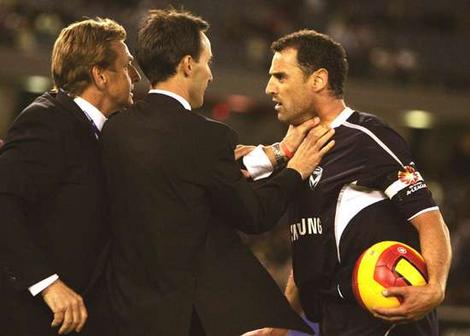
ADELAIDE United coach John Kosmina was sensationally sent off after clashing aggressively with Melbourne Victory skipper Kevin Muscat in the dying minutes of an intense encounter at Telstra Dome last night.
In front of 32,368 fans, Kosmina appeared to hold the ball to prevent Muscat taking a quick throw-in as Melbourne went in search of an equaliser. The two - colleagues last week when Kosmina was assistant Socceroos coach and Muscat in the national squad - pushed, shoved, jostled and shouted at each other after Muscat grabbed the ball and Kosmina ended up on the ground.
The Adelaide boss leapt to his feet and grabbed Muscat by the throat and the two had to be separated by team staff and match officials.
Kosmina was ordered to leave the arena by referee Matthew Breeze.
Saturday, October 14, 2006

Friday, October 13, 2006





Monday, September 25, 2006
More TVs than people in the US
September 25, 2006
The number of television sets has dwarfed the number of people in US households in the past two years, according to Nielsen Media Research.
"There are today 2.73 television sets versus 2.55 people in typical US households," said Gary Holmes, spokesman for Nielsen. "Somewhere between 2001 and 2004, the number of TVs outgrew the number of people."
He attributed that trend to the fact that television sets have become more affordable and to increasing diversity in programming.
"With the proliferation of television channels and programs, there is more desire for everyone in the house to have their own TV set," Holmes said.
He said half of US homes have three or more sets today, and a mere 19 per cent have one set. That is compared to 1975 when 57 per cent of households had one TV set and 11 per cent had three or more.
The increase in the number of television sets coincides with an increase in television viewing, which now stands at eight hours and 14 minutes a day per average household, a record high and a three-minute increase from the 2004-05 season.
The average amount of television watched by an individual viewer increased three minutes per day to four hours and 35 minutes, also a record, Nielsen said.
Holmes said another surprising finding was an increase in the amount of time teenagers, particularly girls, spent watching television.
AFP
The number of television sets has dwarfed the number of people in US households in the past two years, according to Nielsen Media Research.
"There are today 2.73 television sets versus 2.55 people in typical US households," said Gary Holmes, spokesman for Nielsen. "Somewhere between 2001 and 2004, the number of TVs outgrew the number of people."
He attributed that trend to the fact that television sets have become more affordable and to increasing diversity in programming.
"With the proliferation of television channels and programs, there is more desire for everyone in the house to have their own TV set," Holmes said.
He said half of US homes have three or more sets today, and a mere 19 per cent have one set. That is compared to 1975 when 57 per cent of households had one TV set and 11 per cent had three or more.
The increase in the number of television sets coincides with an increase in television viewing, which now stands at eight hours and 14 minutes a day per average household, a record high and a three-minute increase from the 2004-05 season.
The average amount of television watched by an individual viewer increased three minutes per day to four hours and 35 minutes, also a record, Nielsen said.
Holmes said another surprising finding was an increase in the amount of time teenagers, particularly girls, spent watching television.
AFP
Saturday, September 23, 2006
Swans into Grand Final

The Swans 19.13 (127) def Dockers 14.8. (92) to move into the Grand Final.
Barry Hall kicked 6 goals
O'Keefe kicked 4 goals
O'Loughlin also kicked 4 goals
Go Swans !!!!!!!!!!!!!!!!!!!!!!!!!!!!!
64 Foot Wave
Monster breaks off Tassie
September 22, 2006
SMH
Gale force winds have produced a massive 19.5-metre wave off the coast of Tasmania, according to surf forecasters.
The rogue wave was recorded about 9am (AEST) yesterday and is believed to be one of the largest ever measured in Australia, forecasters say.
Swellnet website forecaster Ben Matson said a waverider buoy located 10 kilometres from Cape Sorell, on Tasmania's west coast, recorded a wave peaking at a height of 19.5 metres (64 foot) as westerly winds crossed the coastline.
"It was probably a combination of several waves that all combined at the one time to produce this single enormous wave," he said.
"Large swells are common in the Southern Ocean at this time of year but wave heights of this magnitude are extremely rare."
Mr Matson said waves of that size had the potential to cause significant damage to ships and had been known to "send oil tankers to the bottom of the ocean" in other parts of the world.
Forecasters were currently examining old data but Mr Matson said the wave could be the largest ever measured in the country.
September 22, 2006
SMH
Gale force winds have produced a massive 19.5-metre wave off the coast of Tasmania, according to surf forecasters.
The rogue wave was recorded about 9am (AEST) yesterday and is believed to be one of the largest ever measured in Australia, forecasters say.
Swellnet website forecaster Ben Matson said a waverider buoy located 10 kilometres from Cape Sorell, on Tasmania's west coast, recorded a wave peaking at a height of 19.5 metres (64 foot) as westerly winds crossed the coastline.
"It was probably a combination of several waves that all combined at the one time to produce this single enormous wave," he said.
"Large swells are common in the Southern Ocean at this time of year but wave heights of this magnitude are extremely rare."
Mr Matson said waves of that size had the potential to cause significant damage to ships and had been known to "send oil tankers to the bottom of the ocean" in other parts of the world.
Forecasters were currently examining old data but Mr Matson said the wave could be the largest ever measured in the country.
Friday, September 22, 2006
Vampire Jet Car

The Vampire Jet Car weighs 2,200 lbs. The car is 30 feet long and drinks 7-10 gallons per mile of fuel.
It accelerates at 0-272 in six seconds and is powered by a Rolls Royce Orpheus jet engine.
The car is theoretically capable of 370mph.
Tuesday, September 19, 2006
First penis transplant comes unstuck
Ian Sample in London
September 19, 2006
A CHINESE man who had the world's first penis transplant had the organ removed two weeks later because he and his wife had a "severe psychological problem" with his new penis.
The man's penis was damaged beyond repair in an accident this year, leaving him with a one centimetre-long stump with which he was unable to urinate or have sexual intercourse.
"His quality of life was affected severely," said Dr Weilie Hu, a surgeon at Guangzhou General Hospital.
Doctors spent 15 hours attaching a 10-centimetre penis to the 44-year-old man after the parents of a brain-dead man half his age agreed to donate their son's organ.
The procedure, described in a case study due to appear in the journal European Urology next month, represents a big leap forward in transplant surgery.
After 10 days, tests revealed the organ had a rich blood supply and the man was able to urinate normally. Although the operation was a surgical success, surgeons said they had to remove the penis two weeks later.
"Because of a severe psychological problem of the recipient and his wife, the transplanted penis regretfully had to be cut off," Dr Hu said.
An examination of the organ showed no signs of it being rejected by the body, he said.
Jean-Michel Dubernard, the French surgeon who this year performed the world's first face transplant on a woman who had been attacked by a dog, said psychological factors were a serious issue for many patients receiving certain "allografts", or organs from donors.
"Psychological consequences of hand and face allografts show that it is not so easy to use and see permanently a dead person's hands, nor is it easy to look in a mirror to see a dead person's face," Dr Dubernard wrote in European Urology.
"Clearly, in the Chinese case the failure at a very early stage was first psychological. It involved the recipient's wife and raised many questions."
In 2001, surgeons were forced to amputate the world's first transplanted hand from Clint Hallam, a 50-year-old New Zealander, who said he wanted the "hideous and withered" hand removed because he had become "mentally detached" from it.
Andrew George, a transplant expert at Imperial College London, said: "Doing a penis transplant should be no more complex than anything else. But it takes time for nerve sensations to kick in and it's not clear whether the patient would ever be able to have sex with it."
The Guardian
September 19, 2006
A CHINESE man who had the world's first penis transplant had the organ removed two weeks later because he and his wife had a "severe psychological problem" with his new penis.
The man's penis was damaged beyond repair in an accident this year, leaving him with a one centimetre-long stump with which he was unable to urinate or have sexual intercourse.
"His quality of life was affected severely," said Dr Weilie Hu, a surgeon at Guangzhou General Hospital.
Doctors spent 15 hours attaching a 10-centimetre penis to the 44-year-old man after the parents of a brain-dead man half his age agreed to donate their son's organ.
The procedure, described in a case study due to appear in the journal European Urology next month, represents a big leap forward in transplant surgery.
After 10 days, tests revealed the organ had a rich blood supply and the man was able to urinate normally. Although the operation was a surgical success, surgeons said they had to remove the penis two weeks later.
"Because of a severe psychological problem of the recipient and his wife, the transplanted penis regretfully had to be cut off," Dr Hu said.
An examination of the organ showed no signs of it being rejected by the body, he said.
Jean-Michel Dubernard, the French surgeon who this year performed the world's first face transplant on a woman who had been attacked by a dog, said psychological factors were a serious issue for many patients receiving certain "allografts", or organs from donors.
"Psychological consequences of hand and face allografts show that it is not so easy to use and see permanently a dead person's hands, nor is it easy to look in a mirror to see a dead person's face," Dr Dubernard wrote in European Urology.
"Clearly, in the Chinese case the failure at a very early stage was first psychological. It involved the recipient's wife and raised many questions."
In 2001, surgeons were forced to amputate the world's first transplanted hand from Clint Hallam, a 50-year-old New Zealander, who said he wanted the "hideous and withered" hand removed because he had become "mentally detached" from it.
Andrew George, a transplant expert at Imperial College London, said: "Doing a penis transplant should be no more complex than anything else. But it takes time for nerve sensations to kick in and it's not clear whether the patient would ever be able to have sex with it."
The Guardian
Monday, September 18, 2006
Energy Polariser
ANDREW DENTON: I will move on to what was the low point in your career, which was the Energy Polarizer, which you brought out in the...
PETER BROCK: Yeah, that was an interesting thing, actually, because...
ANDREW DENTON: Can I just explain to those that don't know what it was, it was just a, it was a box...with magnets and crystals, which you said would turn even a dog of a car into a sweet-running one. And basically, the press turned on you as some kind of New-Age crank.
PETER BROCK: They did, but I must tell you that the only portion of crystal in that was a sliver of crystal, not unlike what you have in a wristwatch. So I wasn't exactly, you know, sleeping under pyramids and stuff like that.
ANDREW DENTON: Why did they turn on you?
PETER BROCK: I didn't have the ability to give them a suitable explanation as to why it worked.
ANDREW DENTON: And why not?
PETER BROCK: Too difficult, really. I mean, it was gonna cost me 750,000 dollars to get a scientific validation of it. And I didn't have it. I said, "Look, can you just trust the fact that it does work?" And most of the journalists said, "Yeah, this works good."
PETER BROCK: Yeah, that was an interesting thing, actually, because...
ANDREW DENTON: Can I just explain to those that don't know what it was, it was just a, it was a box...with magnets and crystals, which you said would turn even a dog of a car into a sweet-running one. And basically, the press turned on you as some kind of New-Age crank.
PETER BROCK: They did, but I must tell you that the only portion of crystal in that was a sliver of crystal, not unlike what you have in a wristwatch. So I wasn't exactly, you know, sleeping under pyramids and stuff like that.
ANDREW DENTON: Why did they turn on you?
PETER BROCK: I didn't have the ability to give them a suitable explanation as to why it worked.
ANDREW DENTON: And why not?
PETER BROCK: Too difficult, really. I mean, it was gonna cost me 750,000 dollars to get a scientific validation of it. And I didn't have it. I said, "Look, can you just trust the fact that it does work?" And most of the journalists said, "Yeah, this works good."
Tuesday, September 12, 2006
Fish aren't thick: scientist
David Braithwaite
September 12, 2006 SMH
Fish can be trained en masse and then used to train other fish
Watch this space ... "It's completely ridiculous that an animal could survive without a memory," says Dr Brown.
Having a memory like a goldfish could actually be a good thing, says a Sydney scientist who has spent 10 years proving fish are not as dumb as we think.
Fish are not the bowl-circling dimwits we imagine and could be as socially able as monkeys and elephants, Dr Culum Brown of Macquarie University says.
The biology lecturer has spent the past decade putting fish through learning and memory tests, which he says shows they are much deeper thinkers than they look.
For a start, Dr Brown says the three-second memory of goldfish is a myth: "It's completely ridiculous that an animal could survive without a memory."
Fish are so clever, Dr Brown says, that those schooled in survival skills can even teach their captivity-raised peers how to get by in the sea.
To help prove his theories, Dr Brown put rainbow fish into a tank with a mock trawler net with a single hole and watched how long it took them to find an escape route.
"Without any prior experience the fish learned where the hole was in about five runs," he says.
A year later, the same fish managed to find the hole on their first try, which Dr Brown says shows they easily recalled the skills they had learned.
In another study, Dr Brown scared intertidal gobies from a rock pool and as they dived for safety found they plopped precisely in surrounding pools.
"This suggests that fish are able to form mental maps similar to those people use when planning a route to a familiar destination," he says.
Dr Brown also studies "social learning" among fish, where fish trained to recognise predators and wild food teach captivity-bred fish how to survive.
"Fish can be trained en masse and then used to train other fish," he says.
"What we've found is the latter groups of fish learn more rapidly when ... placed with trained fish."
The research could prove useful to the aquaculture industry, Dr Brown says.
September 12, 2006 SMH
Fish can be trained en masse and then used to train other fish
Watch this space ... "It's completely ridiculous that an animal could survive without a memory," says Dr Brown.
Having a memory like a goldfish could actually be a good thing, says a Sydney scientist who has spent 10 years proving fish are not as dumb as we think.
Fish are not the bowl-circling dimwits we imagine and could be as socially able as monkeys and elephants, Dr Culum Brown of Macquarie University says.
The biology lecturer has spent the past decade putting fish through learning and memory tests, which he says shows they are much deeper thinkers than they look.
For a start, Dr Brown says the three-second memory of goldfish is a myth: "It's completely ridiculous that an animal could survive without a memory."
Fish are so clever, Dr Brown says, that those schooled in survival skills can even teach their captivity-raised peers how to get by in the sea.
To help prove his theories, Dr Brown put rainbow fish into a tank with a mock trawler net with a single hole and watched how long it took them to find an escape route.
"Without any prior experience the fish learned where the hole was in about five runs," he says.
A year later, the same fish managed to find the hole on their first try, which Dr Brown says shows they easily recalled the skills they had learned.
In another study, Dr Brown scared intertidal gobies from a rock pool and as they dived for safety found they plopped precisely in surrounding pools.
"This suggests that fish are able to form mental maps similar to those people use when planning a route to a familiar destination," he says.
Dr Brown also studies "social learning" among fish, where fish trained to recognise predators and wild food teach captivity-bred fish how to survive.
"Fish can be trained en masse and then used to train other fish," he says.
"What we've found is the latter groups of fish learn more rapidly when ... placed with trained fish."
The research could prove useful to the aquaculture industry, Dr Brown says.
Monday, September 11, 2006
Poor twice as likely to commit suicide
Julie Robotham Medical Editor
September 11, 2006
SMH
YOUNG adults from disadvantaged backgrounds are almost twice as likely to commit suicide as their more affluent peers, new research has found.
Despite overall reductions in suicides, the proportion of people from low socio-economic groups who took their lives between 1999 and 2003 rose more steeply than at any other period in the previous three decades, analysis by Richard Taylor, professor of population health at the University of Queensland, found.
"These aren't individual phenomena, these are group phenomena," Professor Taylor said.
"We've got to get beyond the psychiatric model … depression is not an answer. Depression is a question. We have got to look harder at what are the social and economic underpinnings of risk."
Suicide rates peaked in the late 1990s, when the wider use of anti-depressants and the introduction of a National Suicide Prevention Strategy began to turn around an increase that had persisted since the 1970s.
But Professor Taylor said these measures had been insufficient to save the lives of people lower down the income and education scales, who were increasingly priced out of the housing market and denied secure employment.
It was also possible that poorer people had less access to specialist mental health services and medications for their mood disorder and that mental health campaigns might be bypassing the most vulnerable people because their messages were "made by the middle class for the middle class".
Professor Taylor found suicides among 20- to 34-year-old men in the most disadvantaged one-fifth of the population had risen by 8 per cent in the five years from 1999 to 2003, compared with the preceding period, to 48.6 suicide deaths for every 100,000 people. That was nearly double the 27 per 100,000 of young men from the most affluent one-fifth of backgrounds, whose suicide rate fell by 15 per cent over the same period.
The analysis, published this week in the journal Social Psychiatry and Psychiatric Epidemiology, applied Australian Bureau of Statistics rankings of the relative socioeconomic status of small geographic areas to the addresses of people who had died by suicide.
September 11, 2006
SMH
YOUNG adults from disadvantaged backgrounds are almost twice as likely to commit suicide as their more affluent peers, new research has found.
Despite overall reductions in suicides, the proportion of people from low socio-economic groups who took their lives between 1999 and 2003 rose more steeply than at any other period in the previous three decades, analysis by Richard Taylor, professor of population health at the University of Queensland, found.
"These aren't individual phenomena, these are group phenomena," Professor Taylor said.
"We've got to get beyond the psychiatric model … depression is not an answer. Depression is a question. We have got to look harder at what are the social and economic underpinnings of risk."
Suicide rates peaked in the late 1990s, when the wider use of anti-depressants and the introduction of a National Suicide Prevention Strategy began to turn around an increase that had persisted since the 1970s.
But Professor Taylor said these measures had been insufficient to save the lives of people lower down the income and education scales, who were increasingly priced out of the housing market and denied secure employment.
It was also possible that poorer people had less access to specialist mental health services and medications for their mood disorder and that mental health campaigns might be bypassing the most vulnerable people because their messages were "made by the middle class for the middle class".
Professor Taylor found suicides among 20- to 34-year-old men in the most disadvantaged one-fifth of the population had risen by 8 per cent in the five years from 1999 to 2003, compared with the preceding period, to 48.6 suicide deaths for every 100,000 people. That was nearly double the 27 per 100,000 of young men from the most affluent one-fifth of backgrounds, whose suicide rate fell by 15 per cent over the same period.
The analysis, published this week in the journal Social Psychiatry and Psychiatric Epidemiology, applied Australian Bureau of Statistics rankings of the relative socioeconomic status of small geographic areas to the addresses of people who had died by suicide.
Generation Y's crime of their lives
Matthew Moore
September 11, 2006
SMH
ONE IN seven men born in NSW in 1984 had a criminal record by the time they turned 21, the first study of the proportion of generation Y members charged with a crime has found.
The study of all 81,784 people born in the state that year shows that 9.9 per cent of them were brought before a court before they turned 21, and virtually all of that 9.9 per cent were convicted of at least one offence.
About a third of these convictions were for drink-driving and other motor vehicle offences, 13 per cent were for theft and 10 per cent were for "acts intended to cause injury".
The study by NSW Bureau of Crime Statistics reveals that one in 200 people born in 1984 was sentenced to jail before their 21st birthday.
The director of the bureau, Don Weatherburn, said he was surprised such a big proportion of people had criminal records.
"It gives the lie to the proposition that criminals represent some tiny fraction of the community," he said.
As this study was the first of its type, Dr Weatherburn said he could not say whether the proportion of people with criminal records was likely to be different for people born in other years.
One brush with the law was enough for most, as 61 per cent of those who had records had only one appearance before the courts.
Seventy-two per cent of people who appeared before the courts did so after they turned 18.
A small number of people were responsible for a large number of court appearances: 9 per cent of the 9.9 per cent brought before a court appeared in court five times or more before they turned 21 and 2.3 per cent appeared in court 10 times or more.
As most people only offended once, Dr Weatherburn said, it was pointless "coming down hard" on them. He said resources should be allocated to the small group who committed most of the offences, because there were "enormous potential savings".
September 11, 2006
SMH
ONE IN seven men born in NSW in 1984 had a criminal record by the time they turned 21, the first study of the proportion of generation Y members charged with a crime has found.
The study of all 81,784 people born in the state that year shows that 9.9 per cent of them were brought before a court before they turned 21, and virtually all of that 9.9 per cent were convicted of at least one offence.
About a third of these convictions were for drink-driving and other motor vehicle offences, 13 per cent were for theft and 10 per cent were for "acts intended to cause injury".
The study by NSW Bureau of Crime Statistics reveals that one in 200 people born in 1984 was sentenced to jail before their 21st birthday.
The director of the bureau, Don Weatherburn, said he was surprised such a big proportion of people had criminal records.
"It gives the lie to the proposition that criminals represent some tiny fraction of the community," he said.
As this study was the first of its type, Dr Weatherburn said he could not say whether the proportion of people with criminal records was likely to be different for people born in other years.
One brush with the law was enough for most, as 61 per cent of those who had records had only one appearance before the courts.
Seventy-two per cent of people who appeared before the courts did so after they turned 18.
A small number of people were responsible for a large number of court appearances: 9 per cent of the 9.9 per cent brought before a court appeared in court five times or more before they turned 21 and 2.3 per cent appeared in court 10 times or more.
As most people only offended once, Dr Weatherburn said, it was pointless "coming down hard" on them. He said resources should be allocated to the small group who committed most of the offences, because there were "enormous potential savings".
Sunday, September 10, 2006
Peter Brock RIP


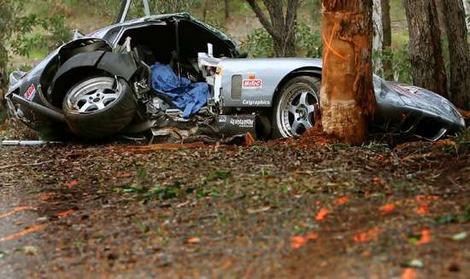
Australian motor racing legend Peter Brock has been killed in an accident while taking part in the Targa West rally in Western Australia, motor sport officials have confirmed.
He was driving a Daytona Coupe and died after hitting a gum tree, his co-driver Mick Hone survived the accident.
Go Swans !!

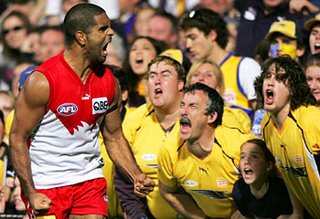 THE Sydney Swans advance to the preliminary final after a thrilling one-point win.
Michael O'Loughlin goaled with three minutes to go to win against the West Coast Eagles last night.
Thursday, September 07, 2006
WHO concerned by drug resistant strain of TB
The World Today - Thursday, 7 September , 2006
Reporter: Zoe Daniel
ELEANOR HALL: The World Health Organisation has released alarming findings about new strains of the disease tuberculosis, which it says are almost untreatable.In most Western countries TB is virtually non-existent but it's still highly prevalent in the third world. These virulent new strains have already infected people in the United States and Eastern Europe.And experts are meeting in South Africa to deal with a serious outbreak in the province of Kwa Zulu Natal, as Africa Correspondent Zoe Daniel reports.
ZOE DANIEL: It's feared that the Extreme Drug Resistant strain of TB was created by inappropriate use of TB medications. It's believed that TB resistance can be created by the use of drugs at the wrong dosage or for the wrong period of time.
Dr Paul Nunn from the World Health Organisation says the increasing prevalence of the drug resistant strain is a huge concern to health authorities.
PAUL NUNN: Well, the World Health Organisation is concerned because it's virtually or definitely untreatable. By definition this extreme drug resistance or XDR, as it's increasingly be called, is resistant to at least three of the six groups of second line drugs that are available. And by definition they're already resistant to the first line drugs. And so this means that any patient with XDR TB cannot get optimal treatment because we recommend that a patient with tuberculosis be treated with at least four drugs.
ZOE DANIEL: In South Africa an outbreak of drug resistant TB in Kwa Zulu Natal illustrates the extent of the problem. South Africa has the highest rate of HIV in the world, and tuberculosis is notorious for attacking the weakened immune systems of those who are HIV positive.However there was no treatment available when the drug resistant strain took hold, and the result for most was death.
PAUL NUNN: We carried out a survey that was published earlier this year showing the problem exists in about two per cent of cases globally. But what's most worrying is an outbreak recently reported from Kwa Zulu Natal showing that the XDR is there. That of the 53 patients that they looked at, 52 died within 210 days. So this is an extraordinarily high mortality rate. And clearly this is linked to the fact that all those tested were HIV infected as well. And this is the problem that we're really worried about. It's the spectre of extreme drug resistance fuelled by HIV in countries that don't really have the resources to address it right now.
ZOE DANIEL: At the moment TB causes about 1.7 million deaths per year around the world. But that's with the cocktail of drugs commonly used to treat it. Now resistance is showing up to the usual front line drugs and many of the so-called second line drugs that are used when the frontline drugs don't work.Dr Paul Nunn says part of the problem is that new drugs aren't coming onto the market because TB isn't present in most Western countries.
PAUL NUNN: During the 1980s and 1990s research into new anti-TB agents virtually disappeared in pharmaceutical companies because the TB problem was felt to be solved in the north and people did not realise the scale of the TB problem in developing countries at that time. And only in the last six or seven years has research really ramped up for new anti TB agents.The global alliance for anti TB drug development leading the fray, if you like, in New York funded largely by the Bill and Melinda Gates foundation. But clearly more investment in that area is required.
ZOE DANIEL: It's not yet clear how easily the drug resistant strain of TB is transmitted.
In Johannesburg, this is Zoe Daniel reporting for The World Today.
Reporter: Zoe Daniel
ELEANOR HALL: The World Health Organisation has released alarming findings about new strains of the disease tuberculosis, which it says are almost untreatable.In most Western countries TB is virtually non-existent but it's still highly prevalent in the third world. These virulent new strains have already infected people in the United States and Eastern Europe.And experts are meeting in South Africa to deal with a serious outbreak in the province of Kwa Zulu Natal, as Africa Correspondent Zoe Daniel reports.
ZOE DANIEL: It's feared that the Extreme Drug Resistant strain of TB was created by inappropriate use of TB medications. It's believed that TB resistance can be created by the use of drugs at the wrong dosage or for the wrong period of time.
Dr Paul Nunn from the World Health Organisation says the increasing prevalence of the drug resistant strain is a huge concern to health authorities.
PAUL NUNN: Well, the World Health Organisation is concerned because it's virtually or definitely untreatable. By definition this extreme drug resistance or XDR, as it's increasingly be called, is resistant to at least three of the six groups of second line drugs that are available. And by definition they're already resistant to the first line drugs. And so this means that any patient with XDR TB cannot get optimal treatment because we recommend that a patient with tuberculosis be treated with at least four drugs.
ZOE DANIEL: In South Africa an outbreak of drug resistant TB in Kwa Zulu Natal illustrates the extent of the problem. South Africa has the highest rate of HIV in the world, and tuberculosis is notorious for attacking the weakened immune systems of those who are HIV positive.However there was no treatment available when the drug resistant strain took hold, and the result for most was death.
PAUL NUNN: We carried out a survey that was published earlier this year showing the problem exists in about two per cent of cases globally. But what's most worrying is an outbreak recently reported from Kwa Zulu Natal showing that the XDR is there. That of the 53 patients that they looked at, 52 died within 210 days. So this is an extraordinarily high mortality rate. And clearly this is linked to the fact that all those tested were HIV infected as well. And this is the problem that we're really worried about. It's the spectre of extreme drug resistance fuelled by HIV in countries that don't really have the resources to address it right now.
ZOE DANIEL: At the moment TB causes about 1.7 million deaths per year around the world. But that's with the cocktail of drugs commonly used to treat it. Now resistance is showing up to the usual front line drugs and many of the so-called second line drugs that are used when the frontline drugs don't work.Dr Paul Nunn says part of the problem is that new drugs aren't coming onto the market because TB isn't present in most Western countries.
PAUL NUNN: During the 1980s and 1990s research into new anti-TB agents virtually disappeared in pharmaceutical companies because the TB problem was felt to be solved in the north and people did not realise the scale of the TB problem in developing countries at that time. And only in the last six or seven years has research really ramped up for new anti TB agents.The global alliance for anti TB drug development leading the fray, if you like, in New York funded largely by the Bill and Melinda Gates foundation. But clearly more investment in that area is required.
ZOE DANIEL: It's not yet clear how easily the drug resistant strain of TB is transmitted.
In Johannesburg, this is Zoe Daniel reporting for The World Today.
Wednesday, September 06, 2006
Yin and Yang

From Wikipedia
Taijitu, the traditional symbol representing the forces of Yin and Yang
The concepts of yin and yang originate in ancient Chinese philosophy and metaphysics, which describes two primal opposing but complementary forces found in all things in the universe.
Yin, is sad, the darker element, is passive, dark, feminine, downward-seeking, and corresponds to the night;
Yang, is happy, the brighter element, is active, light, masculine, upward-seeking and corresponds to the day;
Yin is often symbolized by water, while Yang is symbolized by fire.
The pair probably goes back to ancient agrarian religion; it exists in Confucianism, and it is prominent in Taoism.
Though the words yin and yang only appear once in theTeo Te Ching, the book is laden with examples and clarifications of the concept of mutual arising.
The concept is a fundamental principle of Traditional Chinese Medicine.
Yin and yang are descriptions of complementary opposites rather than absolutes.
Any yin/yang dichotomy can be seen as its opposite when viewed from another perspective.
Monday, September 04, 2006
"Crikey" - Steve Irwin killed by stingray

Crocodile man reported dead
September 4, 2006
Television personality and environmentalist Steve Irwin has died in a marine accident in north Queensland, state government sources say.
The 44-year-old is believed to have been killed by a stingray barb that went through his chest, the sources said.
He was filming an underwater documentary off Port Douglas when the accident occurred.
Mr Irwin's body was being flown to Cairns by helicopter.
Australian emergency officials could not immediately confirm the reports.
Irwin won a global following for his daredevil antics but also triggered outrage in 2004 by holding his then one-month-old baby while feeding a snapping crocodile at his Australian zoo.
It is believed his American-born wife Terri is trekking on Cradle Mountain in Tasmania.
Mr Irwin - known worldwide as the Crocodile Hunter - is famous for his enthusiasm for wildlife and his catchcry "Crikey!''.
The father of two's Crocodile Hunter program was first broadcast in 1992 and has been shown around the world on cable network Discovery.
AAP and SMH
Friday, September 01, 2006
Left or Right Pawed ???
Richard Macey
September 1, 2006
SMH
YOUR dog is inquisitive and loves exploring the neighbourhood. Or he is timid, nervous, and prefers sticking nearer to home.
His behaviour could be linked to his being left- or right-pawed.
And before you punt your wages on the next race at Randwick, it might be handy to know whether the horse, thanks to being left- or right-hoofed, prefers galloping clockwise, as they do in NSW, or anti-clockwise, as in Victoria.
There is growing evidence, says Paul McGreevy, a senior lecturer in the University of Sydney's Faculty of Veterinary Science, that behavioural traits in many animals, including dogs and horses, are linked to their handedness, or "laterality".
That animals have a preferred side has been accepted for almost 20 years. Now Dr McGreevy is conducting a three-year study, funded by the Australian Research Council, to explore "pawedness" in dogs.
His students have tested 270, giving them food cylinders and watching which paw they use to hold them steady. Repeating the experiment 100 times on each dog, they found about 15 per cent are left-pawed, 15 per cent right-pawed, and the rest are neither.
"Dogs that lack any bias are more likely to have noise phobias," Dr McGreevy said. "They get upset by thunderstorms and fireworks. If we can show laterality is a predictor of a dog's motivation or reluctance to explore, we can help guide dog and sniffer dog trainers select the right animals."
Knowing which side of a dog's brain is dominant could change pet training.
"There is a convention to train dogs on the left of the trainer. It's a human convention we have imposed, and it's unlikely to suit all dogs equally."
There appeared to be no differences in pawedness between breeds, but "males are more likely to be left than right, and females more likely to be right than left".
He has also confirmed "hoofedness" in racing horses. After watching 186 grazing in paddocks, observing whether they put their left or right hoofs forward as they ate, he found 40 per cent had a left preference, while 10 per cent had a right bias. The rest had none.
A horse might develop more powerful muscles on, for example, its right side, as a result of its hoofedness. It might thus excel on right curving tracks, but be disadvantaged going anti-clockwise.
That animals share the human trait of being left- or right-handed should not be surprising.
"It's evidence we all came from a common ancestor."
September 1, 2006
SMH
YOUR dog is inquisitive and loves exploring the neighbourhood. Or he is timid, nervous, and prefers sticking nearer to home.
His behaviour could be linked to his being left- or right-pawed.
And before you punt your wages on the next race at Randwick, it might be handy to know whether the horse, thanks to being left- or right-hoofed, prefers galloping clockwise, as they do in NSW, or anti-clockwise, as in Victoria.
There is growing evidence, says Paul McGreevy, a senior lecturer in the University of Sydney's Faculty of Veterinary Science, that behavioural traits in many animals, including dogs and horses, are linked to their handedness, or "laterality".
That animals have a preferred side has been accepted for almost 20 years. Now Dr McGreevy is conducting a three-year study, funded by the Australian Research Council, to explore "pawedness" in dogs.
His students have tested 270, giving them food cylinders and watching which paw they use to hold them steady. Repeating the experiment 100 times on each dog, they found about 15 per cent are left-pawed, 15 per cent right-pawed, and the rest are neither.
"Dogs that lack any bias are more likely to have noise phobias," Dr McGreevy said. "They get upset by thunderstorms and fireworks. If we can show laterality is a predictor of a dog's motivation or reluctance to explore, we can help guide dog and sniffer dog trainers select the right animals."
Knowing which side of a dog's brain is dominant could change pet training.
"There is a convention to train dogs on the left of the trainer. It's a human convention we have imposed, and it's unlikely to suit all dogs equally."
There appeared to be no differences in pawedness between breeds, but "males are more likely to be left than right, and females more likely to be right than left".
He has also confirmed "hoofedness" in racing horses. After watching 186 grazing in paddocks, observing whether they put their left or right hoofs forward as they ate, he found 40 per cent had a left preference, while 10 per cent had a right bias. The rest had none.
A horse might develop more powerful muscles on, for example, its right side, as a result of its hoofedness. It might thus excel on right curving tracks, but be disadvantaged going anti-clockwise.
That animals share the human trait of being left- or right-handed should not be surprising.
"It's evidence we all came from a common ancestor."
Wednesday, August 30, 2006
"Build a Brain" tutorial

Random Man says check out this link . . .
http://www.stanford.edu/group/hopes/basics/braintut/ab0.html
Star Trek's a thesis
By Adam Morton
August 28, 2006
The Age
It's the PhD thesis that boldly goes where no thesis has gone before. Djoymi Baker watched 700 episodes - 624 hours without ads - of Star Trek and its spin-offs, dating from 1966 to 2005, in the name of research.
She analysed the series armed with an exhaustive knowledge of the characters and storylines of ancient mythology - from Homer's Odyssey down.
It may sound like torture for those with an aversion to William Shatner's campy theatrics but, six years and 90,000 words on, it has earned Dr Baker a coveted chancellor's prize for excellence at Melbourne University. And the respect of academics and Trekkies alike.
"I was interested in where myths turn up in less obvious forms, and there wasn't much work on the early years of television and its relation to myth," Dr Baker said.
Importantly, she was also a fan of the series.
"I don't think just because a study is serious and that I'm connecting Star Trek to a broader history of TV and ancient myths that it means there is not also a fun side - I can see the fun side as well."
Among the dark corners where Dr Baker's thesis - titled Broadcast Space: TV Culture, Myth and Star Trek - shines light is the changing link between the starship Enterprise's intergalactic adventures and the real world's space race.
Shatner's monologues were inspired by the visionary speeches of JFK, advocating greater exploration. Thirty years on, the roles were reversed, with astronauts from the National Aeronautics and Space Administration guest-starring on Star Trek spin-offs to promote their underfunded existence.
Since finishing her thesis last year, the 34-year-old has had a daughter and is turning her thesis into an academic text.
She's also writing an introductory piece for a Star Trek exhibition at the Victorian College of the Arts in October.
August 28, 2006
The Age
It's the PhD thesis that boldly goes where no thesis has gone before. Djoymi Baker watched 700 episodes - 624 hours without ads - of Star Trek and its spin-offs, dating from 1966 to 2005, in the name of research.
She analysed the series armed with an exhaustive knowledge of the characters and storylines of ancient mythology - from Homer's Odyssey down.
It may sound like torture for those with an aversion to William Shatner's campy theatrics but, six years and 90,000 words on, it has earned Dr Baker a coveted chancellor's prize for excellence at Melbourne University. And the respect of academics and Trekkies alike.
"I was interested in where myths turn up in less obvious forms, and there wasn't much work on the early years of television and its relation to myth," Dr Baker said.
Importantly, she was also a fan of the series.
"I don't think just because a study is serious and that I'm connecting Star Trek to a broader history of TV and ancient myths that it means there is not also a fun side - I can see the fun side as well."
Among the dark corners where Dr Baker's thesis - titled Broadcast Space: TV Culture, Myth and Star Trek - shines light is the changing link between the starship Enterprise's intergalactic adventures and the real world's space race.
Shatner's monologues were inspired by the visionary speeches of JFK, advocating greater exploration. Thirty years on, the roles were reversed, with astronauts from the National Aeronautics and Space Administration guest-starring on Star Trek spin-offs to promote their underfunded existence.
Since finishing her thesis last year, the 34-year-old has had a daughter and is turning her thesis into an academic text.
She's also writing an introductory piece for a Star Trek exhibition at the Victorian College of the Arts in October.
Monday, August 28, 2006
Scorpions into the Grand Final !!

Lining up the the Scorpions at the SCG this sunday
Leo Barry (back)
Brett Kirk (centre)
Darren Jolly (ruck)
Michael O'Loughlin (forward)
Barry Hall (forward)
With Jason Roe and Trent Hentschel out with leg injuries and Josh Kennedy out with a punctured lung it is not going to be easy for the Scorpions. Hopefully Chris Tarrant is back this week. Fingers crossed !!
Fantastic effort from Matthew Richardson on the weekend (189 points).
Tuesday, August 22, 2006
Dark matter exists
By Robert Roy Britt
Monday, August 21, 2006
Scientists found proof of dark matter in galaxy cluster 1E0657-556
Harvard-Smithsonian Center for Astrophysics
National Aeronautics and Space Administration (NASA)
University of Arizona
New observations of a great big cosmic collision provide the best evidence yet that invisible and mysterious dark matter really does exist.
The collision, between two huge clusters of galaxies, is the "most energetic cosmic event, besides the Big Bang, that we know about," said Maxim Markevitch of the Harvard-Smithsonian Center for Astrophysics in Cambridge, Massachusetts.
The impact split normal matter and dark matter apart, rendering the dark matter's gravitational presence observable.
Scientists announced the discovery today in a teleconference with reporters.
The normal matter in the cosmos -- atoms that make up stars, planets, air and life -- accounts for only a small fraction of what must exist, based on the fact that without an additional source of gravity, galaxies would fly apart and galaxy clusters could not hold together as they do.
Nobody knows where all that gravity comes from, so scientists say there must be some invisible stuff out there, which they call dark matter. Its presence is indirectly supported by many observations.
Given what's known, this is the makeup of the universe:
5 percent normal matter
25 percent dark matter
70 percent dark energy
Dark energy is an even more mysterious phenomenon, a force of some sort that beats out gravity and is causing the universe to expand at an ever-faster pace.
Some theorists have suggested that rather than invoking dark matter, perhaps existing ideas about gravity might be wrong. Maybe gravity is stronger on intergalactic scales than what is predicted by Newton and Einstein.
And all astronomers agree that dark matter is such an exotic idea as to border on the crazy.
"A universe that's dominated by dark stuff seems preposterous, so we wanted to test whether there were any basic flaws in our thinking," said Doug Clowe of the University of Arizona at Tucson, and leader of the study. "These results are direct proof that dark matter exists."
Splitting matter
Clowe and colleagues used NASA's Chandra X-ray Observatory to study the galaxy cluster 1E0657-556, which contains a bullet-shaped cloud of superheated gas. X-rays show the shape was produced by cosmic winds created in a high-speed collision of two clusters of galaxies.
Other telescopes were used to locate and quantify the mass in the clusters. They actually measured the effect of gravitational lensing, in which gravity from the clusters distorts light from thousands of background galaxies, as predicted by Einstein's theory of general relativity.
The dark matter is not seen, but its gravity has a predictable effect on the observations. The resulting blue color in a new image represents the gravity fields observed by noting how the light from each background galaxy is distorted.
Here's what the image reveals:
The hot gas -- normal matter -- was slowed by a drag force described as the cosmic equivalent of air resistance. But the dark matter was not slowed by this effect, presumably because it does not interact with normal matter, as theory had predicted.
So the normal matter and dark matter became separated.
"This proves in a simple and direct way that dark matter exists." Markevitch said in the teleconference.
Other theories must cope
The finding provides further evidence that standard Newtonian gravity, which keeps planets in orbit around the sun, is the glue that makes things stick on the largest scales, too.
It is still possible there is some modification of gravity going on, but these findings make it less necessary to have such theories, said Sean Carroll, a cosmologist at the University of Chicago who was not involved with the study. "No matter what you do [in devising new theories] you're going to have to believe in dark matter."
"We've closed this loophole about gravity, and we've come closer than ever to seeing this invisible matter," Clowe said. "This is the first time we've had a direct detection of dark matter" in which you can't explain the results with any altered-gravity theory, he said.
The findings will be detailed in an upcoming issue of the Astrophysical Journal Letters.
Monday, August 21, 2006
Scientists found proof of dark matter in galaxy cluster 1E0657-556
Harvard-Smithsonian Center for Astrophysics
National Aeronautics and Space Administration (NASA)
University of Arizona
New observations of a great big cosmic collision provide the best evidence yet that invisible and mysterious dark matter really does exist.
The collision, between two huge clusters of galaxies, is the "most energetic cosmic event, besides the Big Bang, that we know about," said Maxim Markevitch of the Harvard-Smithsonian Center for Astrophysics in Cambridge, Massachusetts.
The impact split normal matter and dark matter apart, rendering the dark matter's gravitational presence observable.
Scientists announced the discovery today in a teleconference with reporters.
The normal matter in the cosmos -- atoms that make up stars, planets, air and life -- accounts for only a small fraction of what must exist, based on the fact that without an additional source of gravity, galaxies would fly apart and galaxy clusters could not hold together as they do.
Nobody knows where all that gravity comes from, so scientists say there must be some invisible stuff out there, which they call dark matter. Its presence is indirectly supported by many observations.
Given what's known, this is the makeup of the universe:
5 percent normal matter
25 percent dark matter
70 percent dark energy
Dark energy is an even more mysterious phenomenon, a force of some sort that beats out gravity and is causing the universe to expand at an ever-faster pace.
Some theorists have suggested that rather than invoking dark matter, perhaps existing ideas about gravity might be wrong. Maybe gravity is stronger on intergalactic scales than what is predicted by Newton and Einstein.
And all astronomers agree that dark matter is such an exotic idea as to border on the crazy.
"A universe that's dominated by dark stuff seems preposterous, so we wanted to test whether there were any basic flaws in our thinking," said Doug Clowe of the University of Arizona at Tucson, and leader of the study. "These results are direct proof that dark matter exists."
Splitting matter
Clowe and colleagues used NASA's Chandra X-ray Observatory to study the galaxy cluster 1E0657-556, which contains a bullet-shaped cloud of superheated gas. X-rays show the shape was produced by cosmic winds created in a high-speed collision of two clusters of galaxies.
Other telescopes were used to locate and quantify the mass in the clusters. They actually measured the effect of gravitational lensing, in which gravity from the clusters distorts light from thousands of background galaxies, as predicted by Einstein's theory of general relativity.
The dark matter is not seen, but its gravity has a predictable effect on the observations. The resulting blue color in a new image represents the gravity fields observed by noting how the light from each background galaxy is distorted.
Here's what the image reveals:
The hot gas -- normal matter -- was slowed by a drag force described as the cosmic equivalent of air resistance. But the dark matter was not slowed by this effect, presumably because it does not interact with normal matter, as theory had predicted.
So the normal matter and dark matter became separated.
"This proves in a simple and direct way that dark matter exists." Markevitch said in the teleconference.
Other theories must cope
The finding provides further evidence that standard Newtonian gravity, which keeps planets in orbit around the sun, is the glue that makes things stick on the largest scales, too.
It is still possible there is some modification of gravity going on, but these findings make it less necessary to have such theories, said Sean Carroll, a cosmologist at the University of Chicago who was not involved with the study. "No matter what you do [in devising new theories] you're going to have to believe in dark matter."
"We've closed this loophole about gravity, and we've come closer than ever to seeing this invisible matter," Clowe said. "This is the first time we've had a direct detection of dark matter" in which you can't explain the results with any altered-gravity theory, he said.
The findings will be detailed in an upcoming issue of the Astrophysical Journal Letters.
Monday, August 21, 2006
Good win for the Scorpions

Sydney_Scorpions def Happy Hermits to move into the 2nd Prelim. Final against The Rock Bottoms this coming weekend.
With Tarrant back, the Scorpions are at full strength (hopefully).
Can they take down the UN Peacekeepers in the Grand Final ?
Will need a better game from Hall and Gehrig for starters.
Fingers Crossed.
Sunday, August 20, 2006
Abbott lashes out at scientists
August 20, 2006
Scientists are "peddling" hopes of medical breakthroughs without convincing evidence that expanding stem cell research will deliver, Health Minister Tony Abbott says.
Mr Abbott, who is strongly opposed to therapeutic cloning, today lashed out at "evangelical" scientists, accusing them of giving false hopes to sufferers of crippling diseases just to get "a leg up" in their research.
The comments were some of Mr Abbott's strongest on the issue as MPs and senators head towards a conscience vote on overturning the four year ban on therapeutic cloning - the creation of embryos to produce stem cells.
Labor's health spokeswoman Julia Gillard today called for calm and accused the minister of misleading the public.
Mr Abbott's language, she said, "is calculated in my view to misinform the public and to misrepresent this debate".
"I think Tony Abbott as health minister has actually got an obligation to keep the debate calm and keep it focussed on the facts," Ms Gillard told the Ten Network.
"Instead he believes it's his job to run in with the most inflammatory language he can think of.
"No one in federal parliament is advocating human cloning, that is the complete reproduction of human beings."
But the pro-life minister, a devout Catholic, said politicians were being asked to cross a bridge too far.
"People are asking us to cross a very serious ethical bridge for no good reason because there is no strong evidence that this kind of research is actually going to produce the massive breakthroughs that people are claiming," Mr Abbott told ABC television.
"I think what we are seeing at the moment is a lot of peddling of hope, but no great evidence that these new and radical research techniques are actually going to produce the breakthroughs that some of the more evangelical scientists are claiming for them."
Mr Abbott said MPs and senators needed to explain what had changed since parliament voted in 2002 not to allow therapeutic cloning.
He made it clear that he did not trust scientists to steer the debate, saying they would want "a little bit more human cloning in a few years' time".
"Even potential human life needs to be treated with great respect and we shouldn't be willy-nilly creating potential human life just to satisfy the urges of the scientific community," Mr Abbott said.
Two senators are preparing private members' bills intended to end the ban on therapeutic cloning - Australian Democrat Natasha Stott Despoja and Liberal Kay Patterson, a former health minister.
Senator Patterson plans to base the bill on the findings of the expert Lockhart review, which recommended the Government allow scientists to conduct embryonic stem cell research.
Present laws restrict research to spare IVF embryos.
Mr Abbott said he believed a large number of MPs and senators remained undecided on the issue, but acknowledged the influence of the Lockhart report.
"I certainly think the Lockhart review has had an impact on people but I think that the more people think about this the more concerned they will be about just where this might be leading," he said.
Cabinet rejected the Lockhart review's recommendation in June, but Prime Minister John Howard last week bowed to backbench pressure and promised his MPs a conscience vote should any legislation come to parliament.
AAP
Scientists are "peddling" hopes of medical breakthroughs without convincing evidence that expanding stem cell research will deliver, Health Minister Tony Abbott says.
Mr Abbott, who is strongly opposed to therapeutic cloning, today lashed out at "evangelical" scientists, accusing them of giving false hopes to sufferers of crippling diseases just to get "a leg up" in their research.
The comments were some of Mr Abbott's strongest on the issue as MPs and senators head towards a conscience vote on overturning the four year ban on therapeutic cloning - the creation of embryos to produce stem cells.
Labor's health spokeswoman Julia Gillard today called for calm and accused the minister of misleading the public.
Mr Abbott's language, she said, "is calculated in my view to misinform the public and to misrepresent this debate".
"I think Tony Abbott as health minister has actually got an obligation to keep the debate calm and keep it focussed on the facts," Ms Gillard told the Ten Network.
"Instead he believes it's his job to run in with the most inflammatory language he can think of.
"No one in federal parliament is advocating human cloning, that is the complete reproduction of human beings."
But the pro-life minister, a devout Catholic, said politicians were being asked to cross a bridge too far.
"People are asking us to cross a very serious ethical bridge for no good reason because there is no strong evidence that this kind of research is actually going to produce the massive breakthroughs that people are claiming," Mr Abbott told ABC television.
"I think what we are seeing at the moment is a lot of peddling of hope, but no great evidence that these new and radical research techniques are actually going to produce the breakthroughs that some of the more evangelical scientists are claiming for them."
Mr Abbott said MPs and senators needed to explain what had changed since parliament voted in 2002 not to allow therapeutic cloning.
He made it clear that he did not trust scientists to steer the debate, saying they would want "a little bit more human cloning in a few years' time".
"Even potential human life needs to be treated with great respect and we shouldn't be willy-nilly creating potential human life just to satisfy the urges of the scientific community," Mr Abbott said.
Two senators are preparing private members' bills intended to end the ban on therapeutic cloning - Australian Democrat Natasha Stott Despoja and Liberal Kay Patterson, a former health minister.
Senator Patterson plans to base the bill on the findings of the expert Lockhart review, which recommended the Government allow scientists to conduct embryonic stem cell research.
Present laws restrict research to spare IVF embryos.
Mr Abbott said he believed a large number of MPs and senators remained undecided on the issue, but acknowledged the influence of the Lockhart report.
"I certainly think the Lockhart review has had an impact on people but I think that the more people think about this the more concerned they will be about just where this might be leading," he said.
Cabinet rejected the Lockhart review's recommendation in June, but Prime Minister John Howard last week bowed to backbench pressure and promised his MPs a conscience vote should any legislation come to parliament.
AAP
Carl Sagan - smarter than Asimov
Carl Sagan married three times:
1) the famous biologist, Lynn Margulis (mother of Dorion Sagan and Jeremy Sagan) in 1957
2) artist Linda Salzman (mother of Nick Sagan) in 1968
3) author Ann Druyan (mother of Sasha and Sam) in 1981, to whom he remained married until his death.
Isaac Asimov described Sagan as one of the only two people he ever met who were just plain smarter than Asimov himself.
The other was computer scientist and expert on artifical intelligence, Marvin Minsky.
Thursday, August 17, 2006
World water demand will double by 2050
By Robin Pash
August 16, 2006
AAP
WORLD demand for water will double by 2050, with a third of the globe's population already facing shortages of the precious resource, an international expert has warned.
That will also send the cost of the "blue gold" through the roof, but it is unlikely to match the pricing spiral experienced by crude oil.
Dr Frank Rijsberman, a Dutch scientist who heads the eminent International Water Management Institute, said about 2.5 billion people – most of them in Asia – already faced scarcity of water.
He delivered a daunting assessment of the world's current and future water needs to the Crawford Fund's annual development conference in Canberra today.
But he also said there was plenty of water in the world – how it was managed would be the key to meeting demand.
"The point is, water scarcity is a choice. You're not necessarily water scarce because there is no rain," he told the conference.
"You're water scarce because you're doing something with the water, such as growing food and exporting it."
In another paper delivered to the conference, the International Food Policy Research Institute warned that failure to change current trends in water policy and investment would strip 350 million tonnes from the world's annual food production by 2025.
The figure is more than the entire grain crop in the United States.
Dr Rijsberman said the total amount of water needed for the world would double between now and 2050.
That would likely lead to big price rises – at least double, possibly treble current levels.
But the increases were unlikely to match oil prices, currently approaching $US80 a barrel.
Dr Rijsberman highlighted huge differences in the global pricing of water, saying "designer" products like Perrier bottled water already topped the price of oil.
Bottom-end prices for Australian wine, he noted, were currently cheaper than domestic water, as the wine industry experienced an oversupply.
For domestic use, Australians currently paid between $1 and $2 per cubic metre for water.
But prices were already much higher in many developed nations, such as Germany, which paid about $10 per cubic metre for its domestic water.
With water a big issue in the current Queensland election campaign, Dr Rijsberman said the resource would become an increasingly significant factor in the rise and fall of governments.
State election results in India, for example, were frequently determined by water and energy prices, he said.
Residents of the drought-stricken Queensland city of Toowoomba recently voted against including recycled effluent in the drinking water supply – the first poll of its kind in Australia.
Recycling was inevitable, Dr Rijsberman said, but there was no rush to include it in drinking stocks.
Using waste water for purposes like irrigating crops should be a higher priority, he said.
"Probably the people of Toowoomba are right. You don't have to drink it," Dr Rijsberman said.
"There are a lot of other things you can do before you start drinking it, but that we'll have to recycle it is pretty obvious."
August 16, 2006
AAP
WORLD demand for water will double by 2050, with a third of the globe's population already facing shortages of the precious resource, an international expert has warned.
That will also send the cost of the "blue gold" through the roof, but it is unlikely to match the pricing spiral experienced by crude oil.
Dr Frank Rijsberman, a Dutch scientist who heads the eminent International Water Management Institute, said about 2.5 billion people – most of them in Asia – already faced scarcity of water.
He delivered a daunting assessment of the world's current and future water needs to the Crawford Fund's annual development conference in Canberra today.
But he also said there was plenty of water in the world – how it was managed would be the key to meeting demand.
"The point is, water scarcity is a choice. You're not necessarily water scarce because there is no rain," he told the conference.
"You're water scarce because you're doing something with the water, such as growing food and exporting it."
In another paper delivered to the conference, the International Food Policy Research Institute warned that failure to change current trends in water policy and investment would strip 350 million tonnes from the world's annual food production by 2025.
The figure is more than the entire grain crop in the United States.
Dr Rijsberman said the total amount of water needed for the world would double between now and 2050.
That would likely lead to big price rises – at least double, possibly treble current levels.
But the increases were unlikely to match oil prices, currently approaching $US80 a barrel.
Dr Rijsberman highlighted huge differences in the global pricing of water, saying "designer" products like Perrier bottled water already topped the price of oil.
Bottom-end prices for Australian wine, he noted, were currently cheaper than domestic water, as the wine industry experienced an oversupply.
For domestic use, Australians currently paid between $1 and $2 per cubic metre for water.
But prices were already much higher in many developed nations, such as Germany, which paid about $10 per cubic metre for its domestic water.
With water a big issue in the current Queensland election campaign, Dr Rijsberman said the resource would become an increasingly significant factor in the rise and fall of governments.
State election results in India, for example, were frequently determined by water and energy prices, he said.
Residents of the drought-stricken Queensland city of Toowoomba recently voted against including recycled effluent in the drinking water supply – the first poll of its kind in Australia.
Recycling was inevitable, Dr Rijsberman said, but there was no rush to include it in drinking stocks.
Using waste water for purposes like irrigating crops should be a higher priority, he said.
"Probably the people of Toowoomba are right. You don't have to drink it," Dr Rijsberman said.
"There are a lot of other things you can do before you start drinking it, but that we'll have to recycle it is pretty obvious."
Wednesday, August 16, 2006
Orangutangs look for love online
August 17, 2006
Single male (red hair, long arms, interests include hanging in trees and grooming) seeks female for long-distance relationship and possibility of meeting up in future to help save species.
Zookeepers in the Netherlands are planning to hook up Dutch and Indonesian orangutans over the Internet and believe the link could at some stage be used as an online dating service where apes could get to know one another and keepers could work out whether they would be compatible mates.
First things first: A romantic dinner for two.
"We are going to set up an Internet connection between Indonesia and Apeldoorn so that the apes can see each other and, by means of pressing a button, be able to give one another food, for example," said Anouk Ballot, a spokeswoman for the Apenheul ape park in the central Dutch city of Apeldoorn.
She said the chance of two orangutans actually mating as a result of the online interaction was small due to the problem of transporting them between the Netherlands and Indonesia. "But I wouldn't rule it out completely," she told The Associated Press.
Ballot said the primary aim of the computer link between Apenheul and an orangutan center on the Indonesian part of Borneo was to raise public awareness of the apes and their plight.
Activists say that the spread of palm oil plantations, coupled with logging, especially on Malaysian and Indonesian territories on Borneo island, is threatening animals such as wild orangutans with extinction by chewing up their native jungle habitat.
Ballot said that, in the past, captive orangutans separated by a wall have communicated with one another via a mirror placed in front of the two enclosures. Using Web cams and computer screens is an extension of that, she said.
She stressed that only orangutans who show a natural interest and aptitude will take part. The Apenheul park has 13 orangutans among its collection of apes.
There is still work to be done to set up the Internet connection. "We need to find ape-proof cables and screens," Ballot said, adding that the zoo hopes to have the orangutans online by the end of this year or early 2007.
So next time you run into someone in a chatroom and think "what a baboon," think twice: it just might be.
AP
Boy tied to tree for nine years for biting dogs
August 16, 2006
Authorities in Indian state of West Bengal rescued a 15-year-old boy tied to a tree for nine years because he used to bite dogs and goats besides gnawing on the feet of relatives and neighbours, officials said today.
Rahul Amin Dhali was just six when he first bit a dog in Biramnagar village, 60km north of Kolkata, the state capital, they said.
A few days later he tasted the flesh of a family member.
"We chose to ignore the issue since he was just a child but it turned worse with every passing day," Rahman Dhali, the boy's father, told Reuters.
Rahul later wandered off in the village and bit a goat grazing in a field before nibbling at the paws of the neighbour's pet dog, leaving Rahman, a poor farmer, flummoxed.
When neighbours' complaints increased, the Dhalis chained their son by the wrist to a tree in front of their house, where the boy has since been taught to read.
"We found him tied to a tree with a long chain near a pond and he seemed very sick to us," said Sushanata Dutta, a senior government official who organised Monday's rescue mission after being told of Rahul's condition by village health workers.
"Dhali had the habit of nibbling at his hands and feet when he failed to lure dogs and cats for a bite," Dutta added.
Doctors said the boy was suffering from a serious neurological disorder and was admitted to a psychiatric hospital in Kolkata for treatment.
"Everyone was scared about Dhali because they thought he was a demon possessed with evil powers, but actually he should be fine with several months of treatment," Ranadip Ghosh Roy, one of the doctors treating Rahul, said.
Reuters
Authorities in Indian state of West Bengal rescued a 15-year-old boy tied to a tree for nine years because he used to bite dogs and goats besides gnawing on the feet of relatives and neighbours, officials said today.
Rahul Amin Dhali was just six when he first bit a dog in Biramnagar village, 60km north of Kolkata, the state capital, they said.
A few days later he tasted the flesh of a family member.
"We chose to ignore the issue since he was just a child but it turned worse with every passing day," Rahman Dhali, the boy's father, told Reuters.
Rahul later wandered off in the village and bit a goat grazing in a field before nibbling at the paws of the neighbour's pet dog, leaving Rahman, a poor farmer, flummoxed.
When neighbours' complaints increased, the Dhalis chained their son by the wrist to a tree in front of their house, where the boy has since been taught to read.
"We found him tied to a tree with a long chain near a pond and he seemed very sick to us," said Sushanata Dutta, a senior government official who organised Monday's rescue mission after being told of Rahul's condition by village health workers.
"Dhali had the habit of nibbling at his hands and feet when he failed to lure dogs and cats for a bite," Dutta added.
Doctors said the boy was suffering from a serious neurological disorder and was admitted to a psychiatric hospital in Kolkata for treatment.
"Everyone was scared about Dhali because they thought he was a demon possessed with evil powers, but actually he should be fine with several months of treatment," Ranadip Ghosh Roy, one of the doctors treating Rahul, said.
Reuters
Don't eat toadfish !!
 Angler dies after eating toadfish
August 15, 2006
A man has died in north Queensland after eating what is believed to be a poisonous toadfish.
The 45-year-old Fijian man caught the fish off a jetty near Bowen on Sunday, police said.
He filleted and cooked the fish on a barbecue on Sunday afternoon before collapsing on the beachfront.
An ambulance took him to Bowen Hospital but, attempts to revive him failed.
Two other men with him at the barbecue survived.
It was not known how much of the fish, if any, they had eaten.
A post-mortem examination is due to be conducted today.
AAP
Tuesday, August 15, 2006


Art Neuro's new track

http://www.icompositions.com/music/song.php?sid=43405
"The gal in the pickie is Kate Beckinsale who in my opinion looks like she has been lobotomised; or perhaps she's just had the mother of all orgasms and can't string a coherent sentence together as a result. I guess that too would be a kind of miracle of love. Or she was on drugs during the photo shoot, but I kind of like the way she looks totally stunned"
Art





Remote Control People

11 August 2006
UNSW
Pic: Dr Fitzpatrick steering a man by remote
UNSW researchers have proven it is possible to steer people accurately by remote control as they walk.The research, which has just been published in Current Biology, could eventually be used to diagnose balance disorders and help treat motion sickness or vertigo.
Until now the technique, which uses electrodes placed just behind peoples’ ears and stimulates their nerves, has led people to lose their balance.
What Drs Richard Fitzpatrick and Jane Butler from the Prince of Wales Medical Research Institute (POWMRI) did differently was ask the volunteers to walk with the head in specific pre-calculated positions, facing either downwards or slightly upwards.
While blindfolded, the five female and five male subjects were able to be steered in different directions without affecting their balance. The control was accurate enough to allow them to be steered around the paths and obstacles in Sydney’s Botanical Gardens for extended periods.
The researchers found that with a subject’s head in another position, the same stimulus caused the person to lean in one direction or another but did not steer their walking.
The stimulus affects the semicircular canals, which are small receptors in the inner ear that detect head rotation. These are part of the vestibular system that assists in orientation and balance.
“We were effectively introducing a small signal of vertigo but at subclinical levels. Vertigo is the symptom of spinning that comes from the rotational receptors” said Dr Fitzpatrick.
“We have shown that the brain can effectively break down this signal and that it uses it to control steering and balance.”
The findings support fossil evidence of an evolutionary change in the human semicircular ear canals during the development of upright posture. Collaborating with them in their research and an author on the paper is Dr Brian Day from Institute of Neurology at University College London.
UNSW
Poor Nic !
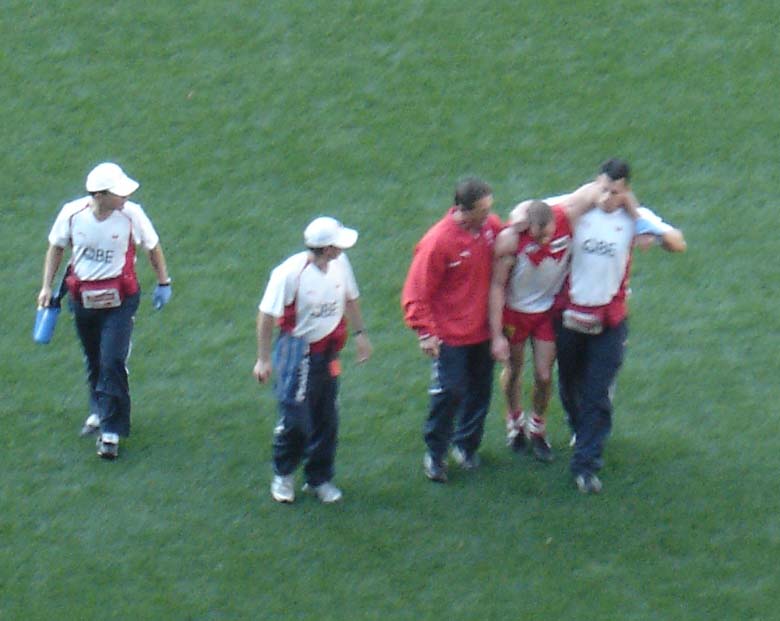
Nic Fosdike in the hands of trainers after hitting his head on the MCG turf after a bumb from Shannon Motlop
Mark Thompson (Geelong Coach)

Look who we saw at the MCG . . .
Just turning round to ask Random Man's advice on what Geelong should do . . .
Maybe a new coach ??? lol

Wednesday, August 09, 2006
Abraham Maslow
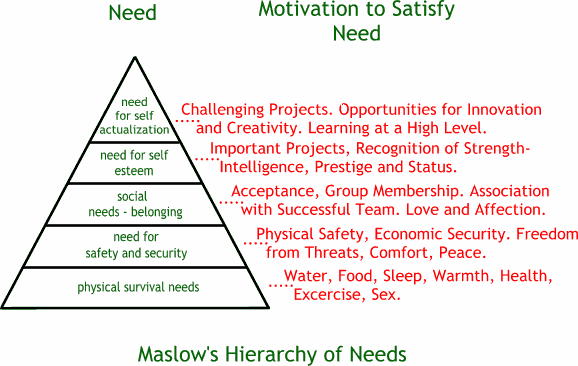
Maslow's Hierarchy of Needs is a theory in psychology that Abraham Maslow proposed in his 1943 paper A Theory of Human Motivation, which he subsequently extended.
His theory contends that as humans meet 'basic needs', they seek to satisfy successively 'higher needs' that occupy a set hierarchy.
Maslow studied exemplary people such as Albert Einstein, Jane Adams, Elanore Roosevelt, and Fredrick Douglas rather than mentally ill or neurotic people, writing that "the study of crippled, stunted, immature, and unhealthy specimens can yield only a cripple psychology and a cripple philosophy." (Motivation and Personality, 1987)
From Wikipedia
Subscribe to:
Posts (Atom)