November 13, 2006
SMH
He might be the most active philanthropist you have never heard of: a retired technology entrepreneur putting his stamp on science research centres at the world's top universities and sponsoring what he hopes will be 21st-century versions of the Nobel Prizes.
With his efficient use of a roughly $600 million (euro466.4 million) fortune _ big but hardly Bill Gates-ishly mind-boggling _ 79-year-old Norwegian-born philanthropist Fred Kavli could end up having an outsized impact on next-generation science.
Many scientists lament that money for basic research is becoming harder to obtain as governments, corporations and other big funders seek specific breakthroughs that can be applied relatively quickly. Kavli, however, is adamant about giving money for open-ended research whose ultimate fruits may not yet be in sight.
"He's quite visionary," said Eric Kandel, Nobel-winning director of the Kavli Institute for Brain Science at Columbia University. "We need more people like him."
Just a few years after seriously beginning his mission to stimulate advances in nanotechnology, neuroscience and astronomy, Kavli has launched 14 research centres in academia's most rarified halls. The sites include Harvard, Yale, Stanford, the Massachusetts Institute of Technology, Holland's Delft University of Technology, the University of Cambridge in England and, in China, Peking University and the Chinese Academy of Sciences.
Although Kavli requires universities to match much of the $7.5 million (euro5.8 million) he typically puts up for an institute, no school has turned him down. Many find money for basic research so rare that they send Kavli's foundation unsolicited appeals.
Kavli expects to eventually create 20 such centres. And beginning in 2008, $1 million (euro780,000) Kavli Prizes in nanotech, neuroscience and astrophysics will be awarded every two years by the Academy of Sciences in Norway, where Kavli was born and first yearned to better grasp man's place in the universe.
"I like to look far into the future," Kavli said in his slightly lilting Norwegian accent. "I think it's important for the benefit of all human beings."
While Kavli's $7.5 million (euro5.8 million) to inaugurate an institute is generous, by some measures it's small. New academic buildings, for example, often cost tens of millions of US dollars (euros). What makes Kavli's model notable is that it resembles how a business builds a brand.
Between the Kavli institutes _ expected to be fed by an annual pool of $20 million (euro15.5 million) after his death _ the Kavli Prizes and regular gatherings of Kavli-funded researchers, Kavli hopes to create something larger than the sum of its parts: a growing organism of avant-garde research.
"Fred's interest really is more abstract than most, because he wants to fund the very best of science and doesn't care where it is," said David Baltimore, a Nobel-winning biologist who helped launch the Kavli Institute for Nanoscience at the California Institute of Technology when he was the school's president.
The Kavli Foundation's momentum is widely credited to its president, David Auston, a former president of Case Western Reserve University in Ohio. Auston's connections and credibility have opened doors for the foundation, which is based in Oxnard, California.
But Kavli is not just the guy who signs the checks. The vision at work here germinated in him long ago, when Kavli was a young dreamer in Norway, marveling at the ethereal glow of the Northern Lights.
Kavli appears to have always set his sights on achieving. At age 13, when World War II led to fuel shortages in Norway, he and his brother started a business making wood briquettes that could be burned to power cars. They also sold planks to furniture factories.
He studied physics in college, then left Norway in 1955 for America with a classic immigrant's narrative. "I was ambitious, let's face it," he said with a wink.
After a year in Canada, Kavli joined a small Los Angeles company that developed flight controls for Atlas missiles. Kavli rose to chief of engineering, but his entrepreneurial side beckoned. So he put a simple ad in the newspaper: "Engineer seeking financial backing to start own business."
What emerged was Kavlico, which specialized in navigational sensors for the defense and aircraft industries.
Kavli invested much of his resulting wealth in Southern California real estate. He also became a well-known community donor near his company's headquarters in Moorpark, California, putting his name on a local performing arts centre, and endowed some university professorships.
But not until he sold Kavlico for $345 million (euro268.2 million) to C-Mac Industries Inc. in 2000 did Kavli set his sights on a larger-scale legacy.
"It's important to realize this guy's kept a very low profile his whole life, until he came out with all this," said Charles Vest, former MIT president and a member of the foundation's board.
The foundation is getting most of Kavli's money _ he is divorced and does not believe in leaving significant sums to his two children _ and his businessman's emphasis on streamlining. Its operations essentially consist of just Kavli, Auston, a communications director and a fund manager.
"One of the problems with philanthropy is to make it effective, and to use money so that it's not wasted away," Kavli said.
That principle is partly why the foundation expects universities to put up their own resources to snare a Kavli Institute. Kavli and Auston believe the rule ensures a university is committed to supporting its researchers in the long term.
Kavli has few concrete expectations for scientists who get his money, other than that they attend interdisciplinary gatherings every so often to share ideas.
"We don't try to tell the institutes what to do," he said. "We try to just select the very best science teams and institutions and support them in what they want to do, and we expect them to choose the very best course of action."
___
On the Net:
http://www.kavlifoundation.org/
Wednesday, November 15, 2006

Jack Williamson- "Science Fiction" Master
Jack Williamson, who died Friday at 98, deserves to be remembered as one of the fathers of science fiction and had a role in inspiring Isaac Asimov, Ray Bradbury, both of whom read his stories when they were still kids.
In 1928, the year his first short story, "The Metal Man," was published in the pulp magazine Amazing Stories, the cutting edge in technology was Charles Lindbergh's solo flight to Paris from New York.
Williamson's last published work, the novel "The Stonehenge Gate," appeared in 2005. The world was immeasurably different, and many of the fantasies he and those who followed him had dreamed of had become reality, from robots to rocket ships. Yet Williamson's themes remained strikingly constant over eight decades - the interaction of man and machine, and the possibility of dystopia.
His 1949 novel "The Humanoids," his first to garner serious critical attention, concerned a group of humans who rebel against their animatronic guardians and zoom around the galaxy via teleportation, which one character mastered "with the greatest of ease." "The story bogs down into complete illogic," complained a Hartford Courant reviewer, who nevertheless enjoyed the descriptions of people re-creating consumer society on dead planets chilled to absolute zero.
"‘The Humanoids' marked a turning point in science fiction and in Jack's career," Williamson's longtime editor, James Frenkel, told the Los Angeles Times."Before that, science fiction had been a cheerleader for science and technology and really had not, for the most part, focused on the potential dangers of science and technology."
In "Dragon's Island" (1951), Williamson chronicled the creation by biologists of a race of supermen who are forced into hiding by an organization bent on hunting them down and killing them. The book was not, as has been reported, the first to use the term "genetic engineering."
However, the Oxford English Dictionary does give Williamson credit for coining "terraforming" - the wholesale resurfacing of a planet. He used the concept to great effect in a late novel, "Terraforming Earth," that won the John W. Campbell Memorial Award for the best science fiction novel of 2001.
Other concepts he came up with or at least was among the first to use in fiction included in vitro insemination ("The Girl From Mars," 1929), artificial gravity ("The Prince of Space," 1931), organ transplants ("The Reefs of Space," 1964, with Frederick Pohl), and antimatter ("Seetee Ship," 1951).
"When I got into the game, I was one of very few players," he told Science Fiction Weekly in 2002. "Every idea seemed to be worth a new story. Nowadays, fresh ideas are harder to find."
As a faculty member at Eastern New Mexico University in the 1960s, Williamson launched one of the nation's first college courses on science fiction and fantasy writing, helping legitimize science fiction as a field worthy of academic attention.
Williamson was born April 29, 1908, in Bisbee, Ariz., a place about as far from his high-tech adventures as can be imagined. When his family moved to eastern New Mexico in 1915, they did so in a covered wagon.Williamson credited a childhood spent on desolate farms and ranches with developing his creative powers."Life would have been absolutely empty without imagination," he told Publishers Weekly in 1986.
In 1926, he discovered the early pulp magazine Amazing Stories, and within two years had landed "The Metal Man" on its cover. From there he became a prolific contributor to the pulps, writing multiple connected stories that were later collected into books including "The Cometeers" (1936) and "The Legion of Space" (1947).
"Jack Williamson was one of the great science-fiction writers," Mr. Bradbury told the Los Angeles Times recently. "He did a series of novels which affected me as a young writer with dreams. I met him at 19, and he became my best friend and teacher."
The New York Sun
15th Nov 2006
In 1928, the year his first short story, "The Metal Man," was published in the pulp magazine Amazing Stories, the cutting edge in technology was Charles Lindbergh's solo flight to Paris from New York.
Williamson's last published work, the novel "The Stonehenge Gate," appeared in 2005. The world was immeasurably different, and many of the fantasies he and those who followed him had dreamed of had become reality, from robots to rocket ships. Yet Williamson's themes remained strikingly constant over eight decades - the interaction of man and machine, and the possibility of dystopia.
His 1949 novel "The Humanoids," his first to garner serious critical attention, concerned a group of humans who rebel against their animatronic guardians and zoom around the galaxy via teleportation, which one character mastered "with the greatest of ease." "The story bogs down into complete illogic," complained a Hartford Courant reviewer, who nevertheless enjoyed the descriptions of people re-creating consumer society on dead planets chilled to absolute zero.
"‘The Humanoids' marked a turning point in science fiction and in Jack's career," Williamson's longtime editor, James Frenkel, told the Los Angeles Times."Before that, science fiction had been a cheerleader for science and technology and really had not, for the most part, focused on the potential dangers of science and technology."
In "Dragon's Island" (1951), Williamson chronicled the creation by biologists of a race of supermen who are forced into hiding by an organization bent on hunting them down and killing them. The book was not, as has been reported, the first to use the term "genetic engineering."
However, the Oxford English Dictionary does give Williamson credit for coining "terraforming" - the wholesale resurfacing of a planet. He used the concept to great effect in a late novel, "Terraforming Earth," that won the John W. Campbell Memorial Award for the best science fiction novel of 2001.
Other concepts he came up with or at least was among the first to use in fiction included in vitro insemination ("The Girl From Mars," 1929), artificial gravity ("The Prince of Space," 1931), organ transplants ("The Reefs of Space," 1964, with Frederick Pohl), and antimatter ("Seetee Ship," 1951).
"When I got into the game, I was one of very few players," he told Science Fiction Weekly in 2002. "Every idea seemed to be worth a new story. Nowadays, fresh ideas are harder to find."
As a faculty member at Eastern New Mexico University in the 1960s, Williamson launched one of the nation's first college courses on science fiction and fantasy writing, helping legitimize science fiction as a field worthy of academic attention.
Williamson was born April 29, 1908, in Bisbee, Ariz., a place about as far from his high-tech adventures as can be imagined. When his family moved to eastern New Mexico in 1915, they did so in a covered wagon.Williamson credited a childhood spent on desolate farms and ranches with developing his creative powers."Life would have been absolutely empty without imagination," he told Publishers Weekly in 1986.
In 1926, he discovered the early pulp magazine Amazing Stories, and within two years had landed "The Metal Man" on its cover. From there he became a prolific contributor to the pulps, writing multiple connected stories that were later collected into books including "The Cometeers" (1936) and "The Legion of Space" (1947).
"Jack Williamson was one of the great science-fiction writers," Mr. Bradbury told the Los Angeles Times recently. "He did a series of novels which affected me as a young writer with dreams. I met him at 19, and he became my best friend and teacher."
The New York Sun
15th Nov 2006
Tuesday, November 14, 2006
Beer spill blocks major highway
November 14, 2006
A major Victorian highway has reopened after a semi-trailer tipped over and its cargo of beer spread across the road.
The Princes Highway, near Geelong, was reopened just after 4.30am (AEDT) today after the beer-laden B-double semi-trailer lost control and overturned last night.
Emergency crews took about 30 minutes to free the driver from his truck cab following the crash, which happened just after 9pm (AEDT).
The man was taken to the Geelong Hospital with possible spinal injuries.
Packaged beer and kegs were spread across the highway and the road was blocked between Cochranes and Pettavel roads.
Police said the goods were recovered, loaded onto another vehicle and transported from the crash scene.
Emergency services continued working at the scene early today to remove fuel spilt on the roadway following the accident.
Heavy haulage equipment was brought in to recover the overturned truck.
AAP
A major Victorian highway has reopened after a semi-trailer tipped over and its cargo of beer spread across the road.
The Princes Highway, near Geelong, was reopened just after 4.30am (AEDT) today after the beer-laden B-double semi-trailer lost control and overturned last night.
Emergency crews took about 30 minutes to free the driver from his truck cab following the crash, which happened just after 9pm (AEDT).
The man was taken to the Geelong Hospital with possible spinal injuries.
Packaged beer and kegs were spread across the highway and the road was blocked between Cochranes and Pettavel roads.
Police said the goods were recovered, loaded onto another vehicle and transported from the crash scene.
Emergency services continued working at the scene early today to remove fuel spilt on the roadway following the accident.
Heavy haulage equipment was brought in to recover the overturned truck.
AAP
Attenborough: Climate is changing
Climate change is the biggest challenge facing the world, naturalist Sir David Attenborough has said.
The veteran broadcaster said scientific data clearly showed that human-induced climate change was now beyond doubt.
Sir David, 80, added that everyone had a responsibility to change their behaviour, including being less wasteful and more energy efficient.
It is the first time Sir David has voiced his concerns in public about the impacts of global warming.
His comments come ahead of a two-part BBC series in which he examines the impacts of global warming on the Earth.
Sir David has been criticised by environmentalists in the past for not speaking out on the matter.
If we do care about our grandchildren then we have to do something
Sir David Attenborough"If you take one moment in time, you can't be sure what the trend is," he told the BBC.
"Now... when we look at the graphs of rising ocean temperatures, rising carbon dioxide in the atmosphere and so on, we know that they are climbing far more steeply than can be accounted for by the natural oscillation of the weather."
Sir David, whose distinguished broadcasting career spans more than half a century, says everyone has a responsibility to act: "What people (must) do is to change their behaviour and their attitudes.
"If we do care about our grandchildren then we have to do something, and we have to demand that our governments do something.
His comments came as a UK parliamentary body, the All-Party Environment Group, issued a report labelling the government a "climate laggard" for its record on reducing emissions.
Sir David, whose natural history programmes have been watched by millions of people around the world, is the latest high-profile figure to say the world is facing a climate crisis.
The Archbishop of Canterbury, Dr Rowan Williams; the government's chief scientist Sir David King, and former Royal Society president Sir Robert May have all expressed public concern on the issue.
This week, former US Vice President Al Gore has been at the Cannes Film Festival to promote a documentary on climate change.
Mr Gore told festival goers that the world was facing a "planetary emergency" due to global warming.
The man who beat him to the White House in the 2000 US presidential elections, George W Bush, remains sceptical about the influence of human activity on the state of the planet's atmosphere.
He says binding targets to reduce greenhouse emissions are inefficient and would harm the US economy.
Last year, he launched a partnership alongside five Asia-Pacific nations to promote technological solutions for reducing the world's dependency on fossil fuels.
Sir David will present a two-part television programme that will explore how climate change is altering the planet, from drought-hit rainforest to the decline of polar bears.
Sir David Attenborough presents Are We Changing Planet Earth?
on BBC One, Wednesday, 24 May 2006, at 2100 BST
BBC
The veteran broadcaster said scientific data clearly showed that human-induced climate change was now beyond doubt.
Sir David, 80, added that everyone had a responsibility to change their behaviour, including being less wasteful and more energy efficient.
It is the first time Sir David has voiced his concerns in public about the impacts of global warming.
His comments come ahead of a two-part BBC series in which he examines the impacts of global warming on the Earth.
Sir David has been criticised by environmentalists in the past for not speaking out on the matter.
If we do care about our grandchildren then we have to do something
Sir David Attenborough"If you take one moment in time, you can't be sure what the trend is," he told the BBC.
"Now... when we look at the graphs of rising ocean temperatures, rising carbon dioxide in the atmosphere and so on, we know that they are climbing far more steeply than can be accounted for by the natural oscillation of the weather."
Sir David, whose distinguished broadcasting career spans more than half a century, says everyone has a responsibility to act: "What people (must) do is to change their behaviour and their attitudes.
"If we do care about our grandchildren then we have to do something, and we have to demand that our governments do something.
His comments came as a UK parliamentary body, the All-Party Environment Group, issued a report labelling the government a "climate laggard" for its record on reducing emissions.
Sir David, whose natural history programmes have been watched by millions of people around the world, is the latest high-profile figure to say the world is facing a climate crisis.
The Archbishop of Canterbury, Dr Rowan Williams; the government's chief scientist Sir David King, and former Royal Society president Sir Robert May have all expressed public concern on the issue.
This week, former US Vice President Al Gore has been at the Cannes Film Festival to promote a documentary on climate change.
Mr Gore told festival goers that the world was facing a "planetary emergency" due to global warming.
The man who beat him to the White House in the 2000 US presidential elections, George W Bush, remains sceptical about the influence of human activity on the state of the planet's atmosphere.
He says binding targets to reduce greenhouse emissions are inefficient and would harm the US economy.
Last year, he launched a partnership alongside five Asia-Pacific nations to promote technological solutions for reducing the world's dependency on fossil fuels.
Sir David will present a two-part television programme that will explore how climate change is altering the planet, from drought-hit rainforest to the decline of polar bears.
Sir David Attenborough presents Are We Changing Planet Earth?
on BBC One, Wednesday, 24 May 2006, at 2100 BST
BBC
Friday, November 10, 2006

Water Scarcity
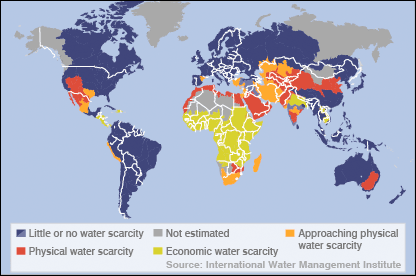
Physical water scarcity: More than 75% of river flows are allocated to agriculture, industries or domestic purposes (accounting for recycling of return flows). This definition of scarcity - relating water availability to water demand - implies that dry areas are not necessarily water-scarce, eg Mauritania.
Approaching physical water scarcity: More than 60% of river flows are allocated. These basins will experience physical water scarcity in the near future.
Economic water scarcity: Water resources are abundant relative to water use, with less than 25% of water from rivers withdrawn for human purposes, but malnutrition exists. These areas could benefit by development of additional blue and green water, but human and financial capacity are limiting.
Little or no water scarcity: Abundant water resources relative to use. Less than 25% of water from rivers is withdrawn for human purposes.
Physical scarcity occurs when the water resources cannot meet the demands of the population. Arid regions are most associated with physical water scarcity. But the IWMI says there is an alarming trend in artificially-created scarcity - even in areas where water is apparently abundant.
This is largely due to overuse; agriculture uses up to 70 times more water to produce food than is used in drinking and other domestic purposes, including cooking, washing and bathing.
The results are desiccated and polluted rivers, declining groundwater and problems of allocation, in which some people win out in access to water over others.
Environment trade-off
Egypt imports more than half of its food because it does not have enough water to grow it domestically.
Australia is faced with major water scarcity in the Murray-Darling Basin as a result of diverting large quantities of water for use in agriculture.
The Aral Sea has shrunk to a quarter of its original volumeAnd the shrunken Aral Sea remains one of the most visible examples where massive diversions of water to agriculture have caused widespread water scarcity, says the report, along with an environmental catastrophe.
"It is possible to reduce water scarcity, feed people and address poverty, but the key trade-off is with the environment," said IWMI's David Molden, who led the assessment.
"People and their governments will face some tough decisions on how to allocate and manage water."
Frank Rijsberman, director general of the institute, told the BBC that one quarter of the world's population lived in river basins where water is physically scarce. Another one billion people live in river basins where water was economically scarce.
As a result, he said, many people around the world dependent on rivers, lakes and other wetlands risk falling into poverty.
Rising demand
The assessment says urbanisation and economic growth will drive food demand towards a higher food intake per capita and richer, more varied diets in coming decades.
Producing milk, meat, sugar, oils and vegetables requires more water than cereals and a different style of water management.
The total amount of water used up in crop production each year could rise from 7,200 cubic km to as much as 13,500 cubic km by 2050.
David Molden said that responding to growing food demand by diverting more water to agriculture and expanding the total area used for growing crops and livestock would exert a major toll on the environment.
Instead, the assessment urges farmers to grow more food without placing added pressure on the environment.
"We must grow more crop per drop, more meat and milk per drop, and more fish per drop," said Mr Molden.
BBC
21 August 2006
Wednesday, November 08, 2006
People first, river second, PM and premiers agree
Stephanie Peatling
November 8, 2006
SMH
DRAINING wetlands and cutting environmental flows to the Murray-Darling river system will be considered by a team of public servants ordered by state and territory leaders to find ways to guarantee towns, farmers and irrigators do not run out of water.
A meeting between the Prime Minister, John Howard, and four state leaders yesterday heard the drought was much worse than a one-in-100-year event; it was more like one in 1000 years.
But scientists and environmentalists say the needs of the river system must be considered alongside those of the people relying on its water.
Professor Gary Jones, the head of the Co-operative Research Centre for Freshwater Ecology, said: "Whilst I recognise these are tough times for everyone concerned, we have to be careful because it won't do any good to damage the river system in the long term."
The executive director of the Australian Conservation Foundation, Don Henry, said any decision to forgo water for environmental purposes would be a "total admission of failure despite years and years of warning".
"We have to look after farmers that are suffering but the really crucial thing is we have to speed up work to bring the Murray-Darling back to health," he said.
After yesterday's summit, permanent water trading between NSW, Victoria and South Australia will begin on January 1 next year. The leaders said this would free up water by dealing with the problem of overallocation of water licences. They agreed to work out how to secure water supplies for 2007-08. A group of state and federal public servants was asked to draw up plans for how this will be done. It will report back by the middle of December.
Mr Howard said he would not direct them to consider specific proposals but "it will be apparent what some of the options are, including the draining of wetlands and allowing some of the dams to dry up. They will be considered. The purpose is to get a warts-and-all action plan. It's serious and we all understand that."
Water efficiency measures and alternative water source projects, such as desalination, will be prioritised when the Federal Government hands out funds from its $2 billion National Water Initiative.
But Mr Howard rejected a suggestion that significant amounts of water could be freed up if Queensland's Cubbie Station was bought out. "While it might be an attractive subject for media focus and debate and interest, the idea that Cubbie Station is the silver bullet is nonsense," Mr Howard said.
A scientific report, commissioned by a similar group of ministers in 2002, found 1500 gigalitres of water - enough to fill Sydney Harbour three times - was needed to address the decline of the whole Murray-Darling system. A meeting of ministers the following year agreed to find a third of that water to sustain five key environmental sites along the river system, but none of that water has yet been returned to the river.
Now the scientific research body CSIRO will prepare regular reports on the sustainable yields of the Murray-Darling basin's surface and groundwater systems.
The Premier of Victoria, Steve Bracks, said: "The figures we've used for an average water flow are not the figures that will be required in the future. This is drought upon drought upon low water reserves. Effectively, if we use the 100-year average, we are not representing what's happening with the effect of climate change and the low water flows and stream flows which are occurring."
The federal Opposition's water spokesman, Anthony Albanese, said water needed to be considered alongside climate change. "We must draw a line in the parched earth - no more denial, no more delay, no more procrastination."
November 8, 2006
SMH
DRAINING wetlands and cutting environmental flows to the Murray-Darling river system will be considered by a team of public servants ordered by state and territory leaders to find ways to guarantee towns, farmers and irrigators do not run out of water.
A meeting between the Prime Minister, John Howard, and four state leaders yesterday heard the drought was much worse than a one-in-100-year event; it was more like one in 1000 years.
But scientists and environmentalists say the needs of the river system must be considered alongside those of the people relying on its water.
Professor Gary Jones, the head of the Co-operative Research Centre for Freshwater Ecology, said: "Whilst I recognise these are tough times for everyone concerned, we have to be careful because it won't do any good to damage the river system in the long term."
The executive director of the Australian Conservation Foundation, Don Henry, said any decision to forgo water for environmental purposes would be a "total admission of failure despite years and years of warning".
"We have to look after farmers that are suffering but the really crucial thing is we have to speed up work to bring the Murray-Darling back to health," he said.
After yesterday's summit, permanent water trading between NSW, Victoria and South Australia will begin on January 1 next year. The leaders said this would free up water by dealing with the problem of overallocation of water licences. They agreed to work out how to secure water supplies for 2007-08. A group of state and federal public servants was asked to draw up plans for how this will be done. It will report back by the middle of December.
Mr Howard said he would not direct them to consider specific proposals but "it will be apparent what some of the options are, including the draining of wetlands and allowing some of the dams to dry up. They will be considered. The purpose is to get a warts-and-all action plan. It's serious and we all understand that."
Water efficiency measures and alternative water source projects, such as desalination, will be prioritised when the Federal Government hands out funds from its $2 billion National Water Initiative.
But Mr Howard rejected a suggestion that significant amounts of water could be freed up if Queensland's Cubbie Station was bought out. "While it might be an attractive subject for media focus and debate and interest, the idea that Cubbie Station is the silver bullet is nonsense," Mr Howard said.
A scientific report, commissioned by a similar group of ministers in 2002, found 1500 gigalitres of water - enough to fill Sydney Harbour three times - was needed to address the decline of the whole Murray-Darling system. A meeting of ministers the following year agreed to find a third of that water to sustain five key environmental sites along the river system, but none of that water has yet been returned to the river.
Now the scientific research body CSIRO will prepare regular reports on the sustainable yields of the Murray-Darling basin's surface and groundwater systems.
The Premier of Victoria, Steve Bracks, said: "The figures we've used for an average water flow are not the figures that will be required in the future. This is drought upon drought upon low water reserves. Effectively, if we use the 100-year average, we are not representing what's happening with the effect of climate change and the low water flows and stream flows which are occurring."
The federal Opposition's water spokesman, Anthony Albanese, said water needed to be considered alongside climate change. "We must draw a line in the parched earth - no more denial, no more delay, no more procrastination."
Olmec Head
 Rancho La Corbata head, at 3.4 m high
Artifacts from the culture later termed Olmec turned up at widespread sites in Mexico and adjacent Central America. The colossal heads are commanding portraits of individual Olmec rulers, and the large symbol displayed on the 'helmet' of each colossal head appears to be an identification motif for that person. Colossal heads glorified the rulers while they were alive, and commemorated them as revered ancestors after their death.

Climate change special: State of denial
04 November 2006
NewScientist
Fred Pearce
KEVIN TRENBERTH reckons he is a marked man. He has argued that last year's devastating Atlantic hurricane season, which spawned hurricane Katrina, was linked to global warming. For the many politicians and minority of scientists who insist there is no evidence for any such link, Trenberth's views are unacceptable and some have called for him step down from an international panel studying climate change. "The attacks on me are clearly designed to get me fired or to resign," says Trenberth.
The attacks fit a familiar pattern. Sceptics have also set their sights on scientists who have spoken out about the accelerating meltdown of the ice sheets in Greenland and Antarctica and the thawing of the planet's permafrost. These concerns will be addressed in the next report by the Intergovernmental Panel on Climate Change (IPCC), the global organisation created by the UN in 1988 to assess the risks of human-induced climate change. Every time one of these assessments is released, about once every five years, some of the American scientists who have played a part in producing it become the targets of concerted attacks apparently designed to bring down their reputations and careers. At stake is the credibility of scientists who fear our planet is hurtling towards disaster and want to warn the public in the US and beyond.
So when the next IPCC report is released in February 2007, who will be the targets and why? When New Scientist spoke to researchers on both sides of the climate divide it became clear that they are ready for a showdown. If the acrimony were to become so intense that American scientists were forced to stop helping in the preparation of IPCC reports, it could seriously dent the organisation and rob the world of some significant voices in the climate change debate.
One of those who knows only too well what it is like to come under attack from climate change sceptics is Ben Santer of the Lawrence Livermore Laboratory in California. The lead author of a chapter in the 1995 IPCC report that talked for the first time about the "discernible human influence on global climate", he was savaged by sceptics and accused of introducing this wording without consulting colleagues who had helped write the chapter. One sceptic called it the "most disturbing corruption of the peer-review process in 60 years". Another accused him of "scientific cleansing" - at a time when the phrase "ethnic cleansing" was synonymous with genocide in Bosnia. The IPCC investigated and dismissed the allegations as baseless.
Another scientist to suffer the ire of the sceptics was Michael Mann of Pennsylvania State University in University Park. He was attacked after the IPCC assessment in 2001, which highlighted his "hockey stick" graph showing that temperatures began a rapid rise in recent decades and are now higher than at any time over the past thousand years. The sceptics accused Mann of cherry-picking his data and criticised him for refusing to disclose his statistical methods which, they claimed, biased the study to show recent warming (New Scientist, 18 March, p 40). Last year, Texas Republican Congressman Joe Barton, chair of the House Committee on Energy and Commerce, ordered Mann to provide the committee with voluminous details of his working procedures, computer programs and past funding. Barton's demands were widely condemned by fellow scientists and on Capitol Hill. "There are people who believe that if they bring down Mike Mann, they can bring down the IPCC," said Santer at the time. Mann's findings, which will be endorsed in the new IPCC report, have since been replicated by other studies.
Santer says, however, that he expects attacks to continue on other fronts. "There is a strategy to single out individuals, tarnish them and try to bring the whole of the science into disrepute," he says. "And Kevin [Trenberth] is a likely target." Mann agrees that the scientists behind the upcoming IPCC report are in for a rough ride. "There is already an orchestrated campaign against the IPCC by climate change contrarians," he says.
“There is a strategy to single out individuals, tarnish them and try to bring the whole of the science into disreputeBen Santer, Lawrence Livermore Laboratory”
The "contrarians" include scientists and politicians who are sceptical of the scientific evidence for climate change. Some of those who spoke to New Scientist insist that they are not planning character assassinations, and intend merely to engage in robust scientific debate, not least by challenging the IPCC's status as the arbiter of truth on climate change.
Many of the IPCC's authors, some of whom asked not to be named, say this is a smokescreen. They claim there is an extensive network of lobby groups and scientists involved in making the case against the IPCC and its reports. Automobile, coal and oil companies have coordinated and funded past attacks on them, the scientists say. Sometimes this has been done through Washington lobby groups such as the Competitive Enterprise Institute (CEI), whose officers include Myron Ebell, a former climate negotiator for George W. Bush's administration. Recently, the CEI made television advertisements arguing against climate change, one of which ended with the words: "Carbon dioxide, they call it pollution, we call it life." CEI's past funders include ExxonMobil, General Motors and the Ford Motor Company.
The money trail
Some sceptical scientists are funded directly by industry. In July, The Washington Post published a leaked letter from the Intermountain Rural Electric Association (IREA), an energy company based in Colorado, that exhorted power companies to support the work of the prominent sceptic Pat Michaels of the University of Virginia, Charlottesville. Worried about the potential cost of cleaning up coal-fired power plants to reduce their CO2 emissions, IREA's general manager, Stanley Lewandowski, wrote: "We believe that it is necessary to support the scientific community that is willing to stand up against the alarmists... In February this year, IREA alone contributed $100,000 to Dr Michaels."
So what is this money buying? For one, an ability to coordinate responses to the IPCC reports. Michaels told New Scientist that a flashpoint in the upcoming report could be hurricanes. Trenberth, who is the head of climate analysis at the National Center for Atmospheric Research (NCAR) in Boulder, Colorado, has angered the IPCC's critics by supporting the idea of a link between global warming and the intensity of hurricanes. The sceptics insist there is no published evidence to back this up. Trenberth says he is simply putting two established facts together: "Sea-surface temperature is rising because of global warming, and high sea-surface temperatures make for more intense storms."
In the aftermath of hurricane Katrina, and with a US administration that has a record of hostility to concerns about climate change, Trenberth's statements are political dynamite. "I suspect the sceptics will want to try and dismantle the argument that there is a link," Mann says. Santer agrees: "If I was an industry-funded sceptic, I'd hit that area hard, for sure." Trenberth himself fears the worst. "I would not be surprised if the hurricane aspect of the report is targeted, along with my own role," he says. "But I am proud of what we have achieved."
One lead author of the chapter on hurricanes told New Scientist that it will include discussion of two papers published last year in Science and Nature, both of which showed that the frequency of the most intense hurricanes has increased in recent years. Even if Trenberth and his co-authors do not directly attribute this to global warming, the mere mention of these papers in the context of climate change is likely to provoke criticism.
Trenberth's opinions have already alienated his co-author Chris Landsea of the National Oceanic and Atmospheric Administration's Atlantic Oceanographic and Meteorological Laboratory in Florida. Landsea disputed Trenberth's view, arguing that older measurements made before the era of satellite observation were not reliable enough to make the claim stick (New Scientist, 3 December 2005, p 36). When IPCC chiefs refused to censure Trenberth for his remarks directly linking last year's hurricanes to climate change, Landsea resigned, claiming that the IPCC had been "subverted, its neutrality lost".
Another sensitive area is the concern that existing models of ice sheets on Greenland and Antarctica massively underestimate future melting and consequent sea-level rise. "Our understanding of the dynamics of ice-sheet destruction has completely changed in the last five years," says Richard Alley of Penn State University, a lead author of the chapter on ice sheets who expects to find himself in the firing line over this issue. "We used to think it would take 10,000 years for melting to penetrate to the bottom of the ice sheet. But now we know it can take just 10 seconds," he says.
The rethink has come from the discovery that when surface water from melting ice drains down though crevasses it can lubricate the join between ice and bedrock. This mechanism appears to explain the faster discharge of ice from Greenland into the Atlantic, but it has yet to be incorporated into ice-sheet models, which still assume that the limiting factor is the rate at which heat penetrates through solid ice.
Michaels dismisses the idea of more rapid loss as "hysteria", and has thrown down a challenge to the IPCC to justify any change to the ice-sheet models. "[The IPCC] criticise people like me for saying the models are wrong, so it's going to be really interesting to see how they respond when their own people say the models are wrong." Alley, however, points out that leading glaciologists mostly agree that the current generation of ice-sheet models are wanting, whereas climatologists are mostly happy with their models.
A third focus for debate will be the way the IPCC treats recent reports of climate change disrupting the natural carbon cycle more than anticipated. This has to do with the release of large amounts of CO2 from rainforests and soils, and methane from permafrost and beneath continental shelves, possibly speeding up global warming. "These are factors not included in the current models, which may cause us to underestimate warming," Mann says.
Some insiders suggest that the IPCC may be more cautious in its upcoming report than it has been in the past, but this is unlikely to placate climate-change sceptics. Roger Pielke of the University of Colorado, Boulder, accuses the IPCC leadership of "seeing their role as political advocates rather than honest brokers". And Michaels has set out to prove this (see "A taste for bad news?", below).
For the majority of climate scientists, who are convinced that global warming is a real and present danger, the most alarming outcome of this discord is that federal funding could be withdrawn from those who work on IPCC reports. Here too Trenberth may find himself caught in the headlights. The US Senate's Environment and Public Works Committee under its chairman James Inhofe has begun investigating NCAR, Trenberth's employer. Inhofe has repeatedly written to NCAR and other agencies demanding details about financial and contractual arrangements with their employees and with federal funding agencies such as the National Science Foundation (NSF). In a letter to the NSF in February, Inhofe said he needed the information to help him in "researching, analyzing and understanding the science of global climate change". Inhofe has a record of hostility to the idea of climate change, having asked on the Senate floor in July 2003: "Could it be that man-made global warming is the greatest hoax ever perpetrated on the American people? It sure sounds like it."
NCAR is not commenting on Inhofe's investigation, but many climate scientists contacted by New Scientist regard it as a tactic designed to intimidate those working on the IPCC report. "Inhofe's actions appear to be an effort to discourage leading US scientists from being involved in international scientific assessment processes such as the IPCC," Mann says.
“There appears to be an effort to discourage US scientists from being involved in international scientific assessment processesMichael Mann, Penn State University”
This is potentially disastrous for the IPCC. Out of 168 scientists listed as lead authors or reviewers involved in assessing the science of climate change, 38 are from the US - more than twice as many as the second-largest national grouping, the British.
IPCC scientists who spoke to New Scientist insist they are not trying to turn science into politics or to shut down genuine debate. They do, however, worry that their conclusions might be drowned out by some politically motivated and industry-funded sceptics. "I'd hate to see hundreds of people putting years of their lives into producing a report that is then trashed by these people for political ends," says Santer. "That is what happened in my case, and I felt very bad about it."
“The literature is intrinsically biased, and that means that the IPCC is also biasedPat Michaels, University of Virginia, Charlottesville”
From issue 2576 of New Scientist magazine, 04 November 2006, page 18-21
A taste for bad news?
Pat Michaels of the University of Virginia, Charlottesville, claims that climate research is biased towards pessimistic conclusions, and says he can prove it.
Michaels has analysed publications by climate scientists in the journals Nature and Science between mid-2005 and mid-2006. He found 115 articles of which 83 said that the likely impact of the greenhouse effect was going to be worse than previously suggested, 23 saw no change and only 9 said that things were not as bad as previously thought.
To most researchers this is solid evidence that the prognosis for the planet is worsening as new science comes in. Michaels rejects this interpretation. To have any faith in the forecasts of climatologists, he argues, "we should expect that new research should have an equal probability of being better or worse [for Earth's climate] than previous research."
His explanation for what he calls "this highly skewed result" is that scientists and journal editors are more interested in bad news. "The literature is intrinsically biased," he says. "And that means that the IPCC - which is largely a literature review process - is also biased." Michaels aims to publish his work in February, when it is likely to distract attention from the IPCC report expected at that time.
NewScientist
Fred Pearce
KEVIN TRENBERTH reckons he is a marked man. He has argued that last year's devastating Atlantic hurricane season, which spawned hurricane Katrina, was linked to global warming. For the many politicians and minority of scientists who insist there is no evidence for any such link, Trenberth's views are unacceptable and some have called for him step down from an international panel studying climate change. "The attacks on me are clearly designed to get me fired or to resign," says Trenberth.
The attacks fit a familiar pattern. Sceptics have also set their sights on scientists who have spoken out about the accelerating meltdown of the ice sheets in Greenland and Antarctica and the thawing of the planet's permafrost. These concerns will be addressed in the next report by the Intergovernmental Panel on Climate Change (IPCC), the global organisation created by the UN in 1988 to assess the risks of human-induced climate change. Every time one of these assessments is released, about once every five years, some of the American scientists who have played a part in producing it become the targets of concerted attacks apparently designed to bring down their reputations and careers. At stake is the credibility of scientists who fear our planet is hurtling towards disaster and want to warn the public in the US and beyond.
So when the next IPCC report is released in February 2007, who will be the targets and why? When New Scientist spoke to researchers on both sides of the climate divide it became clear that they are ready for a showdown. If the acrimony were to become so intense that American scientists were forced to stop helping in the preparation of IPCC reports, it could seriously dent the organisation and rob the world of some significant voices in the climate change debate.
One of those who knows only too well what it is like to come under attack from climate change sceptics is Ben Santer of the Lawrence Livermore Laboratory in California. The lead author of a chapter in the 1995 IPCC report that talked for the first time about the "discernible human influence on global climate", he was savaged by sceptics and accused of introducing this wording without consulting colleagues who had helped write the chapter. One sceptic called it the "most disturbing corruption of the peer-review process in 60 years". Another accused him of "scientific cleansing" - at a time when the phrase "ethnic cleansing" was synonymous with genocide in Bosnia. The IPCC investigated and dismissed the allegations as baseless.
Another scientist to suffer the ire of the sceptics was Michael Mann of Pennsylvania State University in University Park. He was attacked after the IPCC assessment in 2001, which highlighted his "hockey stick" graph showing that temperatures began a rapid rise in recent decades and are now higher than at any time over the past thousand years. The sceptics accused Mann of cherry-picking his data and criticised him for refusing to disclose his statistical methods which, they claimed, biased the study to show recent warming (New Scientist, 18 March, p 40). Last year, Texas Republican Congressman Joe Barton, chair of the House Committee on Energy and Commerce, ordered Mann to provide the committee with voluminous details of his working procedures, computer programs and past funding. Barton's demands were widely condemned by fellow scientists and on Capitol Hill. "There are people who believe that if they bring down Mike Mann, they can bring down the IPCC," said Santer at the time. Mann's findings, which will be endorsed in the new IPCC report, have since been replicated by other studies.
Santer says, however, that he expects attacks to continue on other fronts. "There is a strategy to single out individuals, tarnish them and try to bring the whole of the science into disrepute," he says. "And Kevin [Trenberth] is a likely target." Mann agrees that the scientists behind the upcoming IPCC report are in for a rough ride. "There is already an orchestrated campaign against the IPCC by climate change contrarians," he says.
“There is a strategy to single out individuals, tarnish them and try to bring the whole of the science into disreputeBen Santer, Lawrence Livermore Laboratory”
The "contrarians" include scientists and politicians who are sceptical of the scientific evidence for climate change. Some of those who spoke to New Scientist insist that they are not planning character assassinations, and intend merely to engage in robust scientific debate, not least by challenging the IPCC's status as the arbiter of truth on climate change.
Many of the IPCC's authors, some of whom asked not to be named, say this is a smokescreen. They claim there is an extensive network of lobby groups and scientists involved in making the case against the IPCC and its reports. Automobile, coal and oil companies have coordinated and funded past attacks on them, the scientists say. Sometimes this has been done through Washington lobby groups such as the Competitive Enterprise Institute (CEI), whose officers include Myron Ebell, a former climate negotiator for George W. Bush's administration. Recently, the CEI made television advertisements arguing against climate change, one of which ended with the words: "Carbon dioxide, they call it pollution, we call it life." CEI's past funders include ExxonMobil, General Motors and the Ford Motor Company.
The money trail
Some sceptical scientists are funded directly by industry. In July, The Washington Post published a leaked letter from the Intermountain Rural Electric Association (IREA), an energy company based in Colorado, that exhorted power companies to support the work of the prominent sceptic Pat Michaels of the University of Virginia, Charlottesville. Worried about the potential cost of cleaning up coal-fired power plants to reduce their CO2 emissions, IREA's general manager, Stanley Lewandowski, wrote: "We believe that it is necessary to support the scientific community that is willing to stand up against the alarmists... In February this year, IREA alone contributed $100,000 to Dr Michaels."
So what is this money buying? For one, an ability to coordinate responses to the IPCC reports. Michaels told New Scientist that a flashpoint in the upcoming report could be hurricanes. Trenberth, who is the head of climate analysis at the National Center for Atmospheric Research (NCAR) in Boulder, Colorado, has angered the IPCC's critics by supporting the idea of a link between global warming and the intensity of hurricanes. The sceptics insist there is no published evidence to back this up. Trenberth says he is simply putting two established facts together: "Sea-surface temperature is rising because of global warming, and high sea-surface temperatures make for more intense storms."
In the aftermath of hurricane Katrina, and with a US administration that has a record of hostility to concerns about climate change, Trenberth's statements are political dynamite. "I suspect the sceptics will want to try and dismantle the argument that there is a link," Mann says. Santer agrees: "If I was an industry-funded sceptic, I'd hit that area hard, for sure." Trenberth himself fears the worst. "I would not be surprised if the hurricane aspect of the report is targeted, along with my own role," he says. "But I am proud of what we have achieved."
One lead author of the chapter on hurricanes told New Scientist that it will include discussion of two papers published last year in Science and Nature, both of which showed that the frequency of the most intense hurricanes has increased in recent years. Even if Trenberth and his co-authors do not directly attribute this to global warming, the mere mention of these papers in the context of climate change is likely to provoke criticism.
Trenberth's opinions have already alienated his co-author Chris Landsea of the National Oceanic and Atmospheric Administration's Atlantic Oceanographic and Meteorological Laboratory in Florida. Landsea disputed Trenberth's view, arguing that older measurements made before the era of satellite observation were not reliable enough to make the claim stick (New Scientist, 3 December 2005, p 36). When IPCC chiefs refused to censure Trenberth for his remarks directly linking last year's hurricanes to climate change, Landsea resigned, claiming that the IPCC had been "subverted, its neutrality lost".
Another sensitive area is the concern that existing models of ice sheets on Greenland and Antarctica massively underestimate future melting and consequent sea-level rise. "Our understanding of the dynamics of ice-sheet destruction has completely changed in the last five years," says Richard Alley of Penn State University, a lead author of the chapter on ice sheets who expects to find himself in the firing line over this issue. "We used to think it would take 10,000 years for melting to penetrate to the bottom of the ice sheet. But now we know it can take just 10 seconds," he says.
The rethink has come from the discovery that when surface water from melting ice drains down though crevasses it can lubricate the join between ice and bedrock. This mechanism appears to explain the faster discharge of ice from Greenland into the Atlantic, but it has yet to be incorporated into ice-sheet models, which still assume that the limiting factor is the rate at which heat penetrates through solid ice.
Michaels dismisses the idea of more rapid loss as "hysteria", and has thrown down a challenge to the IPCC to justify any change to the ice-sheet models. "[The IPCC] criticise people like me for saying the models are wrong, so it's going to be really interesting to see how they respond when their own people say the models are wrong." Alley, however, points out that leading glaciologists mostly agree that the current generation of ice-sheet models are wanting, whereas climatologists are mostly happy with their models.
A third focus for debate will be the way the IPCC treats recent reports of climate change disrupting the natural carbon cycle more than anticipated. This has to do with the release of large amounts of CO2 from rainforests and soils, and methane from permafrost and beneath continental shelves, possibly speeding up global warming. "These are factors not included in the current models, which may cause us to underestimate warming," Mann says.
Some insiders suggest that the IPCC may be more cautious in its upcoming report than it has been in the past, but this is unlikely to placate climate-change sceptics. Roger Pielke of the University of Colorado, Boulder, accuses the IPCC leadership of "seeing their role as political advocates rather than honest brokers". And Michaels has set out to prove this (see "A taste for bad news?", below).
For the majority of climate scientists, who are convinced that global warming is a real and present danger, the most alarming outcome of this discord is that federal funding could be withdrawn from those who work on IPCC reports. Here too Trenberth may find himself caught in the headlights. The US Senate's Environment and Public Works Committee under its chairman James Inhofe has begun investigating NCAR, Trenberth's employer. Inhofe has repeatedly written to NCAR and other agencies demanding details about financial and contractual arrangements with their employees and with federal funding agencies such as the National Science Foundation (NSF). In a letter to the NSF in February, Inhofe said he needed the information to help him in "researching, analyzing and understanding the science of global climate change". Inhofe has a record of hostility to the idea of climate change, having asked on the Senate floor in July 2003: "Could it be that man-made global warming is the greatest hoax ever perpetrated on the American people? It sure sounds like it."
NCAR is not commenting on Inhofe's investigation, but many climate scientists contacted by New Scientist regard it as a tactic designed to intimidate those working on the IPCC report. "Inhofe's actions appear to be an effort to discourage leading US scientists from being involved in international scientific assessment processes such as the IPCC," Mann says.
“There appears to be an effort to discourage US scientists from being involved in international scientific assessment processesMichael Mann, Penn State University”
This is potentially disastrous for the IPCC. Out of 168 scientists listed as lead authors or reviewers involved in assessing the science of climate change, 38 are from the US - more than twice as many as the second-largest national grouping, the British.
IPCC scientists who spoke to New Scientist insist they are not trying to turn science into politics or to shut down genuine debate. They do, however, worry that their conclusions might be drowned out by some politically motivated and industry-funded sceptics. "I'd hate to see hundreds of people putting years of their lives into producing a report that is then trashed by these people for political ends," says Santer. "That is what happened in my case, and I felt very bad about it."
“The literature is intrinsically biased, and that means that the IPCC is also biasedPat Michaels, University of Virginia, Charlottesville”
From issue 2576 of New Scientist magazine, 04 November 2006, page 18-21
A taste for bad news?
Pat Michaels of the University of Virginia, Charlottesville, claims that climate research is biased towards pessimistic conclusions, and says he can prove it.
Michaels has analysed publications by climate scientists in the journals Nature and Science between mid-2005 and mid-2006. He found 115 articles of which 83 said that the likely impact of the greenhouse effect was going to be worse than previously suggested, 23 saw no change and only 9 said that things were not as bad as previously thought.
To most researchers this is solid evidence that the prognosis for the planet is worsening as new science comes in. Michaels rejects this interpretation. To have any faith in the forecasts of climatologists, he argues, "we should expect that new research should have an equal probability of being better or worse [for Earth's climate] than previous research."
His explanation for what he calls "this highly skewed result" is that scientists and journal editors are more interested in bad news. "The literature is intrinsically biased," he says. "And that means that the IPCC - which is largely a literature review process - is also biased." Michaels aims to publish his work in February, when it is likely to distract attention from the IPCC report expected at that time.
Tuesday, November 07, 2006
Murdoch calls for climate deal
Peter Alford and Matthew Warren
November 07, 2006
The Australian
RUPERT Murdoch has called for the Kyoto Protocol on climate change to be replaced by a new international agreement that can be endorsed by the US and the emerging industrial giants China and India.
And the chairman of News Corporation, publisher of The Australian, said that while he had until recently been wary of the global warming debate and apparently far-fetched assertions about its causes, he now believed business must lead the search for solutions.
"What is certain is temperatures have been rising and we are not entirely sure of the consequences," he told a Tokyo conference last night. "The planet deserves the benefit of the doubt."
But he did not favour the 1997 Kyoto Protocol on greenhouse emissions, which the US and Australia have refused to sign and which does not bind the major emerging industrial nations.
"I think we should certainly have a protocol and probably a new one," he said, noting the Kyoto pact was impossible for the US to accept and also unlikely to be adopted by the biggest emerging economies.
Any agreement on global warming was useless unless it was adopted by the US, Japan and Northern Europe, but also by China and India: "Whatever is done must apply to all countries."
Mr Murdoch, probably the world's most influential media businessman, described the debate on global warming as an example of the beneficial effects of globalisation.
"Without globalisation, the debate on climate change would be meaningless and without the active support of business, there will be no meaningful solution to the problem of global warming."
He singled out the chief executive of British satellite broadcaster BSkyB, his son James Murdoch, as a leader in the direction the News Corp group now intended to take.
James Murdoch's plan to make BSkyB a carbon-neutral company "is not sentimentality, it is sound business strategy that reduces costs and reassures carbon conscious governments" the group is not complicit in global warming.
Mr Murdoch's comments came as it emerged that a group of blue-chip Australian companies was looking to fast-track commercialisation of low-emission technologies as the basis of an evolving business policy response to climate change.
This new coalition follows the Business Roundtable on Climate Change, which released a report in April to lobby government for early action on reducing greenhouse gas emissions.
The evolving new business policy group has held a number of preliminary discussions and last week formed a work plan to look at which policy tools might accelerate and deepen the commercialisation of low-emission technologies such as clean coal and energy efficiency in Australia.
Companies involved in the discussions include BP Australia, Westpac, Visy, Anglo Coal, ANZ, Insurance Australia Group and Rio Tinto subsidiary Comalco.
Visy Industries was the foundation member of the first business roundtable, and last night a spokesman said the packaging giant was considering if it would participate in the working group.
Visy spokesman Tony Gray said the first roundtable had triggered greater action by corporate Australia to consider how it might respond.
"If we don't sign up it won't be because we don't think it's a good idea, it will be because we're glad more companies are doing it and our efforts are best spent somewhere else," he said.
November 07, 2006
The Australian
RUPERT Murdoch has called for the Kyoto Protocol on climate change to be replaced by a new international agreement that can be endorsed by the US and the emerging industrial giants China and India.
And the chairman of News Corporation, publisher of The Australian, said that while he had until recently been wary of the global warming debate and apparently far-fetched assertions about its causes, he now believed business must lead the search for solutions.
"What is certain is temperatures have been rising and we are not entirely sure of the consequences," he told a Tokyo conference last night. "The planet deserves the benefit of the doubt."
But he did not favour the 1997 Kyoto Protocol on greenhouse emissions, which the US and Australia have refused to sign and which does not bind the major emerging industrial nations.
"I think we should certainly have a protocol and probably a new one," he said, noting the Kyoto pact was impossible for the US to accept and also unlikely to be adopted by the biggest emerging economies.
Any agreement on global warming was useless unless it was adopted by the US, Japan and Northern Europe, but also by China and India: "Whatever is done must apply to all countries."
Mr Murdoch, probably the world's most influential media businessman, described the debate on global warming as an example of the beneficial effects of globalisation.
"Without globalisation, the debate on climate change would be meaningless and without the active support of business, there will be no meaningful solution to the problem of global warming."
He singled out the chief executive of British satellite broadcaster BSkyB, his son James Murdoch, as a leader in the direction the News Corp group now intended to take.
James Murdoch's plan to make BSkyB a carbon-neutral company "is not sentimentality, it is sound business strategy that reduces costs and reassures carbon conscious governments" the group is not complicit in global warming.
Mr Murdoch's comments came as it emerged that a group of blue-chip Australian companies was looking to fast-track commercialisation of low-emission technologies as the basis of an evolving business policy response to climate change.
This new coalition follows the Business Roundtable on Climate Change, which released a report in April to lobby government for early action on reducing greenhouse gas emissions.
The evolving new business policy group has held a number of preliminary discussions and last week formed a work plan to look at which policy tools might accelerate and deepen the commercialisation of low-emission technologies such as clean coal and energy efficiency in Australia.
Companies involved in the discussions include BP Australia, Westpac, Visy, Anglo Coal, ANZ, Insurance Australia Group and Rio Tinto subsidiary Comalco.
Visy Industries was the foundation member of the first business roundtable, and last night a spokesman said the packaging giant was considering if it would participate in the working group.
Visy spokesman Tony Gray said the first roundtable had triggered greater action by corporate Australia to consider how it might respond.
"If we don't sign up it won't be because we don't think it's a good idea, it will be because we're glad more companies are doing it and our efforts are best spent somewhere else," he said.
Australia's drought could be worst in 1,000 years
07 Nov 2006
Reuters
By James Grubel
CANBERRA, Nov 7 (Reuters) - The drought gripping Australia could be the worst in 1,000 years, government officials said on Tuesday, as Australia started to draw up emergency plans to secure long-term water supplies to towns and cities.
The drought affecting more than half of Australia's farmlands, already lasting more than five years, had previously been regarded as the worst in a century.
But officials from the Murray-Darling river basin commission told a water summit of national and state political leaders on Tuesday that analyses of the current prolonged drought now pointed to the driest period in 1,000 years.
"What we're seeing with this drought is a frightening glimpse of the future with global warming," the leader of the South Australian state government Mike Rann told reporters.
A spokeswoman for the Murray-Darling Basin Commission said the current consecutive years of drought had not been observed in the 114 years since records were first kept.
She said mathematical and probability analyses of the current dry spell found Australia was moving into what was possibly a one-in-1,000-year drought.
"We don't have the records to substantiate a one-in-100-year drought any more -- it's beyond that," she told Reuters.
Lack of winter rain has meant record-low inflows into the Murray-Darling river system, which drains an area the size of France and Spain combined and provides water to Australia's major agricultural areas.
The average inflow of water into the Murray River, which flows through three states, is 11,000 gigalitres a year. In the past five months it has received less than 600 gigalitres. One gigalitre is one billion litres.
Green groups have warned that towns and cities along the river system could run out of water if the drought goes into another year.
Prime Minister John Howard used the water summit to announce moves to investigate how to secure log-term water supplies for towns and cities along the Murray River.
The summit also approved a new weir across the Murray to provide emergency water, if needed, for the South Australian capital of Adelaide, a city of about one million people, which draws 40 percent of its drinking water from the Murray River.
But Howard, who remains sceptical about the impact of global warming, declined to publicly declare the drought the worst in 1,000 years. "All I know it is a very bad drought. It is the worst in living memory," Howard told reporters.
The Australian Democrats party criticised the summit, saying the meeting had ignored both the need to buy water back from farmers and irrigators, and the need to put a higher price on water use.
"Making water more expensive is not going to be popular, but it needs to be done," Democrats Senator Andrew Bartlett told reporters.
The Murray-Darling catchment covers 1.06 million sq km (409,000 sq miles), 15 percent of Australia's landmass, and accounts for 41 percent of Australia's agricultural production and A$22 billion worth of the nation's agricultural exports.
Reuters
By James Grubel
CANBERRA, Nov 7 (Reuters) - The drought gripping Australia could be the worst in 1,000 years, government officials said on Tuesday, as Australia started to draw up emergency plans to secure long-term water supplies to towns and cities.
The drought affecting more than half of Australia's farmlands, already lasting more than five years, had previously been regarded as the worst in a century.
But officials from the Murray-Darling river basin commission told a water summit of national and state political leaders on Tuesday that analyses of the current prolonged drought now pointed to the driest period in 1,000 years.
"What we're seeing with this drought is a frightening glimpse of the future with global warming," the leader of the South Australian state government Mike Rann told reporters.
A spokeswoman for the Murray-Darling Basin Commission said the current consecutive years of drought had not been observed in the 114 years since records were first kept.
She said mathematical and probability analyses of the current dry spell found Australia was moving into what was possibly a one-in-1,000-year drought.
"We don't have the records to substantiate a one-in-100-year drought any more -- it's beyond that," she told Reuters.
Lack of winter rain has meant record-low inflows into the Murray-Darling river system, which drains an area the size of France and Spain combined and provides water to Australia's major agricultural areas.
The average inflow of water into the Murray River, which flows through three states, is 11,000 gigalitres a year. In the past five months it has received less than 600 gigalitres. One gigalitre is one billion litres.
Green groups have warned that towns and cities along the river system could run out of water if the drought goes into another year.
Prime Minister John Howard used the water summit to announce moves to investigate how to secure log-term water supplies for towns and cities along the Murray River.
The summit also approved a new weir across the Murray to provide emergency water, if needed, for the South Australian capital of Adelaide, a city of about one million people, which draws 40 percent of its drinking water from the Murray River.
But Howard, who remains sceptical about the impact of global warming, declined to publicly declare the drought the worst in 1,000 years. "All I know it is a very bad drought. It is the worst in living memory," Howard told reporters.
The Australian Democrats party criticised the summit, saying the meeting had ignored both the need to buy water back from farmers and irrigators, and the need to put a higher price on water use.
"Making water more expensive is not going to be popular, but it needs to be done," Democrats Senator Andrew Bartlett told reporters.
The Murray-Darling catchment covers 1.06 million sq km (409,000 sq miles), 15 percent of Australia's landmass, and accounts for 41 percent of Australia's agricultural production and A$22 billion worth of the nation's agricultural exports.
Monday, November 06, 2006

Heat to soar in NSW, says CSIRO
November 6, 2006
Average temperatures in NSW could soar by up to 6.4 degrees by 2070 unless action is taken to tackle climate change, new research by the CSIRO shows.
The study also warns that annual rainfall in key farming areas could drop by 70 per cent in the next 64 years.
The NSW Government, which commissioned the research, seized on the figures to attack Prime Minister John Howard's refusal to sign up for a national emissions trading scheme.
NSW Premier Morris Iemma said climate change was a real threat to the state's way of life.
"The CSIRO research paints a frightening picture; that's why we need a national approach to climate change," he said.
Under the emissions trading scheme proposed by the states, greenhouse gas emissions from Australia's electricity industry would be capped at between 1997 and 2000 levels by 2035.
Electricity generators would be required to hold permits to emit greenhouse gases but would be able to purchase extra permits and offset emissions through forestry and capturing or storing carbon.
"To our national shame, John Howard refuses to sign up in the face of overwhelming evidence of the impact of climate change on families and the economy," Mr Iemma said.
The new research also predicts that summer temperatures in inland northern NSW could be up to 7.1 degrees higher by 2070 and that spring rainfall could be up to 60 per cent lower.
Further climate change studies covering all of the major catchment areas in NSW will be released in the coming months.
The State Government is also funding research into the effect of climate change on rainfall patterns, water availability and flooding in the greater metropolitan region.
AAP
Average temperatures in NSW could soar by up to 6.4 degrees by 2070 unless action is taken to tackle climate change, new research by the CSIRO shows.
The study also warns that annual rainfall in key farming areas could drop by 70 per cent in the next 64 years.
The NSW Government, which commissioned the research, seized on the figures to attack Prime Minister John Howard's refusal to sign up for a national emissions trading scheme.
NSW Premier Morris Iemma said climate change was a real threat to the state's way of life.
"The CSIRO research paints a frightening picture; that's why we need a national approach to climate change," he said.
Under the emissions trading scheme proposed by the states, greenhouse gas emissions from Australia's electricity industry would be capped at between 1997 and 2000 levels by 2035.
Electricity generators would be required to hold permits to emit greenhouse gases but would be able to purchase extra permits and offset emissions through forestry and capturing or storing carbon.
"To our national shame, John Howard refuses to sign up in the face of overwhelming evidence of the impact of climate change on families and the economy," Mr Iemma said.
The new research also predicts that summer temperatures in inland northern NSW could be up to 7.1 degrees higher by 2070 and that spring rainfall could be up to 60 per cent lower.
Further climate change studies covering all of the major catchment areas in NSW will be released in the coming months.
The State Government is also funding research into the effect of climate change on rainfall patterns, water availability and flooding in the greater metropolitan region.
AAP


Friday, November 03, 2006
Study: 90% of the ocean's edible species may be gone by 2048
2nd Nov 2006
By Elizabeth Weise,
USA TODAY
Ninety percent of the fish and shellfish species that are hauled from the ocean to feed people worldwide may be gone by 2048, according to a report in Friday's edition of the journal Science.
Even now, 29% of those species have "collapsed," meaning a 90% decline in the amount being fished from the sea, says Boris Worm, lead author and a professor of marine conservation biology at Dalhousie University in Halifax, Canada.
"It is a very clear trend, and it is accelerating," Worm says. The paper represents four years of work by an international team of researchers at various universities who analyzed oceans species diversity over the past 1,000 years.
Overfishing is a big part of the problem. "Every year it's estimated that human beings remove 150 million metric tons of life from the seas," says Joshua Reichert, environment-program director at Pew Charitable Trusts in Philadelphia.
But fishing isn't the only problem, the report states. Destruction of coastal areas, estuaries and reefs by dredging, building and pollution destroys nursery habitats for young fish. Global warming and the changes in water temperature and salinity are thought to play a role.
As marine species disappear, the ability of others to survive is further harmed by the drop in the ocean's overall productivity and stability, the researchers found.
"Through this research, it became clear to me that we hardly appreciate living on a blue planet," Worm says. "The oceans define our planet, and their fate may to a large extent determine our fate, now and in the future."
Fish and seafood are key protein sources for a world that's expected to add another 3 billion people by 2050. But it's also problem for people who don't eat fish. Sixty percent of Americans live within 60 miles of a coast. Declines in marine biodiversity can:
•Increase coastal flooding because of loss of floodplains and erosion control provided by the wetlands, reefs and underwater vegetation that have a symbiotic relationship with marine life.
•Reduce water quality by destroying the plankton, plants and shellfish that are the ocean's biological filtering ability. A single oyster, for example, can filter 50 gallons of water a day.
•Increase beach closure because of harmful algae blooms, such as red tide, facilitated by the diminished filtering.
The good news is that it's not too late to turn this around, Worm says. When marine ecosystems are protected, the trend can be reversed, he says. Scientists studied 48 areas worldwide that have been safeguarded and report dramatic recoveries in the variety of species and stability of the ecosystem.
"We know how to do this. But it must be done soon," he says. "With each species that is lost, the opportunity for the system to repair itself is diminished."
By Elizabeth Weise,
USA TODAY
Ninety percent of the fish and shellfish species that are hauled from the ocean to feed people worldwide may be gone by 2048, according to a report in Friday's edition of the journal Science.
Even now, 29% of those species have "collapsed," meaning a 90% decline in the amount being fished from the sea, says Boris Worm, lead author and a professor of marine conservation biology at Dalhousie University in Halifax, Canada.
"It is a very clear trend, and it is accelerating," Worm says. The paper represents four years of work by an international team of researchers at various universities who analyzed oceans species diversity over the past 1,000 years.
Overfishing is a big part of the problem. "Every year it's estimated that human beings remove 150 million metric tons of life from the seas," says Joshua Reichert, environment-program director at Pew Charitable Trusts in Philadelphia.
But fishing isn't the only problem, the report states. Destruction of coastal areas, estuaries and reefs by dredging, building and pollution destroys nursery habitats for young fish. Global warming and the changes in water temperature and salinity are thought to play a role.
As marine species disappear, the ability of others to survive is further harmed by the drop in the ocean's overall productivity and stability, the researchers found.
"Through this research, it became clear to me that we hardly appreciate living on a blue planet," Worm says. "The oceans define our planet, and their fate may to a large extent determine our fate, now and in the future."
Fish and seafood are key protein sources for a world that's expected to add another 3 billion people by 2050. But it's also problem for people who don't eat fish. Sixty percent of Americans live within 60 miles of a coast. Declines in marine biodiversity can:
•Increase coastal flooding because of loss of floodplains and erosion control provided by the wetlands, reefs and underwater vegetation that have a symbiotic relationship with marine life.
•Reduce water quality by destroying the plankton, plants and shellfish that are the ocean's biological filtering ability. A single oyster, for example, can filter 50 gallons of water a day.
•Increase beach closure because of harmful algae blooms, such as red tide, facilitated by the diminished filtering.
The good news is that it's not too late to turn this around, Worm says. When marine ecosystems are protected, the trend can be reversed, he says. Scientists studied 48 areas worldwide that have been safeguarded and report dramatic recoveries in the variety of species and stability of the ecosystem.
"We know how to do this. But it must be done soon," he says. "With each species that is lost, the opportunity for the system to repair itself is diminished."
Thursday, November 02, 2006
Quote
"There are in fact two things, science and opinion; the former begets knowledge, the latter ignorance."
Hippocrates
Hippocrates
Monday, October 30, 2006
Young Aussie wins British snooker title

October 30, 2006
SMH
Australian Neil Robertson has won the British snooker Grand Prix.
The 24-year-old from Melbourne beat Englishman Jamie Cope 9-5 in Aberdeen to take the $148,000 prize.
The Press Association reports that Robertson was given odds of 33-1 to win, becoming the first Australian to win a ranking event title.
"I was twitching all over the place toward the end there," Robertson said, adding that it had been the best week of his life.
Frame scores (Robertson first): 40-67 ,100-8 (Break 100) 78-0 (78), 60-59 (59, Robertson), 61-2, 35-70 (55), 59-10, 63-38, 64-31, 98-9 (63), 0-105 (105), 42-69, 27-57, 70-1 (55).
Supreme Court tackles global warming
Corporate America is split on whether the EPA should regulate carbon dioxide
By Marc Gunter,
Fortune senior writer
October 27 2006
NEW YORK (Fortune) -- As the U.S. Supreme Court prepares to take up the issue of climate change, some unusual alliances are forming - and corporate America finds itself on both sides of the debate.
The case before the high court, known as Massachusetts v. EPA, turns on a question that, surprisingly, remains unanswered after seven years of legal wrangling: Does the U.S. EPA have the authority under the 36-year-old Clean Air Act to regulate carbon dioxide as an air pollutant?
It sounds simple, but like the rest of the scientific, legal and political debate about global warming, it's not. Nor is the response from big business.
Carbon dioxide, you may recall from high school science, is a clear, odorless gas that helps trees and crops grow - in other words, not your typical pollutant. Yet rising levels of CO2, most of which is generated by power plants and motor vehicles, contribute to the greenhouse effect, which traps heat in the atmosphere, increasing the earth's surface air temperature.
Here's how the sides have lined up in the case, so far.
Supporting federal regulation are the attorneys general of 13 states, environmental groups, a coalition of church groups, native Americans living in Alaska, - and utility companies Entergy and Calpine, as well the Aspen Skiiing Co.
Such bulwarks of the Fortune 500 as General Electric and Wal-Mart also say they favor federal regulation of greenhouse gases, although they have not joined this case.
On the other side are the EPA, about a dozen mostly-industrial states, the American Petroleum Institute, utilities, car dealers and automakers Daimler Chrysler, Ford and General Motors. It's not every day that the EPA joins forces with big business to ask that its powers be curbed, but that's what's happening here.
"This case makes for strange bedfellows," say the lawyers for Entergy, a $10-billion a year utility company based in New Orleans, in their friend of the court brief. "Entergy's position is atypical of an industry largely opposed to CO2 regulation."
Why? Entergy is the U.S.'s second largest generator of nuclear energy, which does not contribute to global warming. Nuclear power could be advantaged if carbon emissions are regulated or taxed.
Calpine, an $8.7 billion a year utility that also backs regulation, operates natural gas-fired power plants and is North America's largest producer of renewable geothermal energy. It, too, wouldn't mind seeing curbs placed on coal-burning utilities that generate lots of CO2. Then again, Calpine is bankrupt so it has more than global warming to worry about.
As for the Aspen Skiing Co., which filed a friend of the court brief, its CEO has said that the loss of a few dozen days in the ski season because of rising temperatures would wipe out the profits of Colorado ski resorts and lead to "an economic disaster" for the state.
U.S automakers, meanwhile, oppose any regulation that penalizes the big cars and trucks that generate their profits. Coal-burning utilities, too, don't want to have to charge more for electricity, which would likely happen if carbon is regulated or taxed.
Others argue that carbon regulation will curb economic growth. "There are risks of climate change but also of climate change policy," writes Marlo Lewis Jr. of the Competitive Enterprise Institute. Carbon emissions can't be stabilized, much less lowered, he argues, without "heavy constraints on U.S. energy consumption and economic growth."
The Supreme Court case has a tangled history. In 1999, near the end of the Clinton administration, environmental groups petitioned the EPA to regulate greenhouse gas emissions from cars and trucks. The EPA began to look at the issue, but after the 2000 elections the agency's legal counsel decided that it did not have the authority to regulate CO2 for global climate change purposes. That triggered this lawsuit.
Last year, the EPA won an important victory when a three-judge panel of the U.S. Court of Appeals voted 2-1 to support the government's argument. To the surprise of many, the Supreme Court agreed in June to take the case. Oral arguments are scheduled for November 29.
Truth be told, the case may end up having more political than legal impact. A win by the environmentalists "would add to the momentum building for greenhouse gas regulation," Michael Gerrard, a partner at the law firm of Arnold & Porter and author of a fortcoming book on global climate change and U.S. law.
But a win for the environmentalists will merely set off a long round of administrative proceedings, and a defeat probably would not slow down the momentum building for carbon regulation, even in the state and in the corporate world.
"There's a growing unease in many sectors of the economy about the chaotic growth of inconsistent greenhouse gas regulation," Gerrard says.
Already, California's efforts to curb motor vehicle emissions have been joined by 10 other states; California Gov. Schwarzenegger recently signed a bill to regulate industrial sources of CO2; and northeastern states from Maine to Maryland have joined forces to curb CO2 emissions from power plants.
All this brings pressure on the auto industry and electric utilities to find ways to profit from carbon regulation, rather than fight it. The Supreme Court case is "one move in a big chess game," says David Doniger, a lawyer for the Natural Resources Defense Council.
The automakers, in particular, need to find ways to make more-efficient cars and trucks that emit less carbon dioxide, he argues. "We want them to innovate rather than litigate," Doniger says. "They should put their lawyers in a cage and let the engineers out."
That's what GE, Wal-Mart, DuPont and a slew of other companies are doing: They are finding ways to innovate, save energy, cut costs and reduce emissions. Smart companies can see which way the wind is blowing - and how fast the ice is melting.
By Marc Gunter,
Fortune senior writer
October 27 2006
NEW YORK (Fortune) -- As the U.S. Supreme Court prepares to take up the issue of climate change, some unusual alliances are forming - and corporate America finds itself on both sides of the debate.
The case before the high court, known as Massachusetts v. EPA, turns on a question that, surprisingly, remains unanswered after seven years of legal wrangling: Does the U.S. EPA have the authority under the 36-year-old Clean Air Act to regulate carbon dioxide as an air pollutant?
It sounds simple, but like the rest of the scientific, legal and political debate about global warming, it's not. Nor is the response from big business.
Carbon dioxide, you may recall from high school science, is a clear, odorless gas that helps trees and crops grow - in other words, not your typical pollutant. Yet rising levels of CO2, most of which is generated by power plants and motor vehicles, contribute to the greenhouse effect, which traps heat in the atmosphere, increasing the earth's surface air temperature.
Here's how the sides have lined up in the case, so far.
Supporting federal regulation are the attorneys general of 13 states, environmental groups, a coalition of church groups, native Americans living in Alaska, - and utility companies Entergy and Calpine, as well the Aspen Skiiing Co.
Such bulwarks of the Fortune 500 as General Electric and Wal-Mart also say they favor federal regulation of greenhouse gases, although they have not joined this case.
On the other side are the EPA, about a dozen mostly-industrial states, the American Petroleum Institute, utilities, car dealers and automakers Daimler Chrysler, Ford and General Motors. It's not every day that the EPA joins forces with big business to ask that its powers be curbed, but that's what's happening here.
"This case makes for strange bedfellows," say the lawyers for Entergy, a $10-billion a year utility company based in New Orleans, in their friend of the court brief. "Entergy's position is atypical of an industry largely opposed to CO2 regulation."
Why? Entergy is the U.S.'s second largest generator of nuclear energy, which does not contribute to global warming. Nuclear power could be advantaged if carbon emissions are regulated or taxed.
Calpine, an $8.7 billion a year utility that also backs regulation, operates natural gas-fired power plants and is North America's largest producer of renewable geothermal energy. It, too, wouldn't mind seeing curbs placed on coal-burning utilities that generate lots of CO2. Then again, Calpine is bankrupt so it has more than global warming to worry about.
As for the Aspen Skiing Co., which filed a friend of the court brief, its CEO has said that the loss of a few dozen days in the ski season because of rising temperatures would wipe out the profits of Colorado ski resorts and lead to "an economic disaster" for the state.
U.S automakers, meanwhile, oppose any regulation that penalizes the big cars and trucks that generate their profits. Coal-burning utilities, too, don't want to have to charge more for electricity, which would likely happen if carbon is regulated or taxed.
Others argue that carbon regulation will curb economic growth. "There are risks of climate change but also of climate change policy," writes Marlo Lewis Jr. of the Competitive Enterprise Institute. Carbon emissions can't be stabilized, much less lowered, he argues, without "heavy constraints on U.S. energy consumption and economic growth."
The Supreme Court case has a tangled history. In 1999, near the end of the Clinton administration, environmental groups petitioned the EPA to regulate greenhouse gas emissions from cars and trucks. The EPA began to look at the issue, but after the 2000 elections the agency's legal counsel decided that it did not have the authority to regulate CO2 for global climate change purposes. That triggered this lawsuit.
Last year, the EPA won an important victory when a three-judge panel of the U.S. Court of Appeals voted 2-1 to support the government's argument. To the surprise of many, the Supreme Court agreed in June to take the case. Oral arguments are scheduled for November 29.
Truth be told, the case may end up having more political than legal impact. A win by the environmentalists "would add to the momentum building for greenhouse gas regulation," Michael Gerrard, a partner at the law firm of Arnold & Porter and author of a fortcoming book on global climate change and U.S. law.
But a win for the environmentalists will merely set off a long round of administrative proceedings, and a defeat probably would not slow down the momentum building for carbon regulation, even in the state and in the corporate world.
"There's a growing unease in many sectors of the economy about the chaotic growth of inconsistent greenhouse gas regulation," Gerrard says.
Already, California's efforts to curb motor vehicle emissions have been joined by 10 other states; California Gov. Schwarzenegger recently signed a bill to regulate industrial sources of CO2; and northeastern states from Maine to Maryland have joined forces to curb CO2 emissions from power plants.
All this brings pressure on the auto industry and electric utilities to find ways to profit from carbon regulation, rather than fight it. The Supreme Court case is "one move in a big chess game," says David Doniger, a lawyer for the Natural Resources Defense Council.
The automakers, in particular, need to find ways to make more-efficient cars and trucks that emit less carbon dioxide, he argues. "We want them to innovate rather than litigate," Doniger says. "They should put their lawyers in a cage and let the engineers out."
That's what GE, Wal-Mart, DuPont and a slew of other companies are doing: They are finding ways to innovate, save energy, cut costs and reduce emissions. Smart companies can see which way the wind is blowing - and how fast the ice is melting.
Report's stark warning on climate
Analysis By Robert Peston
Business Editor, BBC News
29 October 2006
The Stern Review says that climate change represents the greatest and widest-ranging market failure ever seen. And on the basis of this intellectually rigorous and thorough report, it is hard to disagree.
Sir Nicholas Stern, a distinguished development economist and former chief economist at the World Bank, is not a man given to hyperbole.
Yet he says "our actions over the coming few decades could create risks of major disruption to economic and social activity, later in this century and in the next, on a scale similar to those associated with the great wars and the economic depression of the first half of the 20th Century".
His report gives prescriptions for how to minimise this economic and social disruption.
His central argument is that spending large sums of money now on measures to reduce carbon emissions will bring dividends on a colossal scale. It would be wholly irrational, therefore, not to spend this money.
However, he warns that we are too late to prevent any deleterious consequences from climate change.
The prospects are worst for Africa and developing countries, so the richer nations must provide them with financial and technological help to prepare and adapt.
Tough decisions
He believes it is practical to aim for a stabilisation of greenhouse gas levels in the atmosphere of 500 to 550 parts per million of carbon dioxide equivalent by 2050 - which is double pre-industrial levels and compares with 430ppm today. But even stabilising at that level will probably mean significant climate change.
For 150 years, we've pumped carbon into the atmosphere - whether through energy or transport - as if it had no price David Milliband, Environment Secretary
Even to stabilise at that level, emissions per unit of gross domestic product (GDP) would need to be cut by an average of three-quarters by 2050 - a frightening statistic.
As well as decarbonising the power sector by 60%-70%, there will also have to be an end to deforestation - emissions from deforestation are estimated at more than 18% of global emissions, more than transport. And there will have to be deep cuts in emissions from transport.
The costs of these changes should be around 1% of global GDP by 2050 - in other words the world would be 1% poorer than we would otherwise have been, which would be significant but far from prohibitive.
To be clear, this does not mean we would be 1% poorer than we are today, but that global growth will be slower.
The way to look at this 1% is as an investment. Because the costs of not taking this action are mind-bogglingly large.
Rising estimates
Sir Nicholas Stern's start point is economic modelling carried out in other studies showing that a scenario of 2-3 degrees of warming would lead to a permanent loss of up to 3% in global world output, compared to what would have happened without climate change. But he says those estimates are too low.
He believes 5-6 degrees of warming is a "real possibility" for the next century.
Having fed the probabilities of the various different degrees of global warming into his economic model, he estimates that "business as usual" would lead to a permanent reduction in global per-capita consumption of at least 5%.
But, that estimate does not include the financial cost of the direct impact on human health and the environment from global warming, or the disproportionate costs on poor regions of the world.
It also ignores so-called "feedback mechanisms", which may mean that as the stock of greenhouse gases increases there is a disproportionate rise in warming with each new increment in emissions.
Unfair burden
Putting all these factors together, he comes up with the stark conclusion that if we do nothing to stem climate change, there could be a permanent reduction in consumption per head of 20%.
In other words, everyone in the world would be a fifth poorer than they would otherwise have been.
Even worse, these costs will not be shared evenly. There will be a disproportionate burden on the poorest countries.
So here's the winning formula: Stern says spend 1% of world GDP to be 20% richer than we will otherwise be. It looks like a no-brainer.
There is another way of presenting this analysis of benefits versus costs.
Stern says that if you take the present value (the value in today's money) of the benefits over the coming years of taking action to stabilise greenhouse gases by 2050, then deduct the costs, you end up with a "profit" of $2.5 trillion (£1.32 trillion).
Any way you look at it, the financial case for tackling climate change looks watertight.
Hurdles
That said, there are great impediments to harvesting this dividend.
One is the obvious problem, which is that it requires collective, coordinated action by most of the world's governments - and securing the requisite consensus on the way forward will not be simple.
We should prepare for a whole series of shocks from the effects of climate change that are already unavoidable Robert Peston, BBC Business Editor
In the interests of fairness, Stern argues that the richer countries should take responsibility for between 60% and 80% of reductions in emissions from 1990 levels by 2050.
But assuming that consensus is reached, what is the best way to correct the grotesque market failure that is currently taking us on a path to poverty? How do we start to pay a price for carbon that reflects its true economic and social costs, or a price that includes the present value of future climate change?
There are two main ways of achieving this.
One is through taxation. The other is through rationing the amount of carbon emissions that any business - or any individual - can make, and then creating a proper global market.
Such a move would allow any business or institution that wants to emit more than its entitlement to buy that right, and any business that emits less than its entitlement to sell the unused portion of its entitlement - effectively carbon trading.
Another imperative for governments is to encourage research and development on low-carbon technologies.
Governments must also encourage "behavioural change", through regulation - such as imposing tighter standards on the energy efficiency of buildings - as well as educating the public about the true costs of wasting energy.
Trouble ahead
That said, we should prepare for a whole series of shocks from the effects of climate change that are already unavoidable.
There will probably be both more droughts and more floods. An increased incidence of devastating storms is expected. And there is an increased risk of famine in the poorest countries.
So we must start to get better at monitoring of climate conditions - and adapt ourselves for the new world.
That means reinforcing buildings and infrastructure to make them sturdier in the face of extreme weather conditions, investment in new dykes, and support for financial markets so that it is possible to purchase insurance against climate-related disaster.
It will all be very expensive, disproportionately so for developing countries. So Stern argues, and it's hard to disagree, that there is a strong moral obligation on the richer countries to help the poorest ones protect themselves against the very worst that may transpire.
Business Editor, BBC News
29 October 2006
The Stern Review says that climate change represents the greatest and widest-ranging market failure ever seen. And on the basis of this intellectually rigorous and thorough report, it is hard to disagree.
Sir Nicholas Stern, a distinguished development economist and former chief economist at the World Bank, is not a man given to hyperbole.
Yet he says "our actions over the coming few decades could create risks of major disruption to economic and social activity, later in this century and in the next, on a scale similar to those associated with the great wars and the economic depression of the first half of the 20th Century".
His report gives prescriptions for how to minimise this economic and social disruption.
His central argument is that spending large sums of money now on measures to reduce carbon emissions will bring dividends on a colossal scale. It would be wholly irrational, therefore, not to spend this money.
However, he warns that we are too late to prevent any deleterious consequences from climate change.
The prospects are worst for Africa and developing countries, so the richer nations must provide them with financial and technological help to prepare and adapt.
Tough decisions
He believes it is practical to aim for a stabilisation of greenhouse gas levels in the atmosphere of 500 to 550 parts per million of carbon dioxide equivalent by 2050 - which is double pre-industrial levels and compares with 430ppm today. But even stabilising at that level will probably mean significant climate change.
For 150 years, we've pumped carbon into the atmosphere - whether through energy or transport - as if it had no price David Milliband, Environment Secretary
Even to stabilise at that level, emissions per unit of gross domestic product (GDP) would need to be cut by an average of three-quarters by 2050 - a frightening statistic.
As well as decarbonising the power sector by 60%-70%, there will also have to be an end to deforestation - emissions from deforestation are estimated at more than 18% of global emissions, more than transport. And there will have to be deep cuts in emissions from transport.
The costs of these changes should be around 1% of global GDP by 2050 - in other words the world would be 1% poorer than we would otherwise have been, which would be significant but far from prohibitive.
To be clear, this does not mean we would be 1% poorer than we are today, but that global growth will be slower.
The way to look at this 1% is as an investment. Because the costs of not taking this action are mind-bogglingly large.
Rising estimates
Sir Nicholas Stern's start point is economic modelling carried out in other studies showing that a scenario of 2-3 degrees of warming would lead to a permanent loss of up to 3% in global world output, compared to what would have happened without climate change. But he says those estimates are too low.
He believes 5-6 degrees of warming is a "real possibility" for the next century.
Having fed the probabilities of the various different degrees of global warming into his economic model, he estimates that "business as usual" would lead to a permanent reduction in global per-capita consumption of at least 5%.
But, that estimate does not include the financial cost of the direct impact on human health and the environment from global warming, or the disproportionate costs on poor regions of the world.
It also ignores so-called "feedback mechanisms", which may mean that as the stock of greenhouse gases increases there is a disproportionate rise in warming with each new increment in emissions.
Unfair burden
Putting all these factors together, he comes up with the stark conclusion that if we do nothing to stem climate change, there could be a permanent reduction in consumption per head of 20%.
In other words, everyone in the world would be a fifth poorer than they would otherwise have been.
Even worse, these costs will not be shared evenly. There will be a disproportionate burden on the poorest countries.
So here's the winning formula: Stern says spend 1% of world GDP to be 20% richer than we will otherwise be. It looks like a no-brainer.
There is another way of presenting this analysis of benefits versus costs.
Stern says that if you take the present value (the value in today's money) of the benefits over the coming years of taking action to stabilise greenhouse gases by 2050, then deduct the costs, you end up with a "profit" of $2.5 trillion (£1.32 trillion).
Any way you look at it, the financial case for tackling climate change looks watertight.
Hurdles
That said, there are great impediments to harvesting this dividend.
One is the obvious problem, which is that it requires collective, coordinated action by most of the world's governments - and securing the requisite consensus on the way forward will not be simple.
We should prepare for a whole series of shocks from the effects of climate change that are already unavoidable Robert Peston, BBC Business Editor
In the interests of fairness, Stern argues that the richer countries should take responsibility for between 60% and 80% of reductions in emissions from 1990 levels by 2050.
But assuming that consensus is reached, what is the best way to correct the grotesque market failure that is currently taking us on a path to poverty? How do we start to pay a price for carbon that reflects its true economic and social costs, or a price that includes the present value of future climate change?
There are two main ways of achieving this.
One is through taxation. The other is through rationing the amount of carbon emissions that any business - or any individual - can make, and then creating a proper global market.
Such a move would allow any business or institution that wants to emit more than its entitlement to buy that right, and any business that emits less than its entitlement to sell the unused portion of its entitlement - effectively carbon trading.
Another imperative for governments is to encourage research and development on low-carbon technologies.
Governments must also encourage "behavioural change", through regulation - such as imposing tighter standards on the energy efficiency of buildings - as well as educating the public about the true costs of wasting energy.
Trouble ahead
That said, we should prepare for a whole series of shocks from the effects of climate change that are already unavoidable.
There will probably be both more droughts and more floods. An increased incidence of devastating storms is expected. And there is an increased risk of famine in the poorest countries.
So we must start to get better at monitoring of climate conditions - and adapt ourselves for the new world.
That means reinforcing buildings and infrastructure to make them sturdier in the face of extreme weather conditions, investment in new dykes, and support for financial markets so that it is possible to purchase insurance against climate-related disaster.
It will all be very expensive, disproportionately so for developing countries. So Stern argues, and it's hard to disagree, that there is a strong moral obligation on the richer countries to help the poorest ones protect themselves against the very worst that may transpire.
Evidence grows of waning ocean current
James Randerson in London
October 28, 2006
Scientists have uncovered more evidence of a dramatic weakening in the vast ocean current that gives Western Europe its relatively balmy climate by dragging warm water northwards from the tropics.
The slowdown of the North Atlantic Drift, which climate modellers have predicted will follow global warming, has been confirmed by the most detailed study yet of ocean flow in the Atlantic.
Most alarmingly, the data reveals part of the current, usually 60 times more powerful than the Amazon River, came to a temporary halt during November 2004.
The nightmare scenario of a shutdown in the meridional ocean current that drives the Gulf Stream was dramatically portrayed in disaster film The Day After Tomorrow.
That scenario had Europe and North America plunged into a new ice age virtually overnight. Although no scientist thinks the switch-off could happen that fast, they do agree that even a weakening over a few decades would have profound consequences.
The Gulf Stream originates in the Gulf of Mexico, flows up the US east coast, then crosses the Atlantic, where it splits in two, with one branch crossing to West Africa. The other branch, the North Atlantic Drift, extends towards Europe. The warm water it brings to Western Europe's shores raises the temperature by as much as 10 degrees in some places and without it the continent would be much colder and drier.
Researchers are unsure what to make of the 10-day hiatus in the current in 2004.
"We'd never seen anything like that before and we don't understand it. We didn't know it could happen," said Harry Bryden, of Britain's National Oceanography Centre, who presented the findings to a conference in Birmingham on rapid climate change.
Is it the first sign that the current is stuttering to a halt?
"I want to know more before I say that," Professor Bryden said.
Lloyd Keigwin, of the Woods Hole Oceanographic Institution in the US, said the 2004 shutdown was "the most abrupt change in the whole [climate] record". "Suppose it lasted 30 or 60 days, when do you ring up the prime minister and say let's start stockpiling fuel? … How can we rule out a longer one next year?" he said.
Professor Bryden's group stunned climate researchers last year with data suggesting that the flow rate of the Atlantic circulation had dropped by about 6 million tonnes of water a second from 1957 to 1998.
If the current remained that weak, he predicted, it would lead to a one-degree drop in temperature in Britain in the next decade. A complete shutdown would lead to a four- to six-degree cooling over 20 years.
Guardian News & Media
October 28, 2006
Scientists have uncovered more evidence of a dramatic weakening in the vast ocean current that gives Western Europe its relatively balmy climate by dragging warm water northwards from the tropics.
The slowdown of the North Atlantic Drift, which climate modellers have predicted will follow global warming, has been confirmed by the most detailed study yet of ocean flow in the Atlantic.
Most alarmingly, the data reveals part of the current, usually 60 times more powerful than the Amazon River, came to a temporary halt during November 2004.
The nightmare scenario of a shutdown in the meridional ocean current that drives the Gulf Stream was dramatically portrayed in disaster film The Day After Tomorrow.
That scenario had Europe and North America plunged into a new ice age virtually overnight. Although no scientist thinks the switch-off could happen that fast, they do agree that even a weakening over a few decades would have profound consequences.
The Gulf Stream originates in the Gulf of Mexico, flows up the US east coast, then crosses the Atlantic, where it splits in two, with one branch crossing to West Africa. The other branch, the North Atlantic Drift, extends towards Europe. The warm water it brings to Western Europe's shores raises the temperature by as much as 10 degrees in some places and without it the continent would be much colder and drier.
Researchers are unsure what to make of the 10-day hiatus in the current in 2004.
"We'd never seen anything like that before and we don't understand it. We didn't know it could happen," said Harry Bryden, of Britain's National Oceanography Centre, who presented the findings to a conference in Birmingham on rapid climate change.
Is it the first sign that the current is stuttering to a halt?
"I want to know more before I say that," Professor Bryden said.
Lloyd Keigwin, of the Woods Hole Oceanographic Institution in the US, said the 2004 shutdown was "the most abrupt change in the whole [climate] record". "Suppose it lasted 30 or 60 days, when do you ring up the prime minister and say let's start stockpiling fuel? … How can we rule out a longer one next year?" he said.
Professor Bryden's group stunned climate researchers last year with data suggesting that the flow rate of the Atlantic circulation had dropped by about 6 million tonnes of water a second from 1957 to 1998.
If the current remained that weak, he predicted, it would lead to a one-degree drop in temperature in Britain in the next decade. A complete shutdown would lead to a four- to six-degree cooling over 20 years.
Guardian News & Media
Saturday, October 28, 2006
PM's culture wars a fraud: Rudd
Peter Hartcher
Political Editor
October 28, 2006
SMH
THE Prime Minister, John Howard, is guilty of perpetrating "a fraud" in his so-called culture wars, according to the prominent Labor frontbencher Kevin Rudd.
In the first substantial Labor response to a notably ideological speech by Mr Howard almost a month ago, Mr Rudd stakes out a philosophical alternative for the Opposition.
Mr Rudd argues in a forthcoming essay that the Government's ideological excesses give Labor a chance to "reclaim the centre of Australian politics".
He told the Herald yesterday that Labor needed to engage in the battle of ideas and should not sit idle. His combativeness contrasts with the silence of his leader, Kim Beazley, who has made no substantive response to Mr Howard.
Mr Rudd's essay, his second on political philosophy in a month, seems designed to establish him as something of a philosopher king in Labor and an equal to the Prime Minister.
Labor's response to the Howard Government should be "anchored in Adam Smith and the market with social responsibility, rather than in Karl Marx and madness", he said.
The "culture wars" - whose battlefields include the teaching of history, school standards, migrants' rights, alleged bias at the ABC and homosexual marriage - were a fraud because they are designed not to make real change but to mask the damage inflicted by the Government's economic policies, Mr Rudd claims.
In an address on October 3 to celebrate the 50th anniversary of the conservative journal Quadrant, Mr Howard made a speech advancing the culture wars. He rejoiced in the death of "philo-communism" in Australia and the struggle against "political correctness."
The Prime Minister railed against the "fangs of the left" in the debate over teaching Australian history. And he warned of the ideological fights to come.
He likened the war on terrorism to the struggle against communism - "a generational struggle for ideals of democratic freedom and liberty under the law".
He also warned his audience "we should not underestimate the degree to which the soft-left still holds sway, even dominance, especially in Australia's universities".
Mr Rudd, Labor's spokesman on foreign affairs, has hit back in an essay to be published in the magazine The Monthly next week, a sequel to an earlier essay urging the churches to take a more active role in politics.
Mr Rudd writes in the essay titled Howard's Brutopia that the Prime Minister's speech was a "diversion" from "the debate that Howard is desperate not to have".
That, according to Mr Rudd, is "the values debate in Australia between market fundamentalism and fairness".
In the US, critics of the Republican Party of George Bush make a similar claim. Thomas Frank, for instance, in his book What's the Matter with Kansas? argues that the Republicans' values agenda is a vast "bait-and-switch" manoeuvre so that middle-class voters will not notice that Bush Administration policies are actually damaging their economic interests.
Mr Howard has previously argued that market economics complements social conservatism and his Government pursues both in tandem, but Mr Rudd argues that the two are irreconcilable.
"'Traditional conservative values' are being demolished by an unrestrained market capitalism that sweeps all before it," writes Mr Rudd. "This is the disconcerting reality that the right itself must acknowledge."
According to Mr Rudd: "There are no more corrosive agents at work today on the so-called conservative institutions of family, community, church and country than the unforgiving forces of neo-liberalism, materialism and consumerism, which lay waste to anything in their path."
Political Editor
October 28, 2006
SMH
THE Prime Minister, John Howard, is guilty of perpetrating "a fraud" in his so-called culture wars, according to the prominent Labor frontbencher Kevin Rudd.
In the first substantial Labor response to a notably ideological speech by Mr Howard almost a month ago, Mr Rudd stakes out a philosophical alternative for the Opposition.
Mr Rudd argues in a forthcoming essay that the Government's ideological excesses give Labor a chance to "reclaim the centre of Australian politics".
He told the Herald yesterday that Labor needed to engage in the battle of ideas and should not sit idle. His combativeness contrasts with the silence of his leader, Kim Beazley, who has made no substantive response to Mr Howard.
Mr Rudd's essay, his second on political philosophy in a month, seems designed to establish him as something of a philosopher king in Labor and an equal to the Prime Minister.
Labor's response to the Howard Government should be "anchored in Adam Smith and the market with social responsibility, rather than in Karl Marx and madness", he said.
The "culture wars" - whose battlefields include the teaching of history, school standards, migrants' rights, alleged bias at the ABC and homosexual marriage - were a fraud because they are designed not to make real change but to mask the damage inflicted by the Government's economic policies, Mr Rudd claims.
In an address on October 3 to celebrate the 50th anniversary of the conservative journal Quadrant, Mr Howard made a speech advancing the culture wars. He rejoiced in the death of "philo-communism" in Australia and the struggle against "political correctness."
The Prime Minister railed against the "fangs of the left" in the debate over teaching Australian history. And he warned of the ideological fights to come.
He likened the war on terrorism to the struggle against communism - "a generational struggle for ideals of democratic freedom and liberty under the law".
He also warned his audience "we should not underestimate the degree to which the soft-left still holds sway, even dominance, especially in Australia's universities".
Mr Rudd, Labor's spokesman on foreign affairs, has hit back in an essay to be published in the magazine The Monthly next week, a sequel to an earlier essay urging the churches to take a more active role in politics.
Mr Rudd writes in the essay titled Howard's Brutopia that the Prime Minister's speech was a "diversion" from "the debate that Howard is desperate not to have".
That, according to Mr Rudd, is "the values debate in Australia between market fundamentalism and fairness".
In the US, critics of the Republican Party of George Bush make a similar claim. Thomas Frank, for instance, in his book What's the Matter with Kansas? argues that the Republicans' values agenda is a vast "bait-and-switch" manoeuvre so that middle-class voters will not notice that Bush Administration policies are actually damaging their economic interests.
Mr Howard has previously argued that market economics complements social conservatism and his Government pursues both in tandem, but Mr Rudd argues that the two are irreconcilable.
"'Traditional conservative values' are being demolished by an unrestrained market capitalism that sweeps all before it," writes Mr Rudd. "This is the disconcerting reality that the right itself must acknowledge."
According to Mr Rudd: "There are no more corrosive agents at work today on the so-called conservative institutions of family, community, church and country than the unforgiving forces of neo-liberalism, materialism and consumerism, which lay waste to anything in their path."
A look at the Nobel Peace prize winning Grameen Bank
The Associated Press
13 OCTOBER, 2006
The Grameen Bank, together with its founder Muhammad Yunus, won the 2006 Nobel Peace for pioneering the use of microcredit, the extension of small loans to benefit poor entrepreneurs.
WHAT IS IT: The Grameen Bank hands out microcredit, or very small loans, to the poor of Bangladesh who do not qualify for loans from conventional banks. No collateral is needed and repayment is based on an honor system.
HOW DID IT START: In 1974, Yunus, then an economics professor recently returned from the United States, lent a total of US$27 to 42 villagers who made bamboo furniture. The loans, which were all paid back, allowed them to cut out the middlemen and purchase their own raw materials. Emboldened by his experiment, Yunus won government approval in 1983 to open Grameen, Bengali for "rural."
WHY DO IT: Microcredit proponents believe these small loans are an effective means of alleviating poverty and stimulate the economy from the bottom up.
WHO QUALIFIES: Anyone can qualify, but they must belong to a five-member group. Once the first two members begin to pay back their loans, the others can get theirs. While there is no group responsibility for returning the loans, the bank believes it creates a sense of social responsibility, ensuring all members pay pack their loans.
DOES IT WORK: Grameen claims a 99 percent repayment rate. According to a recent Grameen survey, 58 percent of the families of Grameen borrowers have crossed the poverty line.
WHO OWNS THE BANK: The government of Bangladesh owns 6 percent of the bank while the borrowers own the other 94 percent.
WHAT ARE THE NUMBERS: The bank has handed out US$ 5.72 billion (€4.56 billion) since its inception to 6.61 million people and been repaid US$ 5.07 billion (€4.04). Women account for 97 percent of the loan takers. Grameen Bank has 2,226 branches, works in 71,371 villages and has a total staff of 18,795.
WHAT THE CRITICS SAY: Critics are skeptical about the 99 percent repayment figure and charge that the system leads to the borrower becoming dependent on the loans. Yunus has also been criticized for the level of interest rates that climb as high as 20 percent for loans to businesses that generate income.
13 OCTOBER, 2006
The Grameen Bank, together with its founder Muhammad Yunus, won the 2006 Nobel Peace for pioneering the use of microcredit, the extension of small loans to benefit poor entrepreneurs.
WHAT IS IT: The Grameen Bank hands out microcredit, or very small loans, to the poor of Bangladesh who do not qualify for loans from conventional banks. No collateral is needed and repayment is based on an honor system.
HOW DID IT START: In 1974, Yunus, then an economics professor recently returned from the United States, lent a total of US$27 to 42 villagers who made bamboo furniture. The loans, which were all paid back, allowed them to cut out the middlemen and purchase their own raw materials. Emboldened by his experiment, Yunus won government approval in 1983 to open Grameen, Bengali for "rural."
WHY DO IT: Microcredit proponents believe these small loans are an effective means of alleviating poverty and stimulate the economy from the bottom up.
WHO QUALIFIES: Anyone can qualify, but they must belong to a five-member group. Once the first two members begin to pay back their loans, the others can get theirs. While there is no group responsibility for returning the loans, the bank believes it creates a sense of social responsibility, ensuring all members pay pack their loans.
DOES IT WORK: Grameen claims a 99 percent repayment rate. According to a recent Grameen survey, 58 percent of the families of Grameen borrowers have crossed the poverty line.
WHO OWNS THE BANK: The government of Bangladesh owns 6 percent of the bank while the borrowers own the other 94 percent.
WHAT ARE THE NUMBERS: The bank has handed out US$ 5.72 billion (€4.56 billion) since its inception to 6.61 million people and been repaid US$ 5.07 billion (€4.04). Women account for 97 percent of the loan takers. Grameen Bank has 2,226 branches, works in 71,371 villages and has a total staff of 18,795.
WHAT THE CRITICS SAY: Critics are skeptical about the 99 percent repayment figure and charge that the system leads to the borrower becoming dependent on the loans. Yunus has also been criticized for the level of interest rates that climb as high as 20 percent for loans to businesses that generate income.
Wednesday, October 25, 2006
Apple's iPod code 'cracked'
 Asher Moses
October 24, 2006
The iPod has just had its fifth birthday, but Apple's celebrations may be cut short thanks to a 22-year-old Norwegian who claims he's cracked Apple's proprietary iPod-iTunes ecosystem.
Jon Lech Johansen, affectionately known as DVD Jon, garnered worldwide fame and notoriety when, at the age of 15, he cracked the encryption scheme used by DVD. This allowed for DVDs to be copied and played back on any device.
Now Johansen claims he's mastered the inner workings of the iPod and its FairPlay encryption technology, allowing him to remove many of the restrictions Apple places on its users.
Today, songs purchased from Apple's iTunes store can't be played on non-iPod devices, and, if you've bought songs from other music stores, the chances are you won't be able to play them on the iPod either since they use a form of copy protection that Apple doesn't support.
Johansen's latest company, DoubleTwist, has developed programs to get around these restrictions, and plans to license them to digital music stores that are looking to sell copy-protected songs capable of being played on the iPod.
Johansen's driving force is his belief that users have the right to listen to songs they have bought legally on any device they own.
"Today's reality is that there's this iTunes-iPod ecosystem that excludes everyone else from the market," he told Fortune magazine.
"I don't like closed systems," he added.
Specific details on how his programs work are as yet unknown, but it's understood that they trick an iPod into thinking it's playing an iTunes-purchased song by emulating Apple's own FairPlay encryption technology.
Unlocking the iPod-iTunes ecosystem is seen by many as a good thing for consumers, as it will most likely result in increased competition to the iTunes Store, possibly resulting in lower prices and a higher quality service.
DoubleTwist has already signed its first client, which it refuses to name. It remains to be seen whether or not other companies will license the technology, as it's possible they could be sued by Apple.
Johansen says that his new business is operating well within the law, because, rather than removing protection, his programs are technically adding copy protection.
"The law protects copyrights, but it doesn't keep you locked into the iPod," Johansen told Fortune.
Whether or not US law agrees with him remains to be seen, and may only be determinable in court since there are few previous cases that can be used as precedents.
A spokesman for Apple Australia refused to comment on this story, and would not confirm or deny whether or not Apple would be taking legal action against DoubleTwist.
Either way, Johansen doesn't appear to be concerned, as indicated by the title of his personal blog: So Sue Me.
Tuesday, October 24, 2006
Fat Land

"Fat Land" by Greg Critser
In America, fat and poor go together.
Reviewed by Laura Miller
On Sept. 12, 2001, according to Greg Critser's "Fat Land," one of the few news stories to break through the coverage of the previous day's attacks "was one about the latest obesity statistics (the national rate had jumped again -- to 26 percent)." Overweight will kill far more Americans each year than any terrorist would dare dream of taking out, and Critser is rightly incensed about the death toll racked up by cardiovascular disease, hypertension and especially diabetes, along with all the other fat-related illnesses.
Still, it's taken a while for the true proportions of the epidemic to penetrate my own consciousness, and to shock me it's taken a number like 26 percent (and that's just the obese; about half of us are merely "overweight," at least enough that health problems start to kick in).
Sure, most of the people I know want to lose a few pounds, but none of them are actually obese or even significantly overweight. There's a guy from the University of Colorado's Health Sciences Center, a physiologist named James O. Hill, who's been running around pronouncing that "almost all Americans will be overweight by 2050," but from my little urban corner of the world, the fattening of the land has been nearly invisible.
That's Critser's point. Obesity, he points out, is a condition that "disproportionately plagues the poor and the working poor," while public discussion and policymaking on the topic get steered by the middle and upper classes. A health journalist, Critser decided he needed to lose 40 pounds a few years ago. To do so he enlisted a competent doctor, the prescription weight-loss medication Meridia, jogs in a congenial neighborhood park, a wife who cooked him healthy food, and access to plenty of information. "And money," he adds. "And time." He lost the weight, but "the more I contemplated my success, the more I came to see it not as a triumph of the will, but as a triumph of my economic and social class."
By contrast, he covered the opening of a Krispy Kreme doughnut store in Van Nuys, Calif., a largely working-class Latino area, for Harper's magazine in 1999. The store manager explained to him, "We're looking for bigger families ... Yeah, bigger in size, " meaning, I suppose, that Van Nuys residents have more kids, as most Latino families tend to do, but also that they're likely to be heavier than non-Hispanic whites. African-Americans are more likely to be overweight than either group. And the poorer you are, the more likely you are to be obese.
The association of fat with a lower social status is probably intuitive for most Americans, but so far that's mostly been treated as a cruel stereotype of the overweight, representatives of whom have gone on TV talk shows to tearfully protest that they are not "lazy" or "low class." The innovation Critser brings to the literature of obesity is to take what turns out to be a valid perception after all -- working-class and underclass people are more likely to be fat -- and pull a switcheroo. Rather than regard class status as a stigma unfairly affixed to fat people, he presents fat as a heath liability unjustly foisted on the poor and insufficiently addressed by the affluent.
It's a refreshing argument and often quite persuasive. Critser also traces some developments in international trade, agriculture, social customs, marketing and food sciences that, he maintains, have conspired to boost the calorie content of the average American's diet. High-fructose corn syrup, a sweetener that fosters diabetes, and palm oil, said to enjoy many "molecular similarities to lard," have become pervasive in prepared foods since the 1970s, and they are two of the nastiest, most fattening concoctions known to man. The portion of the average American's food dollar spent on meals obtained away from home jumped from 25 percent to 40 percent between 1970 and 1996. Restaurant food not only tends to be higher in calories (it adds 197 more per day, to be precise), it also comes in increasingly humongous portions, especially if you supersize your order. A regular serving of McDonald's French fries contained 200 calories in 1960; now it has 610. Then there are the between-meal snacks and the sedentary lifestyle.
As you might guess, "Fat Land" is packed with numbers, and while much of this is familiar stuff, some of the studies Critser digs up are fascinating. People, including children 5 and older, eat more food when presented with more of it, which pretty much dispenses with the notion that the body just naturally knows when it's had enough. On the contrary, natural selection has designed many of us to eat as much as we can get, as insurance against future deprivation. In fast-food restaurants, we eat more food when we get larger amounts of it at discount prices, and simply knowing that a greater variety of high-calorie snack foods has been made available to us apparently spurs us on to consume vast quantities of them. Critser debunks the idea that brief bouts of moderate exercise during the course of the day can make you as fit as sustained periods of vigorous activity, and that it's healthy to gain a few pounds as you get older.
But the really interesting and provocative aspect of Critser's book concerns class and poverty, which he insists several times are the "key determinants of obesity and weight-related disease." That's a strong-enough assertion for a magazine article, but he doesn't take it far in this slender book. He speculates a bit about why blacks and Latinos are more prone to overweight, but he doesn't really talk to any of them -- not, for example, a customer amid the crowd packing that new Krispy Kreme store -- about how they feel about eating and exercise, whether they're aware of how deadly obesity can be, whether they try to diet and exercise and, if not, why not. For a champion of the dispossessed, he doesn't seem to want to have much contact with them.
Instead, beyond delivering a well-earned indictment of corporate junk-food mongers, Critser expends a lot of his ire on "baby boomers," a group he blames for creating a social climate in which fat has flourished. The guy is a journalist, so he knows how to pick his straw men; you can get a lot of mileage out of boomer bashing, even with boomers themselves. But Critser's conception of just who these rascals are is hazy and contradictory. Boomers, he says, are elitist and individualistic, overly permissive when it comes to both their kids and themselves, and full of crackpot notions. He blames them for California's pioneering 1979 ballot measure, Prop. 13, which cut property taxes and drastically reduced education expenditures, and for Title IX of the federal Education Amendments of 1972, which mandated that equal money be spent on boys' and girls' physical education programs in schools.
But Prop. 13 was largely supported by older white Californians (the state is rich in retirees) who resented having their (admittedly draconian) property taxes spent on educating the increasing nonwhite kids in the state's schools. If it was a "generational temper tantrum," as Critser says, it wasn't boomers who pitched the fit. And the connection between Title IX and any decline in school P.E. programs seems pretty dodgy to me; all Critser has to support it is the grousing of some school administrators in a Department of Education survey, a fairly predictable bureaucratic response to change. Anyway, the point of Title IX was to spread around the P.E. resources and benefits to more of the students; what could be more elitist than the old-style boys-only programs that focused most of the schools' time and money on a handful of the most athletic children? Critser implies here that the old emphasis on "group participation and peak performance" in competitive team sports somehow produces more fit students, but later he praises P.E. programs that allow kids to choose the activities they prefer -- a far more sensible approach in a world where many prefer cycling or hiking to soccer.
Given his tendency to slant the story, I'm not sure I can trust Critser when he accuses upper- and middle-class critics of putting the kibosh on anti-obesity programs for kids because of overblown fears they will trigger eating disorders. He's right that the threat from obesity dwarfs that from anorexia and its ilk, which he calls "legitimate (and also epidemiologically small) health issues." But it's bizarre to claim that the medical system has been "skewed" so far in "favor" of anorexia that it has produced safe, effective drugs for eating disorders while the cause of weight loss has comparatively languished. Could the lack of anti-obesity drugs be due to the fact that it's simply a lot harder to medicate against the tens of thousands of years of evolution that have built our bodies to efficiently store fuel than it is to correct a mental illness that drives people to starve themselves? I'm willing to bet a year's supply of Big Macs that more is spent on research into how to slim us all down than on how to fatten up a few teenage girls.
Still, "Fat Land" is a lively book with more than a few worthwhile points to make, and you can't help but appreciate a writer who comes up with a line like "In the early 1990s supersize had met Super Mario with a vengeance." At the very least, it has taught me to think twice before I say the words "I'll have the Super Value Combo" the next time I step up to the concession stand at the movies. By now I really ought to know that if I do, I'm going to eat the whole thing.
Says it all . . .
"I will never apologise for the United States of America, ever. I don’t care what it has done. I don’t care what the facts are."
George W Bush,
Newsweek, 15 August, 1988
George W Bush,
Newsweek, 15 August, 1988
Israel says it used phosphorus shells in Lebanon
22 Oct 2006
JERUSALEM
Israel confirmed on Sunday it had used phosporus shells, a controversial munition condemned by many human rights groups, during its war against Hezbollah guerrillas in Lebanon.
The International Red Cross and other human rights organisations have urged a world ban on the munitions, saying they cause undue suffering through severe burns.
An Israeli military spokesman confirmed a report in Israel's left-leaning newspaper Haaretz that it had used phosphorus munitions in the 34-day offensive against Hezbollah, which ended in a U.N.-brokered ceasefire on Aug. 14.
"The army made use of phosphorus shells during the recent conflict with Hezbollah in Lebanon for the purpose of attacking military targets located in open areas," the Israeli military said in a statement.
"According to international law, the usage of phosphorus ammunition is permitted and the army conforms to international regulations and standards."
The United States has acknowledged using incendiary white-phosphorus munitions in a 2004 assault against insurgents in the Iraqi city of Falluja. It says using them against enemy fighters is legal and not banned by any convention.
Human Rights Watch has also accused Israel of using cluster bombs in populated areas of southern Lebanon during the war, which killed about 1,200 Lebanese and 157 Israelis.
Hezbollah, which fired nearly 4,000 rockets into northern Israel, was also accused by human rights groups of using cluster munitions, which are small bomblets that remain unexploded on the ground.
Reuters
JERUSALEM
Israel confirmed on Sunday it had used phosporus shells, a controversial munition condemned by many human rights groups, during its war against Hezbollah guerrillas in Lebanon.
The International Red Cross and other human rights organisations have urged a world ban on the munitions, saying they cause undue suffering through severe burns.
An Israeli military spokesman confirmed a report in Israel's left-leaning newspaper Haaretz that it had used phosphorus munitions in the 34-day offensive against Hezbollah, which ended in a U.N.-brokered ceasefire on Aug. 14.
"The army made use of phosphorus shells during the recent conflict with Hezbollah in Lebanon for the purpose of attacking military targets located in open areas," the Israeli military said in a statement.
"According to international law, the usage of phosphorus ammunition is permitted and the army conforms to international regulations and standards."
The United States has acknowledged using incendiary white-phosphorus munitions in a 2004 assault against insurgents in the Iraqi city of Falluja. It says using them against enemy fighters is legal and not banned by any convention.
Human Rights Watch has also accused Israel of using cluster bombs in populated areas of southern Lebanon during the war, which killed about 1,200 Lebanese and 157 Israelis.
Hezbollah, which fired nearly 4,000 rockets into northern Israel, was also accused by human rights groups of using cluster munitions, which are small bomblets that remain unexploded on the ground.
Reuters
Wednesday, October 18, 2006
Obesity's huge cost dwarfs Medicare
Mark Metherell
October 18, 2006
SMH
OBESITY cost Australians $21 billion last year - double the cost of Medicare.
Analysis by Access Economics, to be published today, has measured the impact of obesity in the loss of productivity and quality of life, and it dwarfs health costs.
The report reveals in graphic terms the drain on human resources as a result of the sharply rising incidence of costly chronic diseases associated with obesity, including type 2 diabetes, heart disease, stroke, osteoarthritis and cancer.
The prevalence of obesity, now afflicting 3.24 million Australians, could more than double, to 7.2 million within 20 years if current trends persist, the analysis by Access Economics says.
It finds the heaviest losses result from the burden of disease, accounting for $17.2 billion a year and representing the non-financial costs of disability, loss of wellbeing and premature death caused by obesity.
The burden of disease figure is based on numerous studies calculating the worth Australians put on their lives in areas such as high-risk occupations. This averages $162,561 a year, and for a whole of life $3.7 million, Access Economics says.
The next biggest loss triggered by obesity was in productivity, estimated at $1.7 billion a year, flowing from the fall in output caused by reduced employment and premature death.
Obesity generates $873 million in health spending and another $804 million in carer costs.
Lost tax revenue, welfare and other government payments incurred by people with obesity was put at $358 million.
The report, commissioned by Diabetes Australia, is to be released at an obesity forum at Parliament organised by the Tasmanian Liberal senator Guy Barnett. "I was surprised and alarmed by the high figures and the finding that there could be 7.2 million Australians with obesity by 2025," he said.
"That is if we do nothing. That prognosis should be totally unacceptable."
The Federal Government has announced a $116 million project to encourage physical activity at schools and healthy tuckshop menus, but it was time for all levels of government and the community to recognise the scale of the problem, he said.
The Access Economics study focused on the impact of obesity, those with excessive body fat, and not the even more widespread numbers of Australians deemed to be overweight, who will also be vulnerable to ill-health.
It found the largest number of obese people was in the 55-59 age group, with 159,000 men and 203,000 women affected.
People with obesity have a three times higher chance of suffering type 2 diabetes and about double the chance of getting cardiovascular conditions including heart disease, high blood pressure and stroke.
Their risk of cancers including colorectal, breast, uterine and kidney cancer rises by 1.75 times and by nearly 2.5 times for osteoarthritis. More than 700,000 Australians suffers these diseases directly as a result of their obesity, the report says.
Cardiovascular disease generated the highest costs of any disease group, $12.6 billion, followed by cancers, $3.9 billion, and diabetes $2.3 billion.
October 18, 2006
SMH
OBESITY cost Australians $21 billion last year - double the cost of Medicare.
Analysis by Access Economics, to be published today, has measured the impact of obesity in the loss of productivity and quality of life, and it dwarfs health costs.
The report reveals in graphic terms the drain on human resources as a result of the sharply rising incidence of costly chronic diseases associated with obesity, including type 2 diabetes, heart disease, stroke, osteoarthritis and cancer.
The prevalence of obesity, now afflicting 3.24 million Australians, could more than double, to 7.2 million within 20 years if current trends persist, the analysis by Access Economics says.
It finds the heaviest losses result from the burden of disease, accounting for $17.2 billion a year and representing the non-financial costs of disability, loss of wellbeing and premature death caused by obesity.
The burden of disease figure is based on numerous studies calculating the worth Australians put on their lives in areas such as high-risk occupations. This averages $162,561 a year, and for a whole of life $3.7 million, Access Economics says.
The next biggest loss triggered by obesity was in productivity, estimated at $1.7 billion a year, flowing from the fall in output caused by reduced employment and premature death.
Obesity generates $873 million in health spending and another $804 million in carer costs.
Lost tax revenue, welfare and other government payments incurred by people with obesity was put at $358 million.
The report, commissioned by Diabetes Australia, is to be released at an obesity forum at Parliament organised by the Tasmanian Liberal senator Guy Barnett. "I was surprised and alarmed by the high figures and the finding that there could be 7.2 million Australians with obesity by 2025," he said.
"That is if we do nothing. That prognosis should be totally unacceptable."
The Federal Government has announced a $116 million project to encourage physical activity at schools and healthy tuckshop menus, but it was time for all levels of government and the community to recognise the scale of the problem, he said.
The Access Economics study focused on the impact of obesity, those with excessive body fat, and not the even more widespread numbers of Australians deemed to be overweight, who will also be vulnerable to ill-health.
It found the largest number of obese people was in the 55-59 age group, with 159,000 men and 203,000 women affected.
People with obesity have a three times higher chance of suffering type 2 diabetes and about double the chance of getting cardiovascular conditions including heart disease, high blood pressure and stroke.
Their risk of cancers including colorectal, breast, uterine and kidney cancer rises by 1.75 times and by nearly 2.5 times for osteoarthritis. More than 700,000 Australians suffers these diseases directly as a result of their obesity, the report says.
Cardiovascular disease generated the highest costs of any disease group, $12.6 billion, followed by cancers, $3.9 billion, and diabetes $2.3 billion.
Tuesday, October 17, 2006
Cutting Edge : The Dark Side of Democracy
Cutting Edge : The Dark Side of Democracy
Time:
Tuesday, October 17, 8:30 PM
Channel:SBS
Duration:60 minutes
Rating:PG
Type:Current Affairs
Tonight's documentary, produced by PBS, tells the story of the Vice President's role as the chief architect of the war on terror, and his battle with Director of Central Intelligence George Tenet for control of the "dark side". Drawing on more than 40 interviews and thousands of documents, the documentary provides a step-by-step examination of what happened inside the councils of war.
From stories of Iraq buying yellowcake uranium from Niger to claims that 9/11 hijacker Mohamed Atta had met with an Iraqi agent in Prague, this documentary dissects the now-familiar assertions that led the nation to war. The program also recounts the Vice President's unprecedented visits to the CIA, where he questioned mid-level analysts on their conclusions.
According to this documentary, CIA officers who were there at the time say the message was clear: Cheney wanted evidence that Iraq was a threat. Insiders tell the story of the battle between the Vice President and the CIA.
Time:
Tuesday, October 17, 8:30 PM
Channel:SBS
Duration:60 minutes
Rating:PG
Type:Current Affairs
Tonight's documentary, produced by PBS, tells the story of the Vice President's role as the chief architect of the war on terror, and his battle with Director of Central Intelligence George Tenet for control of the "dark side". Drawing on more than 40 interviews and thousands of documents, the documentary provides a step-by-step examination of what happened inside the councils of war.
From stories of Iraq buying yellowcake uranium from Niger to claims that 9/11 hijacker Mohamed Atta had met with an Iraqi agent in Prague, this documentary dissects the now-familiar assertions that led the nation to war. The program also recounts the Vice President's unprecedented visits to the CIA, where he questioned mid-level analysts on their conclusions.
According to this documentary, CIA officers who were there at the time say the message was clear: Cheney wanted evidence that Iraq was a threat. Insiders tell the story of the battle between the Vice President and the CIA.
Monday, October 16, 2006
Unholy trinity set to drag us into the abyss
Ian Dunlop
October 16, 2006
SMH
We are about to experience the convergence of three of the great issues confronting humanity.
Climate change, the peaking of oil supply and water shortage are coming together in a manner which will profoundly alter our way of life, our institutions and our ability to prosper on this planet.
Each is a major issue, but their convergence has received minimal attention.
Population is the main driver.
In the 60 years since World War II, the world population has grown at an unprecedented rate, from 2.5 billion to 6.5 billion today, with 9 billion forecast by 2050.
That growth has triggered insatiable demand for natural resources, notably water, oil and other fossil fuels. Exponential economic growth in a finite world hitting physical limits is not a new idea; we have experienced limits at a local level, but we have either side-stepped them or found short-term solutions, becoming overly confident that any global limits could be similarly circumvented.
Today, just as the bulk of the world's population is about to step on to the growth escalator, global limits emerge that are real and imminent. The weight of scientific evidence points to the fact the globe cannot support its present population, let alone an additional 2.5 billion, unless we embrace change.
Climate change, peak oil, water shortage and population are contributing to a "tragedy of the commons", whereby free access and unrestricted demand for a finite resource doom the resource through over-exploitation. The benefits of exploitation accrue to individuals, whereas the costs are borne by all.
Examples at local level abound, include overfishing and interrupting river flows for farming and irrigation. One mark of a mature society is that equitable solutions are found to the "commons" dilemma, and we have been relatively successful in doing this at local level. However as these issues become national and global, solutions become harder. For climate change, peak oil and water, the ultimate "commons" is the earth's atmosphere which we have been using as a garbage dump for carbon and other emissions.
As Aristotle said: "What is common to the greatest number has the least care bestowed upon it. Everyone thinks chiefly of his own, hardly at all of the common interest." In an underpopulated world this may not matter, but in our overpopulated world it is disastrous.
Solutions require that we move beyond narrow national self-interest, take a global view and place our society and economy on a genuinely sustainable footing. Sustainability, "meeting the needs of the present without compromising the ability of future generations to meet their own needs", encompasses the entire basis upon which global society operates, not just the environment. It requires realigning our ethical framework, moving away from the winner-take-all individualism which has created so many of the "commons" problems, to a more co-operative individualism, where managing the global and local "commons" is paramount.
Rather than the negative, focusing on supposed job cuts and fear of change, we should focus on the positive: we have a unique opportunity to set humanity on a new course, built around an ethical renaissance and sustainable societies. Undoubtedly there will be pain in the short term as conventional politics, economics and business models are turned on their head. However, the tools and technologies to solve these problems are available, the cost is less than we have been led to believe, and the benefits greater. Further, change can be achieved rapidly given the right impetus.
The missing ingredients for change are acceptance of the problem, the collective will for action and genuine long-term vision and leadership. Given the dominance of short-term pragmatism in our political and corporate cultures, it is likely our leaders will continue to procrastinate and not rise to the challenge. The pressure for change must come from the community at large, where it is building toward a "tipping point" which will force a fundamental realignment of political and corporate attitudes.
Historically, this has rarely happened without a crisis. Fortunately the trinity are about to trigger that crisis with a prolonged period of "creative destruction" which will radically transform society and economy whether we like it or not. Our stark choice is either to embrace the tipping point bearing down upon us, seizing the opportunity to build a sustainable future, or fudge the issue, try to muddle through in the time-honoured manner and increasingly lose the ability to control our own affairs.
For Australia, along with many other countries, water is the priority. Resolving the water crisis will be the first test of whether we can combine long-term vision and principled leadership with the need to take the hard decisions quickly enough to stave off impending disaster. If so, it will stand us in good stead to tackle the even greater tasks ahead.
Formerly an oil, gas and coal industry executive, Ian Dunlop chaired the Australian Coal Association in 1987-88 and chaired the Experts Group on Emissions Trading of the Australian Greenhouse Office in 1999-2000.
October 16, 2006
SMH
We are about to experience the convergence of three of the great issues confronting humanity.
Climate change, the peaking of oil supply and water shortage are coming together in a manner which will profoundly alter our way of life, our institutions and our ability to prosper on this planet.
Each is a major issue, but their convergence has received minimal attention.
Population is the main driver.
In the 60 years since World War II, the world population has grown at an unprecedented rate, from 2.5 billion to 6.5 billion today, with 9 billion forecast by 2050.
That growth has triggered insatiable demand for natural resources, notably water, oil and other fossil fuels. Exponential economic growth in a finite world hitting physical limits is not a new idea; we have experienced limits at a local level, but we have either side-stepped them or found short-term solutions, becoming overly confident that any global limits could be similarly circumvented.
Today, just as the bulk of the world's population is about to step on to the growth escalator, global limits emerge that are real and imminent. The weight of scientific evidence points to the fact the globe cannot support its present population, let alone an additional 2.5 billion, unless we embrace change.
Climate change, peak oil, water shortage and population are contributing to a "tragedy of the commons", whereby free access and unrestricted demand for a finite resource doom the resource through over-exploitation. The benefits of exploitation accrue to individuals, whereas the costs are borne by all.
Examples at local level abound, include overfishing and interrupting river flows for farming and irrigation. One mark of a mature society is that equitable solutions are found to the "commons" dilemma, and we have been relatively successful in doing this at local level. However as these issues become national and global, solutions become harder. For climate change, peak oil and water, the ultimate "commons" is the earth's atmosphere which we have been using as a garbage dump for carbon and other emissions.
As Aristotle said: "What is common to the greatest number has the least care bestowed upon it. Everyone thinks chiefly of his own, hardly at all of the common interest." In an underpopulated world this may not matter, but in our overpopulated world it is disastrous.
Solutions require that we move beyond narrow national self-interest, take a global view and place our society and economy on a genuinely sustainable footing. Sustainability, "meeting the needs of the present without compromising the ability of future generations to meet their own needs", encompasses the entire basis upon which global society operates, not just the environment. It requires realigning our ethical framework, moving away from the winner-take-all individualism which has created so many of the "commons" problems, to a more co-operative individualism, where managing the global and local "commons" is paramount.
Rather than the negative, focusing on supposed job cuts and fear of change, we should focus on the positive: we have a unique opportunity to set humanity on a new course, built around an ethical renaissance and sustainable societies. Undoubtedly there will be pain in the short term as conventional politics, economics and business models are turned on their head. However, the tools and technologies to solve these problems are available, the cost is less than we have been led to believe, and the benefits greater. Further, change can be achieved rapidly given the right impetus.
The missing ingredients for change are acceptance of the problem, the collective will for action and genuine long-term vision and leadership. Given the dominance of short-term pragmatism in our political and corporate cultures, it is likely our leaders will continue to procrastinate and not rise to the challenge. The pressure for change must come from the community at large, where it is building toward a "tipping point" which will force a fundamental realignment of political and corporate attitudes.
Historically, this has rarely happened without a crisis. Fortunately the trinity are about to trigger that crisis with a prolonged period of "creative destruction" which will radically transform society and economy whether we like it or not. Our stark choice is either to embrace the tipping point bearing down upon us, seizing the opportunity to build a sustainable future, or fudge the issue, try to muddle through in the time-honoured manner and increasingly lose the ability to control our own affairs.
For Australia, along with many other countries, water is the priority. Resolving the water crisis will be the first test of whether we can combine long-term vision and principled leadership with the need to take the hard decisions quickly enough to stave off impending disaster. If so, it will stand us in good stead to tackle the even greater tasks ahead.
Formerly an oil, gas and coal industry executive, Ian Dunlop chaired the Australian Coal Association in 1987-88 and chaired the Experts Group on Emissions Trading of the Australian Greenhouse Office in 1999-2000.
Coach sent off
Michael Lynch
October 16, 2006
SMH
ADELAIDE United coach John Kosmina was sensationally sent off after clashing aggressively with Melbourne Victory skipper Kevin Muscat in the dying minutes of an intense encounter at Telstra Dome last night.
In front of 32,368 fans, Kosmina appeared to hold the ball to prevent Muscat taking a quick throw-in as Melbourne went in search of an equaliser. The two - colleagues last week when Kosmina was assistant Socceroos coach and Muscat in the national squad - pushed, shoved, jostled and shouted at each other after Muscat grabbed the ball and Kosmina ended up on the ground.
The Adelaide boss leapt to his feet and grabbed Muscat by the throat and the two had to be separated by team staff and match officials.
Kosmina was ordered to leave the arena by referee Matthew Breeze.
Saturday, October 14, 2006

Friday, October 13, 2006






Subscribe to:
Posts (Atom)