4 March 2007
The Independent
Geoffrey Lean reports
Everyone agrees global warming is a terrible fact of life. Right? Wrong. A film to be screened this week ridicules the Al Gore orthodoxy.
After two decades, the long scientific and political debate over whether human activities are warming up the Earth is finally over. Or is it? The world scientific community says so. Even the most recalcitrant governments, including the Bush administration, reluctantly agree. But the British media is characteristically unwilling to let an old row simply fade away.
On Thursday, Channel 4 will screen what it calls a "polemical and thought-provoking documentary" - The Great Global Warming Swindle - by one of the environmentalists' favourite hate figures, film-maker Martin Durkin.
It follows hot on the heels of a decision by David Miliband, the Environment Secretary, to send a copy of Al Gore's box-office hit, An Inconvenient Truth - which this month won two Oscars - to every secondary school throughout the country.
And the debate continues in the printed media with the Daily Mail and the Telegraph printing regular articles by sceptics and even The Independent, which - with this newspaper - presses for action to control climate change, giving space to the columnist Dominic Lawson, who rejects much of the green lobby's case. Yet, while contrarians remain common in broadcasting studios and newspaper offices, they are becoming increasingly hard to find in laboratories or governments.
Last month, the official Intergovernmental Panel on Climate Change (IPCC) - which brings together almost all the world's leading scientists in the field and all its governments - published the first instalment of its latest massive "assessment report", concluding that it was 90 per cent certain that human activities are heating up the planet. The conclusion was all the more authoritative as the IPCC is a cautious body that acts by consensus; all governments, including the United States, have to agree its conclusions.
Some scientists still disagree - that is the nature of science - but their numbers are diminishing, and few are leaders in their fields. A recent survey of 928 published scientific papers found not one that dissented over the reality of global warming. Even President Bush admitted - through gritted teeth - in January's State of the Union speech that the climate change presented "a major challenge".
Yet more recently, his main ally against the Kyoto Protocol, the Australian Prime Minister John Howard, has been forced into a U-turn by a massive Australian drought and an approaching election, announcing a ban on energy-wasting incandescent light bulbs.
And Mr Bush's best hope of a replacement - the Canadian premier, Steven Harper - has been forced by public opinion into a similar conversion.
But if environmentalists thought they could finally give up arguing, and focus entirely on promoting action, they can think again. For the clash between the Oscar-winning film and the Channel 4 production is likely to spark new public debate. Both are produced by controversial figures. Al Gore last week came under attack for hypocrisy, after it was revealed that he spends £15,000 a year heating his home, 20 times more than the average American house. And, as The Independent on Sunday has repeatedly pointed out , he failed comprehensively to practise what he preaches when in Government.
Martin Durkin, for his part, achieved notoriety when his previous series on the environment for the channel, called Against Nature , was roundly condemned by the Independent Television Commission for misleading contributors on the purpose of the programmes, and for editing four interviewees in a way that "distorted or mispresented their known views".
Channel 4 was forced to issue a humiliating apology. But it seems to have forgiven Mr Durkin and sees no need to make special checks on the accuracy of the programme. For his part, the film-maker accepts the charge of misleading contributors, but describes the verdict of distortion as "complete tosh."
His programme uncovers no startling new information, any more than does Mr Gore's film. The documentary repeats many of the arguments put in Britain by, among others what appears to be be something of a family cottage industry.
Standing with Dominic Lawson on the sceptic's barricades are his father (or to give him proper deference, Lord Lawson of Blaby) and his brother-in-law Christopher Monckton, Lord Monckton of Brenchley. Surprisingly, there is much common ground between sceptics and the environmentalists. Lord Lawson, for example, says that there is "little doubt that the 20th century ended warmer than it began".
He adds, similarly, that "there is no doubt that atmospheric concentrations of carbon dioxide increased greatly" during it.
He even agrees that it is "highly likely that carbon dioxide emissions" have played a significant part" in heating up the Earth.
He could hardly do otherwise. The measurements of what has happened are clear, and the basic science has been established, unchallenged for 180 years. Instead, the debate is about precisely what contribution to warming the pollution has made, whether it will continue and what to do about it.
The row concentrates on often arcane points of science, frequently delving far back into history. Three of them, raised in this week's documentary, are described above; in each the sceptics have a point, but fail to give the whole picture and so draw the wrong conclusions. Other arguments have been discredited.
Similarly, they emphasise that temperatures in Britain, Greenland and parts of Europe were warmer in the Middle Ages than they are now. That may or may not be true - since no accurate measurements were taken it is hard to be certain.
But, if so, it was only a regional effect: measurements of ice from the poles on which the sceptics place great reliance for other arguments (see table) show it did not happen worldwide. They also claim that tackling global warming would hurt the world's poorest by denying them fossil fuels. But renewable sources of energy should also be the poor's salvation.
They are abundant in the Third World and don't need costly distribution networks to get them to village. And even if the sceptics are right, and the bulk of the world's scientists wrong, there is still a compelling reason for cutting carbon dioxide emissions. For, as often reported in this newspaper, rising levels of the gas - in an entirely separate process - are killing the world's oceans by turning them acid.
Temperature
DURKIN SAYS: Studies of gases in bubbles of air in polar ice sheets reveal that in prehistoric hot periods temperatures began rising before C02 levels. So increasing concentrations of the gas are the result, not the cause of global warming.
GORE SAYS: "It's a complicated relationship, but the most important part of it is this: when there is more C02 in the atmosphere, the temperature increases." He shows two graphs of rising temperature and C02 levels over the past 600,000 years and says they "fit together".
WE SAY: Temperature and C02 are bound together. When one goes up, the other will follow. In prehistory temperatures often started rising 800 years before levels of the gas, and Gore evades this point. But it is irrelevant to what is happening now, because for the first time ever enormous amounts of extra C02 are being released.
The Arctic
DURKIN SAYS: Recent reports of how the amount of ice in the Arctic is shrinking have been exaggerated. The Arctic has always contracted and expanded over history.
GORE SAYS: The Arctic is a "canary in the coal mine". Since the 1970s ,the extent and thickness of its ice cap has "diminished precipitously". If we continue as we are, it will disappear during summers, profoundly changing the climate.
WE SAY: The amount of the ice ebbs and flows with natural warmings and coolings of the climate, and part of this shrinking is probably due to that. But this is being increased by global warming caused by rising levels of greenhouse gases, and these continue to go up. The Arctic is likely to be free of ice by 2050, for the first time in millions of years.
The sun
DURKIN SAYS: The sun is the main cause of global warming. The sun's activity increases from time to time, with increased solar flares, cutting down on cloud formation and raising temperatures on Earth. This activity correlates well with warmer periods over the past several hundred years.
GORE SAYS: The culprit is humanity's emissions of "huge quantities" of carbon dioxide and other greenhouse gases, which trap more of the infrared radiation of the sun that would otherwise escape out into space.
WE SAY: Variations in solar activity may have been responsible for past warm periods, though it's hard to be entirely sure because we have been taking good measurements of it only since 1978. But recent solar increases are too small to have produced the present warming, and have been much less important than greenhouse gases since about 1850.
http://news.independent.co.uk/environment/climate_change/article2326210.ece
Tuesday, March 06, 2007

China goes for green before growth
Rowan Callick,
China correspondent
March 06, 2007
The Australian
CHINA has announced a sweeping program to shut some of its most polluting factories in a green initiative that is likely to cut its economic growth this year to 8 per cent from 10.7 per cent last year.
Premier Wen Jiabao used his state of the nation address yesterday to unveil environmental initiatives that would close a massive section of China's old heavy industry.
The initiatives also ban the wasteful use of land, including building golf courses and free-standing homes.
Launching the annual session of the National People's Congress, Mr Wen said future economic growth would hinge on "environmentally friendly industries".
Projects would be assessed for "energy consumption and environmental impact". Those that failed to meet such standards would be stopped. Mr Wen said China would close "backward" iron foundries with a production capacity of less than 30 million tonnes and "backward" steel mills that could produce 35million tonnes.
Source
China correspondent
March 06, 2007
The Australian
CHINA has announced a sweeping program to shut some of its most polluting factories in a green initiative that is likely to cut its economic growth this year to 8 per cent from 10.7 per cent last year.
Premier Wen Jiabao used his state of the nation address yesterday to unveil environmental initiatives that would close a massive section of China's old heavy industry.
The initiatives also ban the wasteful use of land, including building golf courses and free-standing homes.
Launching the annual session of the National People's Congress, Mr Wen said future economic growth would hinge on "environmentally friendly industries".
Projects would be assessed for "energy consumption and environmental impact". Those that failed to meet such standards would be stopped. Mr Wen said China would close "backward" iron foundries with a production capacity of less than 30 million tonnes and "backward" steel mills that could produce 35million tonnes.
Source
Monday, March 05, 2007
Industry closes anti-coal website


Wendy Frew,
Environment Reporter
March 5, 2007
SMH
THE mining industry has used copyright laws to close an anti-mining website launched by a small protest group in Newcastle.
The NSW Minerals Council has spent hundreds of thousands of dollars on a TV, print and billboard advertising campaign and launched a website extolling the virtues of mining. The campaign's slogan is "Life: brought to you by mining".
The anti-coal group Rising Tide created its own website sending up the campaign with comments such as "Rising sea levels: brought to you by mining".
The website's hosts were forced to remove it within 24 hours of its launch, after the Minerals Council issued a notice under the Copyright Regulations 1969 complaining the content and layout infringed copyright.
Rising Tide remade the website, using its own photographs and layout. However, the council lodged a second complaint.
"They are trying to silence us," said a Rising Tide member, Steve Phillips. "We have issued a counter-notice rejecting the Minerals Council's spurious claims. [It] now has 10 days in which to take the matter [to court]."
There is growing public concern about coal's contribution to climate change, and mining's threat to underground and above-ground water supplies.
The council's chief executive, Nikki Williams, said its complaint was not an attempt to silence Rising Tide. "They have to abide by the [copyright] laws," she said. However, she admitted she had not seen the revised website, and did not know if the council would take the matter to court.
Dr Williams disputed claims by Rising Tide that the council was running the campaign to counter growing concern about coal.
"It is a community awareness campaign … it is about establishing a fair voice for the mining industry; it is simply a matter of the facts," she said, referring to the benefits flowing from the industry such as jobs, cheap electricity and export revenue.
Links
http://www.miningnsw.com.au/
vs
http://www.nswmining.com.au/
Sunday, March 04, 2007
Friday, March 02, 2007
Interesting things !!

A man who was found dressed in latex and handcuffs brought a donkey to his room in a Galway city centre hotel, because he was advised “to get out and meet people,” the local court heard last week.Thomas Aloysius McCarney with an address in south Galway was charged with cruelty to animals, lewd and obscene behaviour, and with being a danger to himself when he appeared before the court on Friday. He was also charged with damage to a mini-bar in the room, but this charge was later dropped when the defendant said that it was the donkey who caused that damage.Solicitor for the accused Ms Sharon Fitzhenry said that her client had been through a difficult time lately and that his wife had left him and that his life had become increasingly lonely.“Mr McCarney has been attending counselling at which he was told that he would be advised to get out and meet people and do interesting things. It was this advice that saw him book into the city centre hotel with a donkey,” she said. She added that Mr McCarney also suffered from a fixation with the Shrek movies and could constantly be heard at work talking to himself saying things like “Isn’t that right, Donkey?”Supt John McBrearty told the court that Mr McCarney who had signed in as “ Mr Shrek” had told hotel staff that the donkey was a family pet and that this was believed by the hotel receptionist who the supt said was “young and hadn’t great English.”Receptionist Irina Legova said that Mr McCarney had told her that the donkey was a breed of “super rabbit” which he was bringing to a pet fair in the city. The court was told that the donkey went berserk in the middle of the night and ran amok in the hotel corridor, forcing hotel staff to call the gardai. McCarney was found in the room wearing a latex suit and handcuffs, the key to which the donkey is believed to have swallowed. He was removed to Mill St station after which it is said he was the subject of much mirth among the lads next door in The Galway Arms.He was fined €2,000 for bringing the donkey to the room under the Unlawful Accommodation of Donkeys Act 1837. Other charges were dropped due to lack of evidence.
http://www.galwayfirst.ie/index.php?option=com_content&task=view&id=114&Itemid=99999999
Thursday, March 01, 2007
Still time to save the world, scientists say
March 1, 2007
SMH
WRENCHING worldwide climate changes can no longer be avoided, but there is still time to stave off the worst consequences of global warming, an international research team says.
The scientists from 11 countries urged sweeping conservation measures to hold the expected increase in temperatures to no more than an average of 2 degrees globally - less than half the expected increase if emissions of greenhouse gas and soot continue unabated.
The scientists called for dramatic actions ranging from carbon taxes and a ban on conventional coal-fired power plants to an end to all beachfront construction worldwide. The researchers were funded by the non-profit UN Foundation and the research society Sigma Xi.
To meet the scientists' goal, global carbon dioxide emissions must level off by 2015 and then drop by two-thirds by 2100.
They urged stricter fuel efficiency standards, as well as fuel taxes, registration fees and rebates that favour more efficient transport, which today is responsible for 40 per cent of the world's carbon emissions.
The researchers also recommended expanded use of biofuels to reduce dependence on the oil that accounts for one-quarter of the world's carbon emissions. They endorsed broader use of nuclear power, if it can be made safer.
In addition, the scientists called for improved designs of appliances and office equipment and "greener" buildings. Taken together, heating, cooling and lighting buildings accounts for almost 30 per cent of the world's greenhouse gas emissions.
Los Angeles Times
SMH
WRENCHING worldwide climate changes can no longer be avoided, but there is still time to stave off the worst consequences of global warming, an international research team says.
The scientists from 11 countries urged sweeping conservation measures to hold the expected increase in temperatures to no more than an average of 2 degrees globally - less than half the expected increase if emissions of greenhouse gas and soot continue unabated.
The scientists called for dramatic actions ranging from carbon taxes and a ban on conventional coal-fired power plants to an end to all beachfront construction worldwide. The researchers were funded by the non-profit UN Foundation and the research society Sigma Xi.
To meet the scientists' goal, global carbon dioxide emissions must level off by 2015 and then drop by two-thirds by 2100.
They urged stricter fuel efficiency standards, as well as fuel taxes, registration fees and rebates that favour more efficient transport, which today is responsible for 40 per cent of the world's carbon emissions.
The researchers also recommended expanded use of biofuels to reduce dependence on the oil that accounts for one-quarter of the world's carbon emissions. They endorsed broader use of nuclear power, if it can be made safer.
In addition, the scientists called for improved designs of appliances and office equipment and "greener" buildings. Taken together, heating, cooling and lighting buildings accounts for almost 30 per cent of the world's greenhouse gas emissions.
Los Angeles Times
International panel presents U.N. with climate change plan
By CHARLES J. HANLEYAP
Special CorrespondentPublished:
Wednesday, February 28, 2007
UNITED NATIONS (AP) – An international panel of scientists presented the United Nations with a sweeping, detailed plan on Tuesday to combat climate change – a challenge, it said, “to which civilization must rise.”Failure would produce a turbulent 21st century of weather extremes, spreading drought and disease, expanding oceans and displaced coastal populations, it said.“The increasing numbers of environmental refugees as sea levels rise and storm surges increase will be in the tens of millions,” panel co-chair Rosina Bierbaum, a University of Michigan ecologist, told reporters.
After a two-year study, the 18-member group, representing 11 nations, offered scores of recommendations: from pouring billions more dollars into research and development of cleaner energy sources, to mobilizing U.N. and other agencies to help affected people, to winning political agreement on a global temperature “ceiling.”Their 166-page report, produced at U.N. request and sponsored by the private United Nations Foundation and the Sigma Xi Scientific Research Society, was issued just three weeks after the Intergovernmental Panel on Climate Change (IPCC), an authoritative U.N. network of 2,000 scientists, made headlines with its latest assessment of climate science.The IPCC expressed its greatest confidence yet that global warming is being caused largely by the accumulation of carbon dioxide and other heat-trapping gases in the atmosphere, mostly from man’s burning of coal, oil and other fossil fuels. If nothing’s done, it said, global temperatures could rise as much as 11 degrees Fahrenheit by 2100.
Temperatures rose an average 1.3 degrees Fahrenheit over the past 100 years. Tuesday's report said the world’s nations should agree to limit further rises this century to no more than 3.6 degrees Fahrenheit.Beyond that, “we would be in a regime where the danger of intolerable and unmanageable impacts on human well-being would rise very rapidly,” said panel member John P. Holdren, director of Massachusetts’ Woods Hole Research Center.The experts panel said global carbon dioxide emissions should be leveled off by 2015-2020, and then cut back to less than one-third that level by 2100, via a vast transformation of global energy systems – toward greater efficiency, away from fossil fuels, and toward biofuels, solar, wind and other renewable energy sources.
That changeover would be spurred by heavy “carbon taxes” or “cap-and-trade” systems, whereby industries’ emissions are capped by governments, and more efficient companies can sell unused allowances to less efficient ones.Such schemes _ already in use in Europe under the Kyoto Protocol climate pact _ have been proposed in the U.S. Congress, but are opposed by the Bush administration, which rejects Kyoto.The White House points to what it says is spending of almost $3 billion a year on energy-technology research and development as its major contribution to combatting climate change. But Holdren said other calculations put spending at under $2 billion, and it's "far from proportionate to either the size of the challenge or the size of the opportunities."
Tuesday's report said such research budgets worldwide are badly underfunded, and require a tripling or quadrupling, to $45 billion or $60 billion a year.Billions more should go toward work on cellulose as a biofuel, overcoming the problems of nuclear energy, reducing solar electricity's cost, and developing other cleaner energy sources, Holdren said. He said intensified research is particularly needed for carbon capture and sequestration _ technology to capture carbon dioxide in power-plant emissions and store it underground.In fact, the experts panel urged governments to immediately ban all new coal-fired power plants except those designed for eventual retrofitting of sequestration technology.
The panel's other co-chair is biodiversity expert Peter H. Raven, Missouri Botanical Garden director and past president of Sigma Xi.
Special CorrespondentPublished:
Wednesday, February 28, 2007
UNITED NATIONS (AP) – An international panel of scientists presented the United Nations with a sweeping, detailed plan on Tuesday to combat climate change – a challenge, it said, “to which civilization must rise.”Failure would produce a turbulent 21st century of weather extremes, spreading drought and disease, expanding oceans and displaced coastal populations, it said.“The increasing numbers of environmental refugees as sea levels rise and storm surges increase will be in the tens of millions,” panel co-chair Rosina Bierbaum, a University of Michigan ecologist, told reporters.
After a two-year study, the 18-member group, representing 11 nations, offered scores of recommendations: from pouring billions more dollars into research and development of cleaner energy sources, to mobilizing U.N. and other agencies to help affected people, to winning political agreement on a global temperature “ceiling.”Their 166-page report, produced at U.N. request and sponsored by the private United Nations Foundation and the Sigma Xi Scientific Research Society, was issued just three weeks after the Intergovernmental Panel on Climate Change (IPCC), an authoritative U.N. network of 2,000 scientists, made headlines with its latest assessment of climate science.The IPCC expressed its greatest confidence yet that global warming is being caused largely by the accumulation of carbon dioxide and other heat-trapping gases in the atmosphere, mostly from man’s burning of coal, oil and other fossil fuels. If nothing’s done, it said, global temperatures could rise as much as 11 degrees Fahrenheit by 2100.
Temperatures rose an average 1.3 degrees Fahrenheit over the past 100 years. Tuesday's report said the world’s nations should agree to limit further rises this century to no more than 3.6 degrees Fahrenheit.Beyond that, “we would be in a regime where the danger of intolerable and unmanageable impacts on human well-being would rise very rapidly,” said panel member John P. Holdren, director of Massachusetts’ Woods Hole Research Center.The experts panel said global carbon dioxide emissions should be leveled off by 2015-2020, and then cut back to less than one-third that level by 2100, via a vast transformation of global energy systems – toward greater efficiency, away from fossil fuels, and toward biofuels, solar, wind and other renewable energy sources.
That changeover would be spurred by heavy “carbon taxes” or “cap-and-trade” systems, whereby industries’ emissions are capped by governments, and more efficient companies can sell unused allowances to less efficient ones.Such schemes _ already in use in Europe under the Kyoto Protocol climate pact _ have been proposed in the U.S. Congress, but are opposed by the Bush administration, which rejects Kyoto.The White House points to what it says is spending of almost $3 billion a year on energy-technology research and development as its major contribution to combatting climate change. But Holdren said other calculations put spending at under $2 billion, and it's "far from proportionate to either the size of the challenge or the size of the opportunities."
Tuesday's report said such research budgets worldwide are badly underfunded, and require a tripling or quadrupling, to $45 billion or $60 billion a year.Billions more should go toward work on cellulose as a biofuel, overcoming the problems of nuclear energy, reducing solar electricity's cost, and developing other cleaner energy sources, Holdren said. He said intensified research is particularly needed for carbon capture and sequestration _ technology to capture carbon dioxide in power-plant emissions and store it underground.In fact, the experts panel urged governments to immediately ban all new coal-fired power plants except those designed for eventual retrofitting of sequestration technology.
The panel's other co-chair is biodiversity expert Peter H. Raven, Missouri Botanical Garden director and past president of Sigma Xi.
Climate change 'a campaign of alarmism'
By Denis Peters
February 28, 2007
Article from: AAP
A CONCERTED and well-organised campaign has created alarm over human-induced climate change, industrial magnate Sir Arvi Parbo says.
Sir Arvi also said today key international reports warning of climate change, including Al Gore's documentary An Inconvenient Truth, are biased and scrutiny of them has been suppressed.
The former head of Western Mining Corporation, BHP and Alcoa Australia, is the keynote speaker at a gathering of climate change sceptics being hosted by Western Australian Liberal MP Dr Dennis Jensen, at Parliament House.
It also is supported by the Lavoisier Group, an Australian organisation set up as a base for climate change sceptics.
One of the founders of the Lavoisier Group is former WMC chief executive Hugh Morgan, one of the businessmen who have formed a company to look at building Australia's first nuclear reactor.
The occasion will also serve as the launch of a new book, entitled Nine Facts About Climate Change, by former Institute of Public Affairs head Ray Evans.
Sir Arvi said he had kept an open mind through 20 years of listening to debate about climate change but was now witnessing a "semi-religious fervour" overshadowing it.
"One must admire the skilful way in which the public has been led to believe that there is no longer any uncertainty, and that disastrous climate change caused by humans is imminent," he said.
"The appointment of Mr Al Gore as adviser to the UK Government on climate change is a good example.
"I am not aware of Mr Gore's ranking as a climate scientist but he has undoubted credentials as a politician and someone who knows how to influence public opinion.
"His film, The Inconvenient Truth has been widely publicised, has been seen by, and has influenced millions of people around the world.
"It has been severely criticised for deliberately and grossly exaggerating and distorting the issues and I understand that the recently published summary for policymakers by the Intergovernmental Panel on Climate Change contradicts a number of Mr Gore's major contentions.
"This, in contrast, has had virtually no publicity and no effect on the public."
Sir Arvi said the review of the economic impact of climate change by former World Bank chief economist Sir Nicholas Stern had been found to be biased and alarming and neither accurate nor objective by a review of distinguished scientists.
"As far as I am aware, this criticism has not been answered," he said.
"An uninvolved observer has to conclude that there has been a concerted and well-organised campaign to create worldwide apprehension and alarm.
"Reading and listening to the media and to political discussion, this campaign has succeeded. In fact it may have succeeded too well."
Greens climate change spokeswoman Senator Christine Milne later described the forum as "the last gasp of the Dad's Army of sceptics". "What they try to do is give the impression that climate change science is uncertain," she said.
"They've been reasonably successful because they've been well funded, as with the tobacco industry before them.
"Now this group of people is trying to extend the life of the fossil fuel industry.
"They are backed by the coal industry and the oil industry."
She said the Lavoisier Group was associated with the Liberal Party and right-wing bodies such as the HR Nicholls Society.
"They are a joke in terms of climate science but they are actually a cost to future generations because they confuse the public when there is now no doubt about the science."
http://www.news.com.au/story/0,23599,21303658-1702,00.html
February 28, 2007
Article from: AAP
A CONCERTED and well-organised campaign has created alarm over human-induced climate change, industrial magnate Sir Arvi Parbo says.
Sir Arvi also said today key international reports warning of climate change, including Al Gore's documentary An Inconvenient Truth, are biased and scrutiny of them has been suppressed.
The former head of Western Mining Corporation, BHP and Alcoa Australia, is the keynote speaker at a gathering of climate change sceptics being hosted by Western Australian Liberal MP Dr Dennis Jensen, at Parliament House.
It also is supported by the Lavoisier Group, an Australian organisation set up as a base for climate change sceptics.
One of the founders of the Lavoisier Group is former WMC chief executive Hugh Morgan, one of the businessmen who have formed a company to look at building Australia's first nuclear reactor.
The occasion will also serve as the launch of a new book, entitled Nine Facts About Climate Change, by former Institute of Public Affairs head Ray Evans.
Sir Arvi said he had kept an open mind through 20 years of listening to debate about climate change but was now witnessing a "semi-religious fervour" overshadowing it.
"One must admire the skilful way in which the public has been led to believe that there is no longer any uncertainty, and that disastrous climate change caused by humans is imminent," he said.
"The appointment of Mr Al Gore as adviser to the UK Government on climate change is a good example.
"I am not aware of Mr Gore's ranking as a climate scientist but he has undoubted credentials as a politician and someone who knows how to influence public opinion.
"His film, The Inconvenient Truth has been widely publicised, has been seen by, and has influenced millions of people around the world.
"It has been severely criticised for deliberately and grossly exaggerating and distorting the issues and I understand that the recently published summary for policymakers by the Intergovernmental Panel on Climate Change contradicts a number of Mr Gore's major contentions.
"This, in contrast, has had virtually no publicity and no effect on the public."
Sir Arvi said the review of the economic impact of climate change by former World Bank chief economist Sir Nicholas Stern had been found to be biased and alarming and neither accurate nor objective by a review of distinguished scientists.
"As far as I am aware, this criticism has not been answered," he said.
"An uninvolved observer has to conclude that there has been a concerted and well-organised campaign to create worldwide apprehension and alarm.
"Reading and listening to the media and to political discussion, this campaign has succeeded. In fact it may have succeeded too well."
Greens climate change spokeswoman Senator Christine Milne later described the forum as "the last gasp of the Dad's Army of sceptics". "What they try to do is give the impression that climate change science is uncertain," she said.
"They've been reasonably successful because they've been well funded, as with the tobacco industry before them.
"Now this group of people is trying to extend the life of the fossil fuel industry.
"They are backed by the coal industry and the oil industry."
She said the Lavoisier Group was associated with the Liberal Party and right-wing bodies such as the HR Nicholls Society.
"They are a joke in terms of climate science but they are actually a cost to future generations because they confuse the public when there is now no doubt about the science."
http://www.news.com.au/story/0,23599,21303658-1702,00.html
Wednesday, February 28, 2007
Hungry ???

The newest addition to the menu at Denny's Beer Barrel Pub in Pennsylvania is one meaty monstrosity of a burger.
The Beer Barrel Main Event Charity Burger weighs in at 55.79 kilograms.
The sizable sandwich features an 36.25 kilogram beef patty, along with a pound each of lettuce, ketchup, relish, mustard and mayonnaise, 160 slices of cheese, up to five onions and 12 tomatoes.
It's topped with a couple of pounds of banana peppers and 33 pickles, then sandwiched into a 13.60 kilogram bun.
Price tag: $A481.
AP
G Wiz - Electric Car
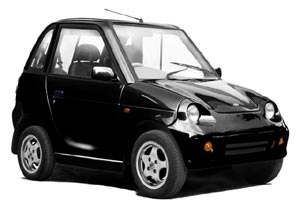 by ALASTAIR MCKAY (30 Apr 2006) Scotland on Sunday
THERE is a map on the wall of the office of GoinGreen's offices in Southall, West London, which shows the spread of emission-free motoring. It looks like the early stages of a virus, with coloured pins marking the address of every owner of a Reva G-Wiz.
So far, the map is restricted to Greater London. The armies of pins have outposts as far as Chislehurst and Beckenham in the south-east, and Wimbledon in the south-west, stretching as far north as Barnet. There are a couple in Ealing.
The big battalions are clustered in the leafier parts of north London, with high concentrations of colour in Primrose Hill and Hampstead. One of those pins is said to belong to Jonathan Ross - a man with a penchant for eccentric vehicles. Since they went on sale in summer 2004, more than 500 of these impish electric cars have been sold.
The analogy with a virus is apt. GoinGreen doesn't advertise its cars, instead selling them by word of mouth and through its website: www.goingreen.co.uk If the pins clump together, it's because the owners tend to recommend them to their friends. But the company did get a burst of publicity this week when the Conservative leader, David Cameron, posed with a G-Wiz (though the pistachio-tie-wearing politician actually drives a not very green Lexus GS 450).
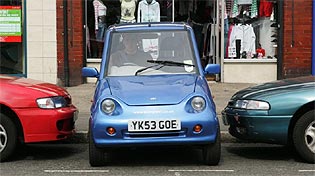
It's to that same blue G-Wiz (reg: YK53 GOE) that I am led for my test-drive. The experience is made even more testing by the presence in the car of Graham, the photographer, and my guide, Joe Byars of GoinGreen. The G-Wiz is designed to seat two adults and two small children. It can take three tall men, but not without one of them doing an unseemly yoga position in the rear. And though the cabin is tall and the road position is quite high, the roof is no respecter of a gentleman's quiff.
The G-Wiz was conceived in California by Dr Lon Bell, an engineer who made his fortune making airbag sensors and seatbelt tensioners, before becoming intrigued by the way cars work.
In designing an electric car, he decided to ignore the assumptions of conventional construction. His first thought was to ask what was necessary in a car, from which he concluded that it needed wheels, with tyres, something to steer and a windscreen. Most of the rest was luxury and got in the way of making a nimble, no-frills electric vehicle for non-polluting urban travel.
As well as a body made from dent-resistant plastic, it has regenerative brakes: pressing the pedal works like a dynamo, recharging the engine.
It also has climate-controlled seating. Each seat has tiny heat-releasing holes which warm the body rather than the air in the car. There is a conventional heater, too, but using it will knock 10 miles from the car's 40-mile range.
Before we set off for the bright lights of Hayes, Joe flips open the bonnet to reveal a bottle containing windscreen fluid, and a small storage space. And that, more or less, is that. To the non-mechanically-minded, the G-Wiz is a remarkable piece of technology. It requires only a little more attention than a mobile phone, and it doesn't make an irritating noise in the cinema. To charge it, you stick a lead in the socket where the petrol cap should be, and you have to water the battery every two or three weeks. "It's like a plant," Joe says. "Every so often a light will come on saying 'Water me, please'."
This procedure is simpler then topping up a steam iron. You don't have to open the bonnet. You stick a small pipe into a hole by the plug, hold it in the air and pour in distilled water. You need never touch an oil can. Oiling is done during servicing. "You water your car," says Joe. "That's all you need to do."
Driving the thing is marginally more complicated, but will not test the aptitude of anyone who has ever sat in a dodgem. There are two pedals - an accelerator and a brake. The handbrake is a twisty device under the dashboard on the left of the steering wheel. The ignition is on the right.
This is the first big shock. When you turn on the engine, nothing happens. Actually, that's the point. There is no engine. When you turn the key you are not greeted by an angry growl of machinery. There is nothing, unless you count the flickering of a small green light on the dashboard. At first, this is disconcerting. Without the engine noise, the instincts of conventional driving don't kick in.
There is no pumping of the accelerator or gentle easing of the brake, and none of the sense of power which it is at the root of all car advertising. In this little moment of uncertainty, with no rush of testosterone to the places that make urban motoring slightly less relaxing than bare-knuckle boxing, it's tempting to forget the routines of driving - the mirror, signal, manoeuvre bit. Fortunately, such disorientation is not that dangerous. The G-Wiz seems to think before it moves, and when it does, it's a stately glide.
There are no gears. The car has a dial, with four modes: reverse, neutral, economy, and full power. In London, where the average speed of travel is less than 10mph, full power (with a top speed of 42mph) is rarely necessary, but it does offer slightly more oomph when easing from traffic lights.
On the open road, there is a perplexing absence of noise. Suddenly, you are aware of the volume from other cars' engines. Aurally, it's a bit like being a non-smoker in a cigar bar: you find yourself defined by the thing you are not doing. But it does make you wonder how much quieter our cities would be if all the short journeys were electric.
The car is cute in the way that Del Trotter's Reliant Robin was, and its green credentials are impeccable. But it is economically attractive, too. The G-Wiz is exempt from road tax, as it produces no carbon emissions. Since it costs only 40p to charge the car for 40 miles of driving, GoinGreen calculates that a London commuter will save the cost of the car (£7,799 with free leather seats, worth £500) in a year.
The biggest problem for the spread of the technology is the need for off-street parking during the recharging process. Some London car parks offer recharging facilities, but flat-dwellers or owners without a driveway will need support from councils to make the G-Wiz a practical option.
Similarly, potential drivers outside London will have to wait until the company expands, or the technology becomes more universal, as servicing is currently only available at GoinGreen's headquarters. How does it feel? Well, not sexy exactly, but there is something endearing about the car that seems to bring out the best in other road users.
Thanks to the demands of the yogic photographer, Graham, I was forced to drive the G-Wiz in an irregular manner, circling the circumference of a roundabout 10 times, stopping in front of a bus, reversing in the wrong direction down a one-way street, and the reaction from other road users and pedestrians was one of tickled tolerance. Even White Van Man was smiling.
Lon Bell has compared the G-Wiz to the early mobile phones. In later models the batteries will be smaller and more efficient. A prototype of a hard-top roadster already exists: it goes at 80mph and has a range of 100 miles. That may bring more torque to the electric revolution, but it will be hard-pushed to replicate the Postman Pattish charm of the little G-Wiz.
Thursday, February 22, 2007
The Economics of Climate Change
By Jonas Hagen
UN Cronicle online
The Stern Review concludes that the cost of acting to decrease global emissions of greenhouse gases is far less than the cost of dealing with the effects of climate change if no mitigation efforts are made.
However, Mr. Stern warned that "even if we are sensible about climate change and get the emissions down, the climate is going to change still more than it has".
While the world was currently experiencing the effects of an increase in global temperatures of 0.7 degrees Celsius, he said that "even if we act strongly to decrease emissions, we've got another 1.5 to 2.0 degrees centigrade to come. So we've seen maybe a quarter or a third of temperature increase we're going to have to cope with. St. Petersburg, New York, London, Cairo, Cape Town, Shanghai, Bombay, Calcutta, Dhaka-they're all under threat from sea-level rise, and many parts of the world will be under threat from hurricanes, typhoons, droughts and floods."
Mr. Stern also warned that the heatwaves that killed thousands of people in Europe in 2003 "will probably be standard by the time we get to 2050", and the Nile river, which ten countries depend on, could drop to one half of current water levels in the second half of this century.
However, the "business as usual" scenario-where no action is taken to reduce emissions- would lead to changes in the earth's climate, he said, "that we don't really understand, absolutely unprecedented and earth-transforming--the difference between where we are now and the last ice age".
Climate change also highlights global inequities, according to Mr. Stern. "All countries in the world will be affected; we're all in this together, but it is the poor that will be hit earliest and hardest. You just have to look at the effects of Katrina in New Orleans, or the effects of the typhoon that hit Bombay a couple of years ago [in July 2005]."
Global security is affected by climate change and "could cause conflict within and across countries", he said, adding that most African leaders he met with at the African Union Summit in Addis Ababa in January 2007 attributed the humanitarian crisis in Darfur to the climate problem-pushed out of their traditional lands by drought, and pastoralists were forced to move and came into conflict with settled farmers.
To reduce emissions, Mr. Stern suggested a range of solutions, which included taxes on emission-producing activities, the development and deployment of low-emission technologies, investing in energy efficiency, and preserving forests around the world.
Time is of the essence, he said. "Even though this is a long-term problem, we've got to start now. We've left it very late. If we had gotten our heads around this problem 20 years ago, it would have been much simpler and much cheaper. If we wait another 20 years, it will be still more difficult and expensive."
Rich countries must take responsibility for a problem they have caused, Mr. Stern said, suggesting emission reductions of 60 to 80 per cent for developed nations. He noted that France had set the goal of a 75 per cent reduction by 2050, the United Kingdom at 60 per cent and the State of California in the United States aimed at 80 per cent.
Developing countries, he added, must understand that they can continue to expand their economies and achieve progress on the Millennium Development Goals-eight targets for human development that UN Member States agreed upon to reach by 2015.
Mr. Stern cited the progressive policy in China, which is "reforesting, not deforesting". The country hoped to make energy production 20 per cent more efficient as part of its 11th five-year plan, which is already underway, he reported, adding that an $8,000 tax was established on sports utility vehicles (SUVs) in Beijing.
"I'm much more optimistic six or nine months ago about where the world is moving", he said.
He called on the international community to "act strongly and on the right kind of scale", stating further that the United Nations is "a place we can really take that forward in a very powerful way".
Mr. Sachs agreed that "we have to move quickly and urgently on this issue. That means setting in place a full century of transition, with much of the transition being completed by 2050."
Some 40 or 50 years from today, energy sources should be very different from what they are today, he said. Supplying significant amounts of energy from nuclear power and coal-fired plants that used carbon sequestration technology, where carbon produced by the burning coal is pumped back into the earth, is "within reach", he noted.
Such plants must be built quickly in China or India, in order to see if they are viable as sources of clean energy. "Once those plants are done, everything is going to become a lot clearer and less hypothetical than it is now", Mr. Sachs pointed out.
UN Cronicle online
The Stern Review concludes that the cost of acting to decrease global emissions of greenhouse gases is far less than the cost of dealing with the effects of climate change if no mitigation efforts are made.
However, Mr. Stern warned that "even if we are sensible about climate change and get the emissions down, the climate is going to change still more than it has".
While the world was currently experiencing the effects of an increase in global temperatures of 0.7 degrees Celsius, he said that "even if we act strongly to decrease emissions, we've got another 1.5 to 2.0 degrees centigrade to come. So we've seen maybe a quarter or a third of temperature increase we're going to have to cope with. St. Petersburg, New York, London, Cairo, Cape Town, Shanghai, Bombay, Calcutta, Dhaka-they're all under threat from sea-level rise, and many parts of the world will be under threat from hurricanes, typhoons, droughts and floods."
Mr. Stern also warned that the heatwaves that killed thousands of people in Europe in 2003 "will probably be standard by the time we get to 2050", and the Nile river, which ten countries depend on, could drop to one half of current water levels in the second half of this century.
However, the "business as usual" scenario-where no action is taken to reduce emissions- would lead to changes in the earth's climate, he said, "that we don't really understand, absolutely unprecedented and earth-transforming--the difference between where we are now and the last ice age".
Climate change also highlights global inequities, according to Mr. Stern. "All countries in the world will be affected; we're all in this together, but it is the poor that will be hit earliest and hardest. You just have to look at the effects of Katrina in New Orleans, or the effects of the typhoon that hit Bombay a couple of years ago [in July 2005]."
Global security is affected by climate change and "could cause conflict within and across countries", he said, adding that most African leaders he met with at the African Union Summit in Addis Ababa in January 2007 attributed the humanitarian crisis in Darfur to the climate problem-pushed out of their traditional lands by drought, and pastoralists were forced to move and came into conflict with settled farmers.
To reduce emissions, Mr. Stern suggested a range of solutions, which included taxes on emission-producing activities, the development and deployment of low-emission technologies, investing in energy efficiency, and preserving forests around the world.
Time is of the essence, he said. "Even though this is a long-term problem, we've got to start now. We've left it very late. If we had gotten our heads around this problem 20 years ago, it would have been much simpler and much cheaper. If we wait another 20 years, it will be still more difficult and expensive."
Rich countries must take responsibility for a problem they have caused, Mr. Stern said, suggesting emission reductions of 60 to 80 per cent for developed nations. He noted that France had set the goal of a 75 per cent reduction by 2050, the United Kingdom at 60 per cent and the State of California in the United States aimed at 80 per cent.
Developing countries, he added, must understand that they can continue to expand their economies and achieve progress on the Millennium Development Goals-eight targets for human development that UN Member States agreed upon to reach by 2015.
Mr. Stern cited the progressive policy in China, which is "reforesting, not deforesting". The country hoped to make energy production 20 per cent more efficient as part of its 11th five-year plan, which is already underway, he reported, adding that an $8,000 tax was established on sports utility vehicles (SUVs) in Beijing.
"I'm much more optimistic six or nine months ago about where the world is moving", he said.
He called on the international community to "act strongly and on the right kind of scale", stating further that the United Nations is "a place we can really take that forward in a very powerful way".
Mr. Sachs agreed that "we have to move quickly and urgently on this issue. That means setting in place a full century of transition, with much of the transition being completed by 2050."
Some 40 or 50 years from today, energy sources should be very different from what they are today, he said. Supplying significant amounts of energy from nuclear power and coal-fired plants that used carbon sequestration technology, where carbon produced by the burning coal is pumped back into the earth, is "within reach", he noted.
Such plants must be built quickly in China or India, in order to see if they are viable as sources of clean energy. "Once those plants are done, everything is going to become a lot clearer and less hypothetical than it is now", Mr. Sachs pointed out.
Wednesday, February 21, 2007
The Changing Climate on Climate Change
by Joseph E. Stiglitz
The message, it seems, has finally gotten through: global warming represents a serious threat to our planet. At the recent World Economic Forum in Davos, world leaders saw climate change, for the first time, topping the list of global concerns.
Europe and Japan have shown their commitment to reduce global warming by imposing costs on themselves and their producers, even if it places them at a competitive disadvantage. The biggest obstacle until now has been the United States. The Clinton administration had called for bold action as far back as 1993, proposing what was in effect a tax on carbon emissions; but an alliance of polluters, led by the coal, oil, and auto industries beat back this initiative.
To the scientific community, the evidence on climate change has, of course, been overwhelming for more than a decade and a half. I participated in the second assessment of the scientific evidence conducted by the Intergovernmental Panel on Climate Change, which perhaps made one critical mistake: it underestimated the pace at which global warming was occurring. The Fourth Assessment, which was just issued, confirms the mounting evidence and the increasing conviction that global warming is the result of the increase in greenhouse gases in the atmosphere.
The increased pace of warming reflects the impact of complex non-linear factors and a variety of “tipping points” that can result in acceleration of the process. For instance, as the Arctic ice cap melts, less sunlight is reflected. Seemingly dramatic changes in weather patterns including the melting of glaciers in Greenland and the thawing of the Siberian permafrost have at last convinced most business leaders that the time for action is now.
Recently, even President Bush seems to have woken up. But a closer look at what he is doing, and not doing, shows clearly that he has mostly heard the call of his campaign contributors from the oil and coal industries, and that he has once again put their interests over the global interest in reducing emissions. If he were truly concerned about global warming, how could he have endorsed the construction of coal-fired electricity plants, even if those plants use more efficient technologies than have been employed in the past?
What is required, first and foremost, are market-based incentives to induce Americans to use less energy and to produce more energy in ways that emit less carbon. But Bush has neither eliminated massive subsidies to the oil industry (though, fortunately, the Democratic Congress may take action) nor provided adequate incentives for conservation. Even his call for energy independence should be seen for what it is a new rationale for old corporate subsidies.
A policy that entails draining America’s limited oil supplies I call it “drain America first” will leave the US even more dependent on foreign oil. The US imposes a tariff of more than 50 cents per gallon on sugar-based ethanol from Brazil, but subsidizes inefficient corn-based American ethanol heavily indeed , it requires more than a gallon of gasoline to fertilize, harvest, transport, process, and distill corn to yield one gallon of ethanol.
As the world’s largest polluter, accounting for roughly a quarter of global carbon emissions, America’s reluctance to do more is perhaps understandable, if not forgivable. But claims by Bush that America cannot afford to do anything about global warming ring hollow: other advanced industrial countries with comparable standards of living emit only a fraction of what the US emits per dollar of GDP.
As a result, American firms with access to cheap energy are given a big competitive advantage over firms in Europe and elsewhere. Some in Europe worry that stringent action on global warming may be counterproductive: energy-intensive industries may simply move to the US or other countries that pay little attention to emissions. And there is more than a grain of truth to these concerns.
A striking fact about climate change is that there is little overlap between the countries that are most vulnerable to its effects mainly poor countries in the South that can ill afford to deal with the consequences and the countries, like the US, that are the largest polluters. What is at stake is in part a moral issue, a matter of global social justice.
The Kyoto Protocol represented the international community’s attempt to begin to deal with global warming in a fair and efficient way. But it left out a majority of the sources of emissions, and unless something is done to include the US and the developing countries in a meaningful way, it will be little more than a symbolic gesture. There needs to be a new “coalition of the willing,” this time perhaps led by Europe and this time directed at a real danger.
This “coalition of the willing” could agree to certain basic standards: to forego building coal-fired plants, increase automobiles’ fuel efficiency, and provide targeted assistance to developing countries to enhance their energy efficiency and reduce emissions. Coalition members could also agree to provide stronger incentives to their own producers, through either more stringent caps on emissions or higher taxes on pollution. They could then agree to impose taxes on products from other countries including the US that are produced in ways that unnecessarily add substantially to global warming. What is at stake is not protecting domestic producers, but protecting our planet.
The changing climate on climate change provides political leaders in Europe and other potential members of this “coalition of the willing” an unprecedented opportunity to move beyond mere rhetoric. The time to act is now.
Joseph E. Stiglitz, a Nobel laureate in economics, is Professor of Economics at Columbia University and was Chairman of the Council of Economic Advisers to President Clinton and Chief Economist and Senior Vice President at the World Bank. His latest book is Making Globalization Work.
The message, it seems, has finally gotten through: global warming represents a serious threat to our planet. At the recent World Economic Forum in Davos, world leaders saw climate change, for the first time, topping the list of global concerns.
Europe and Japan have shown their commitment to reduce global warming by imposing costs on themselves and their producers, even if it places them at a competitive disadvantage. The biggest obstacle until now has been the United States. The Clinton administration had called for bold action as far back as 1993, proposing what was in effect a tax on carbon emissions; but an alliance of polluters, led by the coal, oil, and auto industries beat back this initiative.
To the scientific community, the evidence on climate change has, of course, been overwhelming for more than a decade and a half. I participated in the second assessment of the scientific evidence conducted by the Intergovernmental Panel on Climate Change, which perhaps made one critical mistake: it underestimated the pace at which global warming was occurring. The Fourth Assessment, which was just issued, confirms the mounting evidence and the increasing conviction that global warming is the result of the increase in greenhouse gases in the atmosphere.
The increased pace of warming reflects the impact of complex non-linear factors and a variety of “tipping points” that can result in acceleration of the process. For instance, as the Arctic ice cap melts, less sunlight is reflected. Seemingly dramatic changes in weather patterns including the melting of glaciers in Greenland and the thawing of the Siberian permafrost have at last convinced most business leaders that the time for action is now.
Recently, even President Bush seems to have woken up. But a closer look at what he is doing, and not doing, shows clearly that he has mostly heard the call of his campaign contributors from the oil and coal industries, and that he has once again put their interests over the global interest in reducing emissions. If he were truly concerned about global warming, how could he have endorsed the construction of coal-fired electricity plants, even if those plants use more efficient technologies than have been employed in the past?
What is required, first and foremost, are market-based incentives to induce Americans to use less energy and to produce more energy in ways that emit less carbon. But Bush has neither eliminated massive subsidies to the oil industry (though, fortunately, the Democratic Congress may take action) nor provided adequate incentives for conservation. Even his call for energy independence should be seen for what it is a new rationale for old corporate subsidies.
A policy that entails draining America’s limited oil supplies I call it “drain America first” will leave the US even more dependent on foreign oil. The US imposes a tariff of more than 50 cents per gallon on sugar-based ethanol from Brazil, but subsidizes inefficient corn-based American ethanol heavily indeed , it requires more than a gallon of gasoline to fertilize, harvest, transport, process, and distill corn to yield one gallon of ethanol.
As the world’s largest polluter, accounting for roughly a quarter of global carbon emissions, America’s reluctance to do more is perhaps understandable, if not forgivable. But claims by Bush that America cannot afford to do anything about global warming ring hollow: other advanced industrial countries with comparable standards of living emit only a fraction of what the US emits per dollar of GDP.
As a result, American firms with access to cheap energy are given a big competitive advantage over firms in Europe and elsewhere. Some in Europe worry that stringent action on global warming may be counterproductive: energy-intensive industries may simply move to the US or other countries that pay little attention to emissions. And there is more than a grain of truth to these concerns.
A striking fact about climate change is that there is little overlap between the countries that are most vulnerable to its effects mainly poor countries in the South that can ill afford to deal with the consequences and the countries, like the US, that are the largest polluters. What is at stake is in part a moral issue, a matter of global social justice.
The Kyoto Protocol represented the international community’s attempt to begin to deal with global warming in a fair and efficient way. But it left out a majority of the sources of emissions, and unless something is done to include the US and the developing countries in a meaningful way, it will be little more than a symbolic gesture. There needs to be a new “coalition of the willing,” this time perhaps led by Europe and this time directed at a real danger.
This “coalition of the willing” could agree to certain basic standards: to forego building coal-fired plants, increase automobiles’ fuel efficiency, and provide targeted assistance to developing countries to enhance their energy efficiency and reduce emissions. Coalition members could also agree to provide stronger incentives to their own producers, through either more stringent caps on emissions or higher taxes on pollution. They could then agree to impose taxes on products from other countries including the US that are produced in ways that unnecessarily add substantially to global warming. What is at stake is not protecting domestic producers, but protecting our planet.
The changing climate on climate change provides political leaders in Europe and other potential members of this “coalition of the willing” an unprecedented opportunity to move beyond mere rhetoric. The time to act is now.
Joseph E. Stiglitz, a Nobel laureate in economics, is Professor of Economics at Columbia University and was Chairman of the Council of Economic Advisers to President Clinton and Chief Economist and Senior Vice President at the World Bank. His latest book is Making Globalization Work.
Sunday, February 18, 2007
Remote Control Inventor dies
.jpg) February 17, 2007
February 17, 2007SMH
Hit the mute button for a moment of silence: The co-inventor of the TV remote, Robert Adler, has died.
Adler, who won an Emmy Award along with fellow engineer Eugene Polley for the device, died yesterday of heart failure at a Boise nursing home at 93, Zenith Electronics Corp said today.
In his six-decade career with Zenith, Adler was a prolific inventor, earning more than 180 US patents. He was best known for his 1956 Zenith Space Command remote control, which helped make TV a truly sedentary pastime.
In a May 2004 interview, Adler recalled being among two dozen engineers at Zenith given the mission to find a new way for television viewers to change channels without getting out of their chairs or tripping over a cable.
But he downplayed his role when asked if he felt his invention helped raise a new generation of people too lazy to get off the couch.
"People ask me all the time - 'Don't you feel guilty for it?' And I say that's ridiculous," he said. "It seems reasonable and rational to control the TV from where you normally sit and watch television."
Various sources have credited either Polley, another Zenith engineer, or Adler as the inventor of the device. Polley created the "Flashmatic," a wireless remote introduced in 1955 that operated on photo cells. Adler introduced ultrasonics, or high-frequency sound, to make the device more efficient in 1956.
Zenith credits them as co-inventors, and the National Academy of Television Arts and Sciences awarded both Adler and Polley an Emmy in 1997 for the landmark invention.
"He was part of a project that changed the world," Polley said from his home in Lombard, Illinois.
Adler joined Zenith's research division in 1941 after earning a doctorate in physics from the University of Vienna. He retired as research vice president in 1979, and served as a technical consultant until 1999, when Zenith merged with LG Electronics Inc.
During World War II, Adler specialised in military communications equipment. He later helped develop sensitive amplifiers for ultra high frequency signals used by radio astronomers and by the US Air Force for long-range missile detection.
Adler also was considered a pioneer in SAW technology, or surface acoustic waves, in colour television sets and touch screens. The technology has also been used in cellular telephones.
The US Patent and Trademark Office published his most recent patent application, for advances in touch screen technology, on Feb. 1.
His wife, Ingrid, said Adler would not have chosen the remote control as his favourite invention. In fact, he did not even watch much television.
"He was more of a reader," she said. "He was a man who would dream in the night and wake up and say, 'I just solved a problem.' He was always thinking science."
AP
Big donation for environmental studies centre

pic: Yahoo founder Jerry Yang.
February 16, 2007
SMH
Jerry Yang, co-founder of internet media company Yahoo, is donating $US75 million ($A96m) to Stanford University, which will spend most of the money on a new environmental studies center, the university said on Thursday.
Yang, who started Yahoo in 1994 with fellow student David Filo while working on his doctorate, planned to make the donations over a period of several years, said Howard Pearson, director of Stanford's development office.
It will be the largest of several donations Yang has made to his alma mater, although Pearson declined to say how much he has previously given.
Yang would make the donations with his wife, Akiko Yamazaki, also a Stanford graduate.
Of the total, $US50 million will pay for a new environment and energy building and $US5 million will go toward a doctor training facility for Stanford's medical school.
The remaining $US20 million will be used for future projects, Stanford said.
Yang's net worth was estimated at $US2.4 billion in 2006, according to a report in Forbes magazine last September.
Stanford received $US911 million in alumni donations in its fiscal year ended August 31, up more than 50 percent from the $US603 million the previous year.
Although Yang obtained both bachelor's and master's degrees from Stanford, he never completed his doctorate in electrical engineering, and his biography on Yahoo says he "is currently on a leave of absence" from the program.
Reuters
Bionic eye
Peter Weekes
February 18, 2007
MELBOURNE'S Eye and Ear Hospital will start implanting bionic eyes that restore sight to the blind within a few years.
The hospital is one of three centres outside the United States that have been chosen to implant the revolutionary device developed by the Doheny Eye Institute at the University of Southern California.
American scientists said last week that the first six patients to try the bionic eye had learnt how to detect light, distinguish between objects and perceive direction of motion.
"We expected that all they would be able to do would be to differentiate between light and dark.
But we were amazed to find that they can tell the difference between objects such as a plate, a knife and a cup, and tell which way people are moving," said Professor Mark Humayun of the University of California, who led the research.
His team is preparing to test a more advanced version of the implant on as many as 75 patients.
"If the new trial hits its milestones, the second-generation implant could be commercially available in two years," Professor Humayun said.
The device offers hope to millions of people who have lost their vision to retinitis pigmentosa, a group of inherited eye diseases that cause the degeneration of the photoreceptor cells that capture and process light. It is the most common cause of blindness among those under 50.
The implant is not suitable for every form of blindness, but scientists hope that it might be used to restore the sight of those with degenerative eye diseases, particularly those with macular degeneration who are over 75.
Professor William Campbell, head of the Royal Victorian Eye and Ear Hospital's vitro retinal unit, described the device as "the beginning of a very exciting development in opthamology".
"We have been chosen to be one of the centres around the world where they want to put in their implants, but it will be two or three years before we start doing it. We will be putting some of the early models in when we find suitable candidates and after we have been trained."
The device comes in two parts. A tiny camera in the lens or on the bridge of a pair of lightweight glasses captures images.
This information is transmitted to a radio receiver implanted behind the patient's ear that converts it to electrical signals, which are sent to a grid of electrodes implanted in the retina.
These electrodes stimulate retinal nerve cells to produce electrical impulses that send signals to the brain so the patient can see spots of light in different patterns.
While the first-generation device had 16 electrodes, the new one has 60 electrodes and will cost about $32,000.
The first device took 16 years of research, but the second version has taken just four years.
Source: The Sun-Herald
February 18, 2007
MELBOURNE'S Eye and Ear Hospital will start implanting bionic eyes that restore sight to the blind within a few years.
The hospital is one of three centres outside the United States that have been chosen to implant the revolutionary device developed by the Doheny Eye Institute at the University of Southern California.
American scientists said last week that the first six patients to try the bionic eye had learnt how to detect light, distinguish between objects and perceive direction of motion.
"We expected that all they would be able to do would be to differentiate between light and dark.
But we were amazed to find that they can tell the difference between objects such as a plate, a knife and a cup, and tell which way people are moving," said Professor Mark Humayun of the University of California, who led the research.
His team is preparing to test a more advanced version of the implant on as many as 75 patients.
"If the new trial hits its milestones, the second-generation implant could be commercially available in two years," Professor Humayun said.
The device offers hope to millions of people who have lost their vision to retinitis pigmentosa, a group of inherited eye diseases that cause the degeneration of the photoreceptor cells that capture and process light. It is the most common cause of blindness among those under 50.
The implant is not suitable for every form of blindness, but scientists hope that it might be used to restore the sight of those with degenerative eye diseases, particularly those with macular degeneration who are over 75.
Professor William Campbell, head of the Royal Victorian Eye and Ear Hospital's vitro retinal unit, described the device as "the beginning of a very exciting development in opthamology".
"We have been chosen to be one of the centres around the world where they want to put in their implants, but it will be two or three years before we start doing it. We will be putting some of the early models in when we find suitable candidates and after we have been trained."
The device comes in two parts. A tiny camera in the lens or on the bridge of a pair of lightweight glasses captures images.
This information is transmitted to a radio receiver implanted behind the patient's ear that converts it to electrical signals, which are sent to a grid of electrodes implanted in the retina.
These electrodes stimulate retinal nerve cells to produce electrical impulses that send signals to the brain so the patient can see spots of light in different patterns.
While the first-generation device had 16 electrodes, the new one has 60 electrodes and will cost about $32,000.
The first device took 16 years of research, but the second version has taken just four years.
Source: The Sun-Herald
Friday, February 16, 2007
Shark-wrestling Phil
Jane Holroyd
February 16, 2007
SMH
A South Australian man who wrestled and killed a 1.3-metre shark on Wednesday has been described as a "risk taker" by his wife.
Phillip Kerkhof, 41, jumped into shallow waters to chase the bronze whaler shark because it was eating bait that he and other fisherman were using off a jetty near Port Lincoln.
Mr Kerkhof wrestled the shark after capturing it in his arms and managed to fling it up onto the jetty before killing it.
His wife Christine said Phillip, a bricklayer, had nine lives.
"Just after we got married he fell off a 100-foot weir and did not even go to hospital," she told theage.com.au.
Mrs Kerkhof said she was at home on Wednesday when her husband arrived at their Louth Bay home with the shark.
"When he brought it home he called, 'Come out here! Come outside!' I walked outside and there's a shark on the lawn. I just shook my head because I'm used to my husband doing crazy things.
"He didn't think," Mrs Kerkhof said. "He'd had a few vodkas and wasn't thinking straight. He just does things off impulse. He thought about it later and said, 'That was a bit dangerous.'"
Wednesday, February 14, 2007
The Stranger Within (Human Chimeras)
New Scientist vol 180 issue 2421
15 November 2003, page 34
Human chimeras were once thought to be so rare as to be just a curiosity.
But there's a little bit of someone else in all of us, says Claire
Ainsworth, and sometimes much more...
EXPLAIN this. You are a doctor and one of your patients, a 52-year- old woman, comes to see you, very upset. Tests have revealed something unbelievable about two of her three grown-up sons. Although
she conceived them naturally with her husband, who is definitely
their father, the tests say she isn't their biological mother.
Somehow she has given birth to somebody else's children.
This isn't a trick question - it's a genuine case that Margot Kruskall, a doctor at the Beth Israel Deaconess Medical Center in Boston, Massachusetts, was faced with five years ago. The patient, who we will call Jane, needed a kidney transplant, and so her family underwent blood tests to see if any of them would make a suitable donor. When the results came back, Jane was hoping for good news.
Instead she received a hammer blow. The letter told her outright that
two of her three sons could not be hers. What was going on?
It took Kruskall and her team two years to crack the riddle. In the end they discovered that Jane is a chimera, a mixture of two individuals - non-identical twin sisters - who fused in the womb and grew into a single body. Some parts of her are derived from one twin, others from the other.
It seems bizarre that this can happen at all, but Jane's is not an
isolated case. Around 30 similar instances of chimerism have been
reported, and there are probably many more out there who will never
discover their unusual origins.
While cases like Jane's are the extreme, researchers now think that
there's a little bit of chimera in all of us, and what was once seen
as a biological oddity may serve a vital function. We may owe our
lives to being chimeras.
At first, Jane's case had Kruskall completely puzzled. The original
data came from the tests done to "tissue-type" her and her children.
Such tests are based on a set of genes called the HLA complex, which
encode many different immune proteins, including cell surface proteins that immune cells use to distinguish the body's own tissues
from foreign material. There are hundreds of different versions, or
alleles, of each HLA gene, and because of this, each person's
combination of alleles is almost unique. But because the genes are
clustered close together on chromosome 6, they tend to be inherited
together in a block known as a haplotype. Everyone inherits two HLA
haplotypes, one from each parent.
Transplant doctors know that the closer the match between two people's HLA haplotypes, the lower the risk of a transplant between them being rejected. If you need a transplant, the obvious place to look for people with a similar haplotype is your close family. Your siblings, for example, have a 1-in-4 chance of matching yours exactly, while your children will have at least 50 per cent of your HLA genes.
Confronted with Jane's bizarre test results, Kruskall's team's first line of enquiry was to take another look at Jane's HLA genes and those of her immediate family. They identified Jane's haplotypes and dubbed them 1 and 3. They tested Jane's husband too - he had types 5 and 6. And when they looked at her sons they confirmed that the original tissue-typing was correct. While all three shared a haplotype with their father, only one shared one of Jane's. The other two sons had a haplotype of unknown origin, labelled type 2.
The obvious interpretation was that Jane was not the biological
mother of two of her sons, yet they were all conceived naturally,
so how could this be? One possibility was that both boys were
accidentally swapped at birth, but the chance of this happening twice to the same family is very small. Add in the fact that both sons share a haplotype with their father and it becomes a near impossibility.
Stumped, Kruskall sent her data out to colleagues, asking them if
they could make sense of it. Soon researchers around the world were
scratching their heads in bewilderment. "I did get the most amazing
set of explanations," Kruskall recalls. "No one could quite figure it
out." One suggested that Jane had secretly undergone fertility
treatment using donated eggs. Another speculated that Jane and her
husband had got her sister to conceive children with his sperm, and
then pretended they were hers.
The breakthrough came when Kruskall's team checked the HLA haplotypes of other members of Jane's family who had been omitted from the original tests. They discovered that her brother carried the mystery haplotype 2 - suggesting that the two sons were related to Jane in some way after all. "That really provided the spur that kept us going," Kruskall says.
So where did the sons' odd haplotype come from? Since Jane's blood cells provided no match, the team decided to test DNA from some of her other tissues, including her thyroid gland, mouth and hair. What they discovered was astonishing. Some of her tissues carried haplotypes 1 and 3, while others contained 2 and 4 (The New England Journal of Medicine, vol 346, p 1546). Jane's body was made up of two genetically distinct types of cells.
There was only one conclusion: Jane was a mixture of two different people.
Kruskall thinks the most likely explanation for this is that Jane's mother conceived non-identical twin girls, who fused at an early stage of the pregnancy to form a single embryo. In medical parlance, Jane is a tetragametic chimera, a person whose body is made up from two genetically distinct lines of cells derived from a total of four gametes - eggs and sperm.
This instantly explains why the tissue-typing yielded such paradoxical results. For some reason, cells from only one twin have come to dominate in Jane's blood - the tissue used in tissue-typing. In Jane's other tissues, however, including her ovaries, cells of both types live amicably alongside each other, hence the apparently impossible genetics of her three sons. One came from an egg derived from the twin whose cells dominate Jane's blood, while his two brothers came from eggs derived from the other twin's cells.
Nobody knows how common tetragametic chimerism is. It often has no outward signs and those who uncover their chimeric nature do so only by accident.
Nature reported a similar case to Jane's in 1979, when genetic tests
suggested that a woman could not be the mother of any of her four
children. There had been no hint that the woman was chimeric.
Some chimeras do have unusual physical features. For example, one
girl was discovered to be a chimera because her eyes were different colours, one brown, the other hazel. Others have come to light when doctors investigated problems with their reproductive systems, and
found that they had structures from both male and female reproductive
organs as a result of having cells of both sexes in their bodies. But most probably go through life utterly unaware of their unusual constitution.
"They are probably dramatically under-diagnosed," Kruskall says, "and also dramatically rare."
Yet this kind of chimerism may still be common enough to cast doubt on the way we carry out genetic tests of parenthood. Kruskall is currently helping out with a court case where a woman is suing her partner, claiming that he is the father of her child. In a bizarre twist that would nonplus even Jerry Springer, tissue-typing tests proved he was the father, but ruled her out as the mother. The situation could be explained by chimerism in the mother, Kruskall speculates.
But what about a case where the father was a chimera? "You could imagine that you could rule out a person who is in fact the father," she says. This is especially plausible if one cell line always comes to dominate in the blood, as happened with Jane. Animal studies of chimerism suggest that this is indeed common.
What's more, the incidence of tetragametic chimerism is set to rise,
Kruskall says, because of modern fertility techniques that increase the rate of twinning. Drugs used to make a woman ovulate can cause her to release more than one egg at a time, for example, while many IVF clinics still transfer more than one embryo into the womb. And the fact that embryos are in close contact in the lab dish or when transferred to the womb may encourage them to fuse, according to a report by a team at the University of Edinburgh, UK. In 1998, they reported a case of a chimeric IVF baby who resulted from the accidental fusion of a male embryo and a female embryo (The New England Journal of Medicine, vol 338, p 166). The child was outwardly male, but the left hand side of his internal reproductive system had developed as an ovary and fallopian tube.
Meanwhile, Jane's mystery is solved - and it even has a happy ending. Because her body contains double the normal number of HLA haplotypes, it means that she has a much greater chance of finding a suitable donor kidney.
But the story doesn't end there. There is growing evidence that chimerism in one form or another may not be so unusual at all. In fact, some researchers now think that most of us, if not all, are chimeras of one kind or another. Far from being pure-bred individuals composed of a single genetic cell line, our bodies are cellular mongrels, teeming with cells from our mothers, maybe even from grandparents and siblings. This may seem a little shocking at first. The thought of playing host to cells from other people may offend your sense of individuality. But you may have those outsiders to thank for keeping you healthy.
During pregnancy, the blood of the mother and fetus are kept separate, but some cells manage to slip through, meaning that you will have picked up some cells from your mother, and she some from you. In fact, some 80 to 90 per cent of women carry their children's cells or DNA in their blood during pregnancy and up to 50 per= centcarry them for decades after giving birth, a condition called microchimerism (New Scientist, 24 April 1999, p4). If your mother then had more children, some of your cells could in principle slip back through into your younger sibling's body. And twins can end up swapping cells in the womb, especially if they share a placenta. So a single person can be a veritable menagerie of different cell types from different generations. "Women harbour cells from both their mother and their children," says J. Lee Nelson, an immunologist at the Fred Hutchinson Cancer Research Center in Seattle.
The fact that fetal cells persist in their mother's bloodstream for decades has been known since the mid 1990s. But only recently has anyone investigated how common it is for cells to move the other way – from mothers into their children. To investigate this, Nelson and her colleague Natalie Lambert have been searching for maternal cells in the blood of adult women.
In a forthcoming paper in the journal Arthritis & Rheumatism, they describe how they took blood samples from 32 healthy women and found that 22 per cent of them were carrying white blood cells from their mothers. These maternal cells were relatively rare - at most there were 50 per million blood cells - but Nelson suspects that more extensive tests of blood and other tissues such as bone marrow would reveal microchimerism in a far greater percentage of women. And the same goes for men too. "Our guess would be that it is probably universal," she says.
This discovery raises some puzzling questions. How come the invading cells don't simply get wiped out by the immune system? Do the cells divide inside their new host? And why do mother and child exchange cells at all - is it just an accident, or does it have a purpose?
In the case of fetal cells crossing to the mother, Nelson says we don't know whether it serves any specific purpose, but one important factor could be that these cells encourage the mother's immune system to tolerate her fetus. After all, pregnancy is rather like hosting a transplanted organ for nine months, and transplant researchers have known for some time that microchimerism caused by white blood cells from the transplant mixing with those of the recipient can encourage the host to accept the transplant under certain circumstances. And researchers think the breakdown of this long-term tolerance to fetal cells may be the cause of some autoimmune diseases in women (New Scientist, 24 February 2001, p 8).
"But what benefit [fetal cells] might offer long term, no one knows,"
Nelson says. As for cells passing from mother to fetus, there are hints that this may play a vital role in keeping the unborn child healthy. Your mother's cells don't just hang around passively in your body, Nelson believes. They might play an active role in repairing your tissues, especially while you are still in the womb. And she has evidence that unknown types of maternal cells cross the placenta and then "transdifferentiate" or transform themselves into different kinds of cells that then become part of the baby's body.
Anne Stevens, a researcher in Nelson's team made the discovery while
studying the bodies of babies who had died from an autoimmune disease
called neonatal lupus syndrome, which attacks heart muscle. In the course of testing the heart cells, she found that the babies' hearts contained muscle cells that could only have come from their mothers. Nelson says she can't yet be sure exactly how they got there, but thinks it likely that blood stem cells from the mother made their way to the heart of the developing fetus and transdifferentiated into heart cells. "It really is amazing," she says. "This is really the next conceptual leap in the entire field, I think."
The question is, what are these maternal cells doing? Are they the cause of the autoimmune disease in the children or are they trying to intervene? One possibility is that the presence of the maternal cells triggers the baby's immune system to attack the heart.
Mother and child usually tolerate each other, but if this were to break down, the fetus's immune system would identify the mother's cells as foreign and attack them, with the fetus's own heart cells getting caught in the crossfire.
But Nelson thinks there is another, more positive explanation. "The second possibility is that the maternal cells are there trying to repair the damaged tissue," she says. Her results don't yet tell her which explanation is correct, but she says: "I always go back to remembering that there could well be beneficial functions because [microchimerism] is so common in healthy people."
While microchimerism may force immunologists to rewrite their textbooks, it may also prod us into seeing ourselves in a new light. Rather than being isolated individuals, perhaps we should see ourselves more as a collective - an individual made of many other different individuals. On one level, you are you, a person with your own thoughts and feelings. But zoom in one level and you are a supercolony of individual cells, some cooperating, others competing. Zoom in to the level of your genome, and you find individual chromosomes and genes, all jostling to get through to the next round of natural selection. It's all a question of perspective.
15 November 2003, page 34
Human chimeras were once thought to be so rare as to be just a curiosity.
But there's a little bit of someone else in all of us, says Claire
Ainsworth, and sometimes much more...
EXPLAIN this. You are a doctor and one of your patients, a 52-year- old woman, comes to see you, very upset. Tests have revealed something unbelievable about two of her three grown-up sons. Although
she conceived them naturally with her husband, who is definitely
their father, the tests say she isn't their biological mother.
Somehow she has given birth to somebody else's children.
This isn't a trick question - it's a genuine case that Margot Kruskall, a doctor at the Beth Israel Deaconess Medical Center in Boston, Massachusetts, was faced with five years ago. The patient, who we will call Jane, needed a kidney transplant, and so her family underwent blood tests to see if any of them would make a suitable donor. When the results came back, Jane was hoping for good news.
Instead she received a hammer blow. The letter told her outright that
two of her three sons could not be hers. What was going on?
It took Kruskall and her team two years to crack the riddle. In the end they discovered that Jane is a chimera, a mixture of two individuals - non-identical twin sisters - who fused in the womb and grew into a single body. Some parts of her are derived from one twin, others from the other.
It seems bizarre that this can happen at all, but Jane's is not an
isolated case. Around 30 similar instances of chimerism have been
reported, and there are probably many more out there who will never
discover their unusual origins.
While cases like Jane's are the extreme, researchers now think that
there's a little bit of chimera in all of us, and what was once seen
as a biological oddity may serve a vital function. We may owe our
lives to being chimeras.
At first, Jane's case had Kruskall completely puzzled. The original
data came from the tests done to "tissue-type" her and her children.
Such tests are based on a set of genes called the HLA complex, which
encode many different immune proteins, including cell surface proteins that immune cells use to distinguish the body's own tissues
from foreign material. There are hundreds of different versions, or
alleles, of each HLA gene, and because of this, each person's
combination of alleles is almost unique. But because the genes are
clustered close together on chromosome 6, they tend to be inherited
together in a block known as a haplotype. Everyone inherits two HLA
haplotypes, one from each parent.
Transplant doctors know that the closer the match between two people's HLA haplotypes, the lower the risk of a transplant between them being rejected. If you need a transplant, the obvious place to look for people with a similar haplotype is your close family. Your siblings, for example, have a 1-in-4 chance of matching yours exactly, while your children will have at least 50 per cent of your HLA genes.
Confronted with Jane's bizarre test results, Kruskall's team's first line of enquiry was to take another look at Jane's HLA genes and those of her immediate family. They identified Jane's haplotypes and dubbed them 1 and 3. They tested Jane's husband too - he had types 5 and 6. And when they looked at her sons they confirmed that the original tissue-typing was correct. While all three shared a haplotype with their father, only one shared one of Jane's. The other two sons had a haplotype of unknown origin, labelled type 2.
The obvious interpretation was that Jane was not the biological
mother of two of her sons, yet they were all conceived naturally,
so how could this be? One possibility was that both boys were
accidentally swapped at birth, but the chance of this happening twice to the same family is very small. Add in the fact that both sons share a haplotype with their father and it becomes a near impossibility.
Stumped, Kruskall sent her data out to colleagues, asking them if
they could make sense of it. Soon researchers around the world were
scratching their heads in bewilderment. "I did get the most amazing
set of explanations," Kruskall recalls. "No one could quite figure it
out." One suggested that Jane had secretly undergone fertility
treatment using donated eggs. Another speculated that Jane and her
husband had got her sister to conceive children with his sperm, and
then pretended they were hers.
The breakthrough came when Kruskall's team checked the HLA haplotypes of other members of Jane's family who had been omitted from the original tests. They discovered that her brother carried the mystery haplotype 2 - suggesting that the two sons were related to Jane in some way after all. "That really provided the spur that kept us going," Kruskall says.
So where did the sons' odd haplotype come from? Since Jane's blood cells provided no match, the team decided to test DNA from some of her other tissues, including her thyroid gland, mouth and hair. What they discovered was astonishing. Some of her tissues carried haplotypes 1 and 3, while others contained 2 and 4 (The New England Journal of Medicine, vol 346, p 1546). Jane's body was made up of two genetically distinct types of cells.
There was only one conclusion: Jane was a mixture of two different people.
Kruskall thinks the most likely explanation for this is that Jane's mother conceived non-identical twin girls, who fused at an early stage of the pregnancy to form a single embryo. In medical parlance, Jane is a tetragametic chimera, a person whose body is made up from two genetically distinct lines of cells derived from a total of four gametes - eggs and sperm.
This instantly explains why the tissue-typing yielded such paradoxical results. For some reason, cells from only one twin have come to dominate in Jane's blood - the tissue used in tissue-typing. In Jane's other tissues, however, including her ovaries, cells of both types live amicably alongside each other, hence the apparently impossible genetics of her three sons. One came from an egg derived from the twin whose cells dominate Jane's blood, while his two brothers came from eggs derived from the other twin's cells.
Nobody knows how common tetragametic chimerism is. It often has no outward signs and those who uncover their chimeric nature do so only by accident.
Nature reported a similar case to Jane's in 1979, when genetic tests
suggested that a woman could not be the mother of any of her four
children. There had been no hint that the woman was chimeric.
Some chimeras do have unusual physical features. For example, one
girl was discovered to be a chimera because her eyes were different colours, one brown, the other hazel. Others have come to light when doctors investigated problems with their reproductive systems, and
found that they had structures from both male and female reproductive
organs as a result of having cells of both sexes in their bodies. But most probably go through life utterly unaware of their unusual constitution.
"They are probably dramatically under-diagnosed," Kruskall says, "and also dramatically rare."
Yet this kind of chimerism may still be common enough to cast doubt on the way we carry out genetic tests of parenthood. Kruskall is currently helping out with a court case where a woman is suing her partner, claiming that he is the father of her child. In a bizarre twist that would nonplus even Jerry Springer, tissue-typing tests proved he was the father, but ruled her out as the mother. The situation could be explained by chimerism in the mother, Kruskall speculates.
But what about a case where the father was a chimera? "You could imagine that you could rule out a person who is in fact the father," she says. This is especially plausible if one cell line always comes to dominate in the blood, as happened with Jane. Animal studies of chimerism suggest that this is indeed common.
What's more, the incidence of tetragametic chimerism is set to rise,
Kruskall says, because of modern fertility techniques that increase the rate of twinning. Drugs used to make a woman ovulate can cause her to release more than one egg at a time, for example, while many IVF clinics still transfer more than one embryo into the womb. And the fact that embryos are in close contact in the lab dish or when transferred to the womb may encourage them to fuse, according to a report by a team at the University of Edinburgh, UK. In 1998, they reported a case of a chimeric IVF baby who resulted from the accidental fusion of a male embryo and a female embryo (The New England Journal of Medicine, vol 338, p 166). The child was outwardly male, but the left hand side of his internal reproductive system had developed as an ovary and fallopian tube.
Meanwhile, Jane's mystery is solved - and it even has a happy ending. Because her body contains double the normal number of HLA haplotypes, it means that she has a much greater chance of finding a suitable donor kidney.
But the story doesn't end there. There is growing evidence that chimerism in one form or another may not be so unusual at all. In fact, some researchers now think that most of us, if not all, are chimeras of one kind or another. Far from being pure-bred individuals composed of a single genetic cell line, our bodies are cellular mongrels, teeming with cells from our mothers, maybe even from grandparents and siblings. This may seem a little shocking at first. The thought of playing host to cells from other people may offend your sense of individuality. But you may have those outsiders to thank for keeping you healthy.
During pregnancy, the blood of the mother and fetus are kept separate, but some cells manage to slip through, meaning that you will have picked up some cells from your mother, and she some from you. In fact, some 80 to 90 per cent of women carry their children's cells or DNA in their blood during pregnancy and up to 50 per= centcarry them for decades after giving birth, a condition called microchimerism (New Scientist, 24 April 1999, p4). If your mother then had more children, some of your cells could in principle slip back through into your younger sibling's body. And twins can end up swapping cells in the womb, especially if they share a placenta. So a single person can be a veritable menagerie of different cell types from different generations. "Women harbour cells from both their mother and their children," says J. Lee Nelson, an immunologist at the Fred Hutchinson Cancer Research Center in Seattle.
The fact that fetal cells persist in their mother's bloodstream for decades has been known since the mid 1990s. But only recently has anyone investigated how common it is for cells to move the other way – from mothers into their children. To investigate this, Nelson and her colleague Natalie Lambert have been searching for maternal cells in the blood of adult women.
In a forthcoming paper in the journal Arthritis & Rheumatism, they describe how they took blood samples from 32 healthy women and found that 22 per cent of them were carrying white blood cells from their mothers. These maternal cells were relatively rare - at most there were 50 per million blood cells - but Nelson suspects that more extensive tests of blood and other tissues such as bone marrow would reveal microchimerism in a far greater percentage of women. And the same goes for men too. "Our guess would be that it is probably universal," she says.
This discovery raises some puzzling questions. How come the invading cells don't simply get wiped out by the immune system? Do the cells divide inside their new host? And why do mother and child exchange cells at all - is it just an accident, or does it have a purpose?
In the case of fetal cells crossing to the mother, Nelson says we don't know whether it serves any specific purpose, but one important factor could be that these cells encourage the mother's immune system to tolerate her fetus. After all, pregnancy is rather like hosting a transplanted organ for nine months, and transplant researchers have known for some time that microchimerism caused by white blood cells from the transplant mixing with those of the recipient can encourage the host to accept the transplant under certain circumstances. And researchers think the breakdown of this long-term tolerance to fetal cells may be the cause of some autoimmune diseases in women (New Scientist, 24 February 2001, p 8).
"But what benefit [fetal cells] might offer long term, no one knows,"
Nelson says. As for cells passing from mother to fetus, there are hints that this may play a vital role in keeping the unborn child healthy. Your mother's cells don't just hang around passively in your body, Nelson believes. They might play an active role in repairing your tissues, especially while you are still in the womb. And she has evidence that unknown types of maternal cells cross the placenta and then "transdifferentiate" or transform themselves into different kinds of cells that then become part of the baby's body.
Anne Stevens, a researcher in Nelson's team made the discovery while
studying the bodies of babies who had died from an autoimmune disease
called neonatal lupus syndrome, which attacks heart muscle. In the course of testing the heart cells, she found that the babies' hearts contained muscle cells that could only have come from their mothers. Nelson says she can't yet be sure exactly how they got there, but thinks it likely that blood stem cells from the mother made their way to the heart of the developing fetus and transdifferentiated into heart cells. "It really is amazing," she says. "This is really the next conceptual leap in the entire field, I think."
The question is, what are these maternal cells doing? Are they the cause of the autoimmune disease in the children or are they trying to intervene? One possibility is that the presence of the maternal cells triggers the baby's immune system to attack the heart.
Mother and child usually tolerate each other, but if this were to break down, the fetus's immune system would identify the mother's cells as foreign and attack them, with the fetus's own heart cells getting caught in the crossfire.
But Nelson thinks there is another, more positive explanation. "The second possibility is that the maternal cells are there trying to repair the damaged tissue," she says. Her results don't yet tell her which explanation is correct, but she says: "I always go back to remembering that there could well be beneficial functions because [microchimerism] is so common in healthy people."
While microchimerism may force immunologists to rewrite their textbooks, it may also prod us into seeing ourselves in a new light. Rather than being isolated individuals, perhaps we should see ourselves more as a collective - an individual made of many other different individuals. On one level, you are you, a person with your own thoughts and feelings. But zoom in one level and you are a supercolony of individual cells, some cooperating, others competing. Zoom in to the level of your genome, and you find individual chromosomes and genes, all jostling to get through to the next round of natural selection. It's all a question of perspective.
Saturday, February 03, 2007
World wakes to climate calamity
Stephanie Peatling, Wendy Frew and Jo Chandler
February 3, 2007
SMH
THE world has been delivered its strongest warning yet that human actions are causing global warming and that greenhouse gas emissions must be reined in by 2020 if humanity wants a chance to avoid catastrophic climate change.
A turbulent future of violent storms, devastating drought, higher temperatures and rising sea levels is inevitable, according to the United Nations' Intergovernmental Panel on Climate Change, which released its 1200-page report in Paris last night. The work of 2500 scientists over six years, it is considered the most authoritative evaluation of climate change ever produced.
It details six scenarios under which temperatures are predicted to rise from at least 1.1 degrees and possibly as much as 6.4 degrees by 2100.
The final text of the report says it is "very likely" that human activities led by burning fossil fuels account for most of the warming in the past 50 years. It puts this at a 90 per cent certainty - a significant ramping up of the language of the last report of the panel in 2001, which said the link was "likely". Scientists at the final four-day workshop said this was the most important paragraph of the report.
"There can be no question that the increase in greenhouse gases are dominated by human activities," said the senior US Government scientist, Susan Solomon. She called the warming of the Earth "unequivocal and said greenhouse gases entering the atmosphere were not being cancelled by its normal processes.
The report provides what may be cold comfort in slightly reduced projections on rising sea levels - from 18 centimetres to 59cm by 2100, instead of 9cm to 88cm, as forecast in 2001. But there is a flat pronouncement that global warming is essentially a runaway train that cannot be stopped for hundreds of years.
Human-caused warming and rises in sea levels "would continue for centuries" because the process has already started, "even if greenhouse gas concentrations were to be stabilised", said the 21-page executive summary, which will be delivered to the world's policy makers.
"The observed widespread warming of the atmosphere and ocean, together with ice-mass loss, support the conclusion that it is extremely unlikely that global climate change of the past 50 years can be explained without external forcing, and very likely that is not due to known natural causes alone," it said.
The Australian of the Year, the scientist Tim Flannery, said the highest temperature forecasts could spell disaster for many species. "[It] lays out a sort of middle-of-the road trajectory, which is alarming enough, I can tell you, for this century," Professor Flannery said. "Three degrees will be a disaster for all life on Earth. We will lose somewhere between two out of every 10 and six out of every 10 species living on the planet at that level of warming. It will set in train a series of climate consequences that will run for a thousand years."
The forecasted temperature rise is likely to mean Australia's average temperature rises by 0.7 within the next 20 years and as much as four degrees by the end of the century, the former head of CSIRO's atmospheric research division, Graeme Pearman, said.
Other than a subsequent drop in rainfall, Professor Pearman said temperature and sea rises would have serious consequences for coastal communities.
"Australia has continued to develop more and more towards a coastal community," he said.
Building codes had not been developed that would cope with the storms expected to lash the coast in coming years. The report had depressed him, Professor Pearman said.
"We've been hoping someone would find we were wrong. It simply confirms the issue. It's the issue of whether human societies in general have the capacity to respond to a major threat like this. At the moment I'm not sure we are going to have that. I'm not sure we're going to respond in time."
The 2001 report led scientists to castigate the Australian Government for not taking urgent action six years ago.
Labor will now head into the federal election determined to stake out the green vote with a climate policy that argues the cost of doing nothing will destroy the economy and the environment.
The Minister for Environment and Water, Malcolm Turnbull, said people needed to learn how to adapt to hotter temperatures.
"We have to deal with our built environment in terms of how we deal with heat and energy efficiency and, of course, we have to use water more efficiently," Mr Turnbull said. He said meeting the Kyoto target - which allows Australia's emissions to continue to rise - was "virtuous" but would not change anything.
"Of course we should seek to reduce them [emissions], because we are committed to becoming a good global citizen," he said.
The Government is exploring an emissions trading scheme and nuclear power as part of its climate-change strategy and has already committed millions of dollars to experimental technology such as clean coal and geosequestration. But these strategies are unlikely to deliver significant reductions in emissions for several decades.
Polling by green groups shows voters see the environment as a big point of difference between the Government and the Opposition.
A meeting of Labor's shadow cabinet last week agreed to keep the former leader Kim Beazley's pledge to cut greenhouse gas emissions by half by 2050.
The Opposition has already promised to ratify the Kyoto Protocol, introduce emissions trading and boost the use of renewable energy, but it has not provided any clear timetable for how it would achieve the cuts.
"We cannot deal with the water crisis without dealing with the climate-change crisis at the same time," said the Opposition Leader, Kevin Rudd.
The CSIRO says Australia's emissions must fall 60 per cent by 2050 compared with 1990. But the latest government figures show that by the end of this decade alone, gas emissions from electricity production will have risen by half on their 1990 levels.
The president of the Australian Academy of Science, Professor Kurt Lambeck, said yesterday: "This intensive review of the past five years' scientific evidence was undertaken by hundreds of scientists worldwide and confirms what we already know - we have now lost five years that could have been used in implementing remedial actions."
At the Paris meeting, there was a last-ditch bid to water down the statement from two nations — Saudi Arabia and another unnamed country (not the US or Australia) among the 130 countries represented at the plenary. It eventually passed intact after the meeting accepted a suggestion - initiated by the small Australian delegation - to deal with the dissenting country's concerns in a footnote. It states that there are remaining uncertainties over climate change "based on current methodologies".
Other areas of disagreement were over how much sea levels would rise, and concerns about the ferocity of future cyclones, said Dr Geoff Love, head of the Australian Bureau of Meteorology and a member of the Australian team.
But he said it was not so much about the science as about the semantics in the summary.
As the report co-author Philip Mote, the Washington state climatologist, said in translating his fellow scientists' language: "We did it."
He added: "Scientists are pretty well done arguing about whether the warming in the last 50 years is related to burning fossil fuels."
Professor Flannery said: "It's our problem. We have to do something about it. We have the tools. We're so far lacking the will."
February 3, 2007
SMH
THE world has been delivered its strongest warning yet that human actions are causing global warming and that greenhouse gas emissions must be reined in by 2020 if humanity wants a chance to avoid catastrophic climate change.
A turbulent future of violent storms, devastating drought, higher temperatures and rising sea levels is inevitable, according to the United Nations' Intergovernmental Panel on Climate Change, which released its 1200-page report in Paris last night. The work of 2500 scientists over six years, it is considered the most authoritative evaluation of climate change ever produced.
It details six scenarios under which temperatures are predicted to rise from at least 1.1 degrees and possibly as much as 6.4 degrees by 2100.
The final text of the report says it is "very likely" that human activities led by burning fossil fuels account for most of the warming in the past 50 years. It puts this at a 90 per cent certainty - a significant ramping up of the language of the last report of the panel in 2001, which said the link was "likely". Scientists at the final four-day workshop said this was the most important paragraph of the report.
"There can be no question that the increase in greenhouse gases are dominated by human activities," said the senior US Government scientist, Susan Solomon. She called the warming of the Earth "unequivocal and said greenhouse gases entering the atmosphere were not being cancelled by its normal processes.
The report provides what may be cold comfort in slightly reduced projections on rising sea levels - from 18 centimetres to 59cm by 2100, instead of 9cm to 88cm, as forecast in 2001. But there is a flat pronouncement that global warming is essentially a runaway train that cannot be stopped for hundreds of years.
Human-caused warming and rises in sea levels "would continue for centuries" because the process has already started, "even if greenhouse gas concentrations were to be stabilised", said the 21-page executive summary, which will be delivered to the world's policy makers.
"The observed widespread warming of the atmosphere and ocean, together with ice-mass loss, support the conclusion that it is extremely unlikely that global climate change of the past 50 years can be explained without external forcing, and very likely that is not due to known natural causes alone," it said.
The Australian of the Year, the scientist Tim Flannery, said the highest temperature forecasts could spell disaster for many species. "[It] lays out a sort of middle-of-the road trajectory, which is alarming enough, I can tell you, for this century," Professor Flannery said. "Three degrees will be a disaster for all life on Earth. We will lose somewhere between two out of every 10 and six out of every 10 species living on the planet at that level of warming. It will set in train a series of climate consequences that will run for a thousand years."
The forecasted temperature rise is likely to mean Australia's average temperature rises by 0.7 within the next 20 years and as much as four degrees by the end of the century, the former head of CSIRO's atmospheric research division, Graeme Pearman, said.
Other than a subsequent drop in rainfall, Professor Pearman said temperature and sea rises would have serious consequences for coastal communities.
"Australia has continued to develop more and more towards a coastal community," he said.
Building codes had not been developed that would cope with the storms expected to lash the coast in coming years. The report had depressed him, Professor Pearman said.
"We've been hoping someone would find we were wrong. It simply confirms the issue. It's the issue of whether human societies in general have the capacity to respond to a major threat like this. At the moment I'm not sure we are going to have that. I'm not sure we're going to respond in time."
The 2001 report led scientists to castigate the Australian Government for not taking urgent action six years ago.
Labor will now head into the federal election determined to stake out the green vote with a climate policy that argues the cost of doing nothing will destroy the economy and the environment.
The Minister for Environment and Water, Malcolm Turnbull, said people needed to learn how to adapt to hotter temperatures.
"We have to deal with our built environment in terms of how we deal with heat and energy efficiency and, of course, we have to use water more efficiently," Mr Turnbull said. He said meeting the Kyoto target - which allows Australia's emissions to continue to rise - was "virtuous" but would not change anything.
"Of course we should seek to reduce them [emissions], because we are committed to becoming a good global citizen," he said.
The Government is exploring an emissions trading scheme and nuclear power as part of its climate-change strategy and has already committed millions of dollars to experimental technology such as clean coal and geosequestration. But these strategies are unlikely to deliver significant reductions in emissions for several decades.
Polling by green groups shows voters see the environment as a big point of difference between the Government and the Opposition.
A meeting of Labor's shadow cabinet last week agreed to keep the former leader Kim Beazley's pledge to cut greenhouse gas emissions by half by 2050.
The Opposition has already promised to ratify the Kyoto Protocol, introduce emissions trading and boost the use of renewable energy, but it has not provided any clear timetable for how it would achieve the cuts.
"We cannot deal with the water crisis without dealing with the climate-change crisis at the same time," said the Opposition Leader, Kevin Rudd.
The CSIRO says Australia's emissions must fall 60 per cent by 2050 compared with 1990. But the latest government figures show that by the end of this decade alone, gas emissions from electricity production will have risen by half on their 1990 levels.
The president of the Australian Academy of Science, Professor Kurt Lambeck, said yesterday: "This intensive review of the past five years' scientific evidence was undertaken by hundreds of scientists worldwide and confirms what we already know - we have now lost five years that could have been used in implementing remedial actions."
At the Paris meeting, there was a last-ditch bid to water down the statement from two nations — Saudi Arabia and another unnamed country (not the US or Australia) among the 130 countries represented at the plenary. It eventually passed intact after the meeting accepted a suggestion - initiated by the small Australian delegation - to deal with the dissenting country's concerns in a footnote. It states that there are remaining uncertainties over climate change "based on current methodologies".
Other areas of disagreement were over how much sea levels would rise, and concerns about the ferocity of future cyclones, said Dr Geoff Love, head of the Australian Bureau of Meteorology and a member of the Australian team.
But he said it was not so much about the science as about the semantics in the summary.
As the report co-author Philip Mote, the Washington state climatologist, said in translating his fellow scientists' language: "We did it."
He added: "Scientists are pretty well done arguing about whether the warming in the last 50 years is related to burning fossil fuels."
Professor Flannery said: "It's our problem. We have to do something about it. We have the tools. We're so far lacking the will."
Friday, February 02, 2007
UN panel blames humans for global warming
The United Nations (UN) climate panel has agreed that human activities are causing global warming that may bring more droughts, heatwaves and rising seas, delegates say.
The panel's report, due for release tonight and bolstering conclusions from a 2001 study, may put pressure on governments and companies to do more to curb greenhouse gases mainly from burning fossil fuels in power plants, factories and cars.
Scientists and government officials in the Intergovernmental Panel on Climate Change (IPCC), the most authoritative group on global warming, agreed it was "very likely" that human activities were the main cause of warming in the past 50 years, delegates say.
In IPCC language, "very likely" means at least 90 per cent probability and is the strongest link to human activities since the IPCC was set up in 1988.
The previous study in 2001 said a link was "likely" or 66 per cent probable.
IPCC officials declined comment, saying the report will be released soon.
The IPCC, grouping 2,500 scientists from 130 countries, is also set to say that oceans will keep rising for more than 1,000 years even if governments stabilise greenhouse gas emissions.
The report is the first of four this year by the panel that will outline threats of warming.
Delegates say the Paris meeting, looking at the science of global warming, later agreed a "best estimate" that temperatures will rise by 3 degrees Celsius by 2100 over pre-industrial levels, the biggest change in a century for thousands of years.
Rain, less ice
It says bigger gains, of up to 6.3 degrees Celsius in one model, cannot be ruled out but do not fit well with other data.
The world is now about 5 degrees Celsius warmer than during the last Ice Age.
The draft accord projects that Arctic ice will shrink, and perhaps disappear in summers by 2100, while heatwaves and downpours would get more frequent.
The numbers of tropical hurricanes might decrease but the storms would become stronger.
The Gulf Stream bringing warm waters to the North Atlantic could slow, although a shutdown is highly unlikely, it says.
Sea levels are likely to rise by between 28 and 43 centimetres this century, a lower range than forecast in 2001.
Rising seas threaten low-lying Pacific islands and low-lying coastal nations from Bangladesh to the Netherlands.
"Governments planning coastal defences have to live with large uncertainties for now and quite some time in future," Professor Stefan Rahmstorf of Germany's Potsdam Institute for Climate Impact Research said.
Professor Rahmstorf wrote a report last year saying that observations of past changes indicated a bigger rise by 2100, of 50 to 140 centimetres.
The Eiffel Tower in Paris, near where the IPCC experts were meeting, was to shut off its famous night-time illuminations for five minutes on Thursday night (local time) to draw attention to energy use.
Many experts hope the IPCC report will spur stalled talks on expanding the fight against global warming.
Thirty-five industrial nations aim to cut emissions of greenhouse gases to 5 per cent below 1990 levels by 2008-12 under the UN Kyoto Protocol and want outsiders such as the United States, China and India to do more.
Last week President George W Bush said climate change was a "serious challenge".
But he has stopped short of capping emissions despite pressure from Democrats who control both houses of Congress, arguing Kyoto would damage the economy.
- Reuters
The panel's report, due for release tonight and bolstering conclusions from a 2001 study, may put pressure on governments and companies to do more to curb greenhouse gases mainly from burning fossil fuels in power plants, factories and cars.
Scientists and government officials in the Intergovernmental Panel on Climate Change (IPCC), the most authoritative group on global warming, agreed it was "very likely" that human activities were the main cause of warming in the past 50 years, delegates say.
In IPCC language, "very likely" means at least 90 per cent probability and is the strongest link to human activities since the IPCC was set up in 1988.
The previous study in 2001 said a link was "likely" or 66 per cent probable.
IPCC officials declined comment, saying the report will be released soon.
The IPCC, grouping 2,500 scientists from 130 countries, is also set to say that oceans will keep rising for more than 1,000 years even if governments stabilise greenhouse gas emissions.
The report is the first of four this year by the panel that will outline threats of warming.
Delegates say the Paris meeting, looking at the science of global warming, later agreed a "best estimate" that temperatures will rise by 3 degrees Celsius by 2100 over pre-industrial levels, the biggest change in a century for thousands of years.
Rain, less ice
It says bigger gains, of up to 6.3 degrees Celsius in one model, cannot be ruled out but do not fit well with other data.
The world is now about 5 degrees Celsius warmer than during the last Ice Age.
The draft accord projects that Arctic ice will shrink, and perhaps disappear in summers by 2100, while heatwaves and downpours would get more frequent.
The numbers of tropical hurricanes might decrease but the storms would become stronger.
The Gulf Stream bringing warm waters to the North Atlantic could slow, although a shutdown is highly unlikely, it says.
Sea levels are likely to rise by between 28 and 43 centimetres this century, a lower range than forecast in 2001.
Rising seas threaten low-lying Pacific islands and low-lying coastal nations from Bangladesh to the Netherlands.
"Governments planning coastal defences have to live with large uncertainties for now and quite some time in future," Professor Stefan Rahmstorf of Germany's Potsdam Institute for Climate Impact Research said.
Professor Rahmstorf wrote a report last year saying that observations of past changes indicated a bigger rise by 2100, of 50 to 140 centimetres.
The Eiffel Tower in Paris, near where the IPCC experts were meeting, was to shut off its famous night-time illuminations for five minutes on Thursday night (local time) to draw attention to energy use.
Many experts hope the IPCC report will spur stalled talks on expanding the fight against global warming.
Thirty-five industrial nations aim to cut emissions of greenhouse gases to 5 per cent below 1990 levels by 2008-12 under the UN Kyoto Protocol and want outsiders such as the United States, China and India to do more.
Last week President George W Bush said climate change was a "serious challenge".
But he has stopped short of capping emissions despite pressure from Democrats who control both houses of Congress, arguing Kyoto would damage the economy.
- Reuters
Thursday, February 01, 2007

Thursday, January 25, 2007
Active Denial System

January 25, 2007
The military calls its new weapon an "active denial system," but that's an understatement. It's a ray gun that shoots a beam that makes people feel as if they are about to catch fire.
Apart from causing that terrifying sensation, the technology is supposed to be harmless - a non-lethal way to get enemies to drop their weapons.
Military officials say it could save the lives of innocent civilians and service members in places like Iraq and Afghanistan.
The weapon is not expected to go into production until at least 2010, but all branches of the military have expressed interest in it, officials said.
During the first media demonstration of the weapon yesterday, airmen fired beams from a large dish antenna mounted atop a Humvee at people pretending to be rioters and acting out other scenarios that US troops might encounter in war zones.
The device's two-man crew located their targets through powerful lenses and fired beams from 500 metres away. That is nearly 17 times the range of existing non-lethal weapons, such as rubber bullets.
Anyone hit by the beam immediately jumped out of its path because of the sudden blast of heat throughout the body.
While the heat was not painful, it was intense enough to make the participants think their clothes were about to ignite.
"This is one of the key technologies for the future," said Marine Colonel Kirk Hymes, director of the non-lethal weapons program, which helped develop the new weapon.
"Non-lethal weapons are important for the escalation of force, especially in the environments our forces are operating in."
The system uses electromagnetic millimetre waves, which penetrate the surface of the skin enough to cause discomfort.
The waves cannot go through walls, but they can penetrate most clothing, officials said. They refused to comment on whether the waves can go through glass.
The weapon could be mounted aboard ships, airplanes and helicopters, and routinely used for security or anti-terrorism operations.
"There should be no collateral damage to this," said Senior Airman Adam Navin, 22, of Green Bay, Wis., who has served several tours in Iraq.
Navin and two other airmen were role players in Wednesday's demonstration.
They and 10 reporters who volunteered were shot with the beams. The beams easily penetrated various layers of winter clothing.
The system was developed by the military, but the two devices currently being evaluated were built by defense contractor Raytheon.
Airman Blaine Pernell, 22, of New Orleans, said he could have used the system during his four tours in Iraq, where he manned watchtowers around a base near Kirkuk. He said Iraqis constantly pulled up and faked car problems so they could scout out US forces.
"All we could do is watch them," he said. But if they had the ray gun, troops "could have dispersed them."
AP
Australian of the Year
Environmentalist awarded top honour
January 25, 2007
SMH
Environmentalist Tim Flannery got an early birthday present today when he was named the 2007 Australian of the Year, giving him a platform to convince Australians about the dangers of over-consumption.
As a scientist who has been warning about sustainability and the risk of climate change for decades, public opinion is finally catching up with Dr Flannery.
But the next year will give him an even greater opportunity to convince sceptics that the globe needs to better live within its means.
Prime Minister John Howard, a late climate change convert, bestowed the honour on Dr Flannery at a ceremony at Parliament House tonight.
"He has encouraged Australians into new ways of thinking about our environmental history and future ecological challenges," Mr Howard said.
A renowned explorer and palaeontologist, Dr Flannery, who will turn 51 on Sunday, was the bookies' favourite to take out the award.
His expertise on climate change has come into its own of late as the nation grows increasingly concerned about what global warming could do to our already dry continent.
He has written best-selling books on the issue, been an environmental adviser to the South Australian and federal governments, catalogued the mammals of Melanesia, discovered dinosaur fossils and kangaroo species in his own country, and taught at Harvard.
Dr Flannery accepted his award with pride, vowing to continue his quest to help Australians live sustainably.
"This award means I have an obligation to the people of Australia to continue the quest to create a sustainable future for our country and for our children," he said.
"We can only call ourselves Australian if we have a long-term future in this country and that means to live sustainably."
Tuesday, January 23, 2007
Serial Killer overkill ???
Pickton trial coverage should be respectful: poll
Wency Leung
CanWest News Service
Monday, January 22, 2007
VANCOUVER - A slim majority of B.C. residents say they're interested in the media's coverage of Robert Pickton's murder trial, but most believe news organizations should refrain from reporting salacious details, while one in five say the media have reported "too much" about the case already, according to a poll to be released by the University of B.C. today.
The results of the poll, conducted by Mustel Group for the UBC School of Journalism's Feminist Media Project, found that 52 per cent of the 806 adults surveyed by telephone earlier this month said they are interested in media coverage of the case, compared with 46 per cent who said they are not.
Only one per cent said they are not aware of the trial.
Despite the split in public interest about the case, 53 per cent said the amount of coverage so far is "just right," though 21 per cent said there has already been "too much," according to the poll. Fifteen per cent said there has been too little coverage about the case to date, while the rest did not know.
Pickton's long-awaited trial begins at the New Westminster Courts today, and some 358 members of the local and international media have been accredited to cover the proceedings.
The Port Coquitlam, B.C., pig farmer will be tried on six counts of first-degree murder. He has pleaded not guilty to the murders of Sereena Abotsway, Mona Wilson, Andrea Joesbury, Brenda Wolfe, Marnie Frey and Georgina Papin.
According to the UBC poll, 75 per cent of respondents said the media have so far behaved responsibly in covering the case. Only nine per cent think the media have been irresponsible in their coverage to date.
However, the poll showed that 56 per cent believe the media should restrict violent and sexually explicit details that arise at the trial, compared with 37 per cent who believe the public should know as much detail as possible. The remaining seven per cent did not know.
The survey results indicate that the public isn't as interested in sensational crime stories as the mainstream media might expect, said Mary Lynn Young, assistant professor at UBC School of Journalism.
"There's a disconnect I think," Young said Sunday.
She said the media have largely assumed that crime stories sell newspapers, when, in fact, she said, "there's no systematic data that crime stories sell media over a certain length of time."
On the contrary, she said, the public often prioritizes other issues, such as the environment or health, ahead of crime, and as the poll suggests, when it comes to the Pickton trial, "the clear message was that the public felt less was more."
Young said media should consider the potential impact that revealing violent details from the Pickton trial will have on the public, noting that widespread media coverage surrounding the Paul Bernardo trial in the mid-1990s exacerbated the trauma the Toronto-area community experienced.
"Is it worth putting these details out in the public realm?" Young asked.
"As media, we have not respected the intelligence of our audience enough," she said. "Education levels are rising and I think these (poll) results are signs that people want better quality of information, not just daily trial stenography."
She said that while the trial itself is important, she believes more emphasis should be placed on the larger social issues that led to the disappearance of dozens of Vancouver sex-trade workers, which prompted police to search Pickton's farm in 2002.
For instance, the community and local institutions must bear some responsibility for not addressing the issue of their disappearance, she said.
Young said the UBC poll also showed Vancouver residents are significantly less interested in the Pickton trial than those who live outside of B.C.'s Lower Mainland, in part, because Vancouver residents tend to be younger and are less likely to be consumers of the mainstream news media.
But, she said, another factor may be that Vancouver residents have already heard about the case for several years.
Before the trial even begins in earnest, people may already be experiencing "Pickton trial fatigue," she said.
The survey was conducted between Jan. 3 and Jan. 10, Mustel Group said. The margin of error for the poll is 3.4 percentage points at 95 per cent confidence level.
Vancouver Sun
Wency Leung
CanWest News Service
Monday, January 22, 2007
VANCOUVER - A slim majority of B.C. residents say they're interested in the media's coverage of Robert Pickton's murder trial, but most believe news organizations should refrain from reporting salacious details, while one in five say the media have reported "too much" about the case already, according to a poll to be released by the University of B.C. today.
The results of the poll, conducted by Mustel Group for the UBC School of Journalism's Feminist Media Project, found that 52 per cent of the 806 adults surveyed by telephone earlier this month said they are interested in media coverage of the case, compared with 46 per cent who said they are not.
Only one per cent said they are not aware of the trial.
Despite the split in public interest about the case, 53 per cent said the amount of coverage so far is "just right," though 21 per cent said there has already been "too much," according to the poll. Fifteen per cent said there has been too little coverage about the case to date, while the rest did not know.
Pickton's long-awaited trial begins at the New Westminster Courts today, and some 358 members of the local and international media have been accredited to cover the proceedings.
The Port Coquitlam, B.C., pig farmer will be tried on six counts of first-degree murder. He has pleaded not guilty to the murders of Sereena Abotsway, Mona Wilson, Andrea Joesbury, Brenda Wolfe, Marnie Frey and Georgina Papin.
According to the UBC poll, 75 per cent of respondents said the media have so far behaved responsibly in covering the case. Only nine per cent think the media have been irresponsible in their coverage to date.
However, the poll showed that 56 per cent believe the media should restrict violent and sexually explicit details that arise at the trial, compared with 37 per cent who believe the public should know as much detail as possible. The remaining seven per cent did not know.
The survey results indicate that the public isn't as interested in sensational crime stories as the mainstream media might expect, said Mary Lynn Young, assistant professor at UBC School of Journalism.
"There's a disconnect I think," Young said Sunday.
She said the media have largely assumed that crime stories sell newspapers, when, in fact, she said, "there's no systematic data that crime stories sell media over a certain length of time."
On the contrary, she said, the public often prioritizes other issues, such as the environment or health, ahead of crime, and as the poll suggests, when it comes to the Pickton trial, "the clear message was that the public felt less was more."
Young said media should consider the potential impact that revealing violent details from the Pickton trial will have on the public, noting that widespread media coverage surrounding the Paul Bernardo trial in the mid-1990s exacerbated the trauma the Toronto-area community experienced.
"Is it worth putting these details out in the public realm?" Young asked.
"As media, we have not respected the intelligence of our audience enough," she said. "Education levels are rising and I think these (poll) results are signs that people want better quality of information, not just daily trial stenography."
She said that while the trial itself is important, she believes more emphasis should be placed on the larger social issues that led to the disappearance of dozens of Vancouver sex-trade workers, which prompted police to search Pickton's farm in 2002.
For instance, the community and local institutions must bear some responsibility for not addressing the issue of their disappearance, she said.
Young said the UBC poll also showed Vancouver residents are significantly less interested in the Pickton trial than those who live outside of B.C.'s Lower Mainland, in part, because Vancouver residents tend to be younger and are less likely to be consumers of the mainstream news media.
But, she said, another factor may be that Vancouver residents have already heard about the case for several years.
Before the trial even begins in earnest, people may already be experiencing "Pickton trial fatigue," she said.
The survey was conducted between Jan. 3 and Jan. 10, Mustel Group said. The margin of error for the poll is 3.4 percentage points at 95 per cent confidence level.
Vancouver Sun
Saturday, January 20, 2007
Abnormal to be a married woman
Jacqueline Maley
January 20, 2007
SMH
THE number of unmarried women in Australia is expected to outstrip the number of married ones by the time census results are released later this year, according to projections by experts.
For the first time, single women and those living in de facto relationships will become the norm, marking the beginning of a social trend that will change the way we live, socialise and conduct relationships.
"My expectation is that the 2006 census results, due out in the middle of this year, will confirm that there are now more single women than women in married relationships," the demographer Bernard Salt told the Herald. "These figures are moving very rapidly."
The projections follow reports this week that 51 per cent of American women are unmarried, according to the latest US census results, a figure which has increased from 35 per cent in 1950 and 49 per cent in 2000.
The last Australian census in 2001 counted 3.5 million married females over the age of 15, compared with 3.4 million unmarried females. Mr Salt said the unmarried figure will rise over the next decade, bolstered by two streams of single women.
"The first is young people in their 20s and 30s who are choosing not to formalise their relationships. This is a social revolution, really, led by Generations X and Y," he said.
"The second source is older women. In about 15 years' time you'll see the number of baby boomer widows really start to ratchet up."
David de Vaus, professor of sociology at La Trobe University and author of a study on living alone in Australia, said the 1989 census showed 59 per cent of women were married. In 1991 it was 55 per cent and in 2001 it hovered around 50 per cent.
"My guess is we'll go down again with the next census results. We'll maybe have 45 per cent in a registered marriage, but to compensate for that we'll probably have higher de facto figures."
Monique Kinerson, 34, says finding a partner is on the top of her "to do" list but recently she has been too busy buying her own unit and working overseas.
"The number of unmarried women is surprising only in that it's not what our parents did," she said. "I have pressure from my family sometimes, saying, 'When will you get serious?' I tell them I am serious about life and what I'm doing."
But it's not all about the generation. Younger women are more likely to be partnered than their male counterparts, says Bob Birrell, director of the Centre for Population and Urban Research at Monash University.
Their partnering chances also improve during good economic times. But this trend is dramatically reversed in women over 65.
Mr Salt says the burgeoning number of older singles will give rise to new social arrangements for older women.
"We may see the formation of companion relationships, something we saw in the 1920s following the near-decimation of the male population from World War I," he said.
There will also be an increase in venues for over-55s.
"If you look at the groovy inner city, it's all arranged around cafes and restaurants so that anyone aged 18 to 40 can find a partner, but there are no similar venues for older people. That will change."
January 20, 2007
SMH
THE number of unmarried women in Australia is expected to outstrip the number of married ones by the time census results are released later this year, according to projections by experts.
For the first time, single women and those living in de facto relationships will become the norm, marking the beginning of a social trend that will change the way we live, socialise and conduct relationships.
"My expectation is that the 2006 census results, due out in the middle of this year, will confirm that there are now more single women than women in married relationships," the demographer Bernard Salt told the Herald. "These figures are moving very rapidly."
The projections follow reports this week that 51 per cent of American women are unmarried, according to the latest US census results, a figure which has increased from 35 per cent in 1950 and 49 per cent in 2000.
The last Australian census in 2001 counted 3.5 million married females over the age of 15, compared with 3.4 million unmarried females. Mr Salt said the unmarried figure will rise over the next decade, bolstered by two streams of single women.
"The first is young people in their 20s and 30s who are choosing not to formalise their relationships. This is a social revolution, really, led by Generations X and Y," he said.
"The second source is older women. In about 15 years' time you'll see the number of baby boomer widows really start to ratchet up."
David de Vaus, professor of sociology at La Trobe University and author of a study on living alone in Australia, said the 1989 census showed 59 per cent of women were married. In 1991 it was 55 per cent and in 2001 it hovered around 50 per cent.
"My guess is we'll go down again with the next census results. We'll maybe have 45 per cent in a registered marriage, but to compensate for that we'll probably have higher de facto figures."
Monique Kinerson, 34, says finding a partner is on the top of her "to do" list but recently she has been too busy buying her own unit and working overseas.
"The number of unmarried women is surprising only in that it's not what our parents did," she said. "I have pressure from my family sometimes, saying, 'When will you get serious?' I tell them I am serious about life and what I'm doing."
But it's not all about the generation. Younger women are more likely to be partnered than their male counterparts, says Bob Birrell, director of the Centre for Population and Urban Research at Monash University.
Their partnering chances also improve during good economic times. But this trend is dramatically reversed in women over 65.
Mr Salt says the burgeoning number of older singles will give rise to new social arrangements for older women.
"We may see the formation of companion relationships, something we saw in the 1920s following the near-decimation of the male population from World War I," he said.
There will also be an increase in venues for over-55s.
"If you look at the groovy inner city, it's all arranged around cafes and restaurants so that anyone aged 18 to 40 can find a partner, but there are no similar venues for older people. That will change."
Friday, January 19, 2007
Wild jungle girl
Lost girl recognised by father after 19 years living wild in the jungle
January 19, 2007
HANOI: They say she is "half-human, half-animal". A woman who vanished in the jungle of north-eastern Cambodia as a child has been found after living in the wild for 19 years and has been returned to her father.
Ro Cham H'pnhieng, who cannot speak any intelligible language, appears to have survived by living nocturnally.
Her father, Ksor Lu, says he was able to recognise his daughter by her facial features and the scar on her back, according to yesterday's account in the newspaper Vietnam Rural Today.
Ms Ro was eight years old when she disappeared while herding buffalo in a remote jungle area in 1988. She was discovered this month after a villager noticed his food had been disappearing from a lunch container he left near his farm.
The villager staked out the area, eventually spotting a naked human sneaking in to steal his rice. He gathered some friends, and the group managed to catch her this week.
Ms Ro's father had long thought his daughter was dead. That was until last week, when he was told loggers had found "a forestman" in Ratanakiri province.
Mr Lu arrived and "recognised his daughter from the first sighting" even though her body was blackened, her hair was down to her legs and she could not speak.
Mr Lu said it was difficult to bring her back to normal life because she resisted showering, wearing clothes or using chopsticks. Instead, she would fend him off, shouting and crying.
Four days later she started co-operating, he said. "It is not easy, but life is waiting ahead for her."
Authorities want DNA samples taken from the parents and the woman to see if they match.
Agence France-Presse, Reuters
January 19, 2007
HANOI: They say she is "half-human, half-animal". A woman who vanished in the jungle of north-eastern Cambodia as a child has been found after living in the wild for 19 years and has been returned to her father.
Ro Cham H'pnhieng, who cannot speak any intelligible language, appears to have survived by living nocturnally.
Her father, Ksor Lu, says he was able to recognise his daughter by her facial features and the scar on her back, according to yesterday's account in the newspaper Vietnam Rural Today.
Ms Ro was eight years old when she disappeared while herding buffalo in a remote jungle area in 1988. She was discovered this month after a villager noticed his food had been disappearing from a lunch container he left near his farm.
The villager staked out the area, eventually spotting a naked human sneaking in to steal his rice. He gathered some friends, and the group managed to catch her this week.
Ms Ro's father had long thought his daughter was dead. That was until last week, when he was told loggers had found "a forestman" in Ratanakiri province.
Mr Lu arrived and "recognised his daughter from the first sighting" even though her body was blackened, her hair was down to her legs and she could not speak.
Mr Lu said it was difficult to bring her back to normal life because she resisted showering, wearing clothes or using chopsticks. Instead, she would fend him off, shouting and crying.
Four days later she started co-operating, he said. "It is not easy, but life is waiting ahead for her."
Authorities want DNA samples taken from the parents and the woman to see if they match.
Agence France-Presse, Reuters
Thursday, January 18, 2007
George Bush has plan for global warming
“George Bush has a plan to fight Global warming. Sending 20,000 troops on a mission to the sun.”
David Letterman
David Letterman
Thursday, January 11, 2007
For sale: world's smallest country


January 8, 2007
SMH
A former World War II fort in the North Sea, which was settled 40 years ago and declared a state with its own self-proclaimed royal family, is up for sale, The Times reports.
The tiny Principality of Sealand, which began life as Roughs Tower in 1941, is a 550 square metre steel platform perched on two concrete towers 11 kilometres off the coast of Harwich in eastern England.
It is accessible only by helicopter and boat but according to its owners, who want offers of eight digits or over, boasts uninterrupted sea views, guarantees complete privacy and is a tax haven.
''We have owned the island for 40 years now and my father is 85,'' Prince Michael of Sealand was quoted as saying. ''Perhaps it is time for some rejuvenation.
''Astronomical figures have been mentioned but we will just see what comes forward.''
Although its nation status is disputed, Sealand boasts a military past like any other country, defending its sovereignty from outside threats.
Former British army major Paddy Roy Bates began occupying the island with his family in 1967, declared it a state in international waters and gave himself the title ''prince''.
Britain's Royal Navy attempted to evict him the following year but was unsuccessful. As its forces entered territorial waters, Roy of Sealand fired warning shots from the former fort.
A judge then ruled in his favour that Sealand was outside British government control as it was beyond the three-mile limit of the country's waters.
In 1974, Roy of Sealand introduced a constitution. A flag, national anthem, currency - the gold and silver Sealand dollar which is the equivalent to the US dollar - and passports have followed.
Four years later, Dutch and German businessmen on Sealand to discuss a business deal kidnapped Roy's son, but were overpowered and held as prisoners of war before eventually being released.
AFP
Friday, January 05, 2007
5 NIL
Great Ashes Series !!
Good work !! Go Ponting and the boys.
Will miss Warne and McGrath's bowling and Langer and Martin's batting.
The end of an era in Australian cricket.
Shane Warne was just so good to watch.
Here is a link to Warne's stats:
http://content-aus.cricinfo.com/australia/content/current/player/8166.html
Here is a link to McGrath's stats:
http://content-aus.cricinfo.com/australia/content/player/6565.html
Ride on ...
Bicycle sales outpace cars as companies start treadly fleets
January 5, 2007
SMH
SALES of bicycles outpaced those of motor vehicles in 2006, as more people turned to pedal-power to cut petrol bills.
The industry-backed Cycling Promotion Fund said 1,273,781 new bikes were sold last year, significantly ahead of the 962,521 new cars and trucks bought.
A spokesman for the fund, Ian Christie, said Australians were increasingly using bikes as their preferred form of daily transport.
Mr Christie said sales rose 9 per cent last year as more people turned to bikes to cut petrol costs and boost their fitness.
"There is an emerging trend towards people using bikes as their official company-supplied vehicle in place of the traditional company car," he said.
"Some of Australia's biggest corporations now have bicycle fleets and when you add in government organisations, we now know of at least 50 organisations that operate fleets of bikes.
Although the company bicycle is a long way from taking over from the company car, it's an important trend when you consider that nearly half of all cars sold are to company fleets."
He said sales records were set in all segments of the market, from children's bikes to high-end models, beating vehicle sales for the seventh consecutive year.
Their lead on car sales was extended by 300,000 - a sales edge that exceeds the total sales of the market leader, Toyota.
AAP
January 5, 2007
SMH
SALES of bicycles outpaced those of motor vehicles in 2006, as more people turned to pedal-power to cut petrol bills.
The industry-backed Cycling Promotion Fund said 1,273,781 new bikes were sold last year, significantly ahead of the 962,521 new cars and trucks bought.
A spokesman for the fund, Ian Christie, said Australians were increasingly using bikes as their preferred form of daily transport.
Mr Christie said sales rose 9 per cent last year as more people turned to bikes to cut petrol costs and boost their fitness.
"There is an emerging trend towards people using bikes as their official company-supplied vehicle in place of the traditional company car," he said.
"Some of Australia's biggest corporations now have bicycle fleets and when you add in government organisations, we now know of at least 50 organisations that operate fleets of bikes.
Although the company bicycle is a long way from taking over from the company car, it's an important trend when you consider that nearly half of all cars sold are to company fleets."
He said sales records were set in all segments of the market, from children's bikes to high-end models, beating vehicle sales for the seventh consecutive year.
Their lead on car sales was extended by 300,000 - a sales edge that exceeds the total sales of the market leader, Toyota.
AAP
Subscribe to:
Posts (Atom)