By Robin Pash
August 16, 2006
AAP
WORLD demand for water will double by 2050, with a third of the globe's population already facing shortages of the precious resource, an international expert has warned.
That will also send the cost of the "blue gold" through the roof, but it is unlikely to match the pricing spiral experienced by crude oil.
Dr Frank Rijsberman, a Dutch scientist who heads the eminent International Water Management Institute, said about 2.5 billion people – most of them in Asia – already faced scarcity of water.
He delivered a daunting assessment of the world's current and future water needs to the Crawford Fund's annual development conference in Canberra today.
But he also said there was plenty of water in the world – how it was managed would be the key to meeting demand.
"The point is, water scarcity is a choice. You're not necessarily water scarce because there is no rain," he told the conference.
"You're water scarce because you're doing something with the water, such as growing food and exporting it."
In another paper delivered to the conference, the International Food Policy Research Institute warned that failure to change current trends in water policy and investment would strip 350 million tonnes from the world's annual food production by 2025.
The figure is more than the entire grain crop in the United States.
Dr Rijsberman said the total amount of water needed for the world would double between now and 2050.
That would likely lead to big price rises – at least double, possibly treble current levels.
But the increases were unlikely to match oil prices, currently approaching $US80 a barrel.
Dr Rijsberman highlighted huge differences in the global pricing of water, saying "designer" products like Perrier bottled water already topped the price of oil.
Bottom-end prices for Australian wine, he noted, were currently cheaper than domestic water, as the wine industry experienced an oversupply.
For domestic use, Australians currently paid between $1 and $2 per cubic metre for water.
But prices were already much higher in many developed nations, such as Germany, which paid about $10 per cubic metre for its domestic water.
With water a big issue in the current Queensland election campaign, Dr Rijsberman said the resource would become an increasingly significant factor in the rise and fall of governments.
State election results in India, for example, were frequently determined by water and energy prices, he said.
Residents of the drought-stricken Queensland city of Toowoomba recently voted against including recycled effluent in the drinking water supply – the first poll of its kind in Australia.
Recycling was inevitable, Dr Rijsberman said, but there was no rush to include it in drinking stocks.
Using waste water for purposes like irrigating crops should be a higher priority, he said.
"Probably the people of Toowoomba are right. You don't have to drink it," Dr Rijsberman said.
"There are a lot of other things you can do before you start drinking it, but that we'll have to recycle it is pretty obvious."
Thursday, August 17, 2006

Wednesday, August 16, 2006
Orangutangs look for love online
August 17, 2006
Single male (red hair, long arms, interests include hanging in trees and grooming) seeks female for long-distance relationship and possibility of meeting up in future to help save species.
Zookeepers in the Netherlands are planning to hook up Dutch and Indonesian orangutans over the Internet and believe the link could at some stage be used as an online dating service where apes could get to know one another and keepers could work out whether they would be compatible mates.
First things first: A romantic dinner for two.
"We are going to set up an Internet connection between Indonesia and Apeldoorn so that the apes can see each other and, by means of pressing a button, be able to give one another food, for example," said Anouk Ballot, a spokeswoman for the Apenheul ape park in the central Dutch city of Apeldoorn.
She said the chance of two orangutans actually mating as a result of the online interaction was small due to the problem of transporting them between the Netherlands and Indonesia. "But I wouldn't rule it out completely," she told The Associated Press.
Ballot said the primary aim of the computer link between Apenheul and an orangutan center on the Indonesian part of Borneo was to raise public awareness of the apes and their plight.
Activists say that the spread of palm oil plantations, coupled with logging, especially on Malaysian and Indonesian territories on Borneo island, is threatening animals such as wild orangutans with extinction by chewing up their native jungle habitat.
Ballot said that, in the past, captive orangutans separated by a wall have communicated with one another via a mirror placed in front of the two enclosures. Using Web cams and computer screens is an extension of that, she said.
She stressed that only orangutans who show a natural interest and aptitude will take part. The Apenheul park has 13 orangutans among its collection of apes.
There is still work to be done to set up the Internet connection. "We need to find ape-proof cables and screens," Ballot said, adding that the zoo hopes to have the orangutans online by the end of this year or early 2007.
So next time you run into someone in a chatroom and think "what a baboon," think twice: it just might be.
AP
Boy tied to tree for nine years for biting dogs
August 16, 2006
Authorities in Indian state of West Bengal rescued a 15-year-old boy tied to a tree for nine years because he used to bite dogs and goats besides gnawing on the feet of relatives and neighbours, officials said today.
Rahul Amin Dhali was just six when he first bit a dog in Biramnagar village, 60km north of Kolkata, the state capital, they said.
A few days later he tasted the flesh of a family member.
"We chose to ignore the issue since he was just a child but it turned worse with every passing day," Rahman Dhali, the boy's father, told Reuters.
Rahul later wandered off in the village and bit a goat grazing in a field before nibbling at the paws of the neighbour's pet dog, leaving Rahman, a poor farmer, flummoxed.
When neighbours' complaints increased, the Dhalis chained their son by the wrist to a tree in front of their house, where the boy has since been taught to read.
"We found him tied to a tree with a long chain near a pond and he seemed very sick to us," said Sushanata Dutta, a senior government official who organised Monday's rescue mission after being told of Rahul's condition by village health workers.
"Dhali had the habit of nibbling at his hands and feet when he failed to lure dogs and cats for a bite," Dutta added.
Doctors said the boy was suffering from a serious neurological disorder and was admitted to a psychiatric hospital in Kolkata for treatment.
"Everyone was scared about Dhali because they thought he was a demon possessed with evil powers, but actually he should be fine with several months of treatment," Ranadip Ghosh Roy, one of the doctors treating Rahul, said.
Reuters
Authorities in Indian state of West Bengal rescued a 15-year-old boy tied to a tree for nine years because he used to bite dogs and goats besides gnawing on the feet of relatives and neighbours, officials said today.
Rahul Amin Dhali was just six when he first bit a dog in Biramnagar village, 60km north of Kolkata, the state capital, they said.
A few days later he tasted the flesh of a family member.
"We chose to ignore the issue since he was just a child but it turned worse with every passing day," Rahman Dhali, the boy's father, told Reuters.
Rahul later wandered off in the village and bit a goat grazing in a field before nibbling at the paws of the neighbour's pet dog, leaving Rahman, a poor farmer, flummoxed.
When neighbours' complaints increased, the Dhalis chained their son by the wrist to a tree in front of their house, where the boy has since been taught to read.
"We found him tied to a tree with a long chain near a pond and he seemed very sick to us," said Sushanata Dutta, a senior government official who organised Monday's rescue mission after being told of Rahul's condition by village health workers.
"Dhali had the habit of nibbling at his hands and feet when he failed to lure dogs and cats for a bite," Dutta added.
Doctors said the boy was suffering from a serious neurological disorder and was admitted to a psychiatric hospital in Kolkata for treatment.
"Everyone was scared about Dhali because they thought he was a demon possessed with evil powers, but actually he should be fine with several months of treatment," Ranadip Ghosh Roy, one of the doctors treating Rahul, said.
Reuters
Don't eat toadfish !!
 Angler dies after eating toadfish
August 15, 2006
A man has died in north Queensland after eating what is believed to be a poisonous toadfish.
The 45-year-old Fijian man caught the fish off a jetty near Bowen on Sunday, police said.
He filleted and cooked the fish on a barbecue on Sunday afternoon before collapsing on the beachfront.
An ambulance took him to Bowen Hospital but, attempts to revive him failed.
Two other men with him at the barbecue survived.
It was not known how much of the fish, if any, they had eaten.
A post-mortem examination is due to be conducted today.
AAP
Tuesday, August 15, 2006


Art Neuro's new track

http://www.icompositions.com/music/song.php?sid=43405
"The gal in the pickie is Kate Beckinsale who in my opinion looks like she has been lobotomised; or perhaps she's just had the mother of all orgasms and can't string a coherent sentence together as a result. I guess that too would be a kind of miracle of love. Or she was on drugs during the photo shoot, but I kind of like the way she looks totally stunned"
Art


Remote Control People

11 August 2006
UNSW
Pic: Dr Fitzpatrick steering a man by remote
UNSW researchers have proven it is possible to steer people accurately by remote control as they walk.The research, which has just been published in Current Biology, could eventually be used to diagnose balance disorders and help treat motion sickness or vertigo.
Until now the technique, which uses electrodes placed just behind peoples’ ears and stimulates their nerves, has led people to lose their balance.
What Drs Richard Fitzpatrick and Jane Butler from the Prince of Wales Medical Research Institute (POWMRI) did differently was ask the volunteers to walk with the head in specific pre-calculated positions, facing either downwards or slightly upwards.
While blindfolded, the five female and five male subjects were able to be steered in different directions without affecting their balance. The control was accurate enough to allow them to be steered around the paths and obstacles in Sydney’s Botanical Gardens for extended periods.
The researchers found that with a subject’s head in another position, the same stimulus caused the person to lean in one direction or another but did not steer their walking.
The stimulus affects the semicircular canals, which are small receptors in the inner ear that detect head rotation. These are part of the vestibular system that assists in orientation and balance.
“We were effectively introducing a small signal of vertigo but at subclinical levels. Vertigo is the symptom of spinning that comes from the rotational receptors” said Dr Fitzpatrick.
“We have shown that the brain can effectively break down this signal and that it uses it to control steering and balance.”
The findings support fossil evidence of an evolutionary change in the human semicircular ear canals during the development of upright posture. Collaborating with them in their research and an author on the paper is Dr Brian Day from Institute of Neurology at University College London.
UNSW
Poor Nic !
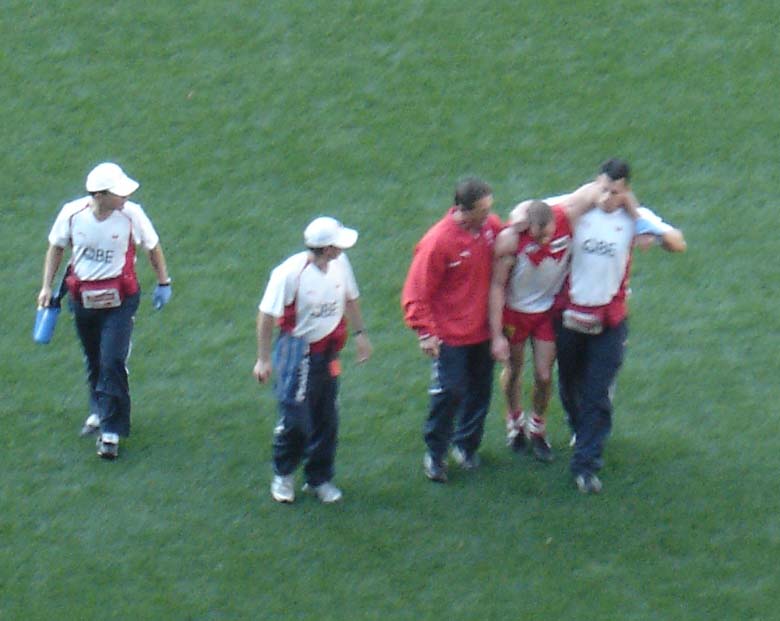
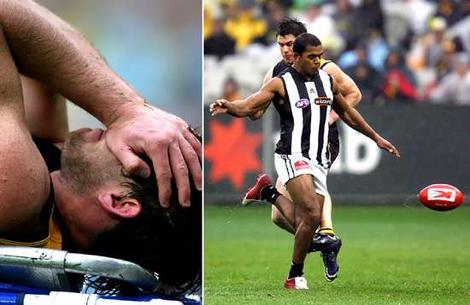
Nic Fosdike in the hands of trainers after hitting his head on the MCG turf after a bumb from Shannon Motlop
Mark Thompson (Geelong Coach)
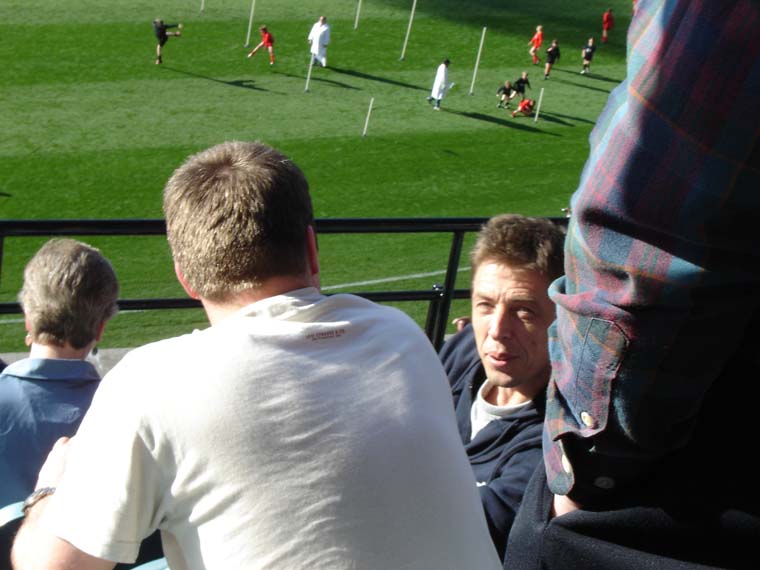
Look who we saw at the MCG . . .
Just turning round to ask Random Man's advice on what Geelong should do . . .
Maybe a new coach ??? lol

Wednesday, August 09, 2006
Abraham Maslow
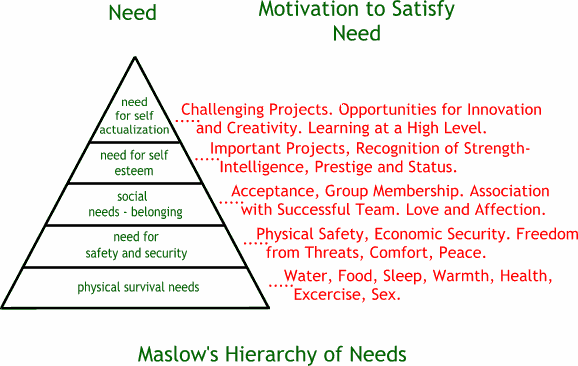
Maslow's Hierarchy of Needs is a theory in psychology that Abraham Maslow proposed in his 1943 paper A Theory of Human Motivation, which he subsequently extended.
His theory contends that as humans meet 'basic needs', they seek to satisfy successively 'higher needs' that occupy a set hierarchy.
Maslow studied exemplary people such as Albert Einstein, Jane Adams, Elanore Roosevelt, and Fredrick Douglas rather than mentally ill or neurotic people, writing that "the study of crippled, stunted, immature, and unhealthy specimens can yield only a cripple psychology and a cripple philosophy." (Motivation and Personality, 1987)
From Wikipedia
Tuesday, July 11, 2006
Ying and Yang ?
Random Man says compare the following ...
Dear updaters
For those of us who didn't know, it appears that marijuana smoking may be bad for you.
The current Archives of Internal Medicine journal includes a free article describing a systematic review of the association of marijuana smoking withthe development of premalignant changes in the lung and lung cancer.
The resulting 19 studies included in the review found an association of marijuana smoking with increased tar exposure, alveolar macrophagetumoricidal dysfunction, increased oxidative stress, and bronchial mucosal histopathologic abnormalities compared with tobacco smokers or nonsmoking controls It can be accessed at:
http://archinte.ama-assn.org/
Dr Malcolm Dobbin
Senior Medical Adviser
Drugs Policy and Services
and the following
Dear Readers,
Thanks to Malcolm Dobbin for bringing Update readers' attention to this week's Archives of Internal Medicine. But the journal's brief, catchy, capitalized headline "The Association Between Marijuana Smoking and Lung Cancer" is contrary to their published article's findings for some reason.
In fact, the authors, after examining 19 rigorous studies, find that there was NO association between cannabis smoking and cancer.
So why would the journal imply in big letters that such an association exists?
The authors state: 'Therefore, we must conclude that no convincing evidence exists for an association between marijuana smoking and lung cancer based on existing data.' Many of us believe that there probably is an association between any smoked organic product and lung damage.
However, when 19 rigorous studies fail to show an association with cancer, we are entitled to conclude that the effect must be relatively small, and substantially less than the long accepted causation with tobacco.
The authors conclusions "is that physicians should advise patients regarding potential adverse health outcomes" of cannabis.
It would appear that politics even pervades peer reviewed journals.
Reefer madness is still with us! I note that the study and one of its authors were partially supported by the National Institute on Drug Abuse (NIDA) in America.
Further evidence of the disconnect between science and drug policy is that even the most serious scientists and clinicians in America still often use the slang term marijuana rather than the correct Latin cannabis or English Indian hemp.
Andrew Byrne ..
Mehra R, Moore BA, Crothers K, Tetrault J, Fiellin DA. The Association Between Marijuana Smoking and Lung Cancer: A Systematic Review. Arch Intern Med. 2006;166:1359-1367
Dear updaters
For those of us who didn't know, it appears that marijuana smoking may be bad for you.
The current Archives of Internal Medicine journal includes a free article describing a systematic review of the association of marijuana smoking withthe development of premalignant changes in the lung and lung cancer.
The resulting 19 studies included in the review found an association of marijuana smoking with increased tar exposure, alveolar macrophagetumoricidal dysfunction, increased oxidative stress, and bronchial mucosal histopathologic abnormalities compared with tobacco smokers or nonsmoking controls It can be accessed at:
http://archinte.ama-assn.org/
Dr Malcolm Dobbin
Senior Medical Adviser
Drugs Policy and Services
and the following
Dear Readers,
Thanks to Malcolm Dobbin for bringing Update readers' attention to this week's Archives of Internal Medicine. But the journal's brief, catchy, capitalized headline "The Association Between Marijuana Smoking and Lung Cancer" is contrary to their published article's findings for some reason.
In fact, the authors, after examining 19 rigorous studies, find that there was NO association between cannabis smoking and cancer.
So why would the journal imply in big letters that such an association exists?
The authors state: 'Therefore, we must conclude that no convincing evidence exists for an association between marijuana smoking and lung cancer based on existing data.' Many of us believe that there probably is an association between any smoked organic product and lung damage.
However, when 19 rigorous studies fail to show an association with cancer, we are entitled to conclude that the effect must be relatively small, and substantially less than the long accepted causation with tobacco.
The authors conclusions "is that physicians should advise patients regarding potential adverse health outcomes" of cannabis.
It would appear that politics even pervades peer reviewed journals.
Reefer madness is still with us! I note that the study and one of its authors were partially supported by the National Institute on Drug Abuse (NIDA) in America.
Further evidence of the disconnect between science and drug policy is that even the most serious scientists and clinicians in America still often use the slang term marijuana rather than the correct Latin cannabis or English Indian hemp.
Andrew Byrne ..
Mehra R, Moore BA, Crothers K, Tetrault J, Fiellin DA. The Association Between Marijuana Smoking and Lung Cancer: A Systematic Review. Arch Intern Med. 2006;166:1359-1367
Koschitzke plays for the Scorpions

Emma Quayle
The Age
July 10, 2006
St Kilda's Justin Koschitzke back in the thick of it, with a custom-made helmet, in a comeback game with the Scorpions. Photo: Wayne Taylor
JUSTIN Koschitzke pushed aside some early-morning apprehension yesterday to find his first fresh match fitness and confidence in the VFL guernsey he expects to wear for the next few weeks.
Nine weeks after his skull was fractured, and his immediate and long-term future questioned, Koschitzke protected his head with a custom-made helmet and played in the ruck for the first half of the Casey Scorpions clash with the Northern Bullants.
Hesitant at first and keen to get his first contest done with, the star-crossed St Kilda player relaxed into the match and finished his half taking a few strong marks across half-back in the No. 73 jumper.
Koschitzke did not shy away from body contact, agitating Bullants player Ali Fahour by hurling him over the boundary line with a tough tackle.
Tuesday, July 04, 2006
Ouch !!
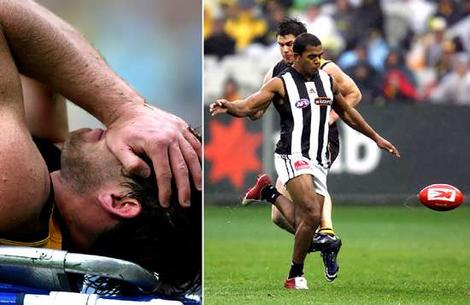
Richmond's Chris Newman has had surgery to repair a badly broken leg, but the Tigers are unsure whether he will be back for the start of next AFL season.
Newman last night had a rod inserted in his tibia and had his fibula realigned, after both bones were broken in a clash of legs with Collingwood's Leon Davis at the MCG yesterday.
'Plenty' of sex assaults on cruises: ex-security officer
July 4, 2006
Passengers on board the Pacific Sky cruise ship were encouraged to engage in binge-drinking while staff also ignored the use of drugs, a former P&O crew member claims.
Former security officer Jeff Dobjeckie will this week meet with lawyers for the coroner at the inquest into the death of Brisbane woman Dianne Brimble.
A naked Mrs Brimble was found dead on the floor of a cabin of the Pacific Sky less than 24 hours after she boarded the cruise liner on September 23, 2002, apparently from an overdose of the date rape drug gamma-hydroxybutyrate, or fantasy.
The body of the 42-year-old mother was found in a cabin belonging to four men, who are among eight men identified by police as being persons of interest.
A newspaper on Tuesday reports that Mr Dobjeckie, who was sacked by P&O in March for arguing with another crew member, will reveal that officers were told to turn a blind eye to drug use.
"We knew of people giving ecstasy to people, that sort of thing," he was quoted as saying.
"There was marijuana smoke coming out of the cabins but we just had to walk on past."
He said bar staff encouraged excessive drinking because they were paid commission for the amount of alcohol they sold.
"You had bar tenders depending on everyone at the Legends Bar and the Starlight Disco getting blind drunk so they could claim commissions," he said.
He also said he had seen "plenty" of sexual assaults during his 10 years onboard cruise ships.
Mr Dobjeckie said he was also outraged that four men of interest into Mrs Brimble's death were allowed back into their cabin, where the Brisbane woman died, while the Brimble family were not allowed to get clothes from their cabin.
He said his story could be backed up by current and former P&O workers, adding that he would tell all to the coroner.
On Friday, he will fly from the Gold Coast to meet with counsel assisting the coroner Ron Hoening.
The inquest into Mrs Brimble's death, being held before Deputy State Coroner Jacqueline Milledge, resumes on July 24.
AAP
Passengers on board the Pacific Sky cruise ship were encouraged to engage in binge-drinking while staff also ignored the use of drugs, a former P&O crew member claims.
Former security officer Jeff Dobjeckie will this week meet with lawyers for the coroner at the inquest into the death of Brisbane woman Dianne Brimble.
A naked Mrs Brimble was found dead on the floor of a cabin of the Pacific Sky less than 24 hours after she boarded the cruise liner on September 23, 2002, apparently from an overdose of the date rape drug gamma-hydroxybutyrate, or fantasy.
The body of the 42-year-old mother was found in a cabin belonging to four men, who are among eight men identified by police as being persons of interest.
A newspaper on Tuesday reports that Mr Dobjeckie, who was sacked by P&O in March for arguing with another crew member, will reveal that officers were told to turn a blind eye to drug use.
"We knew of people giving ecstasy to people, that sort of thing," he was quoted as saying.
"There was marijuana smoke coming out of the cabins but we just had to walk on past."
He said bar staff encouraged excessive drinking because they were paid commission for the amount of alcohol they sold.
"You had bar tenders depending on everyone at the Legends Bar and the Starlight Disco getting blind drunk so they could claim commissions," he said.
He also said he had seen "plenty" of sexual assaults during his 10 years onboard cruise ships.
Mr Dobjeckie said he was also outraged that four men of interest into Mrs Brimble's death were allowed back into their cabin, where the Brisbane woman died, while the Brimble family were not allowed to get clothes from their cabin.
He said his story could be backed up by current and former P&O workers, adding that he would tell all to the coroner.
On Friday, he will fly from the Gold Coast to meet with counsel assisting the coroner Ron Hoening.
The inquest into Mrs Brimble's death, being held before Deputy State Coroner Jacqueline Milledge, resumes on July 24.
AAP
Monday, July 03, 2006
Rabbit Man to get lots of cuddles in jail
Rabbit mutilator jailed
Leonie Lamont
July 3, 2006
Jailed ... Brendan Francis McMahon.Photo: Peter Rae
A Sydney financier has been jailed for 16 months for "the worst case" of aggravated cruelty against animals.
Brendan Francis McMahon, 37, of Tamarama, will have to spend at least 12 months in jail for his torture, mutilation, and alleged sexual offences against 17 rabbits and a guinea pig.
The magistrate, Ian Barnett, said a strong message should be sent to the community that people such as McMahon could not escape responsibility for their actions by the fact they were psychotic at the time.
"In my view this is one of the worst case scenarios of aggravated cruelty to animals," he said.
He accepted McMahon had a lifelong cannabis addiction and, before and during the offences against the animals, had a $125 a day addiction to methamphetamine (also known as ice).
"In my view there is community outrage at this matter and someone should not be allowed to commit such offences of aggravated cruelty against animals and say 'Well I had been using ice at the time. I have been taking cannabis most of my life.'
"My view is ... this is not acceptable."
The dead or dying animals, some skinned, were allegedly found in and around McMahon's York Street office between July and early August last year.
McMahon ran a financial planning and mortgage brokerage, Meares-McMahon Capital, with Jason Meares, the brother of the swimsuit designer Jodhi Meares, former wife of James Packer.
Leonie Lamont
July 3, 2006
Jailed ... Brendan Francis McMahon.Photo: Peter Rae
A Sydney financier has been jailed for 16 months for "the worst case" of aggravated cruelty against animals.
Brendan Francis McMahon, 37, of Tamarama, will have to spend at least 12 months in jail for his torture, mutilation, and alleged sexual offences against 17 rabbits and a guinea pig.
The magistrate, Ian Barnett, said a strong message should be sent to the community that people such as McMahon could not escape responsibility for their actions by the fact they were psychotic at the time.
"In my view this is one of the worst case scenarios of aggravated cruelty to animals," he said.
He accepted McMahon had a lifelong cannabis addiction and, before and during the offences against the animals, had a $125 a day addiction to methamphetamine (also known as ice).
"In my view there is community outrage at this matter and someone should not be allowed to commit such offences of aggravated cruelty against animals and say 'Well I had been using ice at the time. I have been taking cannabis most of my life.'
"My view is ... this is not acceptable."
The dead or dying animals, some skinned, were allegedly found in and around McMahon's York Street office between July and early August last year.
McMahon ran a financial planning and mortgage brokerage, Meares-McMahon Capital, with Jason Meares, the brother of the swimsuit designer Jodhi Meares, former wife of James Packer.
Inner-ear mystery solved
14 March 2006
Belle Dumé is science writer at PhysicsWeb
Why is the cochlea in our ears shaped like a spiral? According to new work by scientists in the US, the spiral shape makes us more sensitive to low frequency sounds. Daphne Manoussaki of Vanderbilt University in Nashville, Tennessee, together with Emilios Dimitriadis and Richard Chadwick at the National Institutes of Health in Bethesda, Maryland, have calculated that the spiral shape can affect the wave mechanics that take place inside the cochlea. It increases the strength of vibrations produced by sound waves, especially at low pitch (Phys. Rev. Lett. 96 088701).
The cochlea is a small seashell-shaped organ in the inner part of the ear where sound vibrations are converted into nerve impulses. These are then sent to the brain as electrical signals. The human cochlea occupies a volume of about 1 cubic centimetre and operates at frequencies between 20 hertz and 20 kilohertz. It can detect sounds over a range of 120 decibels.
Scientists have long wondered whether the cochlea's coiled-up shape plays an important role in how it processes sound. Although intuition said it should, theoretical models did not support the idea. The new work by Manoussaki, who is an applied mathematician, and colleagues has now shown that the spiral shape probably increases hearing sensitivity to low frequency sounds by as much as 20 decibels.
When we hear something, the incoming sounds are transmitted via the tympanic membrane (or eardrum) to the basilar membrane, which runs along the length of the cochlea. The sound waves then cause the basilar membrane to vibrate. Manoussaki and co-workers looked at the equations that describe the mechanical interaction between this membrane and its surrounding fluid. In this way, they were able to describe how the amplitude of the membrane's movement changes across the width in each section of the spiral tube.
The scientists found that the spiral shape makes the membrane deflect more towards the outside of the cochlea wall and less towards the inside. This difference in the membrane's motion, which is effectively a tilt about a line running along its centre, increases with increasing radius of curvature and so enhances hearing sensitivity. "Since low frequency sounds are processed where the spiral curvature is greatest – at the apex of the cochlea - the effect will be more important for low-frequency sound waves," explains Manoussaki.
The spiral structure may have developed because animals use low-frequency sounds, which travel the furthest of all sound waves, for communication and survival. The US team will now try to confirm its results by comparing cochlea in different mammals.
Belle Dumé is science writer at PhysicsWeb
Why is the cochlea in our ears shaped like a spiral? According to new work by scientists in the US, the spiral shape makes us more sensitive to low frequency sounds. Daphne Manoussaki of Vanderbilt University in Nashville, Tennessee, together with Emilios Dimitriadis and Richard Chadwick at the National Institutes of Health in Bethesda, Maryland, have calculated that the spiral shape can affect the wave mechanics that take place inside the cochlea. It increases the strength of vibrations produced by sound waves, especially at low pitch (Phys. Rev. Lett. 96 088701).
The cochlea is a small seashell-shaped organ in the inner part of the ear where sound vibrations are converted into nerve impulses. These are then sent to the brain as electrical signals. The human cochlea occupies a volume of about 1 cubic centimetre and operates at frequencies between 20 hertz and 20 kilohertz. It can detect sounds over a range of 120 decibels.
Scientists have long wondered whether the cochlea's coiled-up shape plays an important role in how it processes sound. Although intuition said it should, theoretical models did not support the idea. The new work by Manoussaki, who is an applied mathematician, and colleagues has now shown that the spiral shape probably increases hearing sensitivity to low frequency sounds by as much as 20 decibels.
When we hear something, the incoming sounds are transmitted via the tympanic membrane (or eardrum) to the basilar membrane, which runs along the length of the cochlea. The sound waves then cause the basilar membrane to vibrate. Manoussaki and co-workers looked at the equations that describe the mechanical interaction between this membrane and its surrounding fluid. In this way, they were able to describe how the amplitude of the membrane's movement changes across the width in each section of the spiral tube.
The scientists found that the spiral shape makes the membrane deflect more towards the outside of the cochlea wall and less towards the inside. This difference in the membrane's motion, which is effectively a tilt about a line running along its centre, increases with increasing radius of curvature and so enhances hearing sensitivity. "Since low frequency sounds are processed where the spiral curvature is greatest – at the apex of the cochlea - the effect will be more important for low-frequency sound waves," explains Manoussaki.
The spiral structure may have developed because animals use low-frequency sounds, which travel the furthest of all sound waves, for communication and survival. The US team will now try to confirm its results by comparing cochlea in different mammals.
Subscribe to:
Posts (Atom)